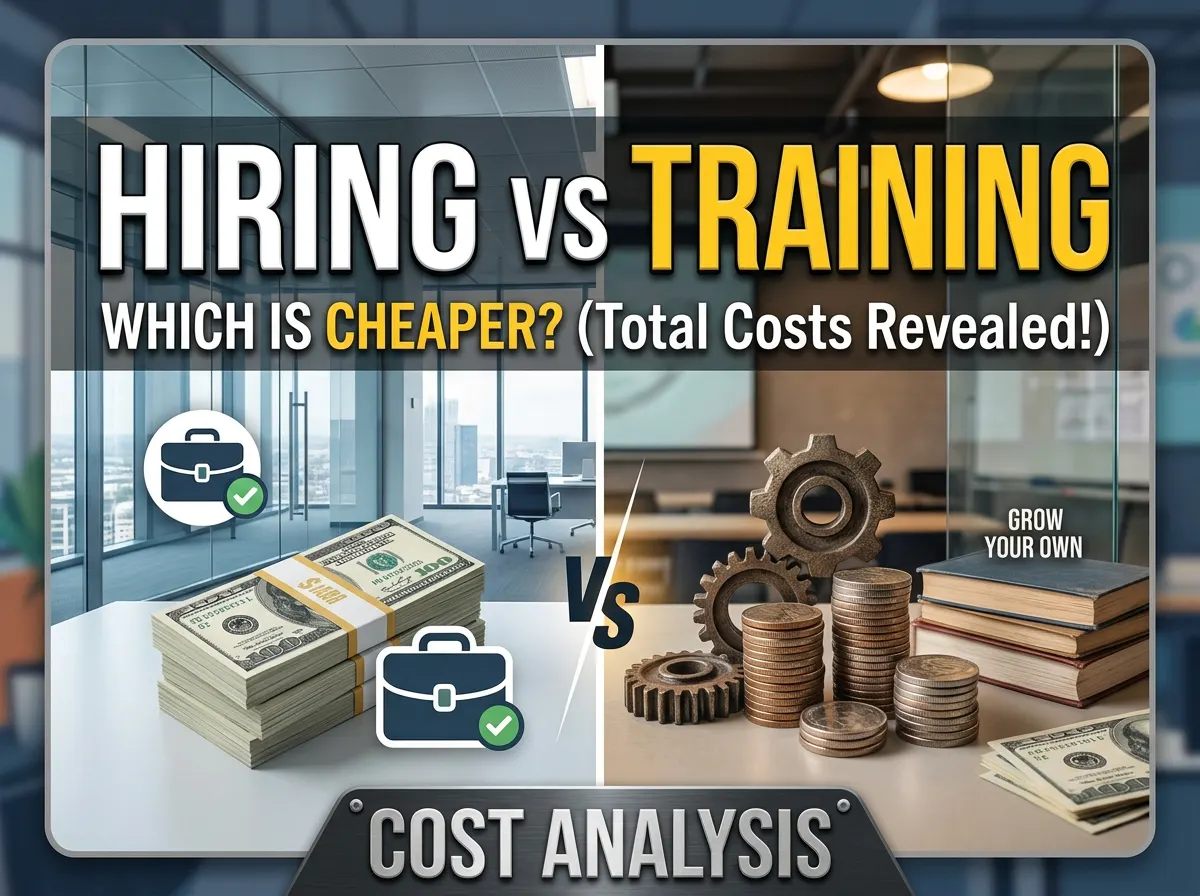
Hiring & Training Costs
Hiring externally now costs about $5,475 on average for a nonexecutive role and $35,879 for an executive one, according to SHRM’s 2025 benchmarking data, and that’s before factoring in the true first-year cost of an employee, which typically runs 1.25x to 1.4x of salary once benefits, payroll taxes, and onboarding are added. Training an existing employee into the role skips most of that recruiting spend, but trades it for a different set of costs: a training budget, a temporary productivity dip while they learn, and the risk the fit still isn’t right. Neither path is universally cheaper; the right call depends on the size of the skill gap and how much you value keeping the person you already have.
This is the classic build-vs-buy decision applied to talent. Before comparing the two paths, it helps to know the baseline: see the full cost to hire an employee from outside the company. If a recruiter or staffing agency is part of your external option, also see why companies use recruiters despite the added fee.
The cost of hiring externally, recapped
SHRM’s 2025 Talent Acquisition Benchmarking Report puts the average direct cost-per-hire in the US at $5,475 for a nonexecutive role and $35,879 for an executive one, up from $4,129 in 2015 and roughly $4,700 in a 2022 SHRM report, a jump of about 33% over the past decade. Those SHRM figures cover direct spending only (job ads, agency fees, internal recruiting overhead); they don’t include interviewer time or the cost of the seat sitting empty, so the true all-in number is higher. Benefits alone make up about 30% to 35% of total compensation, and the average role takes around 44 days to fill, which is its own productivity cost while the position is vacant. That’s the full baseline cost of going outside the company for a hire.
The cost of training an existing employee into the role
Training an internal candidate replaces most of the cost-per-hire line item, no job ads, no external recruiter fee, no cold-start onboarding into company culture and systems, with a different set of costs: the training program itself, a stretch of reduced productivity while the employee is learning instead of fully executing in their old role, and the cost of temporarily covering whatever work they used to do. The Association for Talent Development’s 2026 State of the Industry report puts average direct learning spend at about $846 per employee per year across all organizations, though that figure varies widely: technology, financial services, and consulting firms often spend $1,500 to $3,000+ per employee given how fast those skill sets change, while retail, hospitality, and food service organizations typically spend closer to $400-$800 per employee. Company size matters too, smaller organizations often show above-average per-employee training costs because fixed expenses like learning-platform licenses and facilitator fees don’t spread across as many people, while large enterprises benefit from economies of scale.
There’s also execution risk that doesn’t disappear just because someone is already on payroll: even a strong existing employee may not turn out to have the skills or temperament for the new role. That risk is real, but it’s smaller in dollar terms than the risk on the external side, a widely cited US Department of Labor estimate puts the cost of a bad hire at roughly 30% of that employee’s first-year salary once you count the wasted onboarding, lost productivity, team disruption, and the cost of starting the search over again. An internal move that doesn’t work out rarely triggers that same full-cost cascade, since the person can usually return to (or stay in) a role they already know.
Where training usually wins
Training tends to be the better bet when the skill gap is moderate, when the role requires deep institutional or product knowledge that’s hard to hire for externally, and when retention value matters. An employee who’s promoted or cross-trained is generally more likely to stay than a brand-new hire, and every person who leaves triggers the entire $5,475-plus cost-per-hire and vacancy cycle over again for their replacement. Training also sidesteps the roughly 44-day average vacancy period, since the employee is already contributing somewhere in the business while they ramp up. For roles where the annual training spend needed is a few hundred to a couple thousand dollars, well under the average nonexecutive cost-per-hire, the math tilts toward training before you even factor in the retention upside.
Where hiring externally usually wins
Hiring externally makes more sense when the skill gap is large enough that training would take longer than a typical vacancy period, when the role needs a specialized, licensed, or highly technical skill set that doesn’t exist anywhere in the current team, or when the business genuinely benefits from a fresh outside perspective rather than someone shaped entirely by internal norms. It’s also the faster option in an emergency, if a role needs to be filled immediately and no internal candidate is close to ready, waiting out a training ramp isn’t realistic, even with a bad-hire risk of roughly 30% of first-year salary hanging over the decision.

Hire vs. train, side by side
| Factor | External hire | Train existing employee |
|---|---|---|
| Direct cost | $5,475 avg cost-per-hire (nonexec); $35,879 (exec) | ~$846/employee/year avg training spend (varies $400-$3,000+ by industry) |
| Total first-year cost vs. salary | 1.25x-1.4x | Usually lower direct cost, offset by productivity dip |
| Time to full productivity | ~44-day average fill time, plus ramp-up | No vacancy, but a learning curve in the new role |
| Downside risk if it doesn’t work out | ~30% of first-year salary (bad-hire cost estimate) | Lower financial risk; employee can often return to prior role |
| Institutional knowledge | Starts from zero | Already present |
| Retention impact | Neutral to unknown | Often improves retention (growth opportunity) |
| Best for | Large skill gaps, urgent needs, specialized roles | Moderate skill gaps, succession planning |
How company size changes the math
A small business and a large enterprise don’t face the same trade-off. Smaller organizations often see above-average per-employee training costs because fixed expenses, a learning-management-system license, an outside facilitator’s day rate, get spread across a much smaller headcount, which can make external hiring look relatively more attractive for a one-off skill gap. Large enterprises, by contrast, tend to have lower per-employee training costs and built-in mobility programs, which is part of why bigger companies more often default to promoting or cross-training rather than running an external search for every open role. If you’re a small business weighing this decision, it’s worth pricing out the actual training cost for your specific skill gap rather than assuming the ATD’s $846 average applies directly to you.
The hybrid option: hire for the gap, train for the rest
In practice, many companies land somewhere in between: they hire externally for a genuinely new capability the team lacks entirely, while investing in training and internal mobility for roles where existing employees are close to ready. This blended approach spreads the $5,475-plus average cost-per-hire across fewer external searches while still building a bench of promotable talent internally, which reduces how often the company has to run the full external search-and-vacancy cycle, and absorb its roughly 30%-of-salary bad-hire risk, at all.
A simple framework for deciding
- Estimate the skill gap: is this a stretch of a few months of learning, or a fundamentally different skill set the team has never used?
- Estimate urgency: can the business absorb a ~44-day average vacancy and a training ramp, or does the role need to be filled now?
- Weigh retention: would promoting from within meaningfully reduce the risk of losing a valued employee to a competitor?
- Compare the numbers: the $5,475 average cost-per-hire (or $35,879 for an executive role) plus 1.25x-1.4x first-year salary for an external hire, against your actual training program cost (commonly $400-$3,000+ per employee depending on industry) plus the estimated productivity dip for an internal move.
- Price the downside: a failed external hire risks roughly 30% of that role’s first-year salary in sunk cost; a training investment that doesn’t pan out rarely carries the same size of loss.
Frequently asked questions
Is it always cheaper to train an existing employee than hire externally?
No. It’s usually cheaper in direct dollars, but not always in total cost once you factor in the productivity dip during training and the risk that the employee isn’t a strong fit for the new role. Large skill gaps or urgent needs often favor an external hire despite the higher direct cost.
What does hiring externally cost, on average, in 2025-2026?
SHRM’s 2025 benchmarking data puts average direct cost-per-hire at $5,475 for nonexecutive roles and $35,879 for executive roles, and the true all-in first-year cost of the new employee typically runs 1.25x to 1.4x their base salary once benefits, payroll taxes, and onboarding are included. See the full cost-to-hire breakdown for details.
How much do companies typically spend training an employee per year?
The Association for Talent Development’s 2026 report puts the average at about $846 per employee per year, though technology, finance, and consulting firms often spend $1,500-$3,000+, while retail and hospitality organizations typically spend $400-$800.
What does a bad hire cost compared to a failed internal training attempt?
A commonly cited US Department of Labor estimate puts the cost of a bad external hire at roughly 30% of that employee’s first-year salary once lost productivity, wasted onboarding, and re-hiring are counted. A training investment that doesn’t pan out is usually far cheaper, since the employee typically remains on payroll doing other useful work rather than needing to be replaced entirely.
Does training an employee into a new role reduce turnover?
It often does. Internal mobility and growth opportunities are commonly cited retention drivers, and retaining an employee avoids triggering the full external cost-per-hire cycle again for their eventual replacement.
When does it make sense to use a recruiter instead of training internally?
When the role is hard to fill, needs to move fast, or requires access to passive candidates your internal network can’t reach. See why companies use recruiters if it costs so much for that side of the decision.
For the full picture of what an external hire actually costs, start with how much it costs to hire an employee, then weigh whether paying a recruiter’s fee makes sense for your specific skill gap and timeline.




Leave a Reply