Personal Finance
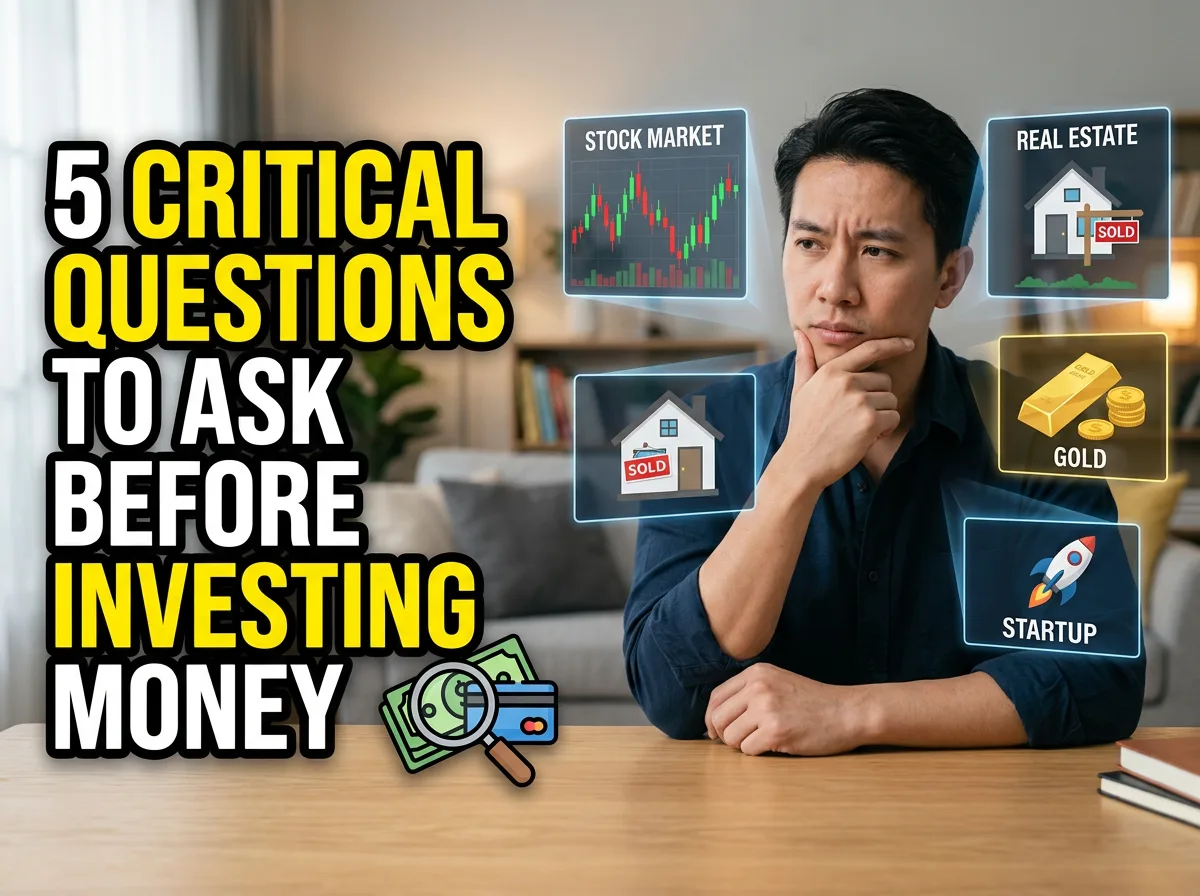
Every dollar you invest is a bet on something you should be able to explain, afford to be wrong about, and know the price tag on before you commit it. The five questions below are the filter that catches most bad investing decisions before the money ever leaves your account.
Quick answer
Before putting money into any investment, ask what it costs, how long you can leave it invested, whether you can genuinely afford to lose it, how diversified it is, and whether you understand it well enough to explain it to someone else. If you can’t answer all five clearly, that’s a signal to slow down before you invest, regardless of who recommended it or how good the pitch sounded.
These questions apply whether you’re investing on your own or working with a financial advisor, they’re about the investment itself, not about who’s managing it. If you’re specifically weighing whether to bring in professional help for the decision, see when to hire a financial advisor; if you’re deciding whether DIY index investing makes more sense for you, see financial advisor vs. index funds.

1. What does this investment actually cost me?
Every investment has a cost structure, even when it isn’t obvious. Mutual funds and ETFs charge an annual expense ratio; some funds and products carry sales loads or surrender charges; individual stocks carry trading costs and, for taxable accounts, capital gains taxes when sold. If you’re investing through a financial advisor, their fee stacks on top of whatever the underlying investments already cost, AUM fees typically run 0.75%–1.5% a year, so a fund with its own 1% expense ratio inside a 1% AUM account effectively costs you 2% annually before any return shows up.
Get the total cost as a single number, in writing, before you commit money. Costs are one of the few things about any investment you can actually know in advance, the SEC’s own investor education arm at Investor.gov specifically flags fees as one of the handful of variables an investor can control directly, unlike future market performance, which no one can guarantee.
2. What’s my actual time horizon for this money?
Be specific: is this money for a goal five years away, twenty years away, or retirement decades out? Longer time horizons generally give investments more room to recover from short-term volatility, while money you’ll need within a few years is generally better kept somewhere more stable than the stock market. If you’re building toward a retirement number, the “25x rule”, target nest egg equals annual expenses times 25, based on a roughly 4% initial withdrawal rate popularized by the Trinity Study, is one common starting point for figuring out how long that time horizon really needs to be, though it’s a rough guide, not a guarantee, since it doesn’t fully account for sequence-of-returns risk or taxes.
3. Can I genuinely afford to lose this money?
Every investment carries some risk of loss, and the honest version of this question isn’t “would it hurt”, it’s “would it change my life.” Money earmarked for rent next month, an emergency fund, or a near-term obligation shouldn’t be in anything volatile. This question isn’t hypothetical for most Americans: Bankrate’s 2026 Emergency Savings Report found only 41% of U.S. adults could cover a $1,000 emergency expense from savings, and the Federal Reserve’s 2025 Survey of Household Economics and Decisionmaking found 63% could cover a $400 surprise expense with cash or its equivalent, meaning 37% could not. If your own cash cushion is thin, that’s the real reason to pause before putting money into anything with meaningful downside risk, not a lack of investing knowledge.
4. Is this actually diversified, or is it one big bet?
A single stock, a single sector fund, or a concentrated position in your employer’s stock all carry more risk than a broad, diversified fund holding hundreds or thousands of underlying companies. Diversification doesn’t eliminate risk, but it spreads it out, so that one company’s bad year doesn’t determine your entire outcome. This isn’t a minor technical point: S&P Dow Jones Indices’ SPIVA Scorecard found that roughly 86% of actively managed large-cap U.S. stock funds underperformed the S&P 500 over the trailing 10 years, and concentrated stock-picking is the primary reason many of them fell short. Ask directly: how many underlying holdings are in this, and how concentrated is it in any single company, sector, or asset class?
5. Could I explain this to someone else in plain language?
If you can’t describe what the investment actually does, how it makes money, and what could make it lose money, in a sentence or two, without jargon, that’s a sign you don’t fully understand what you’re putting money into. This isn’t about sounding smart; it’s a practical filter. Complexity you don’t understand is a real risk in itself, separate from the investment’s actual volatility, because you can’t evaluate what you can’t explain. It’s also exactly the kind of gap that behavioral finance research has repeatedly linked to panic-selling: investors who don’t understand what they own are more prone to reacting emotionally when its price moves.
The five questions at a glance
| Question | What a good answer looks like |
|---|---|
| 1. What does it cost? | One combined number, in writing, covering all layers of fees |
| 2. What’s my time horizon? | A specific timeframe tied to a specific goal, not “someday” |
| 3. Can I afford to lose it? | Yes, without affecting rent, bills, or your emergency fund |
| 4. Is it diversified? | Spread across many holdings, sectors, or asset classes |
| 5. Can I explain it? | A plain-language sentence, no jargon required |
Where each question tends to trip people up
- Cost: people compare the sticker fee (a fund’s expense ratio) but forget to add an advisor’s AUM fee, an account maintenance fee, or a fund’s less-visible trading costs on top of it.
- Time horizon: people invest money for a goal that’s actually only 1–2 years away in the same accounts they use for retirement money that’s decades out, applying the same risk tolerance to both.
- Affordability of loss: people confuse “I have the money sitting in an account” with “I can afford to lose this,” without checking whether that account is also their only emergency cushion.
- Diversification: people assume owning several individual tech stocks is “diversified” because it’s more than one holding, when it’s really one concentrated sector bet.
- Understanding: people accept “trust me, it’s complicated” from a recommender instead of asking for a plain-language explanation until they actually get one.
These questions don’t change based on who’s investing for you
It’s tempting to assume that hiring a financial advisor means you no longer need to ask these questions yourself, but the opposite is closer to true, a good advisor should be able to answer all five clearly for anything they recommend, and a vague or evasive answer to any of them is worth treating the same way whether it comes from an advisor, a friend’s stock tip, or an app notification. If you do decide to bring in professional help, the questions to ask before hiring a financial advisor cover the advisor relationship itself, on top of these five.
This article is general information, not personalized financial advice, and a licensed financial advisor can help you apply these questions to your specific goals, timeline, and risk tolerance.
Frequently asked questions
Do these questions apply to retirement accounts too, like a 401(k)?
Yes, the account type (401(k), IRA, brokerage) doesn’t change the underlying questions about the specific funds you choose inside it. Every fund option in a 401(k) still has its own expense ratio, level of diversification, and risk profile worth checking.
What if I can’t afford to lose any of it?
Then it probably shouldn’t be in a market investment at all. Money you truly cannot afford to lose; next month’s rent, your emergency fund, belongs in something stable, like a savings account, not in anything with meaningful volatility, regardless of the potential upside. With well over a third of U.S. households unable to cover even a small emergency expense from savings according to recent Federal Reserve data, building that cushion often has to come before investing, not alongside it.
How many holdings count as “diversified”?
There’s no single magic number, but broad index funds tracking hundreds or thousands of companies across multiple sectors are generally considered well-diversified, while a handful of individual stocks in the same industry are not. The goal is that no single company’s performance can sink your entire position.
Is it okay to invest in something I don’t fully understand if a professional recommended it?
A professional’s recommendation is useful input, but it doesn’t replace your own understanding of what you’re putting money into. Ask the advisor to explain it until you genuinely can, that’s a reasonable request, and a good advisor will welcome it rather than treat it as a challenge.
Should I ask these questions again if I already own an investment?
It’s worth revisiting periodically, especially after a major life change or when your time horizon shifts, money you could afford to lose at 30 with decades to recover isn’t necessarily money you can afford to lose at 60, even if the investment itself hasn’t changed at all.
Run any investment, DIY or advisor-recommended, through these five questions before committing money. For more on the advisor side of the decision, see when to hire a financial advisor, the financial advisor cost guide, and the questions to ask before hiring a financial advisor.




Leave a Reply