Sleep & Wellness
You’ve decided to fix your sleep. You’ve picked a bedtime, you’re putting your phone away an hour early, maybe you’ve even started a wind-down routine. A week in, it already feels like a chore, and you’re wondering when, if ever, this is supposed to start feeling automatic instead of effortful. It’s a fair question, and the honest answer is more nuanced than the “21 days to build a habit” line you’ve probably heard repeated everywhere. Real habit-formation research paints a messier, more encouraging picture: sleep habits, like any habit, take time to lock in, the timeline varies a lot from person to person, and consistency matters far more than perfection along the way. Here’s what the actual science says about how long it takes, and how to use that timeline to your advantage instead of giving up too early.
Quick answer: how long does it take to form a sleep habit?
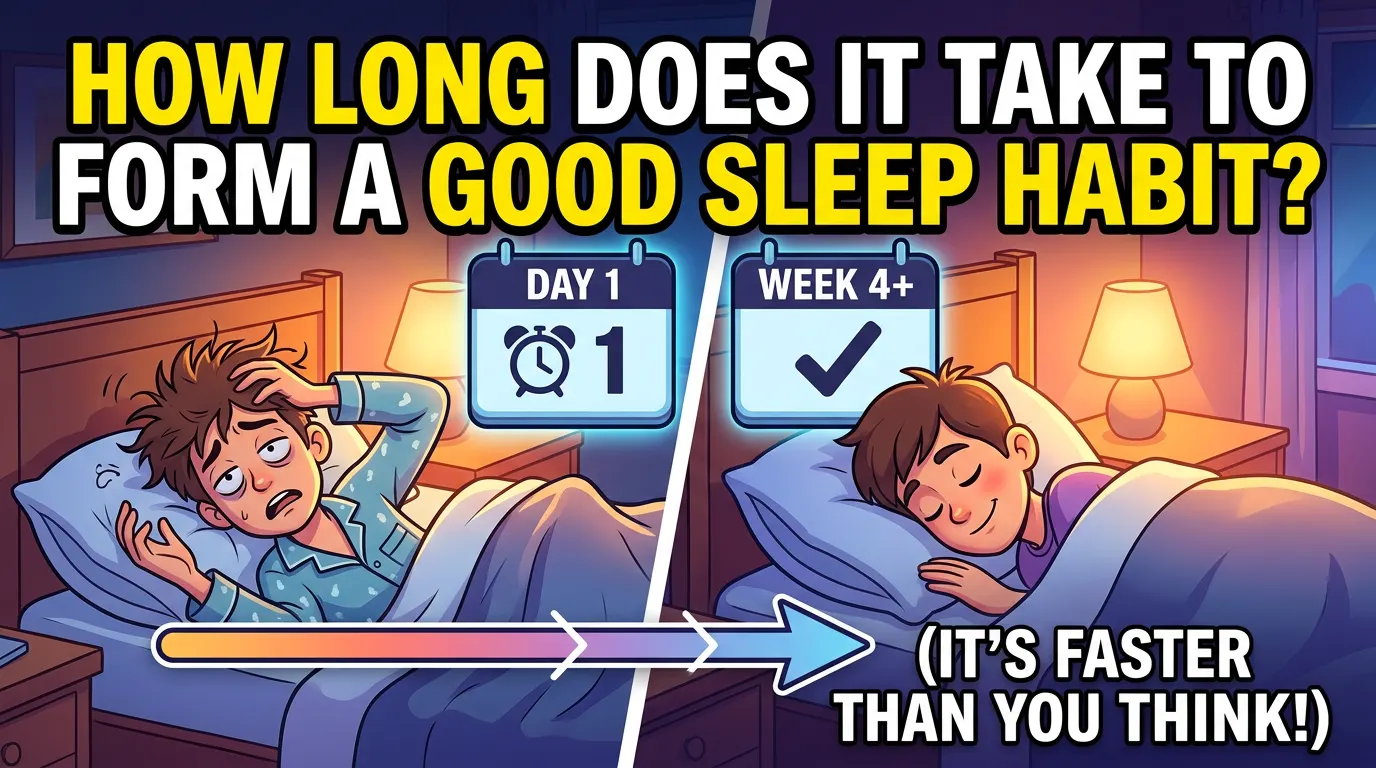
The widely repeated “21 days” figure isn’t based on rigorous research; it traces back to a 1960s plastic surgeon’s informal observations about patients adjusting to appearance changes, not habit science. The most-cited actual study on habit formation, led by researcher Phillippa Lally and published in the European Journal of Social Psychology in 2010, found it took an average of about 66 days for a new behavior to become automatic, but with an enormous range, anywhere from about 18 to 254 days depending on the person and the behavior. For sleep habits specifically, expect somewhere in the range of three to ten weeks of consistent practice before a new bedtime routine or wake time starts to feel automatic rather than effortful, with simpler changes (like a fixed wake time) typically settling in faster than more complex ones (like a full wind-down routine).
Where the “21 days” myth actually comes from
The 21-day habit claim is one of the most widely repeated pieces of self-improvement advice, and it’s almost entirely disconnected from its original source. It traces back to Dr. Maxwell Maltz, a plastic surgeon who wrote in his 1960 book “Psycho-Cybernetics” that he noticed patients seemed to take a minimum of about 21 days to get used to a new face after surgery, or to adjust after losing a limb. Maltz was describing a rough personal observation about psychological adjustment, not presenting a controlled scientific study, and he explicitly used the word “minimum,” not an average or a guarantee. Over the following decades, that anecdotal observation was repeated, simplified, and eventually mutated into the confident-sounding claim that “it takes 21 days to form a habit”, a tidy number that spread through self-help books and social media far more than the nuanced, messier truth ever did.
What the real research actually shows
The most influential real study on how long habit formation takes comes from health psychology researcher Phillippa Lally and colleagues at University College London. Their 2010 study asked participants to choose a new health-related behavior; many chose things like eating a piece of fruit with lunch or going for a run; and to perform it daily for 12 weeks, self-reporting each day how automatic the behavior felt.
- On average, it took about 66 days for a behavior to reach its plateau of automaticity, the point where it stopped requiring active effort or willpower.
- The range across individuals and behaviors was extremely wide: as few as 18 days for some people and behaviors, and as many as 254 days for others.
- Simpler behaviors (like drinking a glass of water at a set time) tended to become automatic faster than more complex behaviors (like a structured exercise routine).
- Missing a single day here and there didn’t meaningfully derail the habit-forming process; occasional lapses didn’t reset the clock or prevent the habit from eventually forming.
The key takeaway from this research isn’t a single magic number; it’s that habit formation is a gradual curve, not a switch that flips on a specific day, and that the timeline depends heavily on the complexity of the behavior and the individual involved. A useful way to think about it: the goal isn’t to survive 21 or 66 days and then relax; it’s to keep showing up consistently until the behavior genuinely stops requiring conscious effort, however long that personally takes.
Why sleep habits are a special case
Sleep habits have a few characteristics that make their formation timeline a bit different from habits like exercise or diet changes.
Your circadian rhythm has its own adjustment period
Unlike, say, remembering to floss, a sleep schedule change also has to work with (or against) your circadian rhythm, the internal biological clock that governs when your body naturally wants to be awake or asleep. Shifting your bedtime or wake time doesn’t just require behavioral repetition; it requires your internal clock to physically recalibrate, a process that’s generally understood to take anywhere from several days to roughly one to two weeks per hour of shift, depending on the person and how consistently the new schedule is followed. This is part of why a new sleep schedule can feel uncomfortable for longer than a habit that doesn’t involve your biological clock at all.
Cue-based habits form faster than willpower-based ones
Habit-formation research consistently points to context and cues as more powerful drivers of automaticity than motivation or willpower. A sleep habit anchored to a strong, consistent cue- the same time on the clock, the same sequence of actions (brushing teeth, dimming lights, reading), the same environment every night, tends to become automatic faster than one you’re relying on remembering to do through sheer discipline. This is why sleep experts consistently recommend a fixed sequence of wind-down actions rather than a vague intention to “go to bed earlier.”
One consistent anchor matters more than a perfect routine
Sleep researchers have repeatedly emphasized that a fixed wake time, getting up at the same time every day, including weekends, is one of the single most powerful anchors for your circadian rhythm, arguably more important than a perfectly consistent bedtime. That’s a useful thing to know when you’re building a new sleep habit: if you can only reliably nail one part of the routine while you’re building the rest, your wake time is the highest-leverage place to start, since it stabilizes your whole 24-hour rhythm even while other pieces are still falling into place.
The habit loop: why repetition alone isn’t the whole story
Behavioral science generally describes habit formation as a three-part loop: a cue (a time, place, or preceding action), a routine (the behavior itself), and a reward (the payoff that reinforces the loop). Repetition matters, but what actually drives a behavior from “effortful” to “automatic” is the strength of the association between the cue and the routine, which is why simply repeating a behavior a fixed number of times, disconnected from a consistent cue, tends to form habits more slowly and less reliably. For sleep, the most useful cues tend to be time-based (the same clock time every night) or action-based (a fixed sequence like brushing teeth, then dimming lights, then reading), and the most effective reward is often simply noticing and acknowledging that you feel calmer or fall asleep faster, a subtle, internal reward, but a real one that reinforces the loop over repeated nights.
This is also why habit-formation timelines vary so much between people, even for the exact same target behavior. Two people trying to build the identical “no screens after 9 p.m.” habit might form it at very different speeds depending on how consistent their cue is (a fixed nightly alarm reminder versus a vague intention), how much friction stands in the way (a charging dock outside the bedroom versus leaving the phone on the nightstand), and how quickly they notice a felt reward (falling asleep faster versus no immediate perceived difference). None of this means willpower is irrelevant, but it does mean that environment design, making the desired behavior the easiest, most obvious option, tends to matter more than sheer motivation over the weeks it takes a habit to solidify.
How to actually build a sleep habit that sticks
Given what the research shows, here’s a practical approach to building durable sleep habits rather than abandoning them after a rough first week.

Start with one anchor, not a whole routine
Trying to change your bedtime, cut caffeine, eliminate screens, and add meditation all in the same week is a common way to overwhelm yourself and abandon everything within days. Pick the single highest-leverage change first, usually a fixed wake time, and hold that steady for one to two weeks before layering in the next change. This mirrors what habit research shows about simpler behaviors forming faster: a single, clear anchor is easier for your brain to automate than a multi-step routine introduced all at once.
Attach the new habit to an existing cue
Habits form faster when they’re tied to a consistent trigger rather than left to memory or motivation. Instead of “I’ll try to wind down earlier,” try “after I load the dishwasher, I turn off overhead lights and switch to a lamp”, a specific, repeatable sequence tied to something you already do every night. Over time, the first action in the chain becomes an automatic cue for the next one.
Expect friction in the first two to three weeks
Based on the Lally research’s fastest-forming behaviors, roughly 18 days is close to the low end of when simple habits start feeling more automatic, but most people should expect the first two to three weeks to genuinely require conscious effort. Knowing this in advance can prevent you from mistaking normal early-stage difficulty for a sign that “this isn’t working,” which is one of the most common reasons people abandon new sleep routines right before they would have started to pay off.
Don’t let a missed night reset your progress
One of the more reassuring findings from habit research is that occasional missed days don’t meaningfully derail habit formation, a single late night, a travel disruption, or one skipped wind-down routine doesn’t reset the clock back to zero. What matters far more than any individual night is your overall consistency across weeks. Treat a missed night the way you’d treat a missed workout: get back to the routine the next day rather than treating the lapse as a failure that invalidates the whole effort.
Track consistency, not perfection
A simple way to stay motivated during the weeks-long formation window is to track how many nights out of the past seven you followed your target routine, rather than judging yourself against an all-or-nothing standard. Seeing your consistency improve from, say, three nights a week to six over the course of a month is a much more honest and encouraging signal of progress than expecting flawless adherence from day one.
Give circadian-dependent changes extra time
If your new habit involves shifting your actual sleep timing (for example, moving your bedtime two hours earlier), be patient with the process; your circadian rhythm adjusts gradually, and pushing too hard too fast can backfire by creating anxiety around sleep, which itself interferes with falling asleep. Shifting your schedule by 15–20 minutes every few days, rather than all at once, tends to be more sustainable and better tolerated by your internal clock.
Habit stacking: a practical shortcut for building routines faster
One popular technique that lines up well with the cue-based nature of habit formation is habit stacking, deliberately attaching a new habit to an existing one you already do reliably, using a simple formula like “after [existing habit], I will [new habit].” For sleep, this might look like “after I turn off the kitchen lights, I will plug my phone in outside the bedroom” or “after I brush my teeth, I will read for ten minutes instead of checking my phone.” Because the existing habit is already automatic, it acts as a reliable, built-in cue for the new one, which tends to shorten the period where you have to consciously remember to perform the behavior. Habit stacking doesn’t shortcut the underlying formation timeline; you still need consistent repetition over several weeks, but it does reduce the chance you’ll simply forget or skip the new behavior during that vulnerable early period, which is often the real reason habits fail to form at all.
Signs your sleep habit is starting to stick
A few practical signals that a new sleep routine is moving from effortful to automatic:
- You start feeling naturally sleepy around your target bedtime without having to remind yourself.
- You wake up close to your target time without an alarm, or right before it goes off.
- The wind-down actions (dimming lights, putting the phone away) happen without much conscious decision-making.
- Deviating from the routine, a late night out, a different environment, feels noticeably off, rather than the routine itself feeling like a burden.
- You’ve stopped actively “trying” to follow the routine, and it just happens as part of your evening.
If you’re several weeks in and still experiencing significant friction with every single night, it may be worth reassessing whether the routine itself is realistic for your schedule and lifestyle, rather than assuming you simply need more willpower.
When habit-building alone isn’t enough
It’s worth being clear-eyed about the limits of habit formation as a fix for sleep problems. If you’re consistently following a solid routine for a month or more and still struggling to fall asleep, stay asleep, or feel rested, that’s a sign something more than habit consistency is at play; whether an underlying sleep disorder, anxiety, depression, or another medical condition. In that case, a doctor or sleep specialist can help identify the actual cause and may recommend a more structured approach like cognitive behavioral therapy for insomnia (CBT-I), which combines habit-based techniques with more targeted clinical strategies. This article is educational in nature and isn’t a substitute for personalized medical advice.
Frequently asked questions
Is the 21-day habit rule completely wrong?
It’s not “wrong” so much as misapplied. The original 21-day observation came from a plastic surgeon’s informal notes about patients adjusting psychologically to a new appearance, not a controlled study on habit formation, and he described it as a rough minimum, not a guaranteed timeline for any habit. More rigorous later research, particularly the Lally et al. 2010 study, found an average closer to 66 days, with a wide range depending on the person and behavior. Twenty-one days isn’t necessarily too short for every habit, but treating it as a universal rule for how long any habit takes isn’t supported by the evidence.
Why does my new sleep routine feel harder in week two than week one?
Initial motivation and novelty often carry people through the first several days of a new routine, but that motivation naturally fades before the behavior has become automatic, creating a common dip where the habit feels harder once the initial enthusiasm wears off but before it’s become effortless. This is a normal part of the habit-formation curve rather than a sign of failure, and pushing through this middle stretch is often what separates people who build a lasting habit from those who abandon it.
Does it take longer to build a sleep habit as you get older?
There isn’t strong direct research specifically comparing habit-formation speed for sleep routines across age groups, so this should be treated cautiously rather than as an established fact. What is well established is that sleep architecture and circadian rhythms shift with age, and older adults may have less flexibility in how far they can comfortably shift their sleep timing, which could plausibly make certain schedule changes feel more effortful for longer, even if the general habit-formation process isn’t dramatically slower.
Should I use a sleep tracker while building a new habit?
A sleep tracker can be a useful, motivating way to visualize consistency and progress over the weeks it takes to form a habit, especially if you tend to respond well to data and streaks. That said, some people become anxious or overly fixated on tracker data, which can itself interfere with sleep, if you notice checking your sleep score is making you more stressed about sleep rather than less, it’s reasonable to use the tracker more loosely or set it aside.
What’s the single fastest sleep habit to build?
Based on habit-formation principles, the simplest and most singular behaviors tend to automate fastest; for sleep, that’s typically a fixed wake time, since it’s a single daily action (getting up) rather than a multi-step sequence. It’s also the anchor sleep researchers consistently point to as having the most outsized impact on your circadian rhythm, which makes it a practical first habit to lock in before adding more complex routine elements like a full wind-down sequence.
How many missed nights will ruin a habit I’m building?
Research on habit formation suggests occasional missed days don’t meaningfully derail the overall process; the habit-formation curve is forgiving of individual lapses as long as the behavior resumes and consistency continues over the following weeks. There’s no specific research-backed number of missed nights that “ruins” progress; the more relevant pattern is whether missed nights become the majority rather than the exception over an extended period.







Leave a Reply