Sleep & Wellness
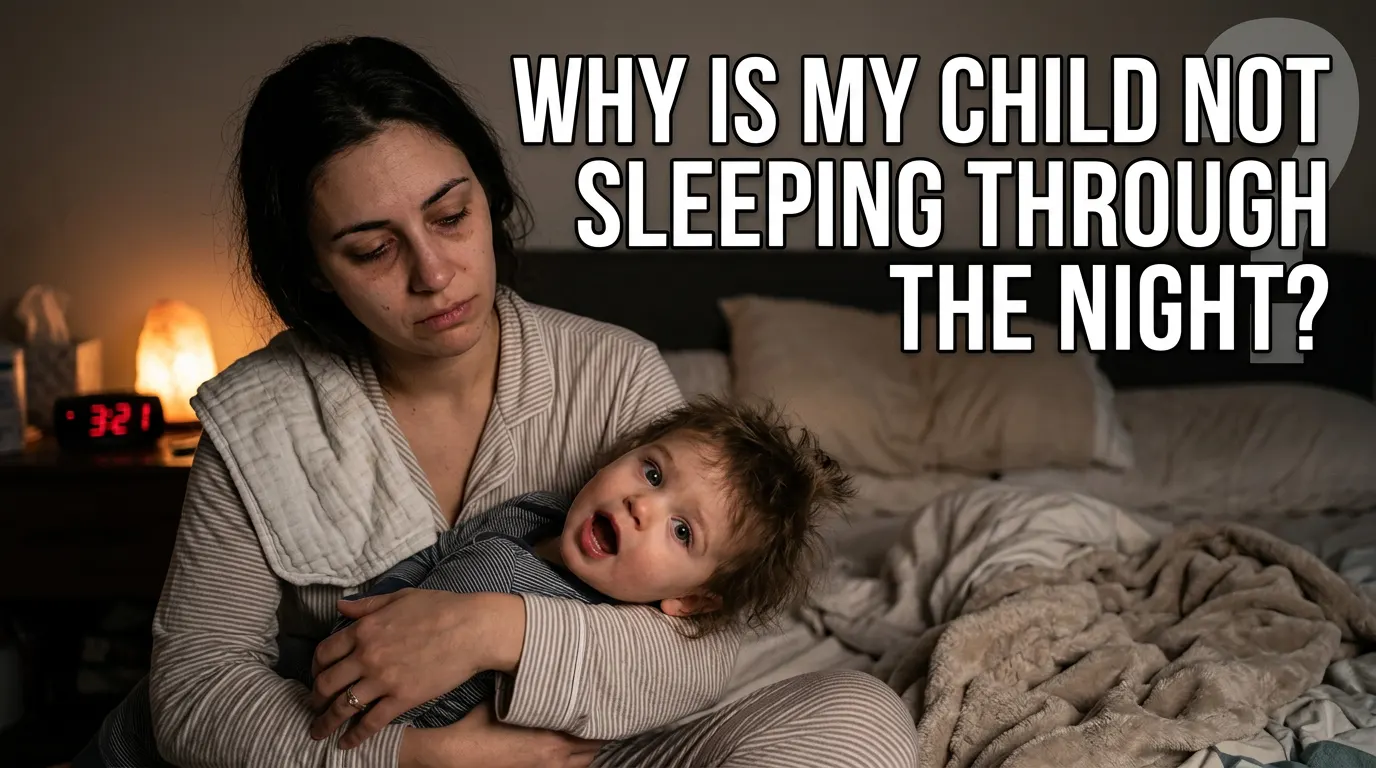
You did everything the books said. Consistent bedtime, dark room, white noise, a predictable routine, and your child is still waking up two, three, sometimes five times a night, at an age when you were told they should be sleeping through by now. Few parenting frustrations are as universal, or as exhausting, as a child who will not stay asleep. The good news is that night waking almost always has an identifiable cause, and most of those causes are common, temporary, and addressable once you know what to look for. This guide walks through what “sleeping through the night” realistically means at different ages, the developmental regressions and everyday triggers behind most night waking, evidence-based ways to respond, and the specific signs that point toward a medical issue a pediatrician should evaluate rather than a phase you can wait out.
Quick answer: why won’t my child sleep through the night?
In the vast majority of cases, a child who is not sleeping through the night is dealing with one (or a combination) of a handful of well-understood causes: a developmental sleep regression tied to a cognitive or physical leap, teething discomfort, separation anxiety that peaks at predictable ages, a learned sleep association that requires a parent’s help to fall back asleep, an inconsistent bedtime routine, or a nap schedule that leaves them over- or under-tired at bedtime. Nearly all of these respond well to a consistent routine and, when age-appropriate, a gentle or graduated sleep training approach. The exceptions worth flagging to your pediatrician are loud snoring, gasping, or breathing pauses during sleep, night waking paired with poor growth or clear signs of pain, or waking that has not improved at all despite weeks of a genuinely consistent approach, those warrant a medical evaluation rather than another week of “staying the course.”
What does “sleeping through the night” actually mean at each age?
One reason night waking feels so frustrating is that the phrase “sleeping through the night” gets used loosely, without much regard for what is developmentally realistic. Here is a general, age-based picture, keeping in mind that every child varies:

- 0–3 months: Frequent night waking is expected and necessary; newborns need to feed every 2–4 hours and have no established circadian rhythm yet.
- 4–6 months: Many babies begin consolidating sleep into longer stretches, but this is highly variable, and the well-documented 4-month regression often disrupts things right in this window.
- 6–12 months: Many healthy, well-fed babies are physically capable of 10–12 hour stretches, but separation anxiety, teething, and the 8–10 month regression frequently interrupt this age range.
- 1–2 years: Night waking is still common, often tied to the 12- and 18-month regressions, molar teething, and a second wave of separation anxiety.
- 2–3 years: Nightmares, a growing imagination, new fears, and the transition out of a crib into a bed can all reintroduce night waking even after a long stretch of solid sleep.
In other words, some night waking is developmentally normal well past the newborn stage, and a single rough patch does not necessarily mean anything is wrong.
How much sleep does my child actually need?
Before troubleshooting night waking, it helps to confirm your child is getting an age-appropriate amount of total sleep, since a schedule mismatch is a surprisingly common hidden driver of night waking. General ranges commonly cited by pediatric sleep guidance look roughly like this:
- 4–12 months: around 12–16 total hours across naps and night sleep.
- 1–2 years: around 11–14 total hours, typically including one to two naps.
- 2–3 years: around 10–13 total hours, often with a single afternoon nap.
These are general ranges, not strict rules, and individual children vary. But if your child is dramatically outside these ranges, or if naps are unusually long, short, or timed very late in the afternoon, that mismatch alone can be enough to drive frequent night waking, independent of any regression or habit.
Sleep regressions by age: what is actually happening
The term “sleep regression” describes a period, usually lasting two to six weeks, where a child who had been sleeping reasonably well suddenly starts waking more often. These cluster around predictable ages because they are tied to real developmental changes, not bad luck.
The 4-month regression
Unlike later regressions, the 4-month shift is considered a permanent change in sleep architecture rather than a temporary phase. Around this age, babies’ sleep cycles mature from the simpler newborn pattern into the same multi-stage cycle (light sleep, deep sleep, REM) that adults have, which includes brief natural arousals between cycles. Babies who have not yet learned to fall back asleep independently often cry out during these normal arousals, which is why this regression tends to stick around until new self-settling skills develop, rather than resolving on its own after a few weeks.
The 8–10 month regression
This stretch usually overlaps with a cluster of developmental milestones: object permanence (understanding that you still exist even when out of sight, which fuels separation anxiety), crawling or pulling to stand, and often the eruption of the first teeth. Babies frequently wake to practice a new physical skill (literally pulling themselves up in the crib) or cry out because they have just realized a parent leaving the room means being truly alone for the first time.
The 12-month regression
Walking, a burst of language development, and continued molar teething tend to converge around the first birthday, and any one of them — let alone all three — can be enough to disrupt sleep that had otherwise stabilized.
The 18-month regression
Toddlers at this age are asserting independence and testing boundaries during the day, which often carries over into bedtime resistance and night waking. Molar teething frequently recurs around this time as well, and some toddlers begin experiencing their first true nightmares as their imagination develops.
The 2-year regression and toddler transitions
Around age two, a more vivid imagination brings on new fears and occasional nightmares, and many families are also navigating the transition from crib to bed around this time, which itself can temporarily disrupt sleep simply because it removes a physical boundary the child was used to.
Teething: how much does it really disrupt sleep?
Teething is one of the most commonly blamed, and most commonly overblamed, causes of night waking. Pediatric guidance generally supports teething causing real, if mild, disruption for a few days around the time a tooth actually breaks through the gum, along with a low-grade temperature, drooling, and gum sensitivity. What it does not reliably explain is weeks of night waking with no other symptoms; teeth take months to emerge, but the acute discomfort around actual eruption is much shorter. If night waking is being consistently attributed to “teething” for more than a week or two without a tooth actually appearing, it is worth considering whether a regression, habit, or another cause is the real driver.
Separation anxiety and night waking
Separation anxiety typically peaks around 8–10 months and again around 18 months to 2 years, and it shows up at night as a child who is genuinely distressed, not just protesting, when a parent leaves the room. Consistent, predictable goodbye routines help enormously here: a short, calm, repeated phrase and action every single time (rather than sneaking out, which tends to increase anxiety once discovered), brief and boring middle-of-the-night check-ins that reassure without turning into playtime, and, once age-appropriate (generally 12 months and older, and only with an item that meets safe sleep guidelines), a comfort object like a small lovey can help bridge the gap between a parent’s presence and independent sleep.
Sleep associations and feeding habits that keep night waking going
Beyond regressions and anxiety, one of the most common reasons night waking persists past the age it would otherwise resolve is a learned sleep association: if a child always falls asleep at bedtime being rocked, fed, or held, they will often expect the same help to fall back asleep during the normal brief wakings everyone has between sleep cycles. This is not a flaw in the child; it is a completely logical response to how they learned to fall asleep in the first place. Two other common contributors are worth checking:
- Ongoing night feeds past when they are nutritionally necessary. Many healthy, well-growing babies past 6 months are physically capable of going without a night feed, but this varies by child, and any change to feeding should be discussed with your pediatrician first, especially for breastfed babies or those with growth concerns.
- Nap schedule mismatches. Counterintuitively, both overtiredness (too little daytime sleep, leading to a stress-hormone-driven, harder time settling) and undertiredness (too much daytime sleep for their age) can increase night waking. Checking your child’s total daily sleep and wake windows against age-typical ranges is often a useful troubleshooting step.
Nightmares versus night terrors: two different things
As children move into the toddler years, two very different phenomena often get lumped together as “bad dreams,” but they look and are handled quite differently. A nightmare typically happens later in the night, during REM sleep, and the child wakes up scared, remembers at least fragments of the dream, and can usually be comforted fairly easily. A night terror, by contrast, usually happens earlier in the night, during deep non-REM sleep, and looks far more alarming: a child may sit up, scream, thrash, or appear wide awake and terrified, but they are not actually conscious, will not remember it afterward, and typically cannot be woken or comforted mid-episode, the most effective response is usually to keep them safe and simply wait it out rather than trying to wake them. Night terrors are relatively common in toddlers and preschoolers, are often linked to overtiredness or an irregular sleep schedule, and are generally outgrown, though frequent or unusually intense episodes are worth mentioning to your pediatrician.
Evidence-based approaches for reducing night waking
Once a pediatrician has ruled out a medical cause and your child is developmentally ready (generally 4–6 months and up for infants; toddlers can typically use adapted versions of the same approaches), a number of behavioral strategies have reasonable research support for reducing night waking:

- Graduated extinction (Ferber method): Checking in at gradually increasing intervals to offer brief reassurance without fully resettling the child yourself. Well studied, with research generally showing improved sleep within one to two weeks and no evidence of harm to the parent-child relationship.
- Chair method / camping out: A parent stays in the room, gradually moving farther away over successive nights, offering a lower-crying alternative to graduated extinction.
- Bedtime fading: Temporarily setting bedtime later to match a child’s actual sleep pressure, then shifting it earlier again once sleep is consolidating well.
- For toddlers specifically: A consistent bedtime routine paired with a simple “sleep pass” or reward-chart system for staying in bed can work well alongside or instead of the methods above, since toddlers can understand simple rules and incentives in a way infants cannot.
Across all of these, research summarized by pediatric sleep specialists consistently points to consistency, sticking with one clear approach for at least one to two weeks, as the biggest predictor of success, more than which specific method a family chooses.
Safe sleep still matters, especially under 12 months
Whatever approach you use to address night waking in a child under 12 months, it should always fit inside the American Academy of Pediatrics’ safe sleep guidelines: back to sleep for every sleep, a firm and flat sleep surface free of pillows, loose blankets, and bumpers, room-sharing without bed-sharing for at least the first 6 months (ideally 12), and a smoke-free sleep environment. No sleep training method or nighttime soothing strategy should ever involve bed-sharing as a shortcut, propping a bottle, or adding soft bedding to help a baby settle. As children move past their first birthday and eventually transition to a toddler bed, the focus shifts toward general room safety, securing furniture, removing cords and small hazards, and ensuring the crib or bed itself remains free of climbing hazards.
When it’s not a phase: signs to see a pediatrician
Most night waking resolves with time, consistency, and age-appropriate strategies, but certain signs point toward something that needs a medical evaluation rather than another week of patience:

- Loud, habitual snoring, gasping, mouth breathing, or witnessed pauses in breathing during sleep, which can indicate obstructive sleep apnea, sometimes related to enlarged tonsils or adenoids.
- Excessive daytime sleepiness or noticeably poor daytime behavior and attention that seems out of proportion to the amount of night waking.
- Signs of pain rather than simple protest, arching, pulling at ears, or reflux-type symptoms alongside the waking.
- Poor weight gain or a clear drop-off on their growth curve.
- Sleepwalking, night terrors, or other parasomnias that involve the child moving around in ways that could be unsafe.
- No meaningful improvement after several weeks of a genuinely consistent bedtime routine and sleep training approach.
Any of these are worth raising with your child’s pediatrician, who may address the issue directly or refer you to a pediatric sleep specialist for further evaluation, potentially including a sleep study.
A quick troubleshooting checklist
- Check the calendar: is this waking lining up with a known regression age (4, 8–10, 12, or 18 months, or age 2)?
- Check the mouth: is a tooth visibly close to breaking through, or has one just erupted in the last few days?
- Check the schedule: is total daily sleep and time awake between naps in the typical range for their age?
- Check the routine: is bedtime consistent night to night, including who puts your child down and how?
- Check the associations: does your child need active help (rocking, feeding, being held) to fall asleep at bedtime that they would also need to fall back asleep overnight?
- Check for red flags: snoring, gasping, pain, or poor growth that warrant a pediatrician visit rather than a schedule tweak.
Frequently asked questions
Is it normal for a 1-year-old to still wake up at night?
Yes. While many 1-year-olds are physically capable of long overnight stretches, night waking around this age is very common, often tied to the 12-month developmental regression, ongoing molar teething, or separation anxiety. Occasional waking at this age does not necessarily indicate a problem.
How long do sleep regressions last?
Most sleep regressions last roughly two to six weeks as a child adjusts to a new developmental skill. The 4-month regression is the exception, since it reflects a permanent shift in sleep architecture rather than a temporary phase, so improvement at that age usually depends on a child learning new self-settling skills rather than simply waiting it out.
Should I feed my toddler back to sleep at night?
This depends on your child’s age, growth, and your own feeding goals, and is worth discussing with your pediatrician, especially for babies under 12 months or those with weight concerns. For many toddlers over a year who no longer nutritionally need night feeds, feeding back to sleep can become a sleep association that keeps night waking going, but the decision to change it is a personal one to make alongside your child’s doctor.
Can teething really cause weeks of night waking?
Teething typically causes noticeable discomfort for only a few days around when a tooth actually breaks through the gum, not for weeks at a time. If night waking has been ongoing for more than a week or two without an actual tooth emerging, it is more likely tied to a developmental regression, a sleep association, or another cause than to teething alone.
What age should a toddler sleep through the night?
There is no single universal age, since individual variation is significant, but many toddlers are developmentally capable of consistent, long overnight stretches somewhere between 18 months and 3 years, assuming no ongoing regression, illness, or sleep association is interfering. Occasional waking well past this age is still common and not automatically a cause for concern.
When should I worry about my child’s night waking?
Reach out to your pediatrician if you notice loud snoring, gasping, or pauses in breathing during sleep, signs of pain rather than simple protest, poor weight gain, unsafe parasomnias like sleepwalking, or no improvement at all after several weeks of a genuinely consistent routine and age-appropriate sleep training approach. These patterns suggest something beyond a typical developmental phase that deserves a closer look.
If you are ever unsure whether your child’s night waking is a normal phase or something that needs medical attention, it is always reasonable to check in with your pediatrician, they would rather reassure you than have you wait through weeks of unnecessary worry or a treatable issue.






Leave a Reply