Sleep & Wellness
If your doctor has suggested a sleep study, you’ve probably noticed there are two very different-sounding options: a take-home kit you sleep with in your own bed, and an overnight stay at a sleep lab wired up to a technician’s monitoring equipment. They sound like they should answer the same question, but they don’t measure the same things, and they’re not interchangeable for every patient. The short version is that a home sleep test can be accurate enough to diagnose moderate-to-severe obstructive sleep apnea in the right patient, but it’s a narrower tool than an in-lab study, and it isn’t approved to rule sleep apnea out the way a lab study can.
Quick answer
A home sleep apnea test (HSAT) can be about as accurate as in-lab polysomnography (PSG) for detecting moderate-to-severe obstructive sleep apnea in an otherwise healthy adult with a high pre-test likelihood of OSA. Outside that specific group, it’s less reliable: HSAT tends to underestimate severity because it can’t measure actual sleep time, and it can miss central sleep apnea, hypoventilation, and non-respiratory sleep disorders entirely. The American Academy of Sleep Medicine recommends in-lab PSG instead of HSAT for anyone with significant heart or lung disease, neuromuscular weakness, suspected hypoventilation, chronic opioid use, a history of stroke, or severe insomnia. Your sleep physician, not a home-test retailer, is who should decide which test fits your situation.
What each test actually measures
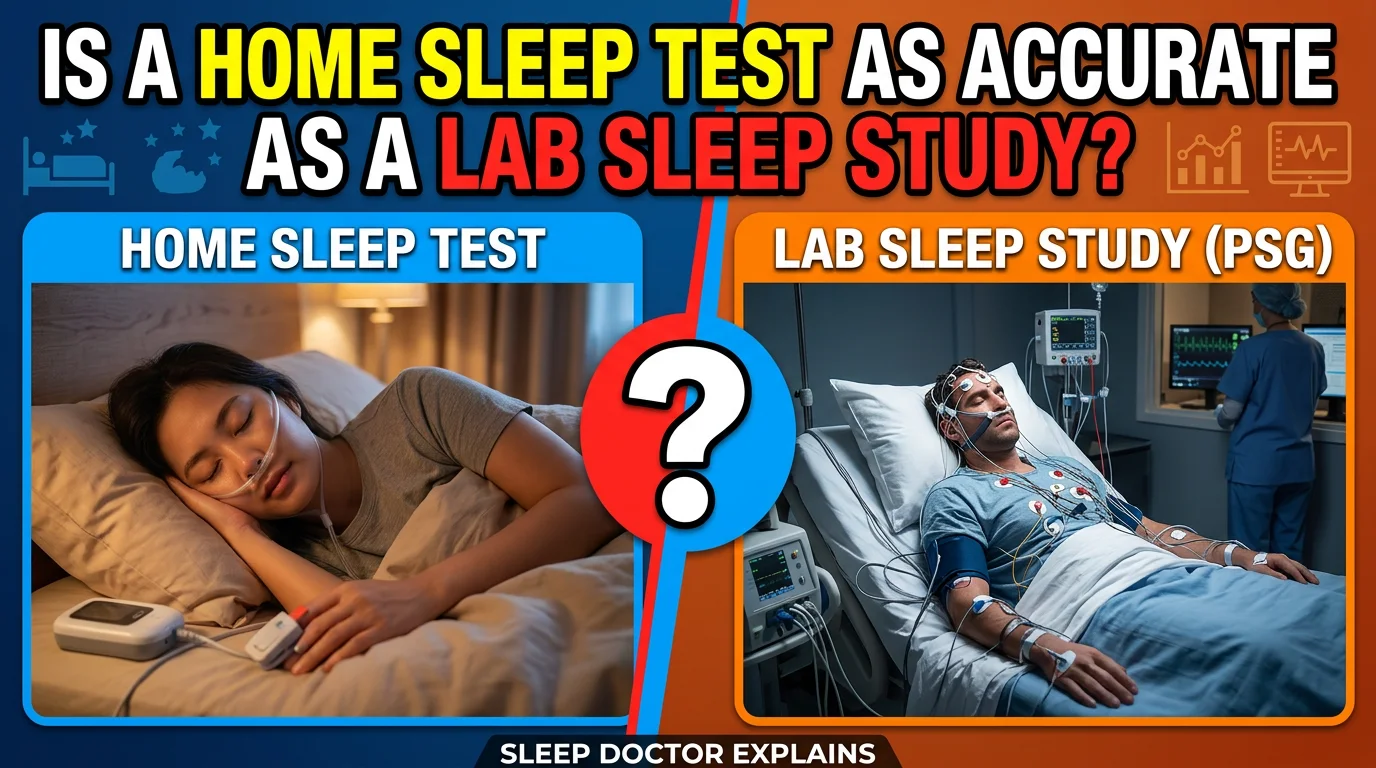
In-lab polysomnography is the most comprehensive sleep test available. Over a night at a sleep center, technicians attach sensors that record brain waves (EEG), eye movement, muscle activity, heart rhythm, airflow, breathing effort, and blood oxygen levels, all while a technician monitors in real time and can intervene if something needs adjusting. Because PSG includes EEG, it can tell the difference between time spent asleep and time spent lying awake, and it can also identify sleep disorders that have nothing to do with breathing, like periodic limb movement disorder, parasomnias, or narcolepsy.
A home sleep apnea test uses a much smaller set of sensors, typically airflow, respiratory effort, and blood oxygen saturation, worn overnight in your own bed with no technician present. It’s built to detect one specific thing: breathing-related events consistent with obstructive sleep apnea, similar to what a lab study is actually testing for, just from fewer signals. What it doesn’t do is measure brain activity, which means it has no way of knowing how much of the recording you actually spent asleep versus quietly awake.
Where the accuracy gap actually comes from
The core diagnostic number in both tests is the apnea-hypopnea index (AHI): the number of breathing disruptions per hour. In a lab study, that “per hour” is per hour of actual sleep, measured directly by EEG. In a home test, there’s no EEG, so the same event count gets divided by total recording time instead, which includes any time spent awake in bed. That mismatch means HSAT-calculated AHI tends to run lower than a lab AHI would for the same person on the same night, because the denominator is inflated by wake time. Research comparing the two has found that the correlation between home and lab results doesn’t fully capture how the two tests actually agree, or disagree, on more nuanced findings.
This bias is one of the reasons a “negative” or borderline home test result is treated cautiously in sleep medicine. If your symptoms strongly suggest sleep apnea but your HSAT comes back normal or inconclusive, the follow-up step is usually an in-lab study, not a repeat home test, precisely because the home test is more likely to under-call severity than over-call it.
What a home test can miss entirely
Beyond underestimating AHI, HSAT has blind spots that aren’t just a matter of degree. Central sleep apnea, where the brain temporarily stops signaling the body to breathe rather than the airway physically collapsing, can be difficult to distinguish from obstructive events on limited-channel home equipment. Sleep-related hypoventilation, a pattern of shallow breathing that raises carbon dioxide levels, generally requires the more detailed monitoring a lab provides. And because HSAT only looks at breathing, it simply cannot diagnose disorders that don’t involve breathing at all, such as narcolepsy, REM sleep behavior disorder, or periodic limb movement disorder, even if one of those is actually behind your symptoms.
Who actually qualifies for a home sleep test
The American Academy of Sleep Medicine’s clinical guideline is specific about this, and it’s worth understanding because it’s what most sleep physicians and insurers follow. HSAT is considered an appropriate option for adults who are otherwise uncomplicated and have an increased likelihood of moderate-to-severe OSA, defined as excessive daytime sleepiness plus at least two of the following signs of sleep apnea: habitual loud snoring, witnessed pauses in breathing or gasping/choking during sleep, or diagnosed high blood pressure.
In-lab PSG is recommended instead of HSAT for patients with any of the following: significant cardiorespiratory disease (such as heart failure or moderate-to-severe lung disease), a history of stroke, neuromuscular disease that could weaken breathing muscles, suspected hypoventilation while awake, chronic opioid use, or severe insomnia. If any of these apply to you, a home test kit isn’t the right starting point regardless of how convenient it is, and a lab study will give a more reliable answer.
Cost and insurance differences
Cost is one of the biggest practical reasons people ask about home testing in the first place, and the gap is real. Home sleep tests typically run from around $150 to roughly $1,000 depending on the equipment and whether it’s billed through insurance, while in-lab studies average closer to $3,000 and can range from about $1,000 to well over $10,000 depending on the facility and coverage. Both Medicare and Medicaid, along with most private insurers, cover home testing specifically for suspected obstructive sleep apnea when it’s ordered by a physician, and coverage for either test type generally requires that testing happen through an approved provider or facility, with your usual deductible and cost-sharing still applying. If cost is a major factor for you, it’s worth asking your doctor directly whether you’re a clinical candidate for HSAT before assuming it’s an option, since the eligibility criteria above matter more than preference here.
What happens if your home test is positive
A positive HSAT showing moderate-to-severe OSA in an appropriate candidate is generally sufficient on its own to start treatment, most often CPAP, without needing a follow-up lab study first. What your sleep physician does with the raw data afterward, converting airflow, effort, and oxygen readings into an AHI and a treatment recommendation, uses the same diagnostic logic used to interpret a full lab study, just from a narrower set of signals. If you want a plain-language walkthrough of how those numbers get turned into a diagnosis either way, this site’s guide to how polysomnography is used to diagnose sleep problems breaks down what each reading actually represents.
This article explains general diagnostic testing categories and isn’t medical advice. Whether a home sleep test or an in-lab study is right for you depends on your symptoms, medical history, and a physician’s evaluation, so talk to your doctor or a board-certified sleep specialist about which option fits your situation.
Frequently asked questions
Can a home sleep test rule out sleep apnea?
Not reliably. Because HSAT tends to underestimate severity and can miss central apnea or non-respiratory disorders, a negative or borderline home result in someone with strong symptoms is usually followed up with an in-lab study rather than treated as a definitive “all clear.”
How many nights do I need to wear a home sleep test?
Most home sleep apnea tests are designed for a single night of recording, though your provider may ask you to repeat the test if the first night’s data is technically inadequate, for example if a sensor came loose or too little of the recording is usable.
Does a home sleep test require a doctor’s order?
Yes. Both home sleep apnea tests and in-lab polysomnography require a physician’s referral based on your symptoms, and insurance coverage for either test generally depends on that referral being on file.
Is an in-lab sleep study more uncomfortable than a home test?
Many people find sleeping away from home with sensors attached and a technician nearby less comfortable initially than testing in their own bed, though sleep centers are designed to make the environment as normal as possible, and most patients still get enough usable sleep for an accurate reading.
Can I choose a home sleep test just because it’s cheaper?
Cost is a legitimate factor to raise with your doctor, but clinical eligibility comes first. If you have a condition on the list that requires in-lab testing, such as significant heart or lung disease or suspected hypoventilation, a home test may produce a result that’s inaccurate enough to delay proper treatment, which usually costs more in the long run.
References
- American Academy of Sleep Medicine – AASM Publishes New Guideline for Diagnostic Testing for Adult Sleep Apnea
- American Academy of Sleep Medicine – Clinical Practice Guideline for Diagnostic Testing for Adult Obstructive Sleep Apnea (PDF)
- PubMed – Use of Polysomnography and Home Sleep Apnea Tests for the Longitudinal Management of Obstructive Sleep Apnea (AASM Clinical Guidance Statement)
- PubMed – Correlations Between Home Sleep Apnea Tests and Polysomnography Outcomes Do Not Fully Reflect the Diagnostic Accuracy of These Tests
- American Association of Sleep Technologists – Home Sleep Apnea Testing (HSAT) Technical Guideline
- Sleep Foundation – How Much Does a Sleep Study Cost?




Leave a Reply