Credit Cards
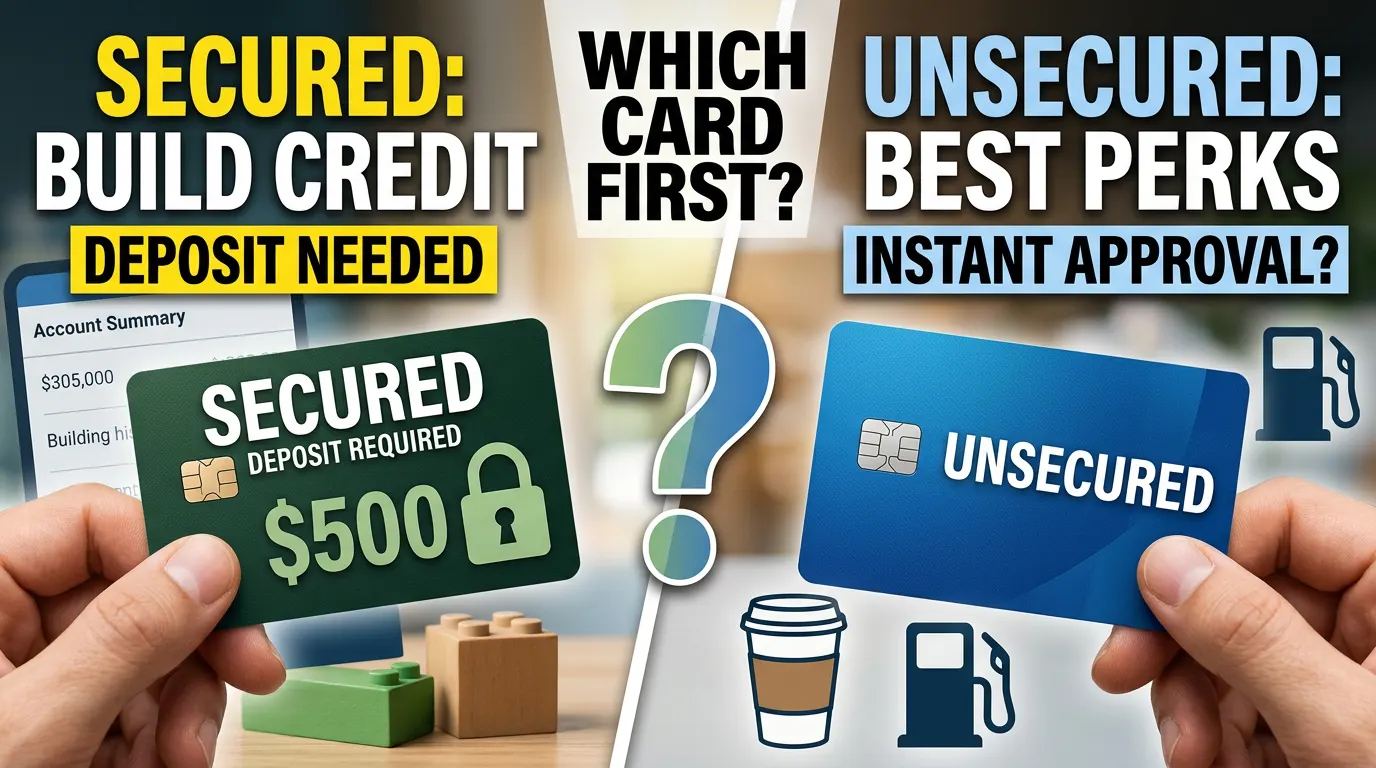
Every first-time or credit-rebuilding applicant eventually runs into the same fork in the road: secured or unsecured? The terms sound technical, but the difference comes down to one simple question, does the issuer require you to put down cash as collateral, or not? That single distinction changes your approval odds, your credit limit, and in some cases your fees, and picking the wrong one first can mean an unnecessary denial or a card that costs more than it should.
This guide breaks down exactly how each type works, compares them side by side, and gives you a clear framework for deciding which one to apply for first based on your actual credit profile.
Quick answer: secured or unsecured, which should you get first?
If you have no credit history, a low or damaged credit score, or have been denied for unsecured cards before, get a secured card first. The refundable deposit does the underwriting work your credit history can’t yet, which makes approval far more likely, and the card still builds credit exactly like an unsecured one because it reports to all three credit bureaus the same way. If you already have fair-to-good credit (roughly a 670+ FICO Score) and steady qualifying income, you can typically go straight to an unsecured card and skip the deposit requirement entirely, there’s no credit benefit to using a secured card if you’d already qualify unsecured.
What actually makes a card “secured”
A secured credit card requires a refundable cash security deposit, which the issuer holds as collateral and which typically becomes your credit limit, deposit $300 and you generally receive a $300 limit, though a small number of issuers extend a limit somewhat above the deposit for responsible use over time. The deposit isn’t a fee; it’s returned to you when you close the account with a zero balance in good standing, or when the issuer upgrades (“graduates”) you to an unsecured card. Because the deposit substitutes for a strong credit history in the issuer’s risk calculation, secured cards are dramatically easier to get approved for than unsecured cards at the same credit tier.
What actually makes a card “unsecured”
An unsecured card requires no deposit at all. The issuer extends you a credit line based purely on your creditworthiness, your credit score, credit history, income, and existing debt and if you default, the issuer has no collateral to fall back on beyond standard debt collection. That’s why unsecured approval, and the size of the credit limit you’re offered, both scale directly with how strong your credit profile already is. Every federal ability-to-pay requirement that applies to secured cards applies equally here: issuers must evaluate your income or assets against your obligations before extending the line, regardless of which type of card it is.
Secured vs. unsecured: side-by-side comparison
| Factor | Secured card | Unsecured card |
|---|---|---|
| Deposit required | Yes, refundable, usually equal to the credit limit | No |
| Approval basis | Ability to fund the deposit + basic ability-to-pay check | Credit score, credit history, and income |
| Typical starting limit | Equal to your chosen deposit | Set by the issuer based on creditworthiness |
| Credit bureau reporting | Reports to all three bureaus, same as unsecured | Reports to all three bureaus |
| Best for | No credit history, rebuilding after damage, recent denials | Established fair-to-good credit and steady income |
| Path forward | Can “graduate” to unsecured with deposit refunded | Already the end state; limits can grow with usage history |
Does a secured card build credit as well as an unsecured one?
Yes, this is the single most misunderstood point about secured cards. The deposit only affects how the issuer funds and protects the credit line; it has no bearing on how the account is reported. Your payment history, credit utilization, and account age all report to Equifax, Experian, and TransUnion identically to an unsecured card. The FICO scoring model weighs payment history at about 35% of your score and amounts owed (utilization) at about 30%, and both factors respond exactly the same way whether the card behind them is secured or not.
The utilization trap with small secured limits
The one place secured cards require more discipline is credit utilization. If your deposit and therefore your limit, is small, say $300, then a single $150 purchase already puts you at 50% utilization, well above the roughly 30% threshold the CFPB and credit scoring models point to as a marker of responsible use. With a low limit, small purchases and quick, even mid-cycle, repayments matter more than they would on a card with a $5,000 unsecured limit. If you can afford a larger deposit, putting down more than the minimum can meaningfully reduce this risk.
Fees: what to compare before choosing either one
Fee structures vary widely across both categories, so “secured” or “unsecured” alone doesn’t tell you which is cheaper; you have to compare the specific card. Some secured cards charge no annual fee at all, which makes them essentially free to hold while you build credit (beyond the refundable deposit itself). Some unsecured cards marketed at bad-credit applicants, on the other hand, charge account-opening fees, program fees, or monthly maintenance fees that can be charged directly to the card, immediately consuming a chunk of an already small limit. Before choosing either type, add up every disclosed first-year fee and weigh it against what you’d pay to simply fund a secured deposit, in many bad-credit comparisons, the secured card ends up both cheaper and easier to be approved for. Our companion guide on Easiest Credit Cards to Get Approved For covers this fee comparison in more depth.
Worked example: building credit with a $300 secured card
Concrete numbers make this easier to picture. Say you fund a $300 deposit and receive a $300 credit limit. Each month you put a recurring bill, a streaming subscription and a phone bill, for example; on the card, totaling around $60, then pay the statement in full before the due date. That keeps your utilization at roughly 20%, comfortably under the 30% threshold most scoring models flag, and it generates an on-time payment every month, which is the single largest factor in your FICO Score. After six to twelve months of this pattern, with no missed payments and no other derogatory marks, it’s common to see a meaningful score improvement, enough, in many cases, to qualify for an unsecured card or a graduation offer from the same issuer. The mechanics are simple; consistency is what actually does the work.
Common myths about secured cards
- Myth: Secured cards build credit slower than unsecured cards. False, the scoring models don’t know or care whether a card is secured. Payment history and utilization are calculated identically either way.
- Myth: The deposit is a fee you never see again. False for cards in good standing. The deposit is refundable collateral, not a cost, though a separate (usually much smaller) annual fee may still apply on some cards, exactly as it can on unsecured cards.
- Myth: Secured cards are only for people who’ve had a bankruptcy or major credit damage. False, they’re equally common and useful for people with no credit history at all, including young adults, recent immigrants building a U.S. credit file for the first time, and anyone re-entering the credit system after years of not using credit.
- Myth: You’ll be stuck with a secured card forever. False in the vast majority of cases. Most secured card programs are explicitly designed as a bridge to an unsecured card, not a permanent product.
Rewards and perks: what to expect from each
Historically, secured cards rarely offered rewards, since the product was designed purely for credit building rather than spending benefits. That has shifted somewhat, and a growing number of secured cards now offer modest cash-back style rewards on everyday categories. Even so, unsecured cards, especially once you qualify for products aimed at good-to-excellent credit, generally offer stronger rewards structures, more valuable perks like purchase protection or travel benefits, and higher earning rates, simply because the issuer is taking on a customer they consider lower-risk and wants to compete for their spending. If rewards are a priority, treat a secured card as a credit-building tool first and plan to move to a rewards-focused unsecured card once your profile supports it, see Travel Rewards vs. Cash Back Credit Cards for how to evaluate those options when you get there.
How to graduate from secured to unsecured
Many secured card programs are explicitly designed as a bridge: after a period of on-time payments and responsible use, commonly discussed as somewhere in the range of six months to a year, though this varies by issuer and isn’t guaranteed on any fixed timeline, the issuer may automatically review the account and offer to convert it to an unsecured card, refunding your deposit once the conversion is complete. If your issuer doesn’t offer automatic graduation, you can also simply close the secured account in good standing (getting your deposit back) and apply for an unsecured card once your score has improved enough to qualify. Either path keeps the account history that built up during the secured period.
A decision framework: which should you apply for first?
- Get a secured card first if: you have no credit history at all, a score below roughly 580–600, a recent bankruptcy or major derogatory mark, or you’ve been denied for unsecured cards recently.
- Go straight to unsecured if: you already have a fair-to-good score (roughly 670+), steady qualifying income, and no recent history of missed payments, a secured deposit would add no benefit in this case.
- Consider both: if you’re not sure where your score stands, check your free credit report at AnnualCreditReport.com and use a prequalification tool (a soft inquiry, so it won’t affect your score) before deciding.
For a broader framework that goes beyond secured vs. unsecured, see How to Choose the Right Credit Card for Your Lifestyle: A Complete Checklist, and if your priority is specifically building or repairing your score, How Credit Cards Affect Your Credit Score covers realistic timelines in detail.
What if you can’t afford a deposit right now?
Not everyone has $200–$500 in spare cash to lock up as collateral, and that’s a legitimate barrier, not a personal failing. If a deposit isn’t realistic right now, the alternatives that don’t require one include becoming an authorized user on a trusted family member’s or partner’s well-managed account, or taking out a credit-builder loan from a credit union, which holds the loan proceeds until you finish making payments rather than requiring an upfront deposit. Both approaches are covered in more detail in Easiest Credit Cards to Get Approved For. Once you’ve saved even a modest amount, a small secured deposit, even $200, is still worth opening sooner rather than later, since account age is itself a scored factor and starting the clock earlier works in your favor.
Should you keep a secured card open after you graduate?
If your secured card converts to an unsecured card automatically, there’s usually no decision to make, it’s the same account, just reclassified, so your account age is preserved. If instead you close a secured account to open a new unsecured one elsewhere, think carefully before doing so: closing your oldest or only account can shorten your average age of accounts and reduce your total available credit, both of which can cause a temporary score dip. In most cases, keeping an older secured account open (even with minimal use) does more for your credit file than closing it does.
Frequently asked questions
Is a secured credit card as good as an unsecured one for building credit?
Yes. Secured cards report to all three credit bureaus exactly the same way unsecured cards do, so payment history and utilization build your credit identically. The deposit only changes how the issuer underwrites the account, not how it’s reported.
Do I get my deposit back from a secured credit card?
Yes, as long as you close the account with a zero balance in good standing, or the issuer graduates you to an unsecured card. The deposit is collateral, not a fee, and issuers only keep it to cover an unpaid balance if you default.
How much deposit do I need for a secured credit card?
Your credit limit typically equals your deposit amount, so the deposit you choose directly determines your starting limit. Many programs allow a range of deposit amounts, and a larger deposit can help keep your utilization ratio lower from the start.
When should I apply for an unsecured card instead of a secured one?
Once you have a fair-to-good credit score, typically 670 or above, and steady income, an unsecured card usually makes more sense since you’d likely qualify without tying up cash in a deposit.
Can a secured credit card hurt my credit score?
Yes, in the same ways any credit card can, missed payments, high utilization relative to your (often small) limit, or closing your oldest account can all lower your score. The card type itself doesn’t create extra risk; how you use it does.
References
- Experian – How Secured Credit Card Deposits Work
- myFICO – What Is a Credit Score?
- myFICO – What’s in Your FICO Score?
- CFPB – § 1026.51 Ability to Pay
- CFPB – Credit Score Myths That Might Be Holding You Back
- CFPB – Report Finds 26 Million Consumers Are Credit Invisible
Related Guides
- Easiest Credit Cards to Get Approved For: Bad Credit, No Credit History & Low Income
- Can You Get a Credit Card Without a Job? Approval Requirements Explained
- How Credit Cards Affect Your Credit Score (and How Long Building Credit Really Takes)
- How to Choose the Right Credit Card for Your Lifestyle: A Complete Checklist
- No Annual Fee Credit Cards: Are Annual Fees Ever Worth Paying?
- Building an Emergency Fund While You Budget: A Step-by-Step Plan






Leave a Reply