Fish & Aquariums
“Cycling” gets mentioned constantly in beginner advice, usually without much explanation of what’s actually happening in the water. I think that’s part of why so many people skip it, it sounds like an optional ritual rather than actual chemistry. It isn’t optional, and once you understand what’s going on, it stops feeling like a mysterious waiting game and starts feeling like a process you can actually track, test for, and predict.
Quick answer
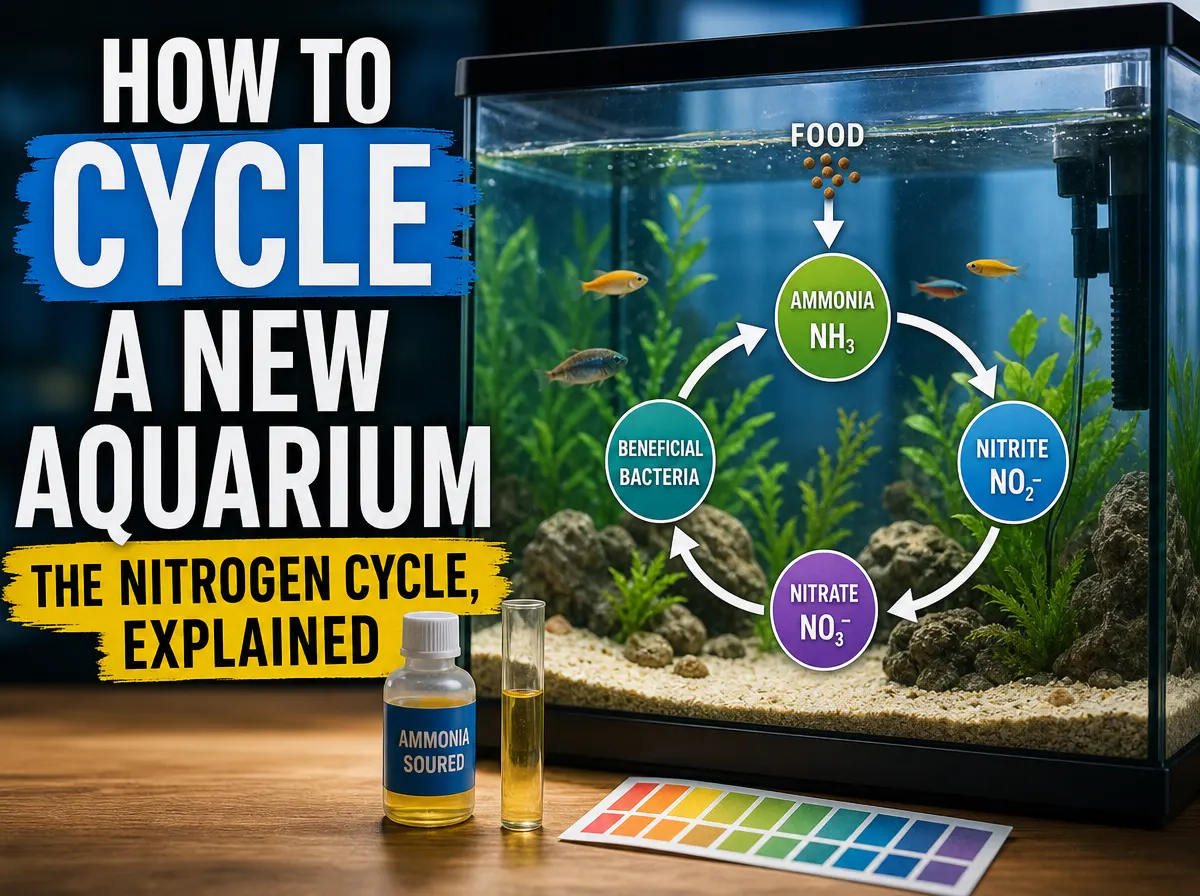
The nitrogen cycle is the process by which bacteria convert toxic ammonia (from fish waste and uneaten food) into nitrite, then into far less harmful nitrate. According to Fishlore and Aqueon’s water-quality guides, a brand-new tank has none of that bacteria yet, so ammonia and nitrite can build up to fish-lethal levels within days. “Cycling” a tank means growing that bacteria colony before adding fish, typically by dosing pure ammonia and testing daily until the tank can process a full dose to zero within 24 hours. This takes roughly 4-6 weeks from scratch, or as little as 1-2 weeks if you seed the tank with bacteria from an already-established one.

Why an uncycled tank is dangerous in the first place
Fish constantly excrete ammonia, both directly through their gills and through waste breaking down in the substrate and filter. In an established tank, this is a non-event, because a standing population of bacteria consumes it almost as fast as it’s produced. In a brand-new tank, none of that bacteria exists yet; the glass, filter media, and substrate are all biologically sterile, so every bit of ammonia a fish produces simply accumulates. Ammonia is toxic to fish even in small concentrations: it damages gill tissue, and depending on your water’s pH, more of it sits in the more toxic un-ionized form at higher pH, which is part of why “cycle the tank first” matters even more in harder, more alkaline water. Nitrite, the next compound in the chain, is a different kind of toxic; it interferes with a fish’s blood ability to carry oxygen, a condition sometimes called “brown blood disease” because of how it visibly discolors gill tissue, a mechanism described in cycling references like Aquarium Science. Skipping the cycle doesn’t just risk slower growth or mild stress; both ammonia and nitrite spikes can kill fish outright within days.
The three stages
| Stage | What’s happening | What you’ll see |
|---|---|---|
| 1. Ammonia rising | You’re dosing ammonia; no bacteria exist yet to consume it | Ammonia readings climb and stay elevated |
| 2. Nitrite spike | Nitrosomonas bacteria establish and start converting ammonia to nitrite | Ammonia starts dropping; nitrite rises, often quite high |
| 3. Nitrate rising, both others falling | Nitrobacter and related nitrite-oxidizing bacteria establish and convert nitrite to nitrate | Both ammonia and nitrite read zero within 24 hours of dosing; nitrate accumulates |
Each stage has a distinct signature if you’re testing daily, which is exactly why testing (not guessing, not waiting a fixed number of weeks) is the only reliable way to know where your tank actually is. The two bacteria species involved are slow-growing compared to most bacteria; their population takes considerably longer to double than most common heterotrophic bacteria under good conditions, which fishkeeping references like Aqua-Fish.net point to as the underlying reason cycling takes weeks rather than days even when everything goes right. Nitrosomonas (ammonia-to-nitrite) typically establishes first and faster; Nitrobacter or related nitrite-oxidizing species establish more slowly, which is why the nitrite spike in stage two is usually the longest and most stubborn part of the process. It’s common for nitrite to stay elevated for one to two weeks even after ammonia is reliably hitting zero.
How to fishless-cycle, step by step
- Set up the tank fully: substrate, filter, heater, dechlorinated water, with the filter running continuously from day one. My beginner setup guide covers this initial setup in full if you haven’t done it before, and if plants are part of the plan, my planted tank setup guide is worth reading alongside this one since planting can happen during the cycle rather than after it.
- Add a source of ammonia: a small amount of pure ammonia (no surfactants, detergents, or added fragrance; check the label carefully, since scented or sudsing ammonia is common on hardware store shelves and unsuitable for this), or a pinch of fish food left to decay, which produces ammonia as it breaks down. Aim for roughly 2-4 ppm ammonia as a starting dose.
- Test daily with a liquid test kit for ammonia and nitrite test strips are faster but noticeably less accurate for this purpose, and the precision matters more during cycling than at almost any other point in the hobby.
- Once ammonia starts dropping on its own within 24 hours, keep dosing a smaller amount (roughly 1-2 ppm) every couple of days to keep the bacteria fed. Don’t let the tank run completely dry of ammonia for extended stretches, or the colony you’re growing can start to shrink from lack of food.
- Once both ammonia and nitrite read zero within 24 hours of a full dose (test right before dosing and again 24 hours later; both readings should be zero), the tank is cycled. Do a large water change to bring nitrate down before adding fish, since nitrate accumulates throughout the process and can be quite high by the time you’re done.

Speeding it up
The fastest legitimate way to cycle a tank is to “seed” it with bacteria from an already-established, healthy tank, a handful of gravel or filter media, a piece of used sponge, or even a bottled bacterial starter product. This can cut cycling time from weeks to days, though it’s still worth testing rather than assuming it’s instantly done, since the seeded bacteria still needs to multiply enough to handle your tank’s specific bioload. If you’re seeding from a friend’s or your own established tank, take the media from the filter itself where the bulk of the colony lives, rather than just a scoop of substrate, for the biggest head start.
Adding live plants also helps, since plants absorb ammonia and nitrate directly through their roots and leaves as a nitrogen source, taking some pressure off the bacterial colony while it establishes. This is one of the reasons a heavily planted tank can sometimes handle a slightly rushed cycle better than a bare one, but it’s a supplement to cycling, not a replacement for it, since plants alone can’t process ammonia fast enough to keep a heavily stocked tank safe. If you’re planning a planted setup, my planted tank guide and fertilizer guide go into how plants and substrate work together once the tank is past this stage.
What if I already have fish in an uncycled tank?
This happens more often than beginner guides admit, usually because fish were bought before anyone explained cycling. If you’re in this position: test daily, do large (30-50%) water changes any time ammonia or nitrite reads above zero, and don’t add more fish until the tank is stable. This approach is sometimes called “fish-in cycling,” and it’s slower and harder on the fish than cycling first, but frequent water changes dilute the toxins faster than they accumulate. Feed lightly (less food means less ammonia produced), don’t rely on ammonia-detoxifying conditioners as a substitute for water changes (they buy time by binding ammonia temporarily, they don’t remove it), and keep testing daily even once things look stable, a fish-in cycle can take considerably longer than 4-6 weeks since you’re constantly diluting the very ammonia the bacteria need to grow on.
Where the bacteria actually live
It’s a common misconception that the bacteria float freely in the water column. In reality, nitrifying bacteria are surface-dwellers; they colonize any wet surface with enough oxygen flow across it, overwhelmingly concentrated in your filter media (which is why running the filter continuously during cycling matters so much), with a smaller but real population on your substrate and hardscape. That’s why a filter media swap or an aggressive scrub-down can crash a cycle, while a routine water change essentially never does, read more about how filters house that bacterial colony and how to clean one without wiping it out.

Common cycling mistakes
- Adding fish too early because ammonia “looked fine” on a single test – one good reading isn’t proof the colony is established; you need consistent zero readings across multiple days after a full dose.
- Using scented or additive-containing ammonia – surfactants and fragrances can be toxic to fish and to the very bacteria you’re trying to grow. Plain, unscented, additive-free ammonia only.
- Cleaning the filter media under tap water mid-cycle – this can wipe out the small but hard-won colony you’ve built and effectively restart the clock.
- Giving up on fishless cycling and adding fish out of impatience – a fish-in cycle from that point on is genuinely harder on the fish than waiting another one to two weeks would have been.
- Not testing daily, or testing inconsistently – cycling is a data problem as much as a chemistry one; sporadic testing makes it easy to miss the point where the tank is actually ready.
Related guides
- Freshwater aquarium setup for beginners
- Aquarium filters explained: types, sizing & setup
- Aquarium maintenance schedule
Frequently asked questions
Why did my cycle stall or crash?
The most common cause is a sudden loss of bacteria, often from a filter clean done under tap water, a medication that’s also antibacterial, or a big drop in tank temperature (bacteria slow down significantly below about 20°C/68°F, and nitrifying activity essentially stalls closer to freezing). If your numbers suddenly reverse, check for one of those first. A less common cause is running out of ammonia to feed the colony for too long, if you stop dosing for a week or more once ammonia starts dropping, the population can shrink back down from lack of food, and you’ll see readings climb again once you resume dosing.
Do I need to cycle again after a water change?
No. Routine water changes remove dissolved nitrate and replenish trace minerals; they don’t meaningfully disturb the bacteria living in your filter and substrate, since the colony isn’t suspended in the water column being removed. Cycling is a one-time setup process for a healthy, maintained tank, not something you repeat with every water change.
Can I use tap water safely once cycled?
Yes, as long as you treat it with a dechlorinator every time, chlorine and chloramine in tap water kill the same bacteria you spent weeks growing, regardless of whether the tank is already cycled. Dechlorinator takes effect within minutes and should be a permanent part of every water change, forever, not just during setup.
How do I know for certain the tank is fully cycled?
Dose ammonia up to roughly 2-3 ppm, then test again 24 hours later. If both ammonia and nitrite read zero at that 24-hour mark, and this holds true across at least two or three consecutive tests on different days, the colony is established enough to handle a typical light-to-moderate fish load. A single zero reading isn’t reliable confirmation on its own, bacteria populations can be inconsistent day to day while still establishing.
Does adding fish gradually still require a full cycle first?
Yes, though it changes what happens afterward. A fully cycled tank’s bacteria colony is sized to the bioload it was cycled with, so adding fish gradually after cycling (rather than stocking fully on day one) is still good practice, since a sudden jump in bioload can temporarily outpace the existing colony and cause a small ammonia blip, sometimes called a mini-cycle, until the bacteria catch up. Adding two or three fish at a time with a week or two between additions gives the colony room to scale up smoothly.
If you’re setting up a tank for the first time, start with my complete beginner’s setup guide, which walks through cycling alongside every other step. Once your water chemistry is sorted, choosing and sizing the right filter is the next thing worth getting right, and a simple maintenance schedule keeps the cycled tank stable long after setup is done.






Leave a Reply