Fish & Aquariums
Most of the questions I get about an aquarium maintenance schedule boil down to one worry: “am I doing enough, or too little?” There’s no single right schedule, it depends on tank size, how heavily it’s stocked, and whether it’s planted, but there is a reasonable default aquarium maintenance schedule, and it’s a lot less demanding than it sounds once you know what actually needs doing versus what can wait. I’ve settled into a rhythm across a few different tanks now, and the version below is close to what I actually do myself, not just a generic list.
Quick answer: the aquarium maintenance schedule in short
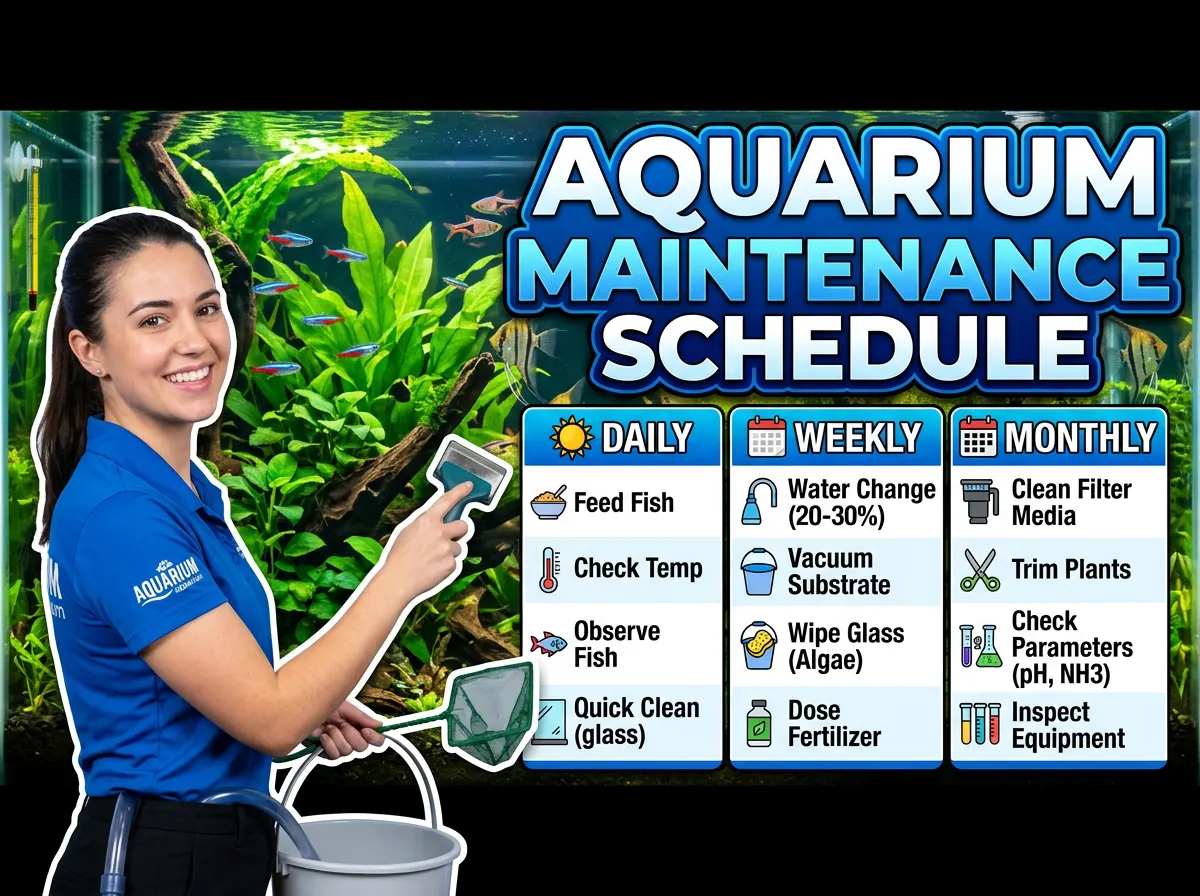
A typical home aquarium maintenance schedule includes a daily glance (fish present and acting normally, equipment running), a weekly partial water change of roughly 10-25% paired with light gravel cleaning, and a monthly deeper check, rinsing filter media in removed tank water, testing parameters, and inspecting equipment. Everything else, trimming plants, replacing bulbs, deep-cleaning decor- is occasional upkeep rather than routine maintenance. The whole aquarium maintenance schedule takes maybe 20-30 minutes a week for an average tank; the thing that actually causes problems isn’t the difficulty of any single task, it’s letting the schedule slide for weeks and then facing all of it at once.

The Blue Pet 5-in-1 aquarium cleaning kit puts five essential maintenance tools on one 19-inch handle, Anti-Chlorine (Dechlorinator), Algae Scraper Pad, Water Test Kit
What maintenance does a fish tank actually need?
Three things, on repeat: partial water changes to dilute waste that builds up in the water, physical cleaning (gravel, glass, filter media) to remove waste before it breaks down, and periodic checks (water parameters, equipment) to catch problems early. Everything else, replacing bulbs, trimming plants, deep-cleaning decor, is occasional upkeep, not routine maintenance. None of it is difficult on its own; the only real skill is not letting it slide for months and then facing all of it at once.
It helps to understand why each of these three matters on its own, rather than just following the aquarium maintenance schedule blindly. Water changes exist because even a well-cycled tank’s bacteria only convert ammonia into nitrate; they don’t remove nitrate, and neither do most fish, so it accumulates steadily and a water change is the only thing diluting it back down. Physical cleaning matters because uneaten food and waste sitting in the substrate or clogging filter media continues decomposing and adding to the bioload even when it’s not immediately visible. And periodic checks exist because equipment fails quietly; a heater that’s drifted out of calibration or a filter that’s slowly clogging doesn’t announce itself until something else goes wrong downstream.
The aquarium maintenance schedule
| Frequency | Tasks |
|---|---|
| Daily (30 seconds, really) | Glance at the fish and check they’re all present and acting normally; confirm the filter and heater are actually running; feed an appropriate amount. |
| Weekly | Partial water change (typically 10-25%); gravel-clean a section of the substrate at the same time; wipe algae off the front glass; top off water lost to evaporation. |
| Monthly | Rinse mechanical filter media in removed tank water (never tap water; chlorine kills the bacteria you want to keep); test water parameters if you have a kit; check the heater is holding temperature accurately; inspect equipment for wear. |
| Occasional / as-needed | Deep-clean decorations, trim or replace plants, replace filter cartridges or UV bulbs, recalibrate or replace a test kit, more thorough substrate vacuuming in bare/open areas. |
If you’re setting a tank up for the first time, this aquarium maintenance schedule starts properly once the nitrogen cycle is established; a brand-new, uncycled tank needs a different, more careful approach for the first several weeks, with more frequent, smaller water changes and no expectation of a stable weekly rhythm until the bacteria colony has actually matured.
Why the weekly water change specifically matters
Of everything on this list, the weekly water change is the task that does the most work, and it’s worth understanding why a partial change is the standard rather than a full one. A partial change (10-25%) dilutes accumulated nitrate and other dissolved waste without disturbing the tank’s overall chemistry or stressing fish with a sudden, large parameter shift. A full water change removes too much at once; it can shock fish with a sudden temperature or chemistry change and, in an emergency scenario, temporarily reduces the water volume the bacteria colony has to work with. The smaller, more frequent approach is more forgiving and, over a month, removes roughly the same amount of accumulated waste as one dramatic change would, with far less risk.
Getting the percentage right for your tank
- Lightly stocked, larger tanks can often get away with the lower end (10-15%) weekly, since bioload relative to water volume is smaller and waste accumulates more slowly.
- Heavily stocked or smaller tanks typically need the higher end (20-25%) or more frequent changes, since waste builds up faster relative to the available water volume.
- Planted tanks sometimes need slightly less, since living plants absorb some nitrogen waste directly, though this reduces rather than eliminates the need for water changes.
- Let nitrate testing guide the exact number rather than following a fixed percentage blindly; if nitrate is consistently climbing between changes, increase the percentage or frequency; if it’s consistently low, you likely have some room to ease back.

How much does aquarium maintenance cost?
Doing it yourself, the ongoing cost is small: a bottle of dechlorinator, occasional filter media, and test kit refills, none of which add up to much over a month. The running cost people actually notice on their electric bill comes almost entirely from the heater and lighting, not from cleaning tasks themselves; a heater cycling on and off in a stable room adds a modest, fairly predictable amount, and it scales with your heater’s wattage and how many hours a day it’s actually working, not with tank size alone. If you’re weighing whether to do it yourself or pay someone, I’ve written a separate breakdown on what professional aquarium cleaning services actually cost and when hiring one is worth it, it’s genuinely a different calculation than DIY upkeep.
Is it difficult to maintain an aquarium?
Not technically difficult; the tasks themselves are simple and take maybe 20-30 minutes a week for an average home tank. What trips people up is consistency: skipping a week here and there doesn’t cause an immediate problem, which makes it easy to keep skipping until the tank is genuinely behind. The honest downsides of owning a tank are the recurring time commitment, needing someone to cover it when you travel, and the upfront cost of doing a setup properly. None of that is unique to aquariums; it’s the same trade-off as any pet that depends entirely on you for its environment.
A well-run freshwater tank and its equipment can easily run for many years; it’s less about the aquarium’s own “lifespan” and more about how consistently the aquarium maintenance schedule above gets followed and how long the livestock itself lives, which varies a lot by species.
Building the habit: making your aquarium maintenance schedule stick
The single biggest reason an aquarium maintenance schedule fails isn’t lack of knowledge; it’s that the routine has no fixed trigger, so it gets pushed back one week at a time until it’s been a month. A few practical habits fix this more reliably than good intentions alone:
- Pin it to a fixed day, not “sometime this week.” “Water change on Sunday” survives busy weeks far better than “water change when I get a chance,” because it doesn’t compete with other decisions for attention.
- Keep supplies staged and ready. A bucket, siphon, and dechlorinator kept near the tank rather than stored away removes the small friction that turns a 15-minute task into something you keep putting off.
- Log what you do, briefly. Even a simple note of the date and percentage changed makes it obvious at a glance whether you’re actually on schedule or have quietly drifted, which memory alone tends to misjudge.
- Pair maintenance with an existing habit. Doing the weekly change right before or after another fixed weekend task anchors it to something that already happens reliably.
- Set a recurring reminder if your aquarium maintenance schedule genuinely slips your mind. There’s no shame in a phone reminder; the goal is consistency, not memory as a skill.
Signs your tank is overdue for maintenance
- Cloudy or discolored water that doesn’t clear up after a day or two, often a sign a water change and filter check are overdue.
- Visible algae spreading across the glass or decor faster than usual.
- A strong smell coming from the tank; a healthy, well-maintained aquarium shouldn’t have a noticeable odor.
- Fish gasping at the surface, unusually lethargic, or clamped fins; these can point to poor water quality and are worth checking parameters over immediately, not waiting for the next scheduled change, since they can also be early signs of ich or other stress-related issues that get worse the longer poor conditions persist.
- Visibly dirty substrate you can see through the glass on the sides of the tank.
- Slower-than-usual plant growth or leaf yellowing in a planted tank, which can point to nutrient imbalance building up between changes.
- A noticeable gap between your last logged water change and today, if you’re keeping any kind of log, this is often the earliest and most objective warning sign, well before the water itself looks obviously off.
If a tank has genuinely fallen off its aquarium maintenance schedule for a while, don’t try to fix everything in one session; a single large water change on a tank that’s drifted can shock fish with a sudden parameter swing. Do a moderate change, test the water, and catch up gradually over a week or two rather than all at once. Fish can generally tolerate a dirty tank for a while, but water quality is cumulative; the longer it’s ignored, the faster problems like ich or fin rot tend to show up.

A simple handwritten aquarium maintenance log
Can you leave a tank unattended for a week or two?
An established, appropriately stocked tank handles a week or two off the aquarium maintenance schedule far better than people expect; fish can go that long without food (most adult fish are fine fasting for a week), and an automatic feeder set to a modest portion covers the actual risk, which is overfeeding by whoever’s checking in, not underfeeding. Ask a neighbor to glance at it rather than feed it, if you can. What you shouldn’t skip is making sure the filter and heater are reliable before you leave, since equipment failure, not a missed water change- is what actually causes problems over a short absence. If you’re leaving during a season with less stable room temperature, it’s worth reading through my notes on winter tank care as well, since equipment reliability matters even more when you’re not there to catch a slow drift.

A small nano tank on a desk next to a larger heavily planted aquarium in the same room.
Adjusting the aquarium maintenance schedule for different tank types
| Tank type | How the routine typically shifts |
|---|---|
| Nano tanks (under ~10 gallons) | Smaller water volume means parameters swing faster, often needs more frequent, smaller water changes rather than the standard weekly rhythm |
| Heavily planted tanks | Plants absorb some nitrogen waste, which can reduce (not eliminate) water change frequency, but adds plant trimming and sometimes fertilizer dosing to the routine |
| Species-only or lightly stocked tanks | Lower bioload generally means more forgiving timing, though water still needs regular changes even with very light stocking |
| Tanks with sensitive or delicate species | Stability matters more than exact percentage; smaller, more frequent changes are often gentler than the standard 10-25% weekly approach |
| New tanks still cycling | Different rules entirely for the first several weeks; see the nitrogen cycle guide rather than applying this aquarium maintenance schedule too early |
Keeping maintenance genuinely low
“Low-maintenance aquarium” is a popular search, and it’s a reasonable goal; a few real levers actually reduce the routine rather than just claiming to:
- Go bigger, not smaller. Larger water volumes dilute waste more and swing in parameters more slowly, which in practice means more forgiving timing on water changes, the opposite of what most people assume.
- Don’t overstock. Bioload is the single biggest driver of how much maintenance a tank needs; a lightly stocked tank in a large volume can genuinely go longer between cleanings than a crowded small one.
- Live plants help by taking up some of the nitrogen waste that would otherwise only leave via water changes; they reduce, but don’t eliminate, the need for them.
- Buy filtration one size up from what the tank technically requires, rather than the bare minimum; more filtration capacity means more margin before waste builds up between cleanings. My notes on why filters need continuous runtime cover the flip side of this: more capacity doesn’t mean it’s ever safe to run it less.
- Choose species matched to your realistic maintenance capacity rather than the other way around; a heavily stocked, high-bioload setup will always demand more from the schedule than a moderately stocked one, regardless of how good your equipment is.
Aquarium maintenance schedule: frequently asked questions
What tools do I actually need for routine maintenance?
A gravel vacuum/siphon, a bucket dedicated to the tank (never one that’s held soap or cleaning chemicals), a dechlorinator, an algae scraper or pad, and a basic liquid water test kit. That covers the weekly and monthly routine above; everything else is optional convenience gear, not a requirement.
Should I follow a fixed maintenance schedule or go by what the water looks like?
Use a fixed aquarium maintenance schedule as the baseline and let test results adjust it, not the other way around; water can look completely clear while ammonia or nitrate is climbing, so “it looks fine” isn’t a reliable signal to skip a scheduled change.
What happens if I skip a week of water changes?
One skipped week on an otherwise well-maintained, appropriately stocked tank rarely causes a visible problem; there’s usually enough buffer that a single missed change is a minor setback, not a crisis. The risk is in it becoming a pattern; nitrate and general waste accumulate cumulatively, so several skipped weeks in a row compound in a way one missed week doesn’t.
Should I clean the filter and do a water change on the same day?
Rinsing filter media doesn’t need to happen every week; monthly is typically enough, but when you do rinse it, doing so on the same day as a scheduled water change is convenient and not a problem. Just avoid rinsing filter media in tap water regardless of timing, since the chlorine will kill beneficial bacteria you want to preserve.
Do saltwater tanks need a different maintenance schedule than freshwater?
The same core principles apply to an aquarium maintenance schedule: regular partial water changes, physical cleaning, and periodic testing, but saltwater setups typically add salinity monitoring, calcium/alkalinity testing for reef tanks specifically, and more careful attention to mixing new saltwater to the correct specific gravity before each change. This guide focuses on freshwater maintenance.
How do I know if I’m overdoing maintenance rather than underdoing it?
Overly frequent, overly large water changes can actually destabilize a tank by constantly resetting parameters the bacteria colony and fish would otherwise adapt to. If nitrate consistently tests near zero and you’re changing more than the standard weekly 10-25%, it’s reasonable to ease back slightly and let the test results, not habit, set the pace.
This aquarium maintenance schedule is the routine side of tank care. If you haven’t set a tank up yet, start with the full beginner’s setup guide, which covers cycling, substrate, and equipment before any of this maintenance routine applies.








Leave a Reply