Fish & Aquariums
Almost everyone who keeps fish long enough eventually deals with ich. It’s not a sign you’re doing something badly wrong, it’s an extremely common parasite that often arrives with new fish, and stress (a new environment, a temperature swing, overcrowding) is usually what lets it take hold. The good news is it’s also one of the more reliably treatable fish diseases, if you catch it early and follow through on treatment. I’ve had it show up in my own tanks more than once, always traceable back to a new fish I didn’t quarantine long enough or a water change where I misjudged the temperature match.
Quick answer
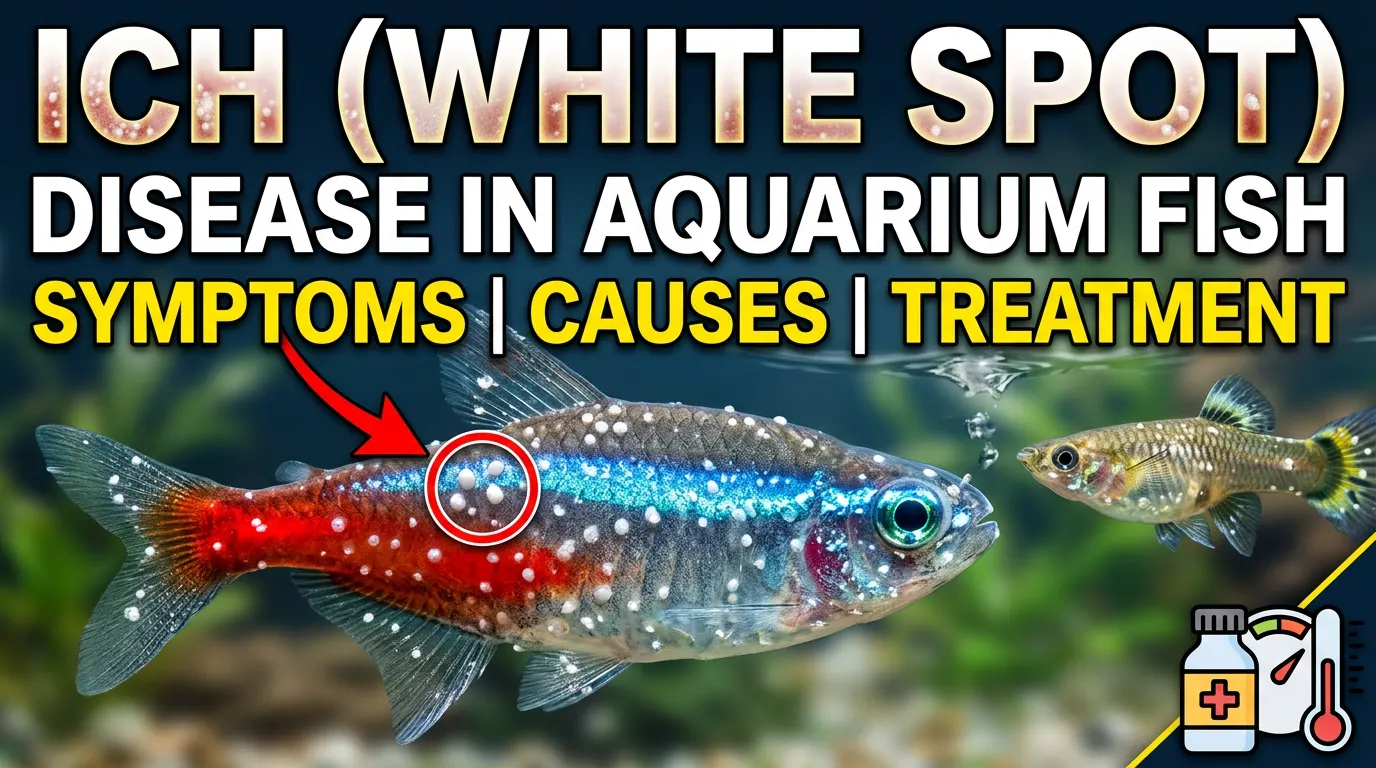
Ich (short for Ichthyophthirius multifiliis, also called white spot disease or “ick”) shows up as small white spots resembling grains of salt scattered across a fish’s body and fins, often with flashing (rubbing against decor) and clamped fins. It’s caused by a parasite that’s present in low numbers in most aquariums but multiplies rapidly when a fish is stressed or immune-compromised. The standard treatment combines raising water temperature gradually to around 82-86°F (28-30°C), which speeds up the parasite’s life cycle so medication can catch it at its vulnerable stage- with a dedicated ich medication, continued for the full course even after visible spots disappear, since the visible spots are only one stage of a multi-stage life cycle.

What to look for
| Sign | What it looks like |
|---|---|
| White spots | Small, distinct white dots like grains of salt, scattered across body and fins, not a uniform film or a single patch |
| Flashing | Fish rubbing their body against gravel, decor, or the glass, trying to relieve irritation from the parasites embedded in their skin |
| Clamped fins | Fins held close to the body rather than spread naturally, a general stress posture |
| Reduced appetite / lethargy | General stress response, especially as the infection progresses and more of the body is affected |
| Rapid gilling | Especially concerning if spots are also present on the gills, which can affect breathing and is a sign to act quickly |
| Excess mucus / cloudy slime coat | Some fish produce extra body mucus in response to the irritation, giving the skin a slightly hazy look even where spots aren’t concentrated |
The parasite’s life cycle, and why it matters for treatment
Understanding roughly how ich moves through its life cycle explains almost every treatment rule that otherwise seems arbitrary, why you have to keep dosing after spots vanish, why raising temperature helps, and why a single dose rarely works. The parasite passes through several distinct stages, and medication and a fish’s own immune system can only reach it during some of them.
- Trophont stage (what you actually see). This is the visible white spot, the parasite burrowed into the fish’s skin, feeding and growing. It’s protected under a layer of the fish’s own tissue during this stage, which is exactly why medication can’t reach or kill it while it’s visible as a spot. This is the single most misunderstood part of ich treatment: seeing spots doesn’t mean medication is failing, it means the parasite is currently in the one stage nothing can touch.
- The parasite drops off the fish. Once mature, the trophont detaches from the fish and falls to the substrate or decor, no longer visible on the fish itself. This can look like “the spots are gone, it’s cured”, which is the most common reason people stop treatment too early.
- Tomont/cyst stage. On the substrate, the parasite forms a cyst and divides rapidly inside it, producing hundreds of new infectious offspring. This stage is also largely protected from most medications by the cyst wall.
- Theront stage (free-swimming and vulnerable). The cyst ruptures, releasing free-swimming parasites into the water column that must find a fish host within roughly a day or two or they die. This free-swimming stage is the only point in the entire cycle where medication and heat genuinely work; it’s exposed, has no fish tissue or cyst wall protecting it, and this is the actual target of every ich treatment.
- Reattachment. A theront that finds a fish burrows in and becomes a new trophont, restarting the cycle, which is exactly why an undertreated tank sees spots seem to clear and then return days later; it’s a new generation reinfecting, not a relapse of the same parasites.
Warmer water speeds up this entire cycle, which sounds counterproductive until you realize the goal isn’t to slow the parasite down; it’s to push it through its protected stages faster so it reaches the vulnerable free-swimming stage sooner and more often within your treatment window, giving medication more chances to actually catch it before it can reattach.
Why it happens
The parasite is often already present at low levels in established tanks, kept in check by fish immune systems and simply not present in numbers large enough to be noticeable. Outbreaks typically follow a stress event: a new fish introduced without quarantine, a sudden temperature swing, overcrowding, or poor water quality. This is part of why a properly cycled, stable tank matters beyond just avoiding ammonia; chronic stress from poor conditions makes fish more vulnerable to ich and other opportunistic issues, the same way fin rot tends to follow water quality problems rather than appear out of nowhere.
New fish are the single most common source, and it’s worth being specific about why: fish arriving from a store or shipment have often been through several stressful transitions already (collection, transport, holding tanks, more transport), any one of which can suppress immune function enough to let a low-level parasite load become a visible outbreak. It’s rarely that the store’s water was dirty; it’s that the fish itself is compromised by the time it reaches your tank, and a new environment on top of that is one stressor too many.

Treatment, step by step
- Raise the tank temperature gradually, over a day or two, to around 82-86°F (28-30°C) if your fish species can tolerate it; this shortens the parasite’s life cycle, pushing it toward the vulnerable free-swimming stage sooner. Increase aeration alongside this, since warmer water holds less dissolved oxygen and a temperature this high can leave fish short of oxygen if surface agitation doesn’t increase to match.
- Add a dedicated ich medication (commonly containing malachite green and/or formalin, or a copper-based treatment; check compatibility with any scaleless fish or invertebrates in the tank first, since some treatments are unsafe for them; copper in particular is toxic to shrimp, snails, and most invertebrates even at doses safe for fish).
- Continue the full treatment course as directed, even after visible spots disappear; the spots you see are one life stage of the parasite; stopping early leaves the cyst and free-swimming stages to reinfect the tank, which is the single most common reason ich treatment “doesn’t work” the first time.
- Do partial water changes as directed between doses, and re-dose after water changes per the product’s instructions, since a water change dilutes the medication along with everything else.
- Keep an eye on ammonia/nitrite during treatment, since some medications can affect beneficial bacteria; test more frequently than usual during this period, and be ready to do an extra water change if ammonia starts climbing.
- Continue treatment for at least several days beyond the last visible spot, following the specific product’s recommended duration rather than your own visual judgment; the life cycle timing means “spots gone” and “parasite gone” are not the same moment.

What to avoid during treatment
- Don’t stop as soon as spots disappear. This is the single most common mistake and the reason ich “keeps coming back”, the parasite is still present in the cyst and free-swimming stages even when nothing is visible on the fish.
- Don’t mix multiple medications or combine an ich treatment with other medications without checking compatibility first; some combinations are more dangerous together than either is alone, and layering treatments rarely speeds things up.
- Don’t run carbon filtration during medicated treatment unless directed otherwise; activated carbon can pull the medication out of the water before it has a chance to work, effectively undosing the tank without you realizing it.
- Don’t skip water changes to “save” the medication. Skipping scheduled water changes to preserve medication concentration usually does more harm than good, since deteriorating water quality adds another stressor on top of the disease itself.
- Don’t add new fish mid-treatment. A tank actively fighting an ich outbreak is not the moment to introduce more stress or more potential hosts for the parasite.
Preventing it in the first place
- Quarantine new fish for 2-4 weeks in a separate tank before adding them to your main display, this is genuinely the single most effective prevention step, and it’s also the one people skip most often because it requires patience and an extra tank.
- Avoid sudden temperature swings, especially during water changes; match new water temperature closely, since a cold-shock event is one of the more common stress triggers that lets a low-level parasite population become a visible outbreak.
- Don’t overcrowd, and maintain good water quality generally, since stressed fish are more susceptible across the board, not just to ich specifically.
- Watch new fish closely during their quarantine period, not just on arrival day; early-stage ich can be genuinely hard to spot, and a fish that looks fine on day one can develop visible spots by day five or six as the parasite population builds.
- Avoid buying fish from a tank that already has visibly sick or spotted fish in it, even if the individual fish you want looks clean; shared water in a display tank means exposure regardless of which fish is showing symptoms.

Ich versus other conditions that get mistaken for it
| Condition | Key difference from ich |
|---|---|
| Velvet disease | Finer, dust-like gold or rust-colored coating rather than distinct white dots, often needs close inspection or a flashlight held at an angle to see clearly |
| Fungal infections | Tends to look like cottony or fuzzy tufts rather than discrete round spots, often on damaged or previously injured tissue specifically |
| Breeding tubercles | Small white bumps on the head/gill covers of some male fish during breeding condition, a normal reproductive trait, not disease, and doesn’t come with flashing or clamped fins |
| Salt or mineral residue on décor (not fish) | Not actually on the fish at all, worth double-checking that spots are genuinely on the fish’s body rather than mistaken for something on nearby glass or decor |
| Lymphocystis | Larger, cauliflower-like white or grey growths rather than small uniform dots, usually fewer and bigger rather than numerous and small |
Frequently asked questions
Is ich contagious to other fish in the tank?
Yes, treat the whole tank, not just the visibly affected fish. By the time spots are visible on one fish, the parasite is very likely already present in the water affecting others, even if they’re not showing symptoms yet, since the free-swimming stage disperses through the whole water column rather than staying near one host.
Can I just raise the temperature without medication?
Heat alone can help in very mild, early cases, but combining it with medication gives a much more reliable outcome. Heat speeds up the parasite’s life cycle; medication is what actually kills it at its vulnerable free-swimming stage. Heat without medication is essentially relying on the fish’s own immune system to clear the free-swimming parasites once they’re exposed, which works less consistently than adding a dedicated treatment.
Is ich the same in saltwater tanks?
No, marine ich is caused by a different parasite (Cryptocaryon irritans) with a similar appearance but a somewhat different life cycle and different treatment specifics, including that raising temperature and copper-based treatments are handled differently in a reef environment because of live rock and invertebrates. This guide covers freshwater ich specifically.
How long does an ich outbreak take to clear up?
A full treatment course commonly runs a week to ten days at raised temperature, sometimes longer, and it’s important to complete the entire recommended course rather than stopping once spots first disappear, since that can happen well before the parasite is actually cleared from the tank.
Why do I keep getting ich even though I quarantine new fish?
The most common reasons are a quarantine period that’s too short (early-stage ich can take a week or more to become visible, so a two- or three-day quarantine catches almost nothing), ongoing background stress in the main tank from water quality or overcrowding that keeps a low-level parasite population from ever fully clearing, or new plants and decor moved between tanks without any quarantine of their own, which can also carry the parasite.
Can ich survive in an empty tank without fish?
The free-swimming stage needs to find a fish host within roughly a day or two or it dies, so a tank left genuinely fishless for a stretch of time will generally clear the parasite on its own, since the cycle can’t complete without a host to reinfect. This is different from simply removing visibly sick fish while others remain, the parasite persists as long as any fish host is present in the water.
Should I treat in a separate hospital tank or the main display?
Because ich spreads through the whole water column rather than staying isolated to one fish, treating the main display is usually necessary once an outbreak is visible, a hospital tank helps for isolating a severely affected individual, but it doesn’t replace treating the tank the parasite is actually living in.
Quarantining new fish before adding them to an established tank is the single change that prevents the most ich outbreaks, worth the extra tank and few weeks of patience if you’re adding fish regularly. If water quality has been an ongoing issue alongside an outbreak, it’s also worth reviewing your regular maintenance routine to make sure the tank isn’t giving the parasite repeated openings to take hold.






Leave a Reply