BROMELIAD GUIDE · UPDATED OCTOBER 2026
By Everydaything Team · Last updated October 2026
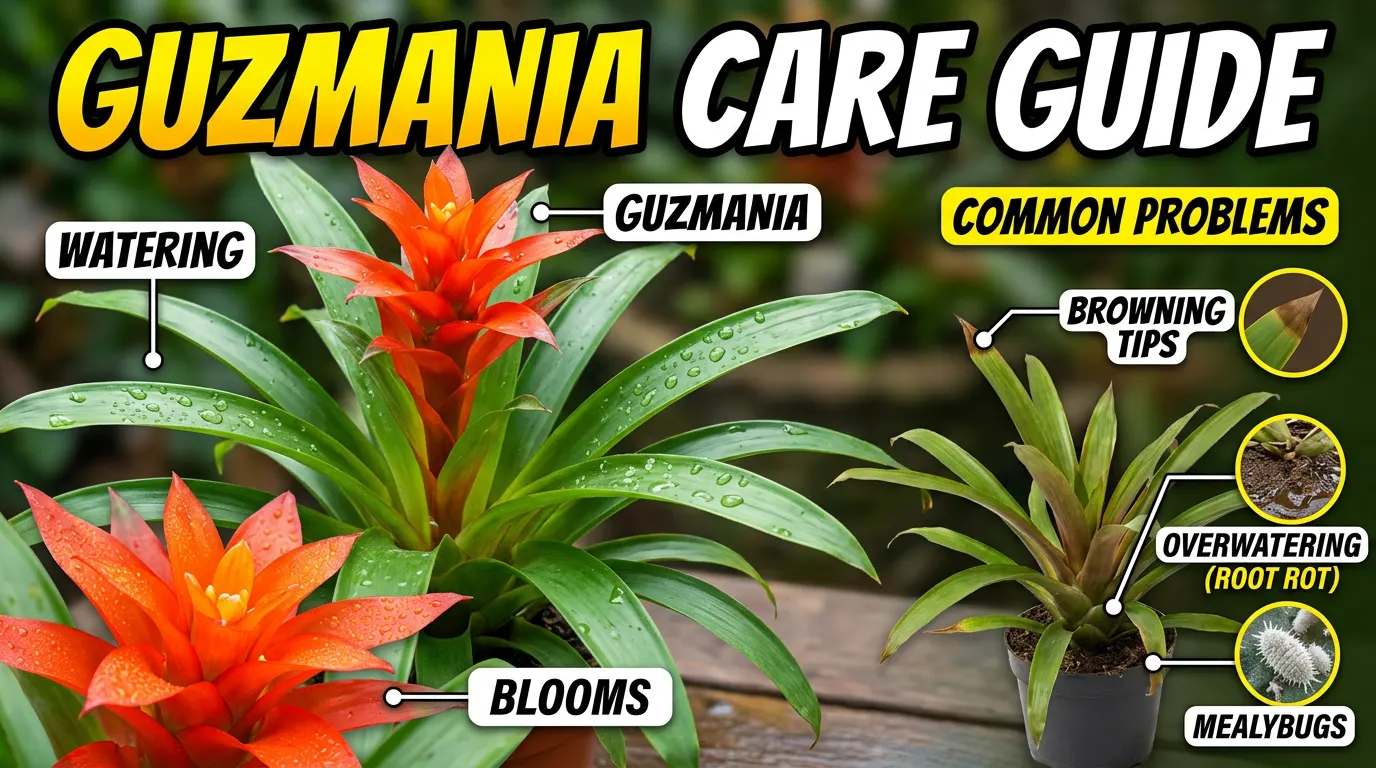
Guzmania care comes down to four habits: bright but gentle light, a cup of fresh water, steady warmth and clean water quality. Guzmania is a genus of mostly tree-dwelling bromeliads from tropical America, and its glossy, spineless rosettes carry a colourful bract that lasts for months. The catch is that each rosette flowers once. This guide explains how to keep a Guzmania healthy, how to fix common problems such as brown tips, crown rot and fading bracts, and how to adapt the routine to Indian seasons.
Quick answer
- Light: part shade or bright filtered light. NC State Extension says Guzmania lingulata tolerates part to full shade and grows well under artificial light.
- Water: keep the medium lightly moist and some fresh water in the cup. Never let the mix dry out completely, because tip burn follows.
- Water quality: trade growers report that Guzmania dislikes alkaline, salty or fluoridated water. Rain or filtered water is safer.
- Warmth: the RHS says it needs temperatures above 15 °C, so keep it away from cold windows and air-conditioner drafts.
- Bloom: the bract can last about two to four months, then the mother plant declines and pups follow.
- Pets: the ASPCA lists Guzmania lingulata var. minor as non-toxic to dogs, cats and horses.
What is a Guzmania?
A Guzmania is a bromeliad in the subfamily Tillandsioideae, the same group as air plants and Vriesea. Wikipedia says the genus holds over 120 species, native from southern Mexico and Central America through northern and western South America, plus Brazil. Most grow as epiphytes in rainforests, in some cases up to 3,500 m in the Andes. The genus honours Anastasio Guzmán, a Spanish-Ecuadorian pharmacist and naturalist.
The plant you buy as a houseplant is usually Guzmania lingulata or a hybrid of it. NC State Extension describes G. lingulata as a tropical epiphytic perennial with a rosette of tongue-shaped leaves, a central water-holding vase and a flower head three to six inches across. The small true flowers are white and sit inside the showy red, orange, yellow, pink or maroon bracts.
| Quick facts | Guzmania lingulata (typical houseplant) |
|---|---|
| Plant type | Evergreen, stemless, epiphytic bromeliad (RHS) |
| Native range | Tropical Americas and the West Indies (NC State) |
| Size | About 1–2 ft tall and wide (NC State); RHS gives 0.1–0.5 m |
| Light | Part to full shade; bright filtered light indoors |
| Minimum temperature | Above 15 °C (RHS rating H1A) |
| Bloom | Summer in the wild; flower head lasts 2–4 months (NC State) |
| Time to maturity | 2–5 years (RHS) |
| Leaves | Smooth and spineless, so easier to handle (trade source) |
| Pet safety | Non-toxic to dogs, cats and horses (ASPCA, var. minor) |

Which Guzmania types and hybrids are common?
Most shop plants are hybrids bred for compact size and strong colour. Kew’s taxonomic record for Guzmania lingulata lists the varieties cardinalis, flammea, lingulata and minor. The RHS lists named selections such as ‘Francesca’ and ‘Red Brimstone’. A US plant patent for ‘Tempo’ shows how modern cultivars arise. It is a hybrid from a cross made in 1993 in Assendelft, in the Netherlands, between two forms of G. lingulata, and it has bright deep red bracts.
Wikipedia also mentions the Wittmackii and Zahnii hybrid groups, although plant labels rarely say which group a pot belongs to. If you want to match colour, our popular bromeliad varieties guide compares cultivars by colour, and the types of bromeliads guide shows where Guzmania sits among the other genera. Not sure what you have? Our bromeliad identification guide helps.
How much light does Guzmania need?
Guzmania prefers part shade or bright filtered light. The RHS lists partial shade, with bright filtered light under glass. NC State Extension says it tolerates dappled sun and deep shade and grows well under artificial light. By comparison, Aechmea fasciata tolerates much brighter light, so do not treat the two alike.
Commercial growers give a useful reference. A Greenhouse Management article on Guzmania production describes greenhouse light levels of 1,000 to 2,000 footcandles, usually under 73 to 80 percent shade cloth. That is bright, but heavily filtered. At home, an east window or a spot a metre or two back from a south or west window is a sensible equivalent. Our bromeliad light guide covers window direction in more detail.
How often should you water a Guzmania?
Water the mix lightly and keep some fresh water in the cup. NC State Extension advises watering sparingly at the roots and keeping water in the central rosette, especially in summer. The RHS adds that the mix should be moist but well-drained, kept barely moist in winter, and misted with soft water in the early morning while growing.
However, do not let the plant dry out completely. The Greenhouse Management article says drying out can cause tip burn, so consumers should keep the medium moist. Equally, the same article lists Pythium as a risk when the medium stays too wet. The sweet spot is a damp, airy mix with a refreshed cup.
Flush the cup every week or so. Stagnant water collects salts and can invite rot. A hobbyist troubleshooting page on bromeliads.info also warns that too much water in the reservoir once the flower spike emerges can rot the base. Once a flower head is up, consider using less cup water and watering the mix instead. Treat that as hobbyist advice, not a rule.
Does water quality matter for Guzmania care?
Yes. The Greenhouse Management article says Guzmania does not tolerate alkaline or salty water and is sensitive to fluoride. If your kettle scales up quickly, your tap water is probably hard. In that case, collected rain or filtered water is gentler on the leaves. Check that rainwater containers are clean.
What temperature and humidity does a Guzmania like?
It likes warm, humid conditions. The RHS rates G. lingulata as H1A, meaning a heated greenhouse or home with temperatures above 15 °C all year. The Greenhouse Management article gives an optimum of roughly 55 to 85 °F (13 to 29 °C) for most bromeliads, says brief dips to 45 °F do not usually matter, and warns that above 95 °F (35 °C) growth slows and disease risk rises.
Cold is the bigger danger. In the Florida Council of Bromeliad Societies cold-sensitivity survey, Guzmania entries are mixed at 26–28 °F, with none in the most cold-sensitive 32 °F group. That is a freeze-survival measure, not a comfort range, so do not use it as a target for your home. For humidity, the trade article gives 65 to 80 percent for most varieties. Grouping plants, a pebble tray or a humidifier all help, as NC State Extension suggests.
What potting mix and fertiliser suit Guzmania?
Use an airy, fast-draining bromeliad or orchid-style mix. NC State Extension recommends potting soil made for bromeliads or orchids, rich in organic matter and well drained. The RHS suggests epiphytic bromeliad compost. Our bromeliad roots, repotting and soil guide explains mixes in depth. Guzmania is top-heavy, so choose a small, stable pot. The trade article recommends 6 to 8 inch containers for commercial plants.
Feed lightly. UF/IFAS advises a general soluble fertiliser every one to two months at one-third to one-half strength, only during active growth, and never in the cup. The Greenhouse Management article also warns that copper-based fungicides are toxic to bromeliads, so read pesticide labels before spraying. This is general information, not professional advice.
How long does a Guzmania bloom last?
The bract-covered flower head lasts about two to four months, according to NC State Extension. The tiny true flowers last far less. The patent for ‘Tempo’ says each flower lasts about a day and the whole inflorescence blooms for about four weeks. In other words, the long colour comes from the bracts, which slowly fade as the plant ages.
After the display, the rosette declines. Wikipedia says the plant dies after flowering, but offsets appear as the parent dies. UF/IFAS adds that bromeliads typically decline one to two years after flowering. Our bromeliad flowering guide explains the full life cycle, including how to trigger a mature plant to bloom with the apple-and-bag trick described by the University of Missouri.
What are the common Guzmania problems?
The most common problems are brown tips, crown rot, pests and a fading bract. The table summarises likely causes. For general bromeliad troubleshooting, see bromeliad problems and root rot.
| Problem | Likely cause | What to try |
|---|---|---|
| Brown leaf tips | Low humidity, uneven watering, salts or tap-water chemicals (Iowa State Extension; trade article) | Raise humidity, keep the mix evenly moist, switch to cleaner water |
| Rot at the crown or base | Too much water in the cup or soggy mix (Pythium risk, trade article) | Drain the cup, improve ventilation, repot into fresh airy mix |
| Bract fading | Normal ageing; the flower head lasts about 2–4 months (NC State) | Keep conditions stable; trim the spent flower head with a clean blade once it browns (hobbyist advice) |
| Pale or limp leaves | Too much or too little light | Adjust placement gradually |
| Sticky leaves, bumps | Scale insects (NC State, trade article) | Wipe off by hand and isolate the plant |
| Cotton-like patches | Mealybugs (RHS, NC State) | Remove with a swab and recheck weekly |
| Leaf spots | Fungal or water problems (NC State) | Improve airflow, avoid wetting leaves in the evening |
Iowa State University Extension lists low humidity as the most likely cause of brown leaf tips on houseplants generally, followed by inconsistent watering, excess fertiliser and tap-water chemicals. That advice is not Guzmania-specific, so treat it as a checklist.
Why does my Guzmania have no pups?
The plant usually makes pups only after it has flowered. The University of Missouri extension says flowering encourages offsets, and UF/IFAS says a pup takes about a year to reach maturity, although some species take much longer. The RHS gives 2 to 5 years to maturity for G. lingulata. So a plant that is still in bloom, or that is young or underfed, may simply not have pups yet.
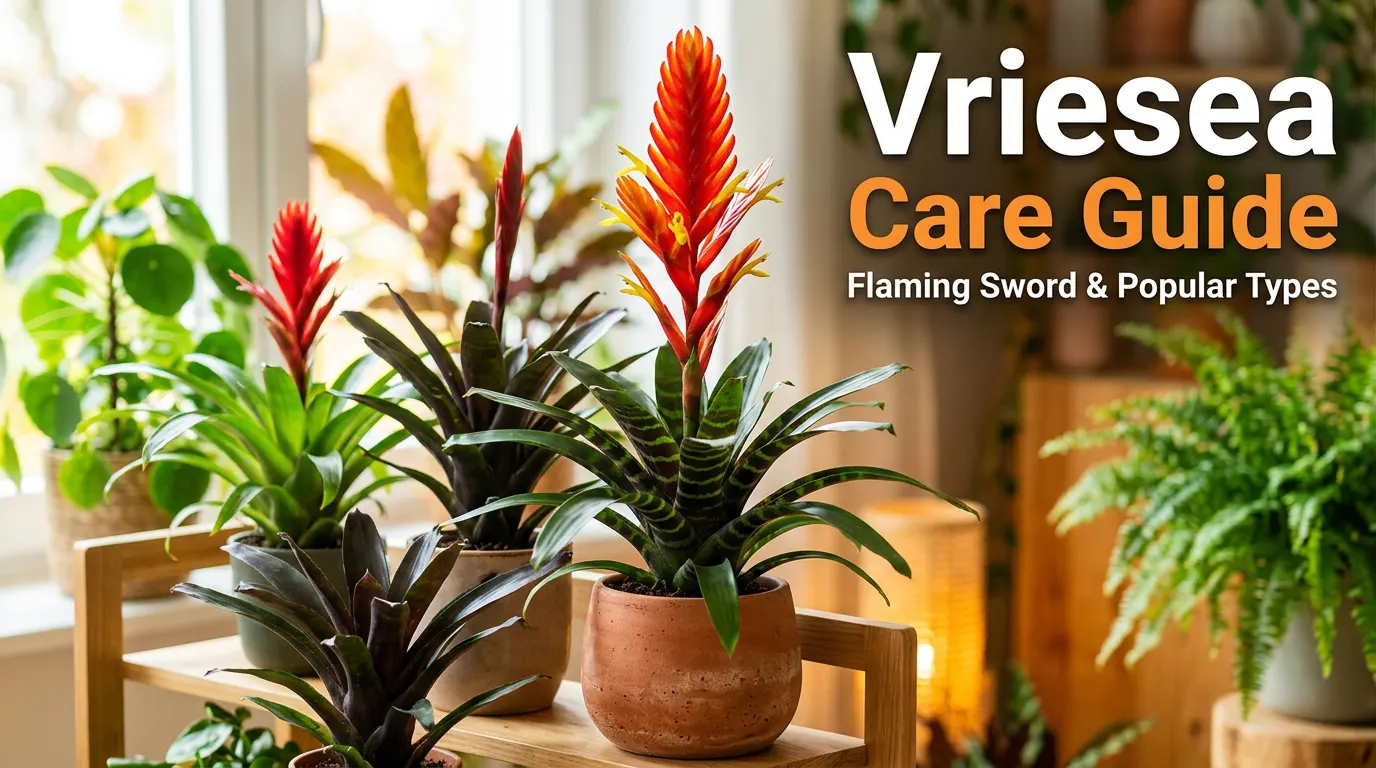
Give the mother steady light and a little weak fertiliser after the bract fades, then look at the base. When a pup reaches one-third to one-half the mother’s size, you can separate it with a clean knife. The full method is in our bromeliad pups guide. Compare this life cycle with the Vriesea care guide, since the two genera behave in a very similar way.

Guzmania care in India: summer, monsoon and winter
Guzmania can work indoors across India, but the seasons need small adjustments. We could not find Indian trial data for Guzmania, so the notes below apply the sources above to local conditions. Treat them as guidance, not proven results.
- Summer: Heat above about 35 °C slows growth, according to the trade article. Keep the plant in bright shade, away from west-facing glass, and refresh the cup often.
- Monsoon: Humidity is high, so water the mix less and keep air moving. Stagnant cups can breed mosquitoes, as covered in our bromeliad mosquito section. Rot is the main risk.
- Winter: Mumbai and Nashik rooms stay mild. In north India, keep the plant off cold sills and away from heater blasts, which dry the air and may brown the tips.
- Water: Hard or alkaline tap water can cause leaf marks, as noted above. Rainwater or filtered water is a practical swap.
For regional planning, see our bromeliad climate in India guide. If you are buying, where to buy bromeliads online in India compares sellers, and bromeliad price in India shows realistic rupee costs. Pick plants with a firm centre, since couriers can bruise the crown. A quick Hinglish reminder: “guzmania ko tez dhoop nahi, halki roshni aur saaf paani chahiye.”
Guzmania, Vriesea and Aechmea: how do they differ?
| Feature | Guzmania | Vriesea | Aechmea fasciata |
|---|---|---|---|
| Subfamily | Tillandsioideae | Tillandsioideae | Bromelioideae |
| Leaves | Smooth, spineless, glossy | Smooth, spineless | Stiff, banded, spiny edges |
| Typical light | Part shade, filtered | Bright filtered | Brighter, still indirect |
| Cold in the FCBS survey | Mixed at 26–28 °F | Mixed; two 32 °F entries | Cold-sensitive at 32 °F |
See the Vriesea care guide and the Aechmea fasciata care guide for full details of the other two. The subfamily row follows standard bromeliad taxonomy, and the light row is a general rule of thumb, not a measured value.
Is Guzmania safe for cats and dogs?
The ASPCA lists Guzmania lingulata var. minor (orange star) as non-toxic to dogs, cats and horses. That is reassuring, but it covers a specific form, not every hybrid on sale. Any plant can cause mild stomach upset if a pet eats a lot of it, and the cup water may be stagnant. For a wider genus-by-genus view, read are bromeliads toxic to cats and dogs. This is general information, not veterinary advice; contact your vet if a pet seems unwell.
Frequently asked questions
How do I care for a Guzmania plant?
Give it bright filtered light, a little fresh water in the cup, a lightly moist airy mix and warmth above 15 °C. Flush the cup regularly and use clean water.
How often should I water a Guzmania?
Keep the mix lightly moist and top up the cup with fresh water. Never let the plant dry out completely, and avoid soggy mix.
What are the common Guzmania problems?
The usual problems are brown tips from dry air or poor water, crown rot from excess cup water, scale and mealybugs, and a bract that fades with age.
Why are my Guzmania leaf tips turning brown?
Low humidity, uneven watering, salt build-up and tap-water chemicals are the main suspects. Raise humidity and switch to rain or filtered water.
How long does a Guzmania flower last?
The coloured bract head lasts roughly two to four months. The tiny true flowers inside each last about a day.
Does a Guzmania die after it flowers?
The flowered rosette slowly declines over one to two years. It usually leaves pups that grow into new plants.
Can Guzmania grow in low light?
It tolerates shade and grows under artificial light, but very dim rooms give soft, dark, slow growth. Bright filtered light is better.
Is Guzmania toxic to cats and dogs?
The ASPCA lists Guzmania lingulata var. minor as non-toxic to dogs, cats and horses. Keep an eye on pets that chew plants, though.
Can I grow Guzmania outdoors in India?
In warm, frost-free areas it can sit in bright shade, such as under a covered balcony. Avoid direct summer sun and heavy monsoon rain in the cup.
References
- Royal Horticultural Society: Guzmania lingulata
- NC State Extension Plant Toolbox: Guzmania lingulata
- ASPCA: Orange Star (Guzmania lingulata minor)
- Kew species data: Guzmania lingulata taxonomic record
- Greenhouse Management: Guzmania production (trade source)
- Florida Council of Bromeliad Societies: Cold sensitivity of bromeliads
- UF/IFAS: Bromeliads (EP337)
- University of Missouri Extension: Bromeliads, houseplants that endure
- Iowa State University Extension: Brown leaf tips and edges on houseplants
- US Plant Patent PP12124: Guzmania ‘Tempo’
- Secondary sources: Wikipedia: Guzmania, bromeliads.info Guzmania page (hobbyist), bromeliads.info troubleshooting (hobbyist)
Related Guides
- Types of Bromeliads: Guzmania, Neoregelia, Aechmea & More
- Bromeliad Pups: How to Separate, Plant and Propagate Them
- Vriesea Care Guide: Flaming Sword and Other Popular Types
- Bromeliad Flowering Guide
- Bromeliad Problems: Yellow Leaves, Root Rot & Common Issues
- Bromeliad Care: The Complete Guide to Growing Them Indoors
- Can Bromeliads Grow Outside? Sun, Shade and Planting in the Ground
- How to Identify a Bromeliad: Leaves, Cups, Flowers and Look-Alikes
- Aechmea Fasciata (Silver Vase) Care: Light, Water and Blooms



Leave a Reply