
Gardening & Plants
“Bromeliad” isn’t one plant, it’s a family of a few thousand species, and the handful sold as houseplants look different enough from each other that people are often surprised they’re related at all. I’ve had a Guzmania and a Neoregelia sitting six inches apart on the same shelf, watered exactly the same way, and had one guest ask if they were even in the same plant family. They are. I covered the general watering-and-care rules in my bromeliad care guide; this is the plant-spotting guide for figuring out which one you actually have, since a few of them need slightly different treatment than the “water the cup” default, and knowing the genus also tells you roughly how big it’ll get, how it’ll flower, and how forgiving it is of a mistake or two.
Quick answer
The bromeliads most commonly sold as houseplants fall into seven groups you’re likely to run into: Guzmania (smooth green leaves, tall upright colored bract), Neoregelia (color comes from the foliage itself, not a tall bract), Aechmea (stiffer, sometimes spiny leaves, a bold architectural flower spike), Vriesea (flat, sword- or “flame”-shaped bracts, often patterned leaves), Tillandsia (air plants, no soil, no central cup, watered by misting or soaking), Alcantarea (the giants of the group, sometimes several feet across), and “matchstick” bromeliads (a nickname, not a genus, for thin red-tipped spike varieties usually within Guzmania or Vriesea). Identify yours by checking, in order: does it have a central water-holding cup and soil-grown roots, or none at all (that alone separates Tillandsia from everything else); then look at the bract shape and leaf texture to narrow it down further. Every genus except Tillandsia follows the same core cup-and-soil care described in the main bromeliad care guide.

Guzmania
Guzmania is the one you’re most likely to see at a grocery store or garden center, and it’s usually the plant people mean when they say “bromeliad” without knowing there’s a whole family behind the name. It has smooth, strappy, glossy green leaves with no spines or serration along the edges, genuinely pleasant to handle, which is part of why it’s such a common gift plant, and a tall, upright colored bract rising from the center, most often red, orange, or yellow, though pink and bicolor cultivars show up too. The true flowers are small, usually white or pale, and tucked among the bracts rather than being the showy part at all; the bract itself is modified leaf tissue, not a petal, which is why it holds its color for months instead of the days or weeks a typical flower would last.
It’s the classic “gift bromeliad,” and its care matches the general guide almost exactly: bright indirect light, water kept in the central cup, a well-draining bark-and-perlite mix. Guzmania is on the softer, more shade-tolerant end of the common genera; its thinner leaf tissue scorches more readily in direct sun than the thicker, silvery-scaled leaves of Aechmea or Alcantarea, so if you’re placing one near a bright south- or west-facing window, keep it a few feet back rather than right on the sill. A Guzmania rosette usually stays compact, in the range of a foot or so across at maturity, which is part of why it works so well as tabletop or shelf décor rather than needing floor space.
Neoregelia
Neoregelia flips the usual bromeliad display logic; it’s grown for its foliage rather than a tall bract. The leaves themselves flush red, pink, purple, or even near-black toward the center, especially under bright light, while the actual flowers are small, sit low in the cup, and are honestly easy to miss entirely if you’re not looking for them. Neoregelia tends to form a flatter, wider rosette than Guzmania, often almost saucer-shaped, and the color display is really a light response more than anything else: strong, bright light triggers the center leaves to flush color as the plant approaches bloom size, while a Neoregelia kept in a dim corner will often stay mostly green and never develop the coloring it’s sold for. If yours arrived vividly colored and has been fading toward plain green since you brought it home, low light is almost always the reason, not a disease or nutrient problem.
Leaf edges on many Neoregelia cultivars are finely serrated, not sharp enough to be a real hazard, but noticeable if you run a finger along one, which is a useful identifying feature if you’re trying to distinguish a Neoregelia from a similarly colored Guzmania cultivar. Because the rosette sits low and wide and the cup is correspondingly broad and shallow, Neoregelia tends to need a bit more frequent cup-flushing than a tall, narrow Guzmania cup of the same volume, simply because a wide shallow pool of standing water picks up dust and debris faster than a deep narrow one.

Aechmea
Aechmea often has stiffer, sometimes spiny-edged leaves and a bold, architectural bract; the “urn plant” (Aechmea fasciata), with its pink, spiky flower spike and mottled silvery-gray banding across the leaves, is the most common houseplant species and the one most people picture when they hear the genus name. That silvery banding is made up of tiny scales called trichomes, which many bromeliads use to absorb water and nutrients directly through the leaf surface, a useful thing to know because it means you generally shouldn’t wipe an Aechmea’s leaves down with a damp cloth the way you might a pothos or a rubber plant, since scrubbing off the trichome layer removes part of how the plant actually feeds itself.
Aechmea is a bit more tolerant of drier air and brighter light than Guzmania, and its rosette tends to be larger and more upright, often reaching a foot and a half to two feet across at maturity. The leaf-edge spines on Aechmea fasciata and several related species are genuinely sharp enough to catch on clothing or scratch skin, so it’s worth handling repotting and pup separation with a bit more care, and a bit more caution around pets or small children, than you’d need with a smooth-leaved Guzmania. The bract itself, unusually for the family, actually turns from pink to a deeper rose or red as it ages rather than simply fading, which sometimes gets mistaken for the plant reblooming when it’s really just the same bract continuing its natural color progression.
Vriesea
Vriesea is known for flat, sword-shaped, often flame-like flower spikes; the “flaming sword” plant is a Vriesea, and the name comes from exactly what it sounds like: a tall, flattened, brightly colored spike that genuinely resembles a blade or a lick of fire rising from the rosette. Many Vriesea cultivars also carry attractively banded, mottled, or striped foliage even when not in bloom, which makes them worth keeping for the leaves alone. It prefers slightly more humidity and softer light than Guzmania or Aechmea; direct sun tends to bleach the leaf patterning and can scorch the flatter bract surface more visibly than it would a rounder Guzmania bract, since there’s more flat surface area facing the light at once.
Because Vriesea leans toward the shadier, more humid end of what common bromeliads tolerate, it’s a genus that does noticeably better in a bathroom with a bright window, a kitchen with some ambient steam, or inside a terrarium than out in a dry, sunny living room. If your home runs on the dry side and you’ve been drawn to a Vriesea for its foliage pattern, a Neoregelia or Guzmania cultivar with similar coloring will generally tolerate typical indoor conditions with less fuss.

Tillandsia (air plants)
Tillandsia is the odd one out, and worth calling out specifically since a lot of people don’t realize air plants are bromeliads at all. Tillandsia has no central water-holding cup and often very reduced or no soil-anchoring roots, it absorbs water and nutrients almost entirely through specialized cells on its leaves called trichomes, the same structures that give many Tillandsia species their silvery, fuzzy-looking coating. That coating isn’t just decorative: it’s what lets some Tillandsia species survive in genuinely dry, bright habitats where a cup-forming bromeliad would struggle, and it’s also why heavily “fuzzy” silver species (sometimes called xeric types) generally want brighter light and less frequent watering than smoother, greener Tillandsia species (mesic types), which come from more humid forest environments in the wild.
Because there’s no cup, the “fill the cup” watering rule from the main care guide doesn’t apply here at all, air plants are watered by misting or a brief full submersion soak, roughly 20 to 30 minutes, once or twice a week depending on your home’s humidity and the specific species, then shaken out firmly to remove pooled water and set somewhere with good airflow to dry upside down or on its side. Water sitting trapped in the base of a Tillandsia’s leaves after a soak is the single most common way people accidentally rot one, the plant doesn’t have a cup built to hold standing water the way a Guzmania or Aechmea does, so leaving it wet at the base for hours is a real risk rather than a minor inconvenience. They’re also the bromeliads most commonly used loose in terrariums, mounted on wood, glued into wreaths, or displayed without any pot or mount at all, since their minimal root system means they genuinely don’t need anything to grow in.
If you’re specifically interested in growing bromeliads inside glass, Tillandsia is usually the easiest starting point precisely because it skips the soil-drainage questions that come up with cup-forming genera in an enclosed space, I’ve written a full rundown of good options in best bromeliads for terrariums, and a broader look at humidity, airflow, and setup considerations in my bromeliads in a terrarium guide.

Alcantarea
Alcantarea is the giant of the group; rosettes can grow several feet across at full maturity, often in silvery, bronze, or burgundy tones, and are usually grown as dramatic standalone specimen plants rather than small tabletop décor. This is the genus you’re most likely to see used as a centerpiece plant in a hotel lobby, a large sunroom, or an outdoor tropical garden bed in warm climates, rather than tucked on a windowsill. They follow the same basic cup-and-soil care as Guzmania and Aechmea, just at a much larger scale, the central cup on a mature Alcantarea can hold a genuinely large volume of water, which also means it takes correspondingly longer to run dry and needs a bit more attention to flushing on a regular schedule so that volume of standing water doesn’t stagnate.
Because of their size, Alcantarea typically need more root space and a sturdier, heavier pot than the smaller genera; a large, top-heavy rosette in a lightweight plastic pot is genuinely prone to tipping over, so a wide, weighted terracotta or ceramic container is worth the extra cost. It’s also worth knowing before you buy one small: a young Alcantarea pup can look deceptively similar to a young Guzmania or Aechmea pup, and the size difference only becomes obvious after a couple of years of growth, so if a nursery tag doesn’t specify the genus and you want something that’ll stay compact, it’s worth asking rather than assuming.
“Matchstick” bromeliad
The “matchstick” bromeliad isn’t a genus of its own; it’s a common name, usually applied to a Guzmania or Vriesea variety, for the type with thin, needle-like, red-tipped spikes that resemble a bundle of matchsticks bundled upright in the center of the rosette. It’s a nickname sold at the point of purchase far more than a botanical classification, which is why you’ll sometimes see the exact same plant labeled “matchstick bromeliad” at one nursery and by its actual cultivar name at another. Same general care as the parent genus applies once you know which one it actually is; it’s mostly sold under this nickname for how distinctive and photogenic the bract shape is rather than any real difference in how it’s grown, watered, or fed. If a plant tagged “matchstick” has smooth green leaves and a soft texture, treat it like a Guzmania; if the leaves feel stiffer or show any banding or mottling, treat it more like a Vriesea and give it slightly softer light.
Comparing the common types at a glance
| Genus | Grown mainly for | Typical size | Light preference | Watering notes |
|---|---|---|---|---|
| Guzmania | Tall upright colored bract | Compact, ~1 ft across | Bright indirect, tolerates lower light | Standard cup-and-soil care |
| Neoregelia | Colorful center foliage | Flat, wide rosette | Bright light for best color | Wide shallow cup, flush a bit more often |
| Aechmea | Bold architectural flower spike | Larger, upright | Tolerates brighter light, drier air | Standard care; avoid wiping leaf trichomes off |
| Vriesea | Flat “flaming sword” spike, patterned leaves | Medium, upright | Softer light, more humidity | Standard care; leaf pattern bleaches in direct sun |
| Tillandsia | Sculptural foliage, no soil needed | Small, varies widely | Varies by species (xeric vs. mesic) | Misting or soak-and-dry; no cup at all |
| Alcantarea | Dramatic large specimen rosette | Large, up to several feet | Bright light | Standard care at larger scale; heavier pot needed |
| “Matchstick” | Thin red-tipped spike bracts | Varies (nickname, not a genus) | Depends on the actual parent genus | Depends on the actual parent genus |
Does the type affect how it flowers and produces pups?
Not in any way that changes the fundamentals; every genus covered here, Tillandsia included, follows the same one-bloom-then-pups lifecycle described in the main bromeliad care guide. What does vary by genus is the timeline and the display: a Guzmania or Neoregelia pup might reach flowering size in a couple of years under decent light, while a slower-growing Alcantarea can take considerably longer simply because it has so much more rosette to build before it’s mature enough to bloom. Tillandsia species also vary widely among themselves; some flower and pup within a year or two, others take considerably longer, which is more about the individual species than anything specific to being an air plant.
Frequently asked questions
How do I know which type of bromeliad I have?
Start with whether it has a visible central cup and soil-grown roots (Guzmania, Neoregelia, Aechmea, Vriesea, Alcantarea) or no cup and minimal roots (Tillandsia/air plant). From there, bract shape and leaf texture are the fastest way to narrow it down: a tall upright bract points to Guzmania, a flat sword-shaped one to Vriesea, a bold spiky architectural spike with banded silvery leaves to Aechmea, colorful foliage with the flower tucked low in the center to Neoregelia, and an oversized rosette several feet across to Alcantarea.
Do all bromeliad types only flower once?
Yes, the one-bloom-then-pups lifecycle covered in the main care guide applies across every genus here, air plants included. The bract or flower spike lasts a long time, sometimes months, but the individual rosette doesn’t rebloom; it’s replaced by the pups it produces at its base before it declines.
Which bromeliad type is easiest for a beginner?
Guzmania is generally the most forgiving of the cup-and-soil types, it tolerates a range of indirect light levels and doesn’t have the sharp leaf edges of Aechmea or the higher humidity preference of Vriesea. Among air plants, smoother, greener mesic-type Tillandsia species are typically easier for a first-timer than heavily silver, fuzzy xeric species, which need brighter light and a different watering rhythm to thrive.
Why does my Neoregelia have green leaves instead of the red color it had when I bought it?
Almost always insufficient light. Neoregelia’s center-leaf coloring is a direct response to bright light, and a plant moved from a nursery greenhouse into a dimmer home will gradually lose that flush of color over the following weeks as new leaves grow in plainer green. Moving it somewhere brighter, more direct light than you’d give a Guzmania is the fix, though existing leaves generally won’t regain color; you’re waiting for new growth to come in richer.
Are air plants really bromeliads, or just a separate category sold near them?
They’re genuinely bromeliads; Tillandsia is a real genus within the Bromeliaceae family, just one that evolved without the water-holding cup and soil-anchoring roots that define the more familiar potted types. The care looks completely different, but botanically it’s the same family as Guzmania and Aechmea.
Can I tell a plant’s genus just from the color of its bract?
Not reliably on its own; red, orange, pink, and yellow bracts show up across several genera, so color alone isn’t a safe identifier. Shape is more diagnostic: a tall upright spike (Guzmania), a flat blade-like spike (Vriesea), and a spiky, rounded architectural head (Aechmea) look distinct enough from each other that combining shape with leaf texture will get you a confident identification almost every time.
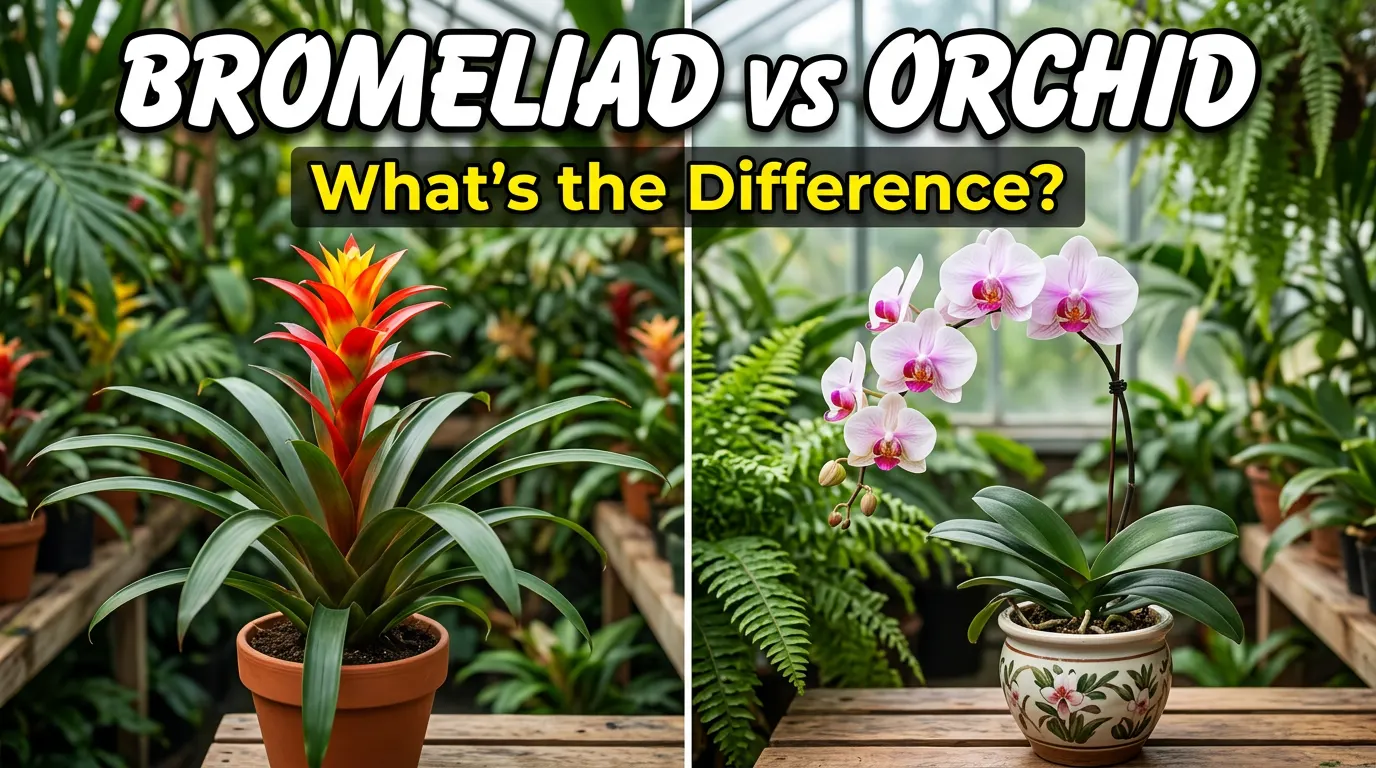
Whatever type you’ve got, the core care principles are the same across everything except Tillandsia; see the full bromeliad care guide for watering, light, and what to do once it flowers. If you’re comparing a bromeliad against another common gift plant, my bromeliad vs. orchid guide covers how their care actually differs, and if you’re weighing whether to grow yours mounted rather than potted, see how to mount a bromeliad on wood.





Leave a Reply