BROMELIAD GUIDE · UPDATED OCTOBER 2026
By Everydaything Team · Last updated October 2026
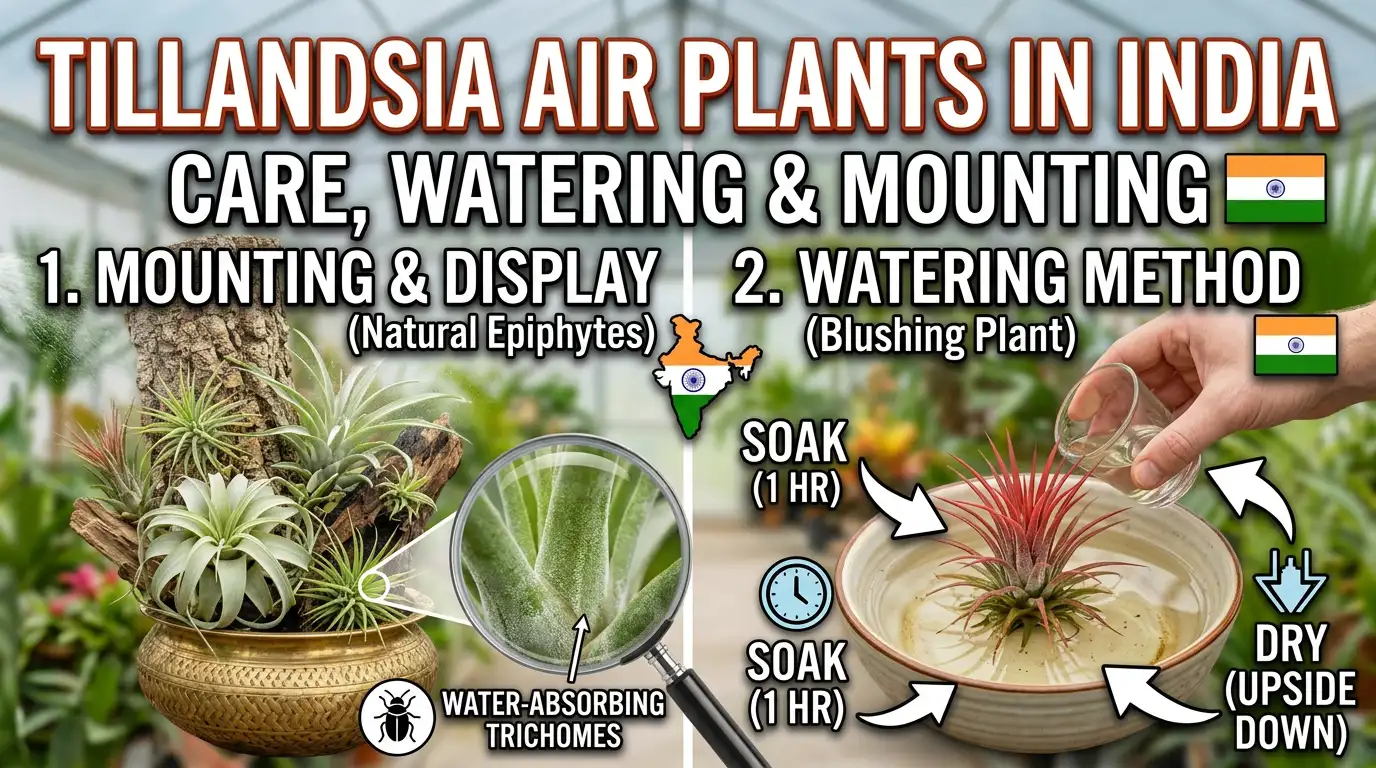
Air plants (Tillandsia) are bromeliads: the genus has roughly 650 species in the pineapple family, and most grow on trees or rocks without soil. They take in water and nutrients through scales on their leaves, so good care in India comes down to a proper soak or mist, bright indirect light and quick drying.
This guide focuses on what changes for Indian homes: humid monsoons, dry air-conditioned rooms, hard tap water and summer heat. If you want the wider family picture first, our guide to types of bromeliads places Tillandsia among its relatives.
Quick facts: Tillandsia air plants
| Topic | What the sources say |
|---|---|
| Family and size | Bromeliaceae; about 650 species, 635 of them epiphytes (Wikipedia). A Missouri Botanical Garden factsheet says over 400 species |
| How they drink | Leaf scales (trichomes) absorb water; roots mainly anchor |
| Light | Bright, indirect; east or west window preferred (Penn State) |
| Watering | Weekly soak of 20 minutes to an hour, or thorough misting; dry within about four hours |
| Feeding | Bromeliad fertiliser at quarter strength, about monthly (Clemson) |
| Flowering | Once per plant, then pups |
| Typical Fish Bazaar listing price | Rs 400 to Rs 600 per plant (checked 4 October 2026) |

Is Tillandsia a bromeliad?
Yes. Tillandsia belongs to Bromeliaceae, the same family as the pineapple, Neoregelia and Aechmea. Wikipedia describes the genus as native from northern Mexico and the south-eastern United States through the Caribbean to central Argentina, and notes that most species photosynthesise with the CAM cycle, opening their stomata at night.
That night-time habit is why the bromeliad-focused site bromeliads.info recommends watering in the morning rather than the evening. For a seller-side comparison of air plants and rosette bromeliads in glass, see Fish Bazaar’s air plants vs bromeliads guide.
How do air plants absorb water without roots?
They absorb it through trichomes, tiny scales on the leaf surface. Wikipedia says these cells rapidly absorb water that collects on them and take in nutrients from dust and debris, while any roots are mainly a stabilising anchor. Most Tillandsia are epiphytes; our guide to epiphytic vs terrestrial bromeliads explains the difference.
Penn State Extension adds a useful distinction: dense, fuzzy, silvery trichomes mark dry-habitat (xeric) plants that cope better with arid conditions, while smaller trichomes mark greener, wetter-habitat (mesic) types. Knowing which you own tells you how much soaking it wants.
Should you soak or mist air plants in Indian humidity?
Soak weekly as the baseline, and treat misting as a supplement. Extension guides disagree a little: Clemson suggests weekly misting or a 20 to 30 minute submersion, Penn State lists misting, rinsing and a weekly soak of 20 minutes to an hour, and bromeliads.info warns that misting alone is a misconception.
The New York Botanical Garden’s guide says fuzzy, silver-leaved plants need less soaking while greener tropical types suit 10 to 20 minute soaks, and it prefers distilled water because tap water can overwhelm plants with mineral salts. Whatever you choose, drain well: Clemson suggests shaking out water and turning the plant upside down.
| Indian season or room | Suggested routine (our inference) | Basis |
|---|---|---|
| Pre-monsoon and dry air-conditioned rooms (March to May) | Weekly soak, plus a light mist between if leaves start to curl | Penn State advises misting every other day in low household humidity |
| Monsoon (June to September) | Soak less often or rinse only; add airflow with a fan | Plants must dry out or they can suffocate and rot (bromeliads.info) |
| Winter (October to February) | Weekly soak; keep away from heaters and vents | BSI says mist more often in dry winters; Penn State warns about vents |
The India Meteorological Department defines the southwest monsoon as June to September. Humid air slows drying, so the sources’ four-hour drying rule matters most in those months.
How long should an air plant dry after watering?
At least four hours before it goes back into a terrarium or enclosed holder, according to Penn State, and ideally with moving air. If water pools between the leaves, tip the plant upside down and let it drain. Never leave a plant sitting wet in a dish overnight.
How much light do air plants need?
Bright, indirect light, with an east or west window as the usual best choice. Penn State says south windows work from autumn to spring but can overheat plants in summer, and that north windows and interior rooms are unsuitable. UF/IFAS also lists south, east and west windows, and warns against direct sun.
The NYBG notes that dry-climate silver types handle strong sun better than tropical green ones, and that under artificial light they need about 12 hours a day with the light no more than two feet away. For lux figures and Indian window directions, see our guide to bromeliad indirect light, which covers the bromeliad family as a whole.
What can you mount air plants on?
Anything rough that dries quickly: cork bark, driftwood, rock, shells or pebbles. UF/IFAS lists shells, cork, bark and pebbles, secured with liquid nails, hot glue or wire, and stresses that the surface must not hold water. Clemson adds that fishing line or thin wire works for hanging.
| Use | Avoid |
|---|---|
| Cork bark, driftwood, rock, shells, pebbles | Soil or any surface that stays wet (NYBG) |
| Waterproof glue, wire, staples, fishing line | Copper-containing materials (bromeliads.info) |
| Open glass holders with airflow | Fertilisers with boron, copper or zinc (NYBG) |
We cover mounting rosette-type bromeliads in how to mount a bromeliad on wood, so we do not repeat those steps here. Bromeliads.info adds that Tillandsia roots can be trimmed if needed, but living tissue should never be damaged.

Can air plants live in a terrarium?
Yes, in open or well-ventilated ones, but not sealed jars. Bromeliads.info says air plants in a terrarium need sufficient airflow, and the NYBG says glass orbs must have openings. Penn State advises drying plants for at least four hours before returning them to a terrarium.
For a living display, place air plants on wood or rock above the substrate and keep closed-jar humidity for rosette bromeliads. Our bromeliads in a terrarium guide and build guide show the layering, and the vivarium bromeliads guide covers upper-level placement.
What are the most common air plant mistakes?
- Soaking without drying: trapped moisture in the centre leads to rot (Clemson, Penn State).
- Sealed containers: no airflow means suffocation and rot.
- Misting only: bromeliads.info says this will not give enough water over time, although UF/IFAS recommends thorough misting to the point of runoff. Do it generously or soak instead.
- Evening watering: bromeliads.info recommends mornings because the plants open stomata at night.
- Copper and wet mounts: avoid both, as above.
- Air-conditioner and heater vents: Penn State warns that they dry plants out fast.
- Ignoring curled leaves: Clemson says curled or rolled leaves signal too little water.
- Hard tap water: the NYBG warns that tap water can overwhelm plants with mineral salts over time; use rainwater or filtered water if yours is hard.
How much do air plants cost in India?
At Fish Bazaar, the 10 Tillandsia listings were priced at Rs 400 to Rs 600 per plant when we checked on 4 October 2026, with common ionantha types at the low end. For context, myBageecha listed 39 bromeliads between Rs 275 and Rs 750 in October 2026, with only one of them a Tillandsia. For a wider look at sellers, see our guide to where to buy bromeliads online in India.
| Listing price (per plant) | Examples at Fish Bazaar |
|---|---|
| Rs 400 | Tillandsia ionantha, ionantha ‘Bravo’, funkiana, ionantha var. vanhyningii |
| Rs 500 | stricta, ‘Funky One’, ‘Sweet Isabel’ |
| Rs 600 | capitata ‘Domingensis’, stricta ‘Silver’, brachycaulos multiflora |
Disclosure: Fish Bazaar is operated by the same team that publishes this site, and you can browse its Tillandsia air plants collection. Live plants there are non-returnable, so report damage on arrival, and shipping is a flat Rs 100 across India, free above Rs 499 as of October 2026. Prices and policies change, so check before ordering. When comparing sellers, ask whether plants are nursery-grown: Tillandsia xerographica, for example, is on CITES Appendix II, which regulates trade.
Do air plants flower, and are they safe?
Each plant flowers once, then the parent slowly declines while pups form at its base. Clemson says small flowers form in late winter and mid-summer in US conditions, so timing will differ in India; our guide to how bromeliads flower covers the bloom cycle and pups.
On safety, the ASPCA lists Neoregelia as non-toxic to dogs and cats, but we did not find a Tillandsia entry, so treat that as unconfirmed. Small plants, glue and wire are also a swallowing and choking risk, so keep them away from pets and young children.
Frequently asked questions
Is Tillandsia a bromeliad?
Yes. Tillandsia is a genus of about 650 species in the bromeliad family, Bromeliaceae, and most are epiphytes.
How often should I water air plants in India?
A weekly soak is the usual baseline. Extension guides suggest 20 minutes to an hour, with less time for fuzzy silver types, and more frequent misting in very dry rooms.
Is it better to soak or mist air plants?
Soaking is more reliable, and misting works as a supplement in dry air. Bromeliads.info says misting alone is not enough water.
How long should air plants dry after watering?
At least four hours, with airflow, before returning them to a terrarium or enclosed holder.
What is the best window for air plants?
East or west, with bright indirect light. South windows can overheat plants in summer and north windows are usually too dim.
Can air plants live in a closed terrarium?
No. They need airflow to dry between waterings, so use open or well-ventilated displays.
What should I mount air plants on?
Cork bark, driftwood, rock or shells, held with waterproof glue or wire. Avoid copper and anything that stays wet.
Why are my air plant’s leaves curling?
Curled or rolled leaves usually mean the plant needs water. Soak it, then drain and dry it properly.
How much do air plants cost in India?
At Fish Bazaar’s listings, Rs 400 to Rs 600 per plant as of 4 October 2026. Other sellers vary, so compare size, quality and whether plants are nursery-grown.
This article is general horticultural information, not veterinary or medical advice. If a pet or child swallows a plant or adhesive, contact a vet or doctor.
References
- Penn State Extension, Tillandsias as houseplants
- Clemson Home and Garden Information Center, Air plants
- UF/IFAS Gardening Solutions, Air plant: Tillandsia
- New York Botanical Garden, Air plant (Tillandsia) research guide
- Bromeliads.info, Exploring the Tillandsia bromeliad
- Bromeliad Society International, Frequently asked questions
- Missouri Botanical Garden, Bromeliad care and culture
- Wikipedia, Tillandsia and Tillandsia xerographica
- ASPCA, Neoregelia toxicity
- India Meteorological Department, Monsoon press release (2023)
- myBageecha, Bromeliads collection
Related Guides
- How to Mount a Bromeliad on Wood (Epiphytic Display)
- Bromeliads in a Terrarium: The Complete Guide
- Fish Bazaar: Air plants vs bromeliads for terrariums
- Where to Buy Bromeliads Online in India
- Growing Bromeliads in India: Climate, Regions & Seasons
- Bromeliad Price in India
- Bromeliad Light Requirements: Indirect Light Explained
- How Do Bromeliads Flower? Spikes, Timing & Reblooming
- Epiphytic vs Terrestrial Bromeliads





Leave a Reply