BROMELIAD GUIDE · UPDATED OCTOBER 2026
By Everydaything Team · Last updated October 2026
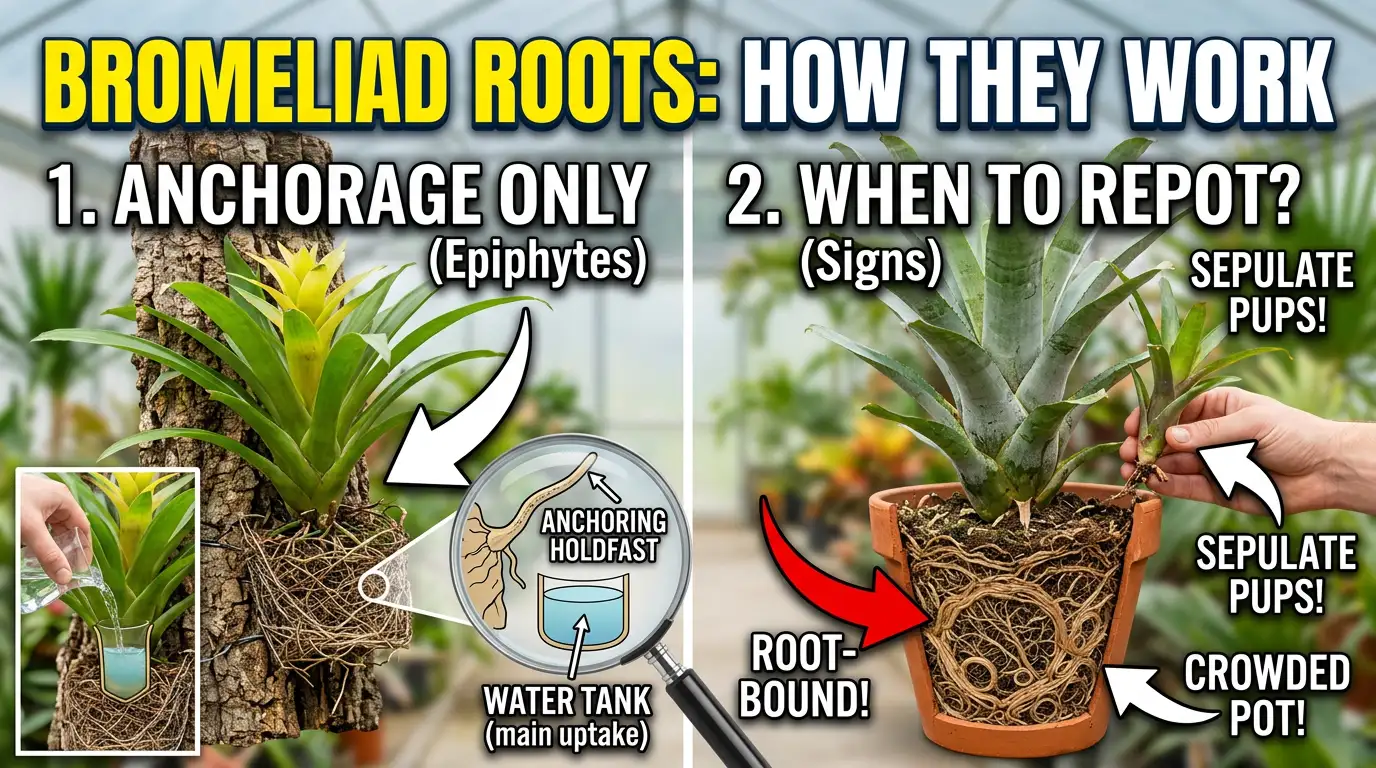
Bromeliad root systems are small, and in epiphytic types they mainly anchor the plant while the leaves and central tank do most of the absorbing. Newer research shows roots matter more than once believed, especially in young plants and for nitrogen. Most bromeliads rarely need repotting, so the safest rule is to repot only when there is a clear reason.
Quick facts: bromeliad root systems at a glance
| Question | Short answer |
|---|---|
| Main job of the roots | Anchorage, especially in epiphytic types; some uptake in juveniles and for nitrogen |
| Main route for water and minerals | Leaf surface scales (trichomes) and the central cup, in adult epiphytes |
| Terrestrial types (Cryptanthus, Dyckia, pineapple) | Grow in soil and lean on their roots more |
| Pot size | Small: RHS suggests 7.5 to 12.5 cm pots for bromeliads |
| Biggest root killer | Waterlogged, slow-draining mix |
| Repotting frequency | Rare; most blooming plants never need it |
What do bromeliad roots actually do?
In most bromeliads grown at home, roots are holdfasts. The University of Wisconsin Extension says roots primarily provide anchorage and that, in epiphytes, the uptake of water and nutrients has been taken over by the leaves. Missouri Botanical Garden’s care sheet puts it similarly for rainforest plants: roots mainly hold the plant to a branch.
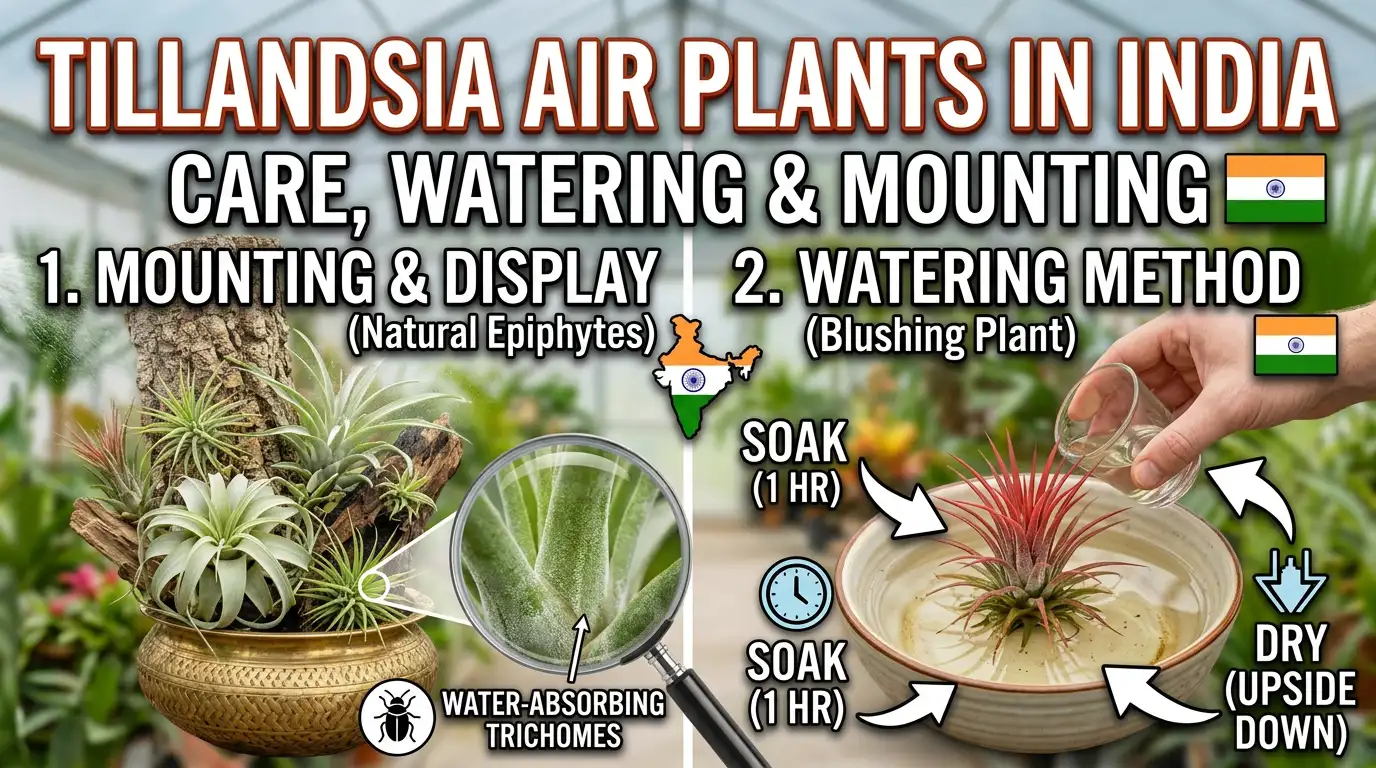
That is why an epiphytic bromeliad can live on bark, a mounted board or a very small pot. The most extreme case is air plants: Tillandsia has around 650 species, about 635 of them epiphytic, and its roots act as a fragile scaffold to grip a surface, while some desert species have almost no roots at all. Our guide to Tillandsia air plants in India shows how to grow these nearly rootless plants at home.
If you mount a plant instead of potting it, our guide on how to mount a bromeliad on wood shows how roots attach without soil.

Do bromeliad roots absorb water and nutrients?
Yes, more than the old textbook line suggests, though the leaves still lead in adult epiphytes. Three studies on the commonly grown silver vase bromeliad (Aechmea fasciata) and relatives sharpen the picture.
- Juveniles rely on roots; adults rely on leaves. A 2024 paper in Annals of Botany by Takahashi and Mercier, covering Vriesea gigantea, Aechmea fasciata and Guzmania lingulata, found that roots in juvenile plants are primary or comparable absorption organs, while leaf trichomes dominate in adults and roots keep a complementary role. Using both together improved growth over either alone (abstract).
- Roots can be better at inorganic nitrogen. Gomes and colleagues (2021, Plant and Soil) applied nitrogen into either the tank or the substrate of A. fasciata and concluded the roots were more efficient for inorganic nitrogen. Leaf trichomes could take up ammonium nitrate from the tank, but higher doses did not raise biomass (paper).
- Nitrogen is the first limit. In a macronutrient-omission experiment, nitrogen limited growth most, followed by phosphorus and potassium, then calcium and magnesium, then sulphur. Nitrogen-starved plants showed yellowing and smaller leaves; phosphorus-starved plants turned reddish (Young et al., 2018).
What this means for you: a healthy root system still pays off, but you do not need to push fertiliser through the pot. Our bromeliad care complete guide covers feeding and watering of the cup.
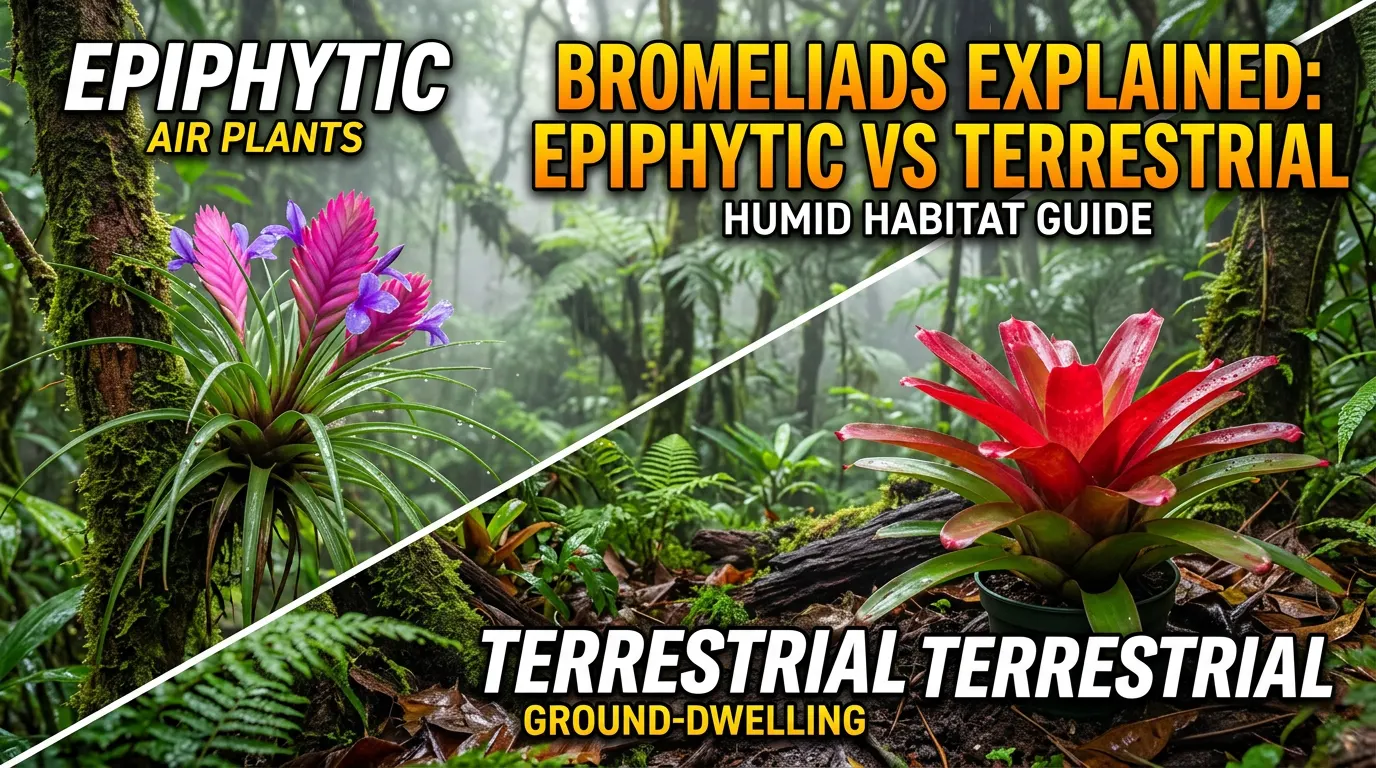
How do roots differ in epiphytic and terrestrial bromeliads?
Epiphytes cling to trees or rocks and treat roots as grips. Terrestrial types grow in soil and depend on their roots more. RHS notes that terrestrial types such as pineapples and Cryptanthus root in soil and need different feeding from epiphytes. Dyckia is a terrestrial genus of rocky, sunny places in Brazil and central South America, so it behaves like a succulent with a firm, soil-gripping root system. For the full habit comparison and humidity needs, read epiphytic vs terrestrial bromeliads and their humid habitat.
| Group | Examples | What roots do | Potting implication |
|---|---|---|---|
| Epiphytic | Tillandsia, many Vriesea, many Aechmea | Mostly anchor; juveniles absorb more | Airy mix or mounting; small pots |
| Terrestrial | Cryptanthus, Dyckia, pineapple | Anchor and take up water from the medium | Gritty, free-draining mix; roots matter more |
| Flexible | Neoregelia | Can grow on trees or in soil | Orchid-type bark mix works |
Gardenia’s Neoregelia profile notes the genus can grow both on trees and in soil, which is one reason it adapts so well to pots. For a deeper habit comparison, see our types of bromeliads guide.
What do healthy and unhealthy bromeliad roots look like?

Healthy roots are firm and hold the pot mix or the mount tightly, while unhealthy roots are soft and discoloured. This is practical horticultural judgement rather than a measured standard, but it is a reliable first check before you do anything drastic.
| Sign | Healthy | Warning |
|---|---|---|
| Feel | Firm, springy | Mushy or hollow |
| Colour | Pale, tan or dark but intact | Black and slimy |
| Smell | Neutral or earthy | Sour or rotten |
| Plant grip | Plant resists a gentle tug | Plant wobbles or lifts out |
| Crown | Leaves tight | Centre leaves pull out easily |
RHS warns that bromeliad roots are prone to rotting in waterlogged conditions, and Clemson’s extension notes that root rot typically follows a slow-draining mix or over-frequent watering. If your plant already shows these warnings, follow the diagnosis steps in our guide to bromeliad yellow leaves and root rot rather than repotting blindly.
When should you repot a bromeliad?
Repot when a non-flowering plant has outgrown its pot, when the mix has broken down and stays soggy, or when you are separating a pup. Bromeliads.info notes that most blooming bromeliads will not need repotting in home cultivation, whereas small, non-flowering ones do when they outgrow the container.
- Outgrown pot: the rosette is wider than the pot rim and the plant tips over.
- Collapsed mix: the medium has turned to sludge and no longer drains.
- Pup separation: Bromeliads.info advises waiting until pups reach about one-third of the mother’s size, then keeping new pups under a plastic cover for three to four weeks while roots establish.
When should you NOT repot a bromeliad?
Do not repot just because a plant looks tired, has few visible roots, or is in bloom. The sources above agree that bromeliad root systems are small, so a modest root ball is normal.
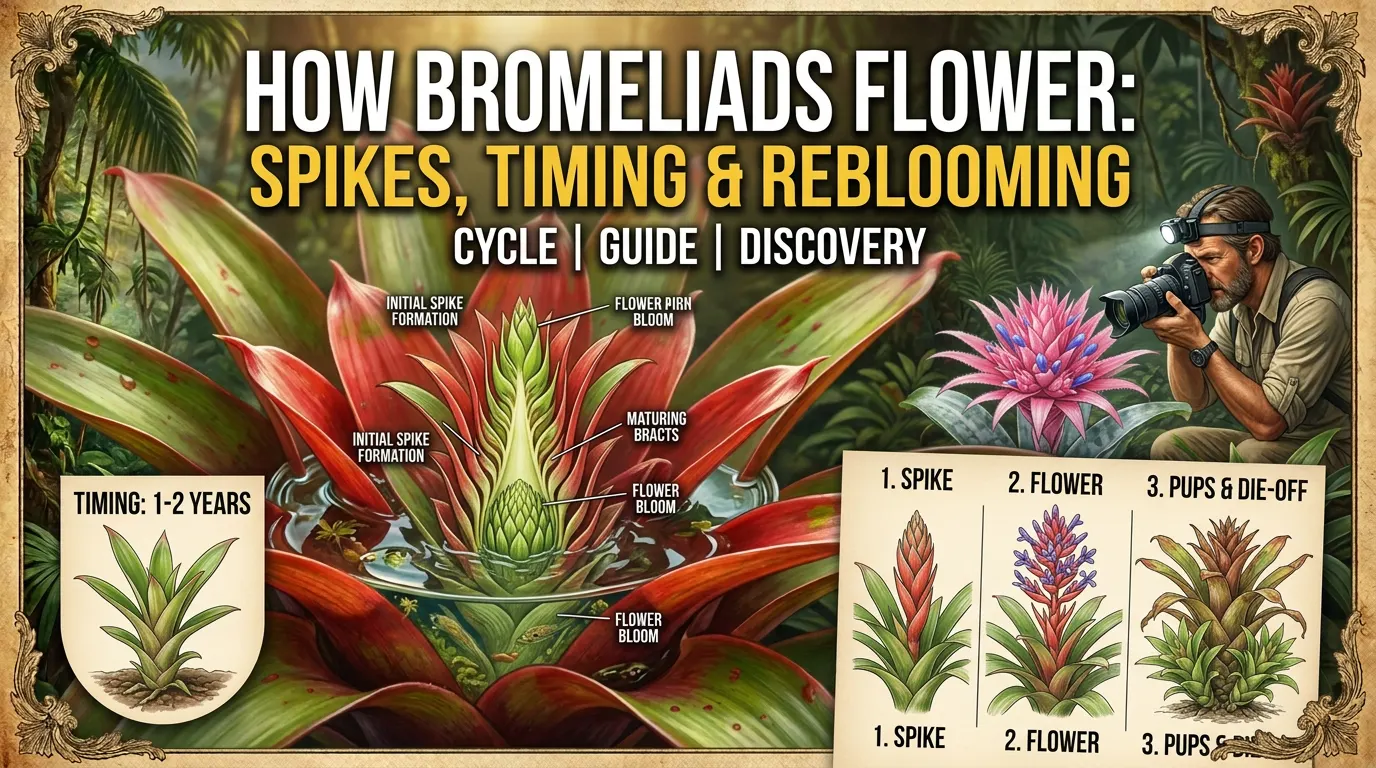
- While it is flowering, unless the pot has failed. Disturbance buys you nothing. Our guide to how bromeliads flower explains the bloom cycle and why the mother plant then produces pups.
- For yellow leaves alone. Check drainage, light and cup water first. Repotting into a bigger pot can make a wet-root problem worse, since RHS warns against overpotting.
- At the peak of heat. A fresh transplant with few active roots is fragile. In most Indian cities, late spring heat and the first heavy monsoon weeks are poor times; this is practical advice, not a figure from a study.
- To “upgrade” the pot. UW Extension advises a pot smaller than you would use for other plants of the same size.
What is the best potting mix for bromeliads in India?
An airy, free-draining mix of chunky bark, a gritty ingredient and a little fibre. RHS recommends equal parts fine composted bark (or orchid compost), grit and coir fibre. UW Extension suggests orchid bark with coarse perlite and humus, and says the mix should be acidic, moisture-retentive and fast-draining, never garden soil.
| Ingredient | Role | India-friendly option |
|---|---|---|
| Orchid or pine bark | Air gaps, mild acidity | Orchid bark from nurseries; coarse grade |
| Perlite or grit | Drainage | Coarse perlite or washed grit |
| Coir fibre or coco chips | Holds moisture without packing down | Coco chips or coir, rinsed well before use |
| Garden soil or clay-heavy potting soil | Not recommended | Avoid |
Coco chips are a practical Indian substitute for the coir in the RHS formula; rinse them well and keep the mix chunky. Pot material matters too: UW Extension says porous clay dries faster, which suits humid climates, while plastic holds moisture longer in dry indoor air. In a monsoon-soaked balcony, terracotta is the safer choice; in an air-conditioned flat, plastic may be fine.
Can plants live without a pot altogether? Often yes; Fish Bazaar’s article on whether bromeliads can live without soil explains the idea in an Indian setting.
How do you repot a bromeliad step by step?
- Water lightly a day before so the plant is not stressed.
- Ease the plant out, keeping as much root as possible. Do not strip healthy roots.
- Trim only black, mushy roots with clean scissors. Bromeliads.info recommends sterilising containers with mild soap or diluted bleach.
- Choose a pot only slightly larger than the root ball. The same source suggests a maximum of six inches.
- Set the plant so all leaves stay above the mix, then firm gently.
- Water into the cup, wait before drenching the mix, and keep in bright shade.
What are air roots and should you cut them?
Air roots are roots that grow above the mix or along a mount, grabbing onto bark, pots or neighbouring plants. In epiphytes they are normal grips, not a sign of trouble. Leave healthy ones alone and tuck them into the mix or a mount if the plant becomes top-heavy. Only remove roots that are dead and dry.

Seasonal root care in Indian conditions
For region-by-region climate guidance, see growing bromeliads in India: climate, regions and seasons. In short:
- Monsoon: prioritise drainage and airflow; empty any standing water in the pot saucer, and keep the cup fresh.
- Summer: shade the pot; dark plastic in direct sun can overheat roots.
- Cooler north Indian winters: cold, wet mix is a rot risk. RHS suggests a winter minimum around 10 C (50 F), so move plants indoors on cold nights.
Seller note: Fish Bazaar, operated by the same team as this site, sells bromeliads in sets of 10, including many Neoregelia and some Cryptanthus earth stars, which suits big projects and shared orders. Live plants are non-returnable, so report damage on arrival. Prices and policies change, so check before ordering.
Frequently asked questions
Do bromeliads need deep pots?
No. Their root systems are small, and RHS suggests pots of about 7.5 to 12.5 cm.
Do bromeliad roots absorb water?
Yes, to a degree. Juveniles rely on roots strongly, while adult epiphytes depend more on leaf trichomes and the cup.
How often should I repot a bromeliad?
Rarely. Most blooming bromeliads do not need repotting; non-flowering ones need it when they outgrow the pot.
What is the best soil for bromeliads?
An airy mix such as equal parts bark, grit and coir, per RHS. Avoid garden soil.
Can I use coco chips for bromeliads?
Coco chips can replace coir fibre in a bark and grit mix. Rinse them and keep the mix chunky and free-draining.
What do healthy bromeliad roots look like?
Firm and gripping. Mushy, black, foul-smelling roots signal rot.
Should I cut air roots?
Not if they are healthy. They are normal grips on epiphytes; trim only dead ones.
Is terracotta or plastic better?
Per UW Extension, clay dries faster and suits humid climates; plastic holds moisture longer in dry indoor air.
When is the best time to repot in India?
Pick mild, settled weather and avoid peak summer heat and heavy monsoon downpours. This is practical guidance rather than a studied figure.
References
- Bromeliads, University of Wisconsin-Madison Extension
- Bromeliad Care and Culture, Missouri Botanical Garden
- How to grow bromeliads, Royal Horticultural Society
- Bromeliads, Clemson Home and Garden Information Center
- Takahashi and Mercier (2024), New insights into the role of the root system of epiphytic bromeliads, Annals of Botany
- Gomes et al. (2021), Nitrogen uptake by ornamental bromeliad: leaf and root efficiency, Plant and Soil
- Young et al. (2018), Silver vase bromeliad: plant growth and mineral nutrition under macronutrients omission, Scientia Horticulturae
- Soil and potting needs for bromeliads, Bromeliads.info
- Bromeliad care and culture overview, Bromeliads.info
- Tillandsia, Wikipedia
- Dyckia, Wikipedia
- Neoregelia, Gardenia.net
Related Guides
- Bromeliad Problems: Yellow Leaves and Root Rot
- Bromeliad Care Complete Guide
- How to Mount a Bromeliad on Wood
- Fish Bazaar: Where to Plant Bromeliads in India
- Where to Buy Bromeliads Online in India
- Growing Bromeliads in India: Climate, Regions and Seasons
- Epiphytic vs Terrestrial Bromeliads and Their Humid Habitat
- Tillandsia Air Plants in India
- Bromeliad Light Requirements
- How Do Bromeliads Flower?
- What Is a Bromeliad? Meaning, Pronunciation and Quick Facts



Leave a Reply