BROMELIAD GUIDE · UPDATED OCTOBER 2026
By Everydaything Team · Last updated October 2026
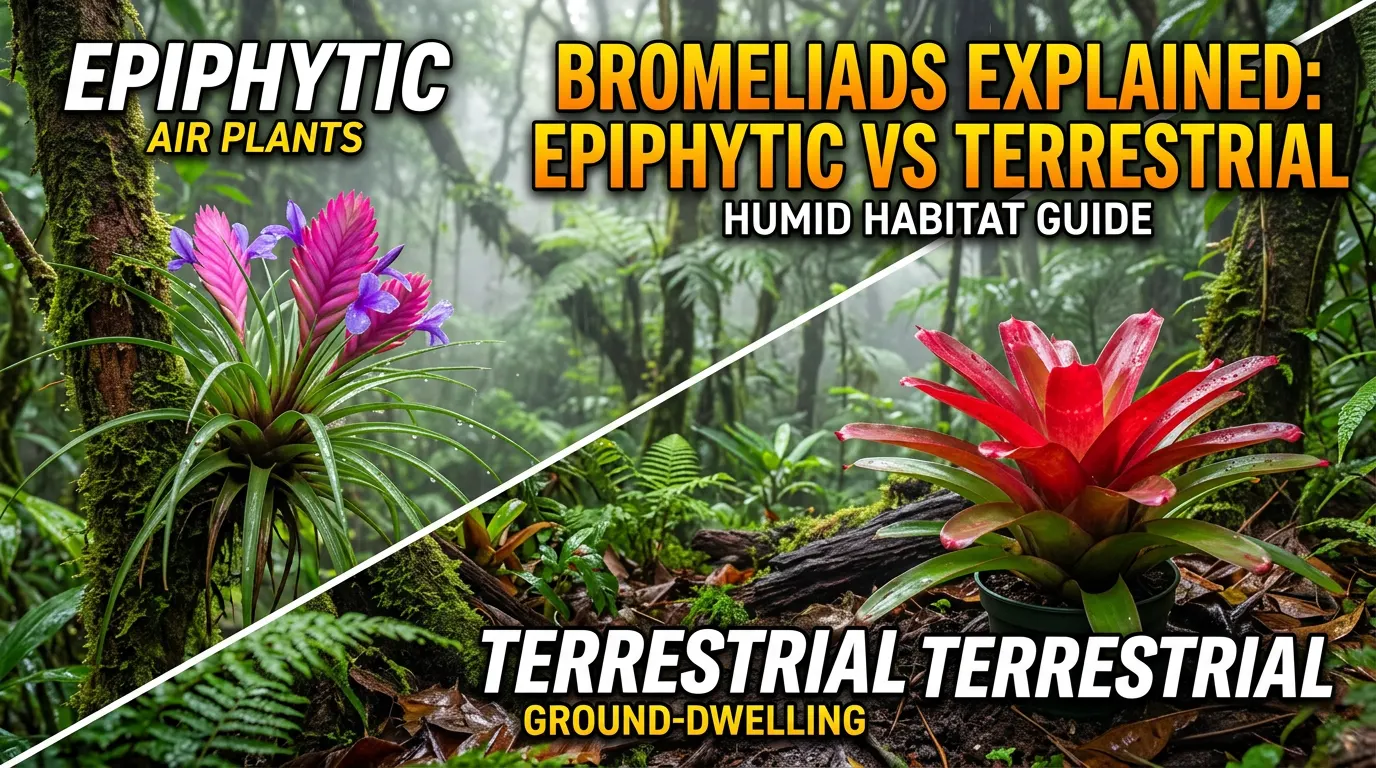
Epiphytic bromeliads are bromeliads that grow on trees or other supports without taking nutrients from them, while terrestrial bromeliads root in soil. A third group, saxicolous types, grows on rock. All three come from the Americas, and most epiphytes expect humid air and mild temperatures, which shapes how you grow them in India.
Quick facts: epiphytic vs terrestrial bromeliads
| Feature | Epiphytic | Terrestrial | Saxicolous (rock-dwelling) |
|---|---|---|---|
| Grows on | Trees, branches, sometimes rocks | Ground or soil | Rock faces and outcrops |
| Role of roots | Mostly anchor | Anchor and take up water | Grip crevices |
| Typical genera | Tillandsia, many Vriesea, Aechmea | Cryptanthus, Dyckia, Puya, pineapple | Some Vriesea, Dyckia |
| Humidity need | Higher; misting or humid air | Moderate; many tolerate drier air | Varies by species |
| Potting | Airy mix or mount | Gritty soil mix | Mount, or gritty mix |
What are epiphytic, terrestrial and saxicolous bromeliads?
These three words describe where a bromeliad anchors itself. Bromeliads.info lists the three habits as epiphytic (on trees), terrestrial (on the ground) and saxicolous (on rocks). If the basic term is new to you, start with what a bromeliad is, with meaning, pronunciation and quick facts.
Epiphytes are not parasites. Clemson’s extension explains that epiphytic types cling to a tree or rocks and obtain their water and minerals from the environment. The Missouri Botanical Garden care sheet adds that the majority of bromeliads are epiphytic, with some lithophytic (rock-dwelling) species, and uses tiny Tillandsia and giant terrestrial Puya raimondii as the two extremes.
The family is large. The Bromeliaceae overview counts about 80 genera and 3,700 species, with roughly 1,814 species epiphytic and the rest lithophytic or terrestrial. Totals vary between sources as taxonomy is revised, so treat all figures as approximate. For the family tree itself, see Fish Bazaar’s piece on the Bromeliaceae family and its species.

Where do bromeliads grow in the wild?
Bromeliads are native to the tropical and subtropical Americas, with one West African exception, Pitcairnia feliciana. Wikipedia reports habitats from sea level up to 4,200 m, spanning rainforest to desert. That range is why one family contains both a moss-like air plant and a spiny rock-garden plant.
- Tillandsia: forests, mountains and deserts from northern Mexico and the southeastern United States through Central America and the Caribbean to central Argentina.
- Neoregelia: South American rainforests, mainly Brazil, often as epiphytes.
- Cryptanthus: all species are endemic to Brazil.
- Dyckia: arid and high-altitude regions of Brazil and central South America.
- Puya: the Andes and southern Central America.
Fish Bazaar’s article on bromeliads in the wild gives another view of these habitats from an Indian seller’s perspective. Our own Bromeliaceae family history covers how the family was discovered and named.
How humid does a bromeliad habitat need to be?
For most home-grown bromeliads, relative humidity of roughly 40 to 75 per cent is cited, with epiphytes at the higher end. Sources differ because they target different climates and species, so use the ranges as a guide rather than a rule.
| Source | Humidity guidance | Temperature guidance |
|---|---|---|
| UW-Madison Extension | 50 to 75 per cent, higher as temperatures rise | Days 70 to 90 F (21 to 32 C); nights 50 to 65 F (10 to 18 C) |
| Bromeliads.info | 40 to 60 per cent | Days 70 to 75 F; nights 60 to 65 F; avoid below 40 F (about 4 C) |
| RHS | Damp gravel tray or misting | About 21 C in summer; winter minimum 10 C |
| Clemson HGIC | Most houses not moist enough; mist often | 60 to 85 F (about 16 to 29 C) |
Why does it matter? A study of the epiphyte Tillandsia guatemalensis in the highlands of Chiapas, Mexico, at about 2,450 to 2,500 m found that during the dry season (November to April) more than half the seedlings in a natural population died, while survival was high in the rainy months. Seedling germination was high after the rains began, so the limit was water availability, not seed supply (Castro Hernandez et al., 1999). The same study noted that oak bark held water better than pine bark, a reminder that the surface an epiphyte sits on affects its moisture supply. Light matters alongside humidity, as our bromeliad light requirements guide explains.
What is a tank bromeliad and where does the humid habitat come from?
A tank bromeliad has a central cup formed by tightly overlapping leaf bases that holds rain and debris. Wikipedia notes such rosettes can accumulate up to around 10 litres, and a 2019 review of 311 papers reported tank-bromeliad water storage of over 40,000 litres per hectare in Brazilian restinga forest and over 50,000 litres per hectare in Colombian cloud forest. In other words, in the wild the plants build their own humid microclimate. Those pools also shelter wildlife, which we cover in bromeliad tree frogs and how frogs live in bromeliads.
At home, UW-Madison Extension advises rainwater for tanks (tap water is tolerated) and a weekly flush to prevent salt build-up. Our bromeliad care complete guide covers watering routines, and the bromeliad vs orchid comparison shows how epiphytic bromeliads differ from the better-known epiphytic orchids.
How do epiphytic and terrestrial bromeliads differ in growing?
| Care point | Epiphytic bromeliads | Terrestrial bromeliads |
|---|---|---|
| Water | Keep the cup topped up; mist or dunk air plants | Water the medium, let it drain; less reliance on the cup |
| Medium | Bark-based, airy, or none (mounted) | Free-draining soil or gritty mix |
| Feeding | Light feeding via leaves or cup | Feeding via soil, per RHS |
| Light | Bright, filtered; often shade-tolerant | Many want brighter light; Dyckia and Puya like sun |
| Cold | Frost-sensitive in most cases | Some cold-hardy; Puya is the standout |
UF/IFAS notes that most bromeliads are frost-sensitive tropical plants, but certain cold-hardy varieties exist: Puya species tolerate temperatures down to about 20 F (roughly -7 C), and thick-leaved types such as many Dyckia are fairly cold-hardy. The same source says inadequate light produces long, thin, greener leaves and strong light produces shorter, thicker, lighter-coloured leaves.
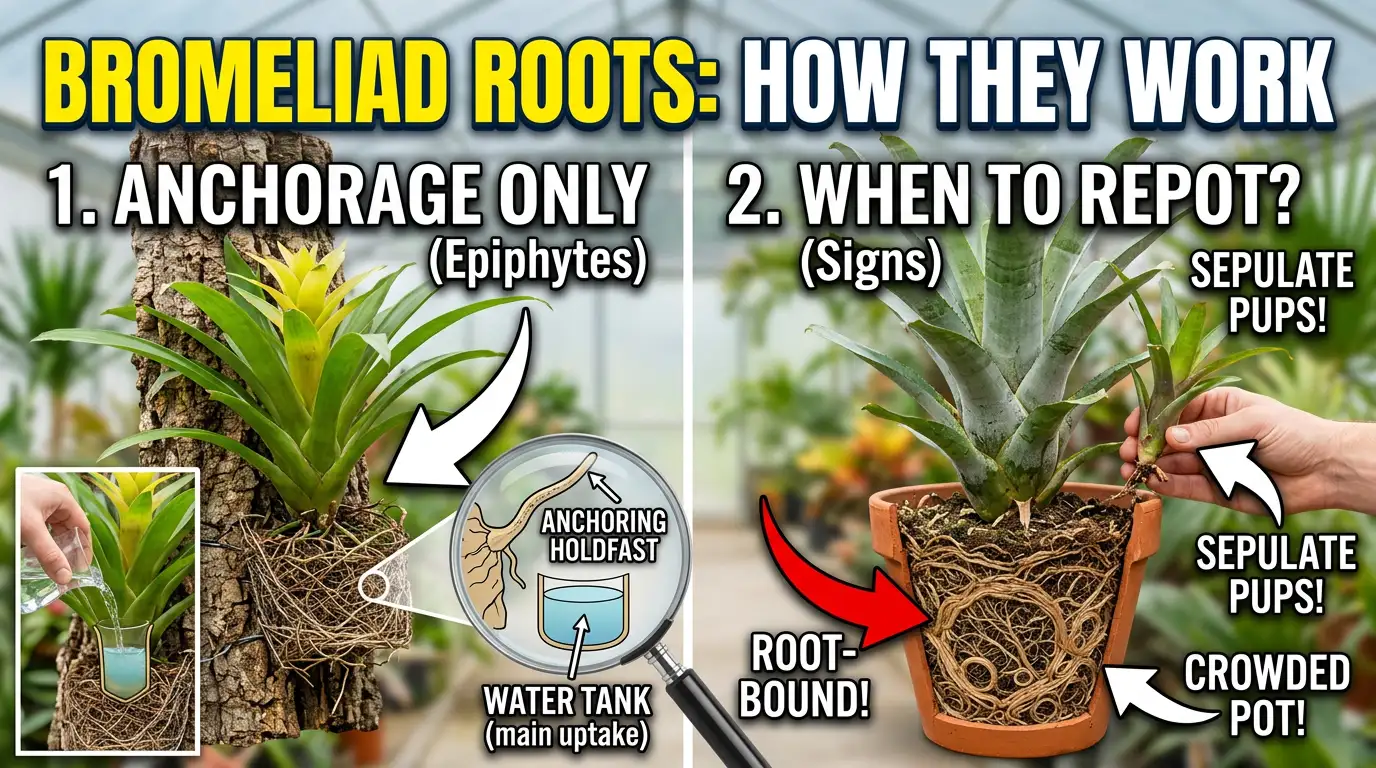
For root details, including how roots behave in each group and when to repot, see our guide to bromeliad roots: how they work and when to repot.
Which genera show the differences best?
| Genus | Habit | Facts from sources |
|---|---|---|
| Tillandsia | Epiphytic | About 650 species, about 635 epiphytic; trichomes absorb water from air; Spanish moss tolerates frost to -10 C (Wikipedia) |
| Neoregelia | Epiphytic or terrestrial | Over 100 species and many hybrids; Brazilian rainforest origin; 15 to 27 C suggested (Gardenia.net) |
| Cryptanthus | Terrestrial | All endemic to Brazil; 76 accepted species in 2022 after a 2017 revision split the genus (Wikipedia) |
| Dyckia | Terrestrial, rocky sites | Arid and high-altitude Brazil and central South America; stiff, thorny leaves (Wikipedia) |
| Puya | Terrestrial | 226 species in the Andes and southern Central America; P. raimondii flower spikes reach 9 to 10 m (Wikipedia) |
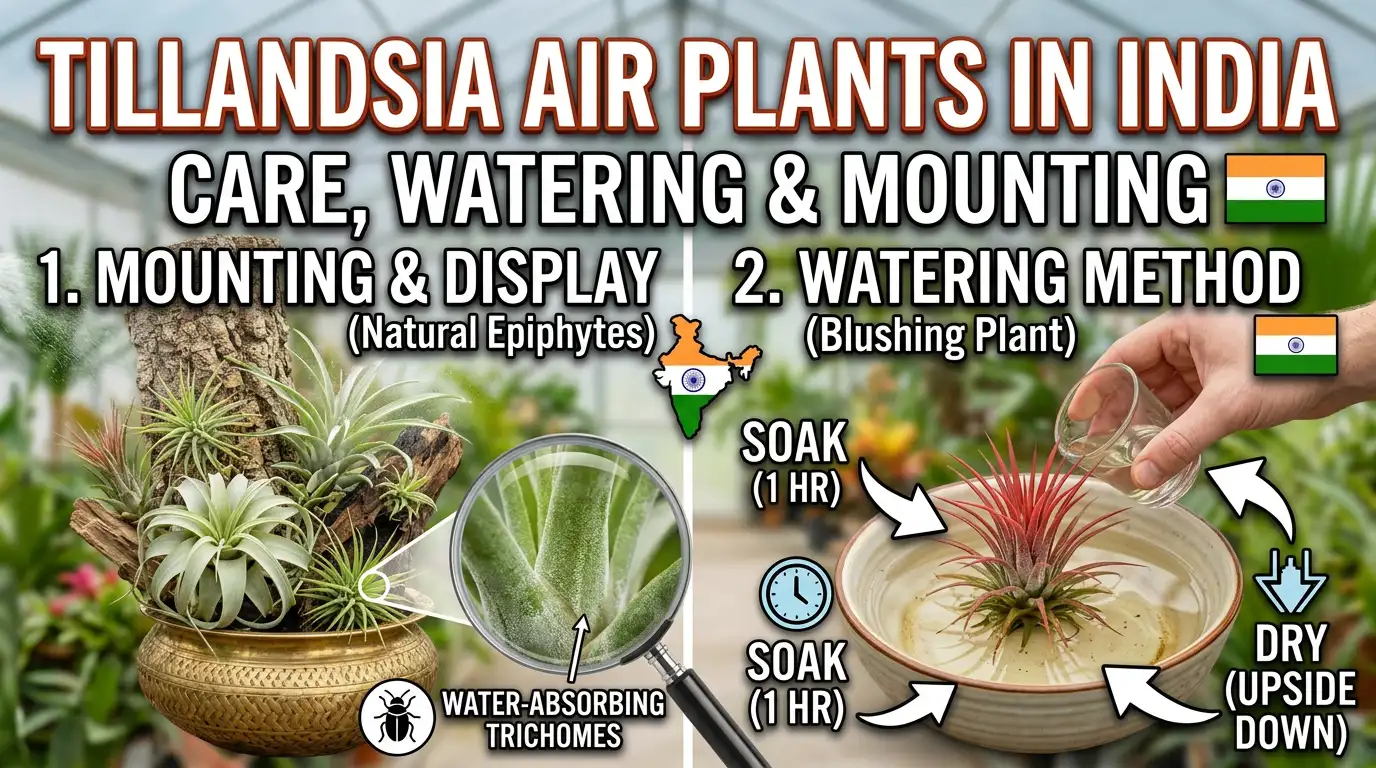
Several of these genera are covered in our types of bromeliads guide. For the epiphytic Tillandsia in particular, see Tillandsia air plants in India. If you want the smallest epiphytes, Fish Bazaar compares air plants and bromeliads for terrariums.
Can epiphytic bromeliads grow in Indian conditions?
Yes, with the right placement. India’s climate is varied, so match the plant to your local pattern rather than to a single rule. For a fuller regional breakdown, read growing bromeliads in India: climate, regions and seasons.
- Humid coast and wet regions (for example Konkan, Kerala, parts of the Northeast): monsoon humidity suits epiphytes, but good airflow and drainage are the limit. Stagnant air and a soggy mix invite rot.
- Hot, dry interiors and the north plains in summer: peak heat of 35 to 45 C is above the comfort ranges in the sources (around 32 C upper end), so provide shade, airflow and extra misting for epiphytes. Terrestrial Dyckia and Puya are the natural choice for such sites.
- Cooler winters in the north: keep frost-tender types above the 10 C minimum RHS suggests, and use cold-tolerant genera outdoors only if you have verified their hardiness.
- Air-conditioned flats: AC dries the air. Use a humidity tray or grouped plants, as the sources suggest, and check what the plants actually feel like.
These Indian notes are practical guidance built on the cited ranges, not measured data from Indian locations. Terrarium builders often use a closed or semi-closed space to hold humidity; see our bromeliads in a terrarium complete guide and the list of best bromeliads for terrariums.
How do you choose between epiphytic and terrestrial types?
- Humid, shaded space or terrarium: choose epiphytic Neoregelia, Aechmea or Tillandsia.
- Bright, drier balcony: choose terrestrial Dyckia or hardy Cryptanthus.
- Mounted display: choose epiphytes; see how to mount a bromeliad on wood.
- Low-maintenance beginner plant: pick a robust Neoregelia and keep the cup clean.
Seller note: Fish Bazaar, operated by the same team as this site, stocks Neoregelia, Tillandsia air plants and Cryptanthus earth stars, mostly sold in sets of 10. That suits large builds and shared orders; single-plant buyers may prefer another seller. Live plants are non-returnable under its policy, so report damage on arrival. Prices and policies change, so check before ordering. Our guide to where to buy bromeliads online in India compares other sellers.
Frequently asked questions
What does epiphytic mean for a bromeliad?
It means the plant grows on another plant or support for anchorage only. It does not feed on the host.
Are all bromeliads epiphytes?
No. Roughly half are epiphytic by Wikipedia’s count; others are terrestrial or rock-dwelling.
Which bromeliads are terrestrial?
Cryptanthus, Dyckia, Puya and pineapple are common examples.
What humidity do bromeliads need?
Sources cite about 40 to 60 per cent or 50 to 75 per cent, with epiphytes preferring the higher range and more humidity as temperatures rise.
Where do bromeliads come from?
The tropical and subtropical Americas, plus one West African species, Pitcairnia feliciana.
Can bromeliads grow without soil?
Epiphytic types can, on a mount or bark, as long as they receive moisture and air movement.
Are bromeliads suitable for Indian summers?
Many can cope with shade, airflow and regular watering, but peak heat above 35 C is beyond the ranges quoted in sources, so protect them.
Do terrestrial bromeliads need a tank of water?
Many do not rely on it, and their roots take up more from the medium. Check each genus’s habit.
What is a saxicolous bromeliad?
One that grows on rock, also called lithophytic in some sources.
References
- Bromeliaceae, Wikipedia
- Tillandsia, Wikipedia
- Cryptanthus, Wikipedia
- Dyckia, Wikipedia
- Puya, Wikipedia
- Neoregelia, Gardenia.net
- Bromeliads, University of Wisconsin-Madison Extension
- Bromeliad care and culture overview, Bromeliads.info
- Soil and potting needs for bromeliads, Bromeliads.info
- How to grow bromeliads, Royal Horticultural Society
- Bromeliads, Clemson Home and Garden Information Center
- Bromeliads, UF/IFAS Gardening Solutions
- Bromeliad Care and Culture, Missouri Botanical Garden
- Castro Hernandez et al. (1999), Influence of humidity, nutrients and light on establishment of Tillandsia guatemalensis in Chiapas, Mexico
- Ladino et al. (2019), Ecosystem services provided by bromeliad plants: a systematic review, Ecology and Evolution
Related Guides
- Types of Bromeliads Guide
- Bromeliad Care Complete Guide
- Bromeliad vs Orchid: What Is the Difference?
- Fish Bazaar: Bromeliads in the Wild and Their Habitat
- Where to Buy Bromeliads Online in India
- Growing Bromeliads in India: Climate, Regions and Seasons
- Bromeliad Roots: How They Work, When to Repot
- Tillandsia Air Plants in India
- Bromeliad Light Requirements
- What Is a Bromeliad? Meaning, Pronunciation and Quick Facts
- Bromeliaceae Family History: Pineapples, Explorers and the 19th Century
- Bromeliad Tree Frogs: How Frogs Live in Bromeliads




Leave a Reply