Gardening & Plants
Bromeliads and orchids end up next to each other in a lot of garden center displays, gift baskets, and “exotic flowering plant” roundups, so it’s a fair question, are they the same thing, or related? They’re not. They just happen to share a few surface-level traits that make people assume they belong to the same group. I’ve had both sitting on the same shelf for years, and the number of people who’ve asked me “so is that the orchid or the other one” tells me this mix-up is more common than the plant world gives it credit for. This is the comparison I wish existed the first time someone handed me a blooming bromeliad and I went looking for orchid care advice, because that’s exactly the mistake that nearly killed my first one.
Quick answer
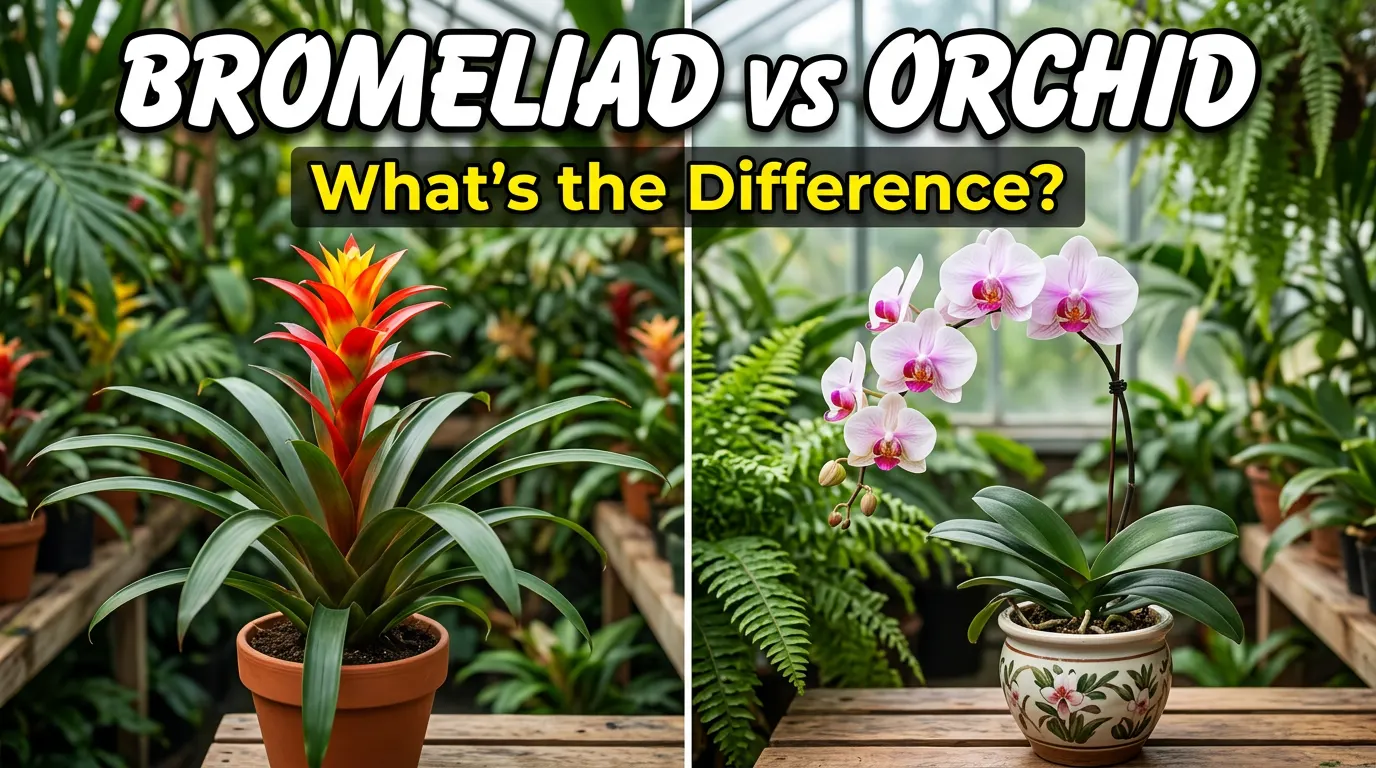
Bromeliads (family Bromeliaceae) and orchids (family Orchidaceae) are two completely separate, unrelated plant families that both happen to include a lot of epiphytic species, plants that grow perched on trees rather than rooted in soil. That shared growth habit, plus both being sold as long-lasting flowering houseplants, is where the resemblance ends. Their flowering biology, watering needs, and typical care are genuinely different, and the single most important practical difference is what happens after the flower fades: an orchid can often be coaxed into reblooming on the same plant, while a bromeliad rosette flowers exactly once and then produces offsets before it declines.

Where the confusion comes from
- Both are often epiphytes. Many bromeliads and many orchids grow on tree branches in the wild rather than in soil, which gives them a similarly “exotic” look and a similar mounted or bark-based potting style when sold as houseplants. Neither family invented epiphytic growth; it’s evolved independently many times across very different plant lineages, which is part of why two unrelated families can end up looking and growing so much alike.
- Both are sold as long-blooming gift plants. A blooming Guzmania bromeliad and a blooming Phalaenopsis orchid both hold color for months, and both show up in the same nursery section marketed the same way, as low-fuss, long-lasting flowering gifts, often shrink-wrapped in a decorative pot with no drainage hole, which is its own separate problem for both plants.
- Both have a reputation for being “fussy” that isn’t really deserved. Neither is actually difficult once you know the one or two things that matter, but that reputation lumps them together in people’s minds as similarly tricky, when the actual sources of difficulty are almost opposite: overwatering the bromeliad’s soil while under-watering its cup, versus overwatering an orchid’s roots because the bark mix looks dry on the surface.
- The flowers of both are frequently something other than a typical flower. What most people call a bromeliad’s “flower” is usually a colored bract, modified leaf tissue, not a petal, while an orchid’s flower spike carries true flowers that can look almost architectural. Neither behaves quite like a rose or a tulip, which primes people to lump them into the same mental category of “unusual, showy flowering plant.”
How their care actually differs
| Bromeliad | Orchid | |
|---|---|---|
| Watering | Fill the central cup formed by the leaves; keep soil barely moist | No central cup on most types, water the roots/bark mix, then let it dry out between waterings |
| Growing medium | Well-draining potting mix, or mounted (Tillandsia) | Chunky bark or moss mix, almost never regular potting soil |
| Flowering | Each rosette blooms exactly once, then produces pups and declines | Many common orchids (like Phalaenopsis) can rebloom on the same plant, sometimes repeatedly, for years |
| After it stops blooming | The plant is finishing its life cycle; grow on the pups it leaves behind | The plant isn’t dying; with the right care it can spike and rebloom again later |
| Roots | Often modest; the leaf rosette does more of the water-holding work | Thick, often visibly green-tipped aerial roots that photosynthesize and signal watering needs |
| Typical lifespan of one flowering | The bract or spike can hold color for two to six months | A single flower spike often blooms for one to three months, sometimes longer |
| Light needs | Bright indirect light for most common genera | Bright indirect light for most common genera (similar range to bromeliads) |
| Humidity preference | Tolerates average home humidity reasonably well | Generally appreciates a bit more humidity than average home air |
| Signs of overwatering | Soft, mushy base; standing water in the cup for too long | Yellowing, wrinkled, or blackened roots inside the bark mix |
| Fertilizing | Very light, quarter-strength monthly during the growing season | Light, orchid-specific formula, typically weekly-to-monthly depending on the product |
The single most important practical difference is what to do when the flower fades. Treat a spent orchid like a spent bromeliad, give up on it and toss it, and you’ll throw away a plant that might have rebloomed with a bit of patience. Treat a spent bromeliad like an orchid and keep waiting for the same rosette to flower again, and you’ll wait forever, because that’s simply not how the plant works. It’s the one detail worth remembering if you only take away one thing from this comparison.

Why the two plants evolved such different flowering strategies
It’s worth understanding the “why” behind the biggest difference, since it makes the care advice easier to remember than treating it as an arbitrary rule. A bromeliad rosette is monocarpic; it flowers once, sets seed (or in cultivation, produces offsets instead), and then its job is essentially done, so the plant redirects its remaining energy into the pups rather than maintaining the original rosette indefinitely. This is the same basic strategy several other plant families use, and it’s not a sign of poor health or bad care; it’s simply how the plant is built to reproduce. An orchid, by contrast, is typically polycarpic; the same plant structure can produce multiple flower spikes over its lifetime, given the right seasonal cues (often a period of cooler night temperatures) to trigger a new spike. Neither strategy is “better”; they’re just different solutions to the same basic problem of getting pollinated and reproducing, and knowing which one your plant uses tells you exactly what to expect once the current flower fades.
Telling them apart at a glance, before they even flower
You don’t need to wait for a bloom to identify which one you’re looking at. A bromeliad’s leaves overlap tightly at the base into a rosette that forms a visible cup or funnel shape; even a non-blooming bromeliad has that structural “vase” look. An orchid’s leaves, by contrast, grow from a stem or pseudobulb and don’t form a cup at all; instead, look at the roots. Most common houseplant orchids have thick, cord-like aerial roots, often silvery-green and sometimes visibly emerging from drainage holes or growing along the surface of the bark mix, which is a feature bromeliads simply don’t have. If you’re holding a plant with a tight rosette and a central funnel, it’s a bromeliad; if you’re holding a plant with thick snaking roots and no funnel structure, it’s an orchid.

Can you grow them together?
Yes, and it’s a common combination in mixed epiphyte displays, mounted on the same piece of driftwood, or grouped in the same bright, humid spot, since both tolerate similar light and humidity ranges as houseplants. Just water each according to its own needs rather than treating them as one routine: soak or mist the orchid’s roots and let them dry, and keep the bromeliad’s central cup topped up separately. If you’re mounting both on the same piece of wood, it helps to position the orchid’s roots slightly higher or in a spot with better airflow than the bromeliad’s root zone, since orchid roots are more prone to rot from prolonged dampness than a bromeliad’s are, the bromeliad’s cup is doing the water-holding work up top, so its root zone can afford to be a bit drier overall.
A mixed epiphyte mount is also a good way to hedge your bets on bloom timing, since a bromeliad flowers once and then fades while an orchid can rebloom; pairing the two means there’s a reasonable chance something is in flower on the display at any given point across the year, rather than both plants happening to be between blooms at the same time.
Photo placeholder
A mixed mounted display on a large piece of driftwood combining a small Neoregelia bromeliad, an orchid with visible aerial roots gripping the bark, and a cluster of Tillandsia air plants, hanging on a bright wall, soft indirect daylight
Common mistakes that come from mixing up their care
The two most common mistakes I see, and hear about from readers, both come directly from applying one plant’s rules to the other:
- Watering a bromeliad’s soil the way you’d water an orchid’s bark. Letting the potting mix dry out completely between waterings is correct for an orchid but leaves a bromeliad’s cup empty, which is the part that actually matters most for the plant’s day-to-day water supply.
- Discarding a bromeliad or an orchid at the wrong moment. Tossing a spent orchid because “it’s done flowering” throws away a plant that’s very likely to rebloom with continued care; conversely, holding onto a declining bromeliad rosette waiting for a second bloom that will never come means missing the window to focus energy on separating and growing its pups instead.
- Assuming both need identical humidity and misting. Both tolerate normal home humidity reasonably well, but an orchid’s exposed aerial roots and an air plant’s leaf-surface absorption respond differently to ambient moisture than a bromeliad’s cup-fed rosette does, so a misting routine tuned for one isn’t automatically right for the other.

Frequently asked questions
Are bromeliads and orchids in the same plant family?
No. Bromeliaceae and Orchidaceae are entirely separate families with no close relation; the similarities people notice are about growth habit and how they’re marketed, not botany. Orchidaceae is actually one of the largest plant families in the world, and Bromeliaceae is a much smaller, almost entirely New World family; they simply don’t share a close common ancestor.
Which is easier to care for, a bromeliad or an orchid?
Most common houseplant bromeliads (Guzmania, Aechmea) are a bit more forgiving for a beginner; the “fill the cup” watering rule is harder to get wrong than judging when an orchid’s bark mix has actually dried out. Orchids reward a bit more attention with repeat blooms, though, which bromeliads don’t offer on the same plant.
Why did my orchid stop flowering but my bromeliad’s flower is still going strong months later?
These are two different, unrelated things happening on two different timelines. An orchid’s individual flower spike naturally finishes blooming after a matter of weeks to a few months and can be encouraged to spike again later with the right conditions. A bromeliad’s colored bract is modified leaf tissue rather than a true flower, which is exactly why it holds color for so much longer, often several months, before the whole rosette begins its natural decline.
Can I use orchid fertilizer on a bromeliad, or vice versa?
A dilute, balanced liquid fertilizer works reasonably well for either plant in a pinch, but it’s worth diluting further than the label suggests either way; both are adapted to nutrient-poor growing conditions in the wild and are more easily over-fertilized than under-fertilized. If you already own an orchid-specific fertilizer, using it at a light dilution on a bromeliad’s soil (not its cup) won’t cause a problem; it’s simply not formulated with the bromeliad’s needs specifically in mind the way a general dilute houseplant fertilizer would be.
Do both plants need to be mounted, or can they be grown in regular pots?
Neither needs to be mounted; most common bromeliads and orchids sold as houseplants are grown perfectly well in pots, just with growing media suited to their epiphytic roots (a bark-and-perlite mix for bromeliads, a chunky bark or moss mix for orchids) rather than dense standard potting soil. Mounting is a display choice that mimics their wild growth habit more closely, not a requirement for either plant to thrive.
For the full watering, light, and flowering rundown on bromeliads specifically, see my bromeliad care guide, or the types of bromeliads guide if you’re trying to identify which one you actually have. If your bromeliad’s care is going wrong somewhere and you’re troubleshooting, my common bromeliad problems guide covers the usual culprits, and if you’d rather grow yours mounted the way the epiphytes above naturally live, see how to mount a bromeliad on wood.




Leave a Reply