
BROMELIAD IDENTIFICATION GUIDE · UPDATED OCTOBER 2026
By Everydaything Team · Last updated October 2026
How to identify a bromeliad comes down to four quick checks: a rosette of strap-shaped leaves, the leaf edges, a central water cup, and a flower head with showy bracts. Match those clues and you can usually name the genus, such as Guzmania, Neoregelia or Aechmea. This guide gives a practical key in plain words, a decision table, the most common look-alikes and ways to confirm the name, with notes for Indian buyers.
Quick answer
- Rosette first: bromeliad leaves usually spiral from a base into a rosette, and the bases wrap tightly around each other.
- Edges decide the family branch: smooth edges point to Guzmania, Vriesea or Tillandsia, while teeth or spines point to Aechmea, Neoregelia, Billbergia and pineapple relatives.
- Cup test: many, but not all, hold water in the centre. Most air plants and many ground-rooted types do not.
- Life cycle clue: most flower once, then make pups, as UF/IFAS describes.
- Look-alikes: agave, aloe, yucca and screw pine have fleshy or woody features that bromeliads lack.
What makes a plant a bromeliad?
A bromeliad belongs to the family Bromeliaceae, which Kew’s Plants of the World Online describes as mostly epiphytic or terrestrial perennial herbs, chiefly from tropical America (Kew POWO). Their leaves are spiral, often rosetted, with sheathing bases and edges that are smooth or spiny. Flowers sit in terminal clusters with brightly coloured bracts.
Sources disagree on how many genera exist. Botany Brisbane cites 72 to 98 genera depending on classification, while EBSCO gives about 56 genera and 2,600 species (Botany Brisbane; EBSCO). Those counts matter little for identification, but they explain why names change.
Two traits help most. First, each flower has three sepals and three petals. Second, leaf hairs called scales absorb water in many species. The pineapple is the best-known example, because UF/IFAS confirms that Ananas comosus is a bromeliad (UF/IFAS FP039). For basics, see our what is a bromeliad guide.
How to identify a bromeliad step by step
The method below works with a plant in your hand or with a clear photo. Learning how to identify a bromeliad gets easier once you practise the same five checks in order.

Step 1: Look at the overall shape
Most bromeliads form a rosette. Some are a tight vase, some a wide open star, and some a ground-hugging mat. NC State describes Guzmania leaves as overlapping into a funnel-like central tank, whereas Tillandsia forms small rosettes covered in grey scales (Guzmania; Tillandsia).
Step 2: Run a finger along the leaf edge
Smooth edges and spines split the family into two broad camps. In the Tillandsioideae subfamily, which includes Tillandsia, Guzmania and Vriesea, leaf edges are smooth and spineless. In the Bromelioideae, which includes Aechmea, Neoregelia, Billbergia, Cryptanthus and Ananas, leaves are almost always toothed or spined (Wikipedia; Botany Brisbane). Wear gloves for the second group.
Step 3: Check for a central cup
Many bromeliads hold water between the leaf bases. EBSCO notes tanks in genera such as Aechmea, and NC State says Guzmania has a funnel-like vase. However, most air plants and many ground-rooted types, such as Dyckia and Cryptanthus, do not rely on a cup. If your plant has no cup, it points to those groups.
Step 4: Inspect the leaf surface
Silvery-grey scales point to Tillandsia, whose leaves NC State says are covered in absorbent grey scales. Transverse bands suggest Aechmea fasciata, a species named for them, and NC State lists black spines on its margins (NC State). Dark cross-bands on smooth, flat leaves suggest Vriesea splendens (RHS).
Step 5: Study the flower and the life cycle
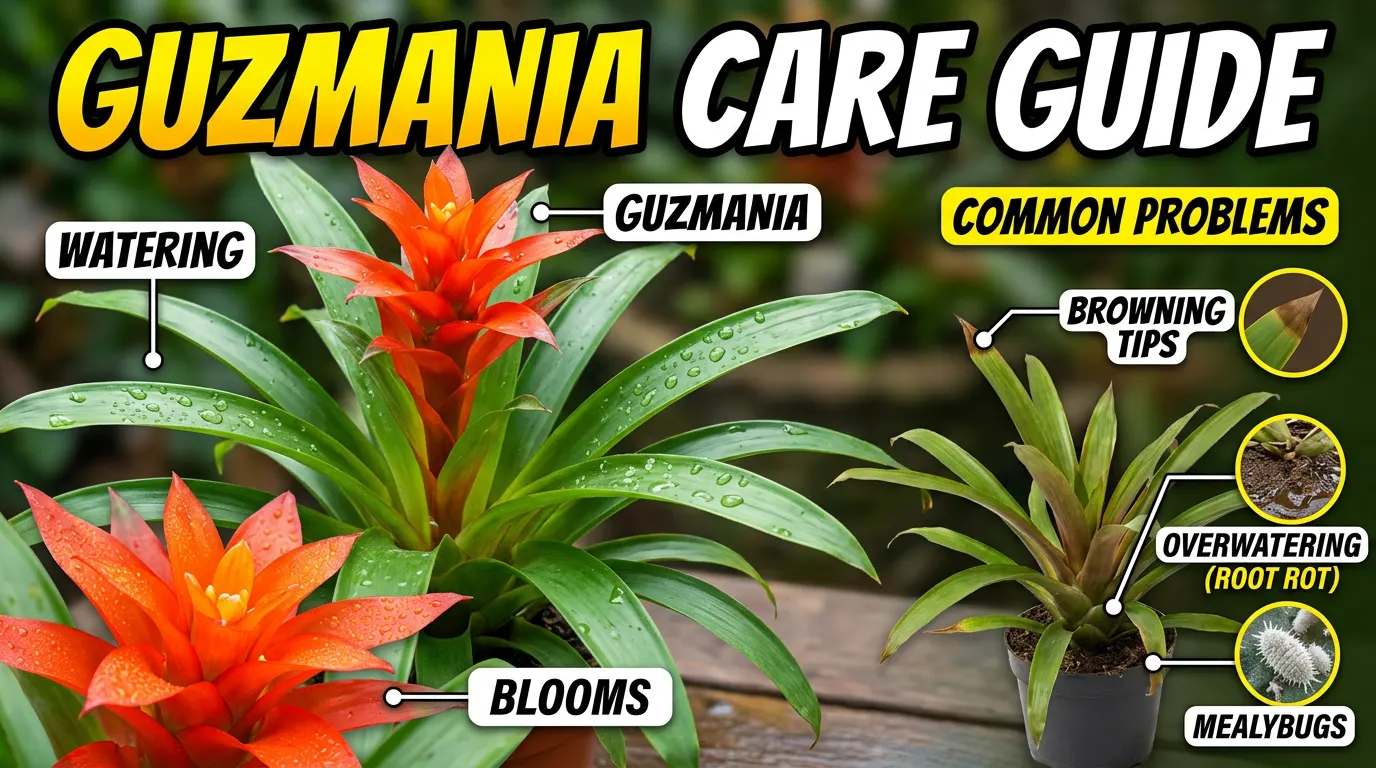
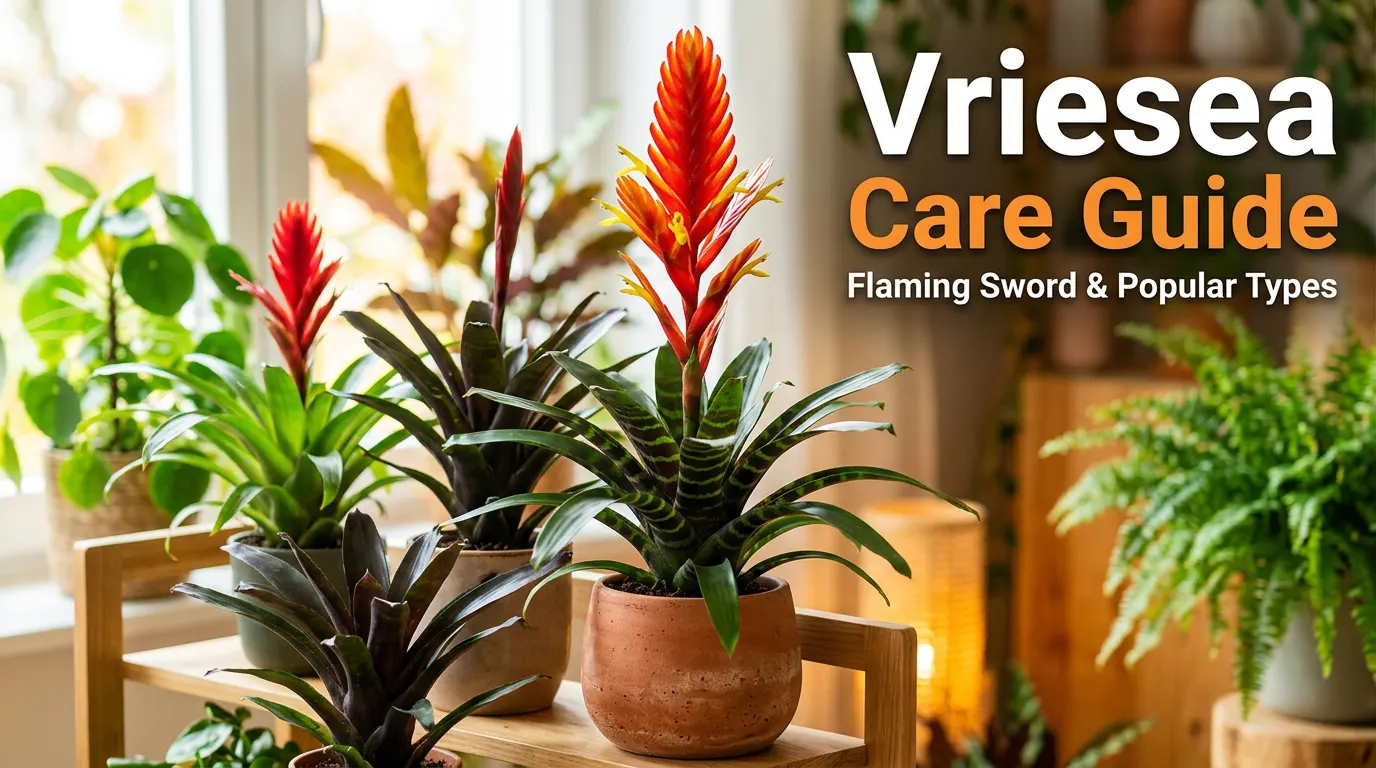
The inflorescence is often the quickest tell. Guzmania carries a torch-like head of crowded red, orange, pink or green bracts with small white or yellow flowers. Vriesea splendens has an erect scarlet spike. Billbergia nutans carries nodding flowers beneath pink bracts, while Neoregelia keeps small flowers inside the cup. Most bromeliads flower once, then slowly decline while pups grow, as UF/IFAS describes. Our bromeliad flowering guide covers timing and reblooming.
How to identify a bromeliad genus: a decision table
This table answers “how do I know what type of bromeliad I have?” in a few lines. Use it as a starting point, not a verdict, because hybrids blur the lines and cultivated forms often differ from the wild type.
| What you see | Likely group | Why |
|---|---|---|
| Smooth-edged, leathery strap leaves; funnel cup; torch-like head of bracts | Guzmania | NC State describes entire margins and a funnel-like tank |
| Smooth, strap-shaped, banded leaves; erect spike of scarlet bracts | Vriesea (e.g. flaming sword) | RHS describes cross-banded leaves and a scarlet spike |
| Stiff, broad leaves with spines; grey cross-bands; pink head of small purple flowers | Aechmea fasciata (silver vase) | NC State and RHS describe banding, black teeth and a pink head |
| Wide open rosette; centre turns red before bloom; small flowers inside the cup | Neoregelia | NC State notes the red centre, and UF/IFAS places the small flowers inside the cup |
| Narrow, upright vase; nodding flowers under pink bracts | Billbergia nutans | RHS and Museums of History NSW describe it |
| Small, silvery, scale-covered; often mounted; usually no cup | Tillandsia (air plants) | NC State: absorbent grey scales, few wiry roots |
| Low, star-shaped, grows in soil; flowers tucked between leaves | Cryptanthus (earth star) | Clemson Extension says terrestrial, star-like |
| Stiff, narrow, hook-spined leaves; grows in soil; flower stalk from the side | Dyckia | Hobby source; confirm with a specialist |
| Large rosette, fruit on a central stalk | Pineapple (Ananas) | UF/IFAS FP039 |
| Huge rock-grown rosette, about 1.5 m | Alcantarea imperialis | UZH reports roughly 1.5 m after about ten years |
For genus overviews with growth habits, use our types of bromeliads guide. To go from genus to named plants, see the popular bromeliad varieties guide.
Which bromeliads have spiky leaves?
Aechmea, Neoregelia and other Bromelioideae usually have teeth or spines, and Dyckia is known for hooked ones. A hobby site warns that Dyckia spines can easily draw blood (Gardener’s Path). UF/IFAS adds that pineapple leaves often have spiny tips and margins, though some cultivars, such as ‘Smooth Cayenne’, are spineless.
By contrast, Guzmania, Vriesea and Tillandsia have smooth edges. So “what type has spiky leaves” usually means Aechmea, Neoregelia or a ground-rooted type. Check our Aechmea fasciata care guide and Neoregelia care guide if yours matches. For the smooth-edged side, read the Guzmania care guide and the Vriesea care guide.
How to identify a bromeliad and not an agave, aloe or yucca
Several rosette plants fool beginners. The usual suspects are agave, aloe, yucca and screw pine. When you learn how to identify a bromeliad, the clues that matter most are leaf texture and plant size.
| Plant | Family | How it differs from a bromeliad |
|---|---|---|
| Agave (Agave americana) | Asparagaceae | Fleshy leaves with edge spines, a rosette 6-10 ft wide, and one huge flower stalk after 10-25 years (NC State) |
| Aloe | Asphodelaceae | Thick, soft, succulent leaves with gel-like sap and toothed edges; flowers on leafless stems (NC State, RHS) |
| Yucca (Yucca elephantipes) | Asparagaceae | Stiff, leathery leaves on a woody trunk, growing 8-12 m tall (RHS) |
| Screw pine (Pandanus) | Pandanaceae | Woody tree on stilt roots with sword-shaped, spiny-edged leaves up to 1.5 m (CMC Vellore, Botany Brisbane) |
| Orchids | Orchidaceae | Different flowers and roots; see our bromeliad versus orchid guide |
Notice a trap: agave leaves are fleshy, whereas most bromeliad leaves are tougher and strap-like. Aloe sap is gel-like, a trait NC State lists for the genus. Our bromeliad vs orchid guide covers the orchid mix-up in detail.
What is a “false bromeliad”?
We found no botanical definition of the phrase, so treat it as a search habit, not a category. It appears to cover two situations. In the first, a non-bromeliad such as agave or aloe gets mistaken for one. In the second, a real bromeliad has “false” or “pineapple” in its common name.
The second case catches people out. Hechtia texensis is called Texas false agave, yet it belongs to Bromeliaceae. Dyckia fosteriana is called hardy pineapple, and the RHS also places it in Bromeliaceae. Taxonomy is moving too. Wikipedia notes that Hechtia and Puya now sit in their own subfamilies, split off from Pitcairnioideae (Wikipedia). So the ground-rooted, spiny group is real, but it is not “false”.
How can you confirm what bromeliad you have?
Even if you know how to identify a bromeliad by eye, a second opinion helps. Combine a good photo, the plant tag and at least one expert source. Take clear shots of the whole plant, a leaf edge, the leaf surface and any flower. Then try these routes.
- Bromeliad Cultivar Register: the Bromeliad Society International has been the registration authority since 1980 (ISHS), and its register lists named cultivars.
- Brom-L and the FloraPix gallery: Brom-L is a free list created in 1993 for bromeliad growers and taxonomists, and it links to a photo gallery (Brom-L). Check the list rules before posting photos.
- iNaturalist: community members suggest names, and an observation reaches Research Grade when more than two thirds of identifiers agree (iNaturalist help).
- Plant ID apps: use them for a shortlist. One review says apps perform worse on cultivated, tropical garden plants (PlantPono).
Remember the register covers cultivars, not every hybrid. For named cultivars such as ‘Fireball’ or ‘Blue Tango’, our bromeliad varieties guide explains the naming system.

How to identify a bromeliad in India
Knowing how to identify a bromeliad matters more in India because labels are the main problem. A Kerala grower profile lists ‘match stick’ among popular Neoregelias, whereas botanical sources place the matchstick bromeliad in Aechmea (Onmanorama; Botany Brisbane). That mismatch shows why a Latin name matters when you buy.
For a local reference, eFlora of India has a Bromeliaceae page and an e-group where members post “Bromeliad for ID” requests, including photos from Mumbai (eFlora of India). We did not find a dedicated Indian bromeliad society, so international lists remain the practical backup.
Common Indian look-alikes include aloe, agave and screw pine, which the Vellore profile calls keora. Ask the seller three questions: the Latin name, whether it is a cultivar, and the pup or plant age. Our where to buy bromeliads online in India guide compares sellers, and the Tillandsia in India guide helps with air plants. If you search in Hinglish, “yeh bromeliad hai ya nahi” (is this a bromeliad or not) is best answered by the cup and leaf-edge tests above.
Why does the right ID matter for care and safety?
Light, watering and flowering habits differ by genus. For instance, NC State lists Guzmania for part to full shade, while Neoregelia takes a few hours of direct sun. Naming the plant also helps with pets: the ASPCA lists Neoregelia as non-toxic to dogs and cats, but data for other genera varies. See our bromeliad pet safety guide before you decide.
Once you know how to identify a bromeliad and have a name, the complete bromeliad care guide covers the basics, and our epiphytic versus terrestrial bromeliads guide explains why some grow on trees and others in soil.
Frequently asked questions
How do I know what type of bromeliad I have?
Check the rosette shape, the leaf edges, whether there is a central cup, and the flower head. Smooth edges and a funnel cup suggest Guzmania, while spiny leaves with grey bands suggest Aechmea. Silvery scale-covered plants without a cup are usually Tillandsia.
What does a bromeliad look like?
Most form a rosette of strap-shaped leaves that overlap at the base, often with a central cup and a long-lasting flower head of coloured bracts. Size ranges from small air plants to rock-dwelling giants such as Alcantarea imperialis.
What type of bromeliad has spiky leaves?
Genera in the Bromelioideae, such as Aechmea and Neoregelia, are usually toothed or spined. Dyckia has hooked spines, and many pineapples have spiny tips and margins. Guzmania, Vriesea and Tillandsia have smooth edges.
How can I tell a bromeliad from an agave or aloe?
Agave and aloe have thick, fleshy leaves. NC State notes aloe sap is gel-like, and agave leaves are fleshy with edge spines. Bromeliad leaves are usually tougher and strap-like, and many hold water in a central cup.
Is a pineapple a bromeliad?
Yes. UF/IFAS states that the pineapple, Ananas comosus, belongs to the bromeliad family. It forms a stiff rosette, fruits on a central stalk, then produces pups.
What is a false bromeliad?
It is not a botanical term. The phrase is used for non-bromeliads that look similar, such as agave, and for real bromeliads with misleading names, such as the Texas false agave, Hechtia texensis.
Are Dyckia, Hechtia and Puya bromeliads?
Yes. All three are in Bromeliaceae. Wikipedia notes that Hechtia and Puya now have their own subfamilies, and the name Texas false agave shows how easily these ground-rooted, spiny plants get mistaken for agave.
Where can I get a bromeliad identified?
Try the Bromeliad Society International cultivar register, the Brom-L list and gallery, iNaturalist, or the eFlora of India e-group. Treat app suggestions as a shortlist and confirm with a source.
Can I identify a bromeliad from the flower alone?
Often, but not always. Guzmania has a torch-like bract head, Vriesea splendens has an erect scarlet spike, Billbergia has nodding flowers, and Neoregelia flowers sit inside the cup. Hybrids can blur these clues.
References and further reading
- Kew Plants of the World Online: Bromeliaceae
- Botany Brisbane: Bromeliaceae
- EBSCO Research Starters: Bromeliaceae
- UF/IFAS: Pineapple (Ananas comosus) fact sheet FP039
- NC State Extension Plant Toolbox: Guzmania
- NC State Extension Plant Toolbox: Tillandsia
- NC State Extension Plant Toolbox: Aechmea fasciata
- NC State Extension Plant Toolbox: Agave americana
- NC State Extension Plant Toolbox: Aloe
- RHS: Vriesea splendens
- RHS: Yucca elephantipes
- RHS: Dyckia fosteriana
- Clemson HGIC: Earth stars (Cryptanthus)
- CMC Vellore: Screw pine (Pandanus odoratissimus)
- UF/IFAS: Bromeliads at a Glance (ENH1071)
- ASPCA: Neoregelia (crimson cup)
- ISHS: Cultivar registration authority for Bromeliaceae
- Brom-L: Bromeliad discussion list
- iNaturalist help: community identifications
- eFlora of India: Bromeliaceae
- Wikipedia: Pitcairnioideae (secondary)
- Wikipedia: Tillandsioideae (secondary)
- PlantPono: Evaluating and ranking plant ID apps (secondary)
- Gardener’s Path: Dyckia (hobby site, secondary)
Related Guides
- Types of Bromeliads: Guzmania, Neoregelia, Aechmea & More
- Popular Bromeliad Varieties: Blue Tango, Queen’s Tears, Zebra and More
- Neoregelia Care Guide: Fireball, Size and Propagation
- Aechmea Fasciata (Silver Vase) Care: Light, Water and Blooms
- Guzmania Care Guide: Watering, Blooms and Common Problems
- Vriesea Care Guide: Flaming Sword and Other Popular Types
- Are Bromeliads Toxic to Cats, Dogs and Humans? Safety Guide
- What Is a Bromeliad? Meaning, Pronunciation & Quick Facts
- Bromeliad vs Orchid: What’s the Difference?
- Where to Buy Bromeliads Online in India: 8 Sellers Compared




Leave a Reply