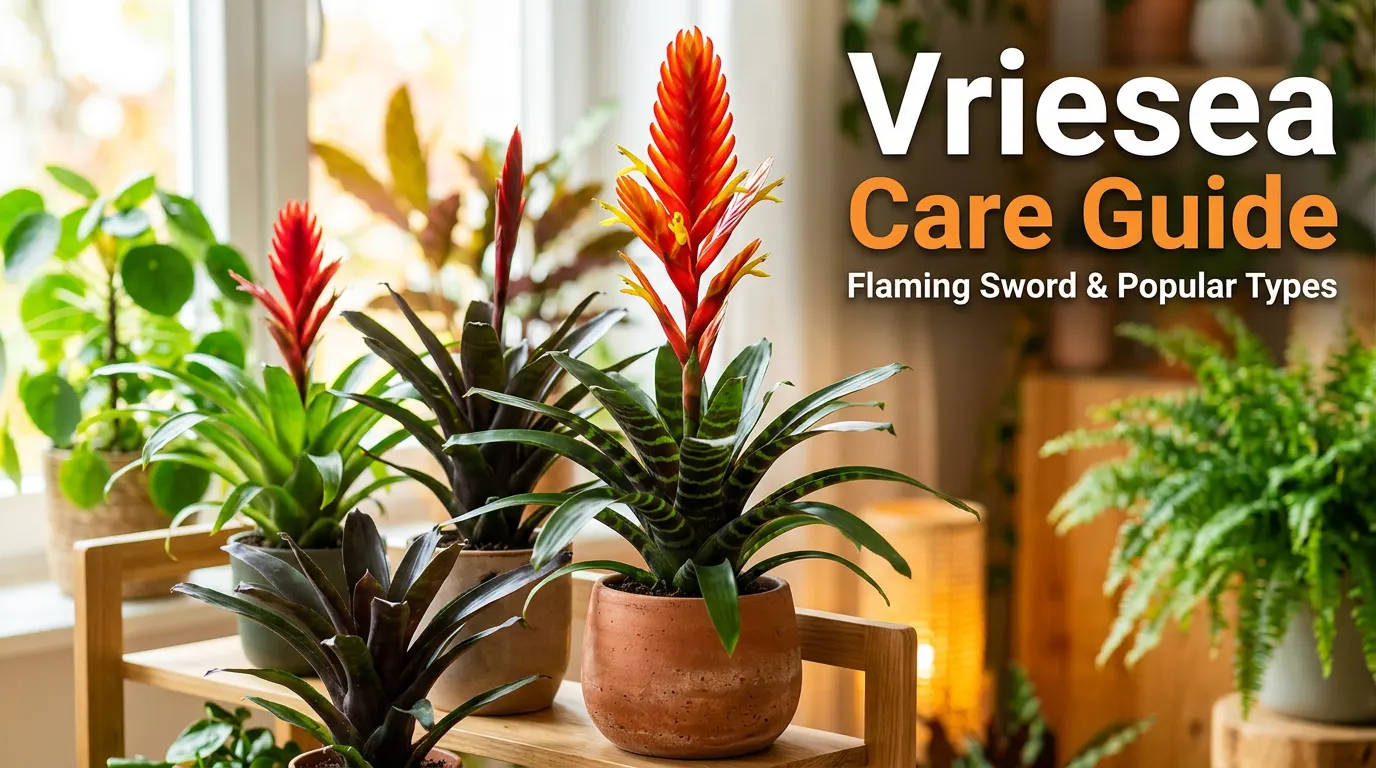
BROMELIAD GUIDE · UPDATED OCTOBER 2026
By Everydaything Team · Last updated October 2026
Vriesea care is simple once you know the plant: bright indirect light, a little fresh water in the central cup, steady warmth and an airy mix. The best-known Vriesea is Vriesea splendens, the flaming sword, whose banded leaves and flat red flower spike make a bold houseplant. Like most bromeliads, each rosette flowers once and then leaves pups. This guide covers the name confusion around Vriesea and Lutheria, how to water, light and feed it, how long the red spike lasts and how to adapt care to Indian seasons.
Quick answer
- Light: bright indirect light to partial shade. NC State Extension lists 2 to 6 hours of direct sun as the upper end of partial shade.
- Water: water through the central cup, keep the mix moist but well drained, and let the top half dry between waterings.
- Warmth: NC State says it thrives at 60 to 80 °F (about 16 to 27 °C). The RHS says it needs above 15 °C.
- Cold: a Belgian greenhouse study found Vriesea tolerated 2 °C but not frost at −4 °C.
- Bloom: the red spike lasts weeks to months. The plant then declines and makes pups.
- Name: some authorities now call it Lutheria splendens. Care is identical.
What is Vriesea splendens (flaming sword)?
Vriesea splendens is an epiphytic bromeliad from northern South America and Trinidad. Wikipedia gives Trinidad, eastern Venezuela and the Guianas, while NC State Extension says tropical rain forests from eastern Colombia to Trinidad and Tobago. The RHS lists it under Guyana, so sources vary on its exact range. Wikipedia adds that it was introduced to Europe in 1840 and holds the RHS Award of Garden Merit.
The leaves form a tight, arching rosette with dark horizontal bands. NC State describes them as soft, smooth, grey-green or purplish with dark green or reddish-brown bands. In summer, an erect, flattened spike carries overlapping scarlet bracts, with tubular yellow flowers peeping out. That spike gives the plant its flaming sword name.

| Quick facts | Vriesea splendens |
|---|---|
| Common names | Flaming sword |
| Plant type | Epiphytic, evergreen bromeliad |
| Size | NC State: 2–3 ft tall, 1.5–2 ft wide; RHS: up to 0.5–1 m tall |
| Leaves | Smooth-edged, banded, no spines |
| Flowers | Red bract spike with small yellow flowers, summer |
| Light | Bright indirect to partial shade |
| Temperature | 60–80 °F (NC State); above 15 °C (RHS H1A) |
| Time to maturity | 2–5 years (RHS); pups bloom in 3–5 years (NC State) |
| Pets | No ASPCA entry found for Vriesea |
Is Vriesea now called Lutheria, and does it matter?
It matters for labels, not for care. In 2016, Barfuss and colleagues published a revision of the bromeliad subfamily Tillandsioideae in Phytotaxa. They split five genera from Vriesea: Goudaea, Jagrantia, Lutheria (four species), Stigmatodon (18 species) and Zizkaea. Some authorities now place the flaming sword in Lutheria. NC State Extension lists it as Lutheria splendens, and the EPPO database lists Lutheria splendens (Brongniart) Barfuss & Till as an alternative name. Wikipedia says V. splendens is sometimes considered a synonym of it. Meanwhile, the RHS still uses Vriesea splendens, and nurseries mostly keep the old name.
Genus counts differ too. A plant database summarising Kew data counts roughly 177 accepted Vriesea species, while World Flora Online treats about 245. In practice, buy by plant description and not by genus name. If a tag says Vriesea, Lutheria or “flaming sword”, the care below applies. See our types of bromeliads guide for how Vriesea relates to the other genera.
Which Vriesea types and hybrids are common?
Most shop plants are hybrids of V. splendens. Retailers sell Vriesea ‘Splenriet’ as a V. splendens hybrid with a red flower spike. We could not verify its parentage in a cultivar register, so treat that as a retail description. Large species also exist. UF/IFAS says V. hieroglyphica rosettes can reach up to five feet across, so it is a garden plant rather than a windowsill one.
Wikipedia notes that the Bromeliad Cultivar Register lists a number of V. splendens cultivars. If you want to compare colours across genera, our popular bromeliad varieties page is the place to start. Unsure of a plant you already own? Use the bromeliad identification guide.
How much light does a Vriesea need?
Bright indirect light to partial shade is best. NC State Extension gives bright, indirect light or partial shade, defined as 2 to 6 hours of direct sun. The RHS prefers a north or east aspect in a sheltered spot. A secondary gardening source adds that brighter light gives the most vivid banding and bract colour, but that full sun is too much.
A plain east window is a safe start. If the leaves bleach or the bands fade, move the plant back. If the leaves go dark and soft, give it more light. Our bromeliad light guide covers window direction. By contrast, the University of Missouri says thick-leaved Aechmea fasciata tolerates brighter light than thin-leaved types, so the two may need different spots.
How do you water Vriesea?
Water through the central cup, and keep the mix moist but not soggy. NC State Extension says to let the top half of the potting mix dry out between waterings. The RHS adds daily misting with soft water while the plant is growing, and keeping it just moist in winter.
Flush the cup every week or two. A secondary gardening source suggests distilled water, since stagnant cup water can lead to crown rot. Rain or filtered water is a practical alternative in hard-water cities. Treat the cup as a reservoir, not a pond. In cool or cloudy weather, reduce the water in the cup.
What temperature does Vriesea tolerate?
Warm and mild conditions suit it, and brief cool spells are tolerable. A peer-reviewed study by Vervaeke and colleagues in Acta Horticulturae (2004) tested bromeliads in heated Belgian greenhouses. Aechmea fasciata grew more slowly and showed cell membrane damage under the cooler regime of 15/12 °C day/night. The two Vriesea tested handled the cold better, tolerating 2 °C, although frost at −4 °C was lethal.
The Florida Council of Bromeliad Societies cold-sensitivity survey agrees that the genus is mixed. Many Vriesea entries survived 20 °F, many were damaged at 26–28 °F, and two V. splendens forms were in the most sensitive 32 °F group. Therefore, freezing is the real limit. These are survival figures, so for comfortable growth aim for the 60 to 80 °F range that NC State gives. UF/IFAS also advises emptying the cup when temperatures below 40 °F (about 4 °C) are likely.
What potting mix and fertiliser does Vriesea like?
Use an airy bromeliad or orchid mix. NC State Extension recommends potting or orchid mix and notes that the plant can be mounted on slabs or bark, a style we cover in how to mount a bromeliad on wood. Our bromeliad roots, repotting and soil guide compares mixes in detail.
Feed lightly. The RHS suggests a quarter-strength foliar feed every four to five weeks in the growing season. UF/IFAS suggests a general soluble fertiliser every one to two months at one-third to one-half strength. Both UF/IFAS and the University of Missouri advise keeping fertiliser out of the cup.
How long does the flaming sword bloom last?
The red spike stays attractive for weeks to many months. Sources differ, so treat any single figure with caution. A hobbyist site says the spike lasts several weeks, an encyclopedia entry on LLIFLE says it may last “many months”, and a secondary gardening guide says ‘Splenriet’ can hold colour for up to six months. The yellow flowers themselves last about one day each, according to LLIFLE. As with Guzmania, the long show is mostly the bract.
Maturity takes patience. The RHS gives 2 to 5 years to maturity, and NC State says pups bloom in 3 to 5 years. Our bromeliad flowering guide explains how age, light and ethylene affect bloom, including the apple method described by the University of Missouri. To compare, read the Guzmania care guide, which has a very similar life cycle.
What are the common Vriesea problems?
Most problems come from rot, pests and cold. The table matches symptoms with sources. For general fixes, see bromeliad problems and root rot.
| Symptom | Likely cause | What to try |
|---|---|---|
| Soft, brown crown or base | Stagnant cup water or soggy mix; bacterial soft rot (NC State) | Empty the cup, let the mix dry, improve airflow |
| Brown spots on leaves | Leaf spots (NC State) | Remove the worst leaves, keep foliage dry at night |
| Sticky leaves, bumps | Scale insects (RHS, NC State) | Wipe off by hand; recheck weekly |
| Cotton-like patches | Mealybugs (NC State) | Remove with a swab and isolate the plant |
| Brown line across leaves | Cold water in the cup (UF/IFAS) | Keep warmer; empty the cup in cold weather |
| Brown tips | Dry air, uneven watering or salts (Iowa State Extension, general houseplants) | Raise humidity; use rain or filtered water |
| Pups not appearing | Plant has not flowered yet or is still young | Wait; pups follow flowering (Missouri Extension) |

One caution on fungicides. A secondary gardening source recommends copper fungicide for rot and leaf spot, but a trade article on Guzmania production warns that copper-based fungicides are toxic to bromeliads. Because advice conflicts, read the product label and test on one leaf first, or ask a local nursery. This is general information, not professional advice.
How do you separate Vriesea pups?
Wait until the pup is about one-third to one-half the mother’s size. UF/IFAS says to cut the pup when it is half the parent’s size, and the bromeliads.info article says one-third to one-half. NC State notes that offsets are far easier than seed, which it calls unreliable. Cut cleanly where the pup joins the mother and pot it in fresh mix. Our bromeliad pups guide has the full step-by-step method.
How is Vriesea different from Guzmania?
Both belong to Tillandsioideae and have smooth, spineless leaves, so they look alike from a distance. Vriesea often shows banded or patterned foliage with a flat, sword-like bract spike. Guzmania usually has plain glossy leaves and a star-shaped bract.
| Feature | Vriesea splendens | Guzmania lingulata |
|---|---|---|
| Leaves | Banded, smooth edges | Plain, glossy, smooth edges |
| Bract | Flattened red spike | Rounded star of red or orange bracts |
| Light (NC State) | Bright indirect to partial shade | Part to full shade |
| Temperature | 60–80 °F (NC State) | RHS H1A, above 15 °C |
| Cold survey (FCBS) | Mixed; two 32 °F entries | Mixed; no 32 °F entries |
| Pet listing | No ASPCA entry found | ASPCA lists var. minor as non-toxic |
The first two rows are general descriptions rather than measurements. For the full Guzmania routine, see the Guzmania care guide, and for the spiny, banded species, the Aechmea fasciata care guide. For genus-level context, compare Neoregelia care.
Vriesea care in India: summer, monsoon and winter
Vriesea suits warm Indian homes, with some seasonal care. We could not find peer-reviewed trials of Vriesea in India, so the notes below apply the sources above. They are guidance, not tested results. The eFlora of India community pages include posts on Lutheria (Vriesea) hybrids, including one from Himachal Pradesh, which suggests these plants are grown in India, but they give no care data.
- Summer: Keep it in bright shade, away from west-facing glass. Refresh the cup often so the water does not stagnate in heat.
- Monsoon: Humidity rises, so water the mix less and keep air moving. Empty the cup weekly to prevent mosquitoes, as covered in our bromeliad mosquito section. Rot is the main risk.
- Winter: Rooms in Mumbai, Pune and Nashik stay mild. In north India, keep the plant off cold sills, because frost is lethal (−4 °C in the Belgian study) and chilling is harmful long before that.
For regional planning, read our bromeliad climate in India guide. When you buy, where to buy bromeliads online in India compares sellers, and bromeliad price in India shows rupee costs. A quick Hinglish reminder: “vriesea ko halki dhoop, saaf paani aur hawadaar jagah chahiye.”
Is Vriesea safe for cats and dogs?
We could not find an ASPCA entry for Vriesea, and the NC State and RHS pages do not mention toxicity. ASPCA does list related bromeliads, such as Neoregelia and Guzmania lingulata var. minor, as non-toxic to dogs and cats, but that does not guarantee a different genus is safe. Treat Vriesea as unconfirmed, keep it out of reach of chewing pets and read are bromeliads toxic to cats and dogs. This is general information, not veterinary advice; contact your vet if a pet seems unwell.
Frequently asked questions
How do I care for a Vriesea?
Give it bright indirect light, a little fresh water in the cup, a moist but airy mix and temperatures between roughly 16 and 27 °C. Flush the cup every week or two.
What is a Vriesea splendens?
It is the flaming sword, an epiphytic bromeliad from northern South America with banded leaves and a flat red bract spike. Some authorities call it Lutheria splendens.
How often should I water a Vriesea?
Keep some water in the cup and let the top half of the potting mix dry out between waterings. Cut back in cool, cloudy weather.
How long does the flaming sword bloom last?
The red bract spike lasts weeks to many months, depending on the plant and source. The small yellow flowers last about a day each.
Does Vriesea die after flowering?
The flowered rosette slowly declines, but it produces pups first. The pups carry on the plant and bloom in a few years.
Is Vriesea the same as Lutheria?
A 2016 revision moved some species into Lutheria, and some sources now list the flaming sword that way. Nurseries and the RHS still use Vriesea, and care is the same.
Can Vriesea take cold weather?
Not frost. A Belgian greenhouse study found Vriesea tolerated 2 °C but frost at −4 °C was lethal, so keep it above about 15 °C for good growth.
Is Vriesea toxic to cats and dogs?
We found no ASPCA listing for Vriesea. Related bromeliads are listed as non-toxic, but keep pets away from it to be safe.
Why is my Vriesea not flowering?
It is probably too young, since maturity takes two to five years, or it has too little light. A mature plant can be encouraged with the apple-and-bag method.
References
- NC State Extension Plant Toolbox: Lutheria splendens (Vriesea splendens)
- Royal Horticultural Society: Vriesea splendens
- Barfuss et al. (2016), Taxonomic revision of Bromeliaceae subfam. Tillandsioideae, Phytotaxa 279(1)
- Vervaeke et al. (2004), Consequences of chilling and cold stress on the cultivation of bromeliads, Acta Horticulturae 659
- EPPO Global Database: Vriesea splendens
- Florida Council of Bromeliad Societies: Cold sensitivity of bromeliads
- UF/IFAS: Bromeliads (EP337)
- UF/IFAS Gardening Solutions: Bromeliads
- University of Missouri Extension: Bromeliads, houseplants that endure
- Iowa State University Extension: Brown leaf tips and edges on houseplants
- Greenhouse Management: Guzmania production (trade source)
- Secondary sources: Wikipedia: Vriesea splendens, Wikipedia: Tillandsioideae, PlantaeDB: Vriesea, LLIFLE: Vriesea splendens, Gardener’s Path: Vriesea, bromeliads.info (hobbyist), eFlora of India: Lutheria (Vriesea) hybrids
Related Guides
- Types of Bromeliads: Guzmania, Neoregelia, Aechmea & More
- Guzmania Care Guide: Watering, Blooms and Common Problems
- Neoregelia Care Guide: Fireball, Size and Propagation
- Popular Bromeliad Varieties: Blue Tango, Queen’s Tears, Zebra and More
- Bromeliad Flowering Guide
- Bromeliad Care: The Complete Guide to Growing Them Indoors
- Bromeliad Pups: How to Separate, Plant and Propagate Them
- How to Identify a Bromeliad: Leaves, Cups, Flowers and Look-Alikes
- Aechmea Fasciata (Silver Vase) Care: Light, Water and Blooms
- Bromeliad Problems: Yellow Leaves, Root Rot & Common Issues





Leave a Reply