Gardening & Plants
I covered the major bromeliad genera generally in my types of bromeliads guide, but a terrarium narrows the field; scale is the deciding factor here more than looks, since a rosette that would be perfectly reasonable in a floor pot can dominate a small glass container within a year. This is the question I get asked most often after someone reads my build guide: fine, I know how to layer a terrarium, but which actual bromeliad do I put in it? Below is the shortlist I’d hand a beginner, along with the identification and sourcing details that usually come up right after.
Quick answer
The best bromeliads for a terrarium are naturally small ones: Cryptanthus (“earth star”), mini Neoregelia cultivars, Tillandsia (air plants), and mini Guzmania cultivars. All four stay compact enough to live in a tabletop glass container long-term without outgrowing it, unlike standard full-size Guzmania, Aechmea, or Vriesea, which will eventually need a larger open pot. If you want the single easiest option for a first terrarium, a mini Neoregelia or a Cryptanthus is the safest starting point, both tolerate a range of humidity and light conditions while you’re still learning your setup.
Mini vs full-size: which for your terrarium?
Mini and dwarf cultivars, not standard full-size plants, are the right default for anything smaller than a large floor-standing terrarium or vivarium. A full-size Guzmania or Aechmea will eventually outgrow a tabletop container and need to be moved to a regular pot, which is a fine outcome if you’re using the terrarium as a temporary display, but not if you want the plant to stay in place long-term. Mini varieties (often labeled “mini” or a specific dwarf cultivar name at the nursery) are bred or naturally occur to stay a fraction of the size while keeping the same general look and care needs as their full-size relatives.
It’s worth being specific about what “outgrow” actually looks like in practice, because it happens more gradually than people expect. A bromeliad doesn’t burst out of a container overnight, what typically happens is the outer leaves start pressing against the glass and curling or bending unnaturally to fit, new leaf growth comes in shorter and more crowded than it should, and airflow around the base gets worse as the rosette fills the available space. None of that is an emergency, but it’s a sign the plant would be healthier and better-looking in a larger home, and it’s much easier to plan for that ahead of time than to react to it once the terrarium already looks cramped.

Beginner-friendly picks
| Plant | Mature size in a terrarium | Why it works |
|---|---|---|
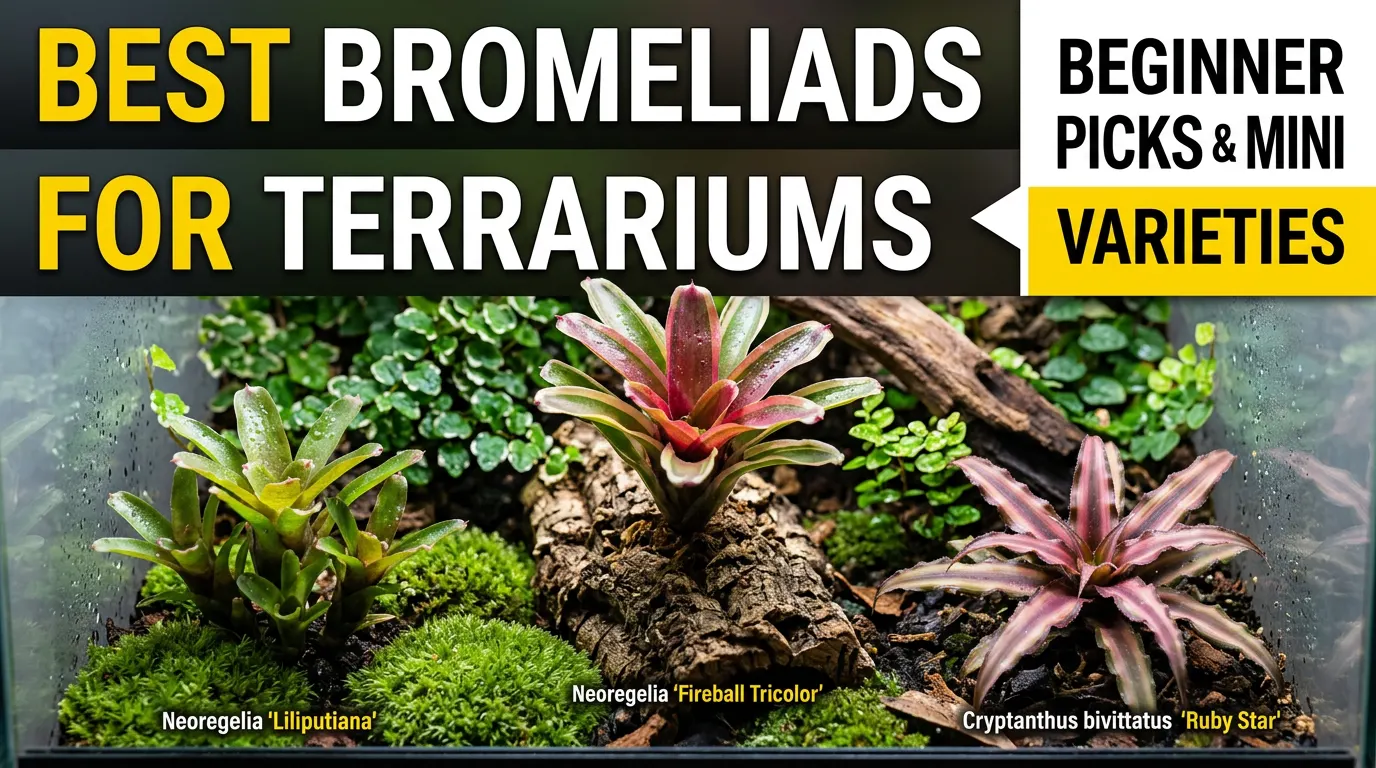
| Cryptanthus (“earth star”) | 3-8 inches across | Naturally small, low-growing, no tall bract to outgrow the space, one of the most terrarium-scaled bromeliads there is |
| Mini Neoregelia varieties | 4-8 inches across | Compact rosette, colorful foliage, tolerates the humidity of a closed setup well |
| Tillandsia (air plants) | 1-6 inches, species-dependent | No soil, no pot, easiest to fit into tight hardscape or mount on wood, covered in more depth in my types guide |
| Mini Guzmania cultivars | 6-10 inches | Same easy care as standard Guzmania, scaled down to fit a smaller container |
| Neoregelia ‘Fireball’ (or similar dwarf red cultivars) | 4-6 inches | Reliable color even in lower light, one of the most widely available mini cultivars at general nurseries |
The “pink pineapple” bromeliad sold in some nurseries is typically a dyed or specially bred pink-toned Guzmania or similar cultivar; its care is identical to a standard Guzmania of the same size; the pink coloring is cosmetic, not a different care requirement. The dye or color treatment (where used) is applied to the bract and doesn’t affect the plant’s health, though it also won’t be passed on to any pups the plant produces; offsets will typically revert to the cultivar’s natural coloring.
A closer look at each pick
Cryptanthus
Cryptanthus is probably the single most terrarium-friendly bromeliad genus that exists, and it’s a shame it doesn’t get more attention outside dedicated plant circles. It grows as a flat, star-shaped rosette with wavy, often boldly striped or colored leaves, stays low to the substrate rather than reaching upward, and doesn’t hold water in a central cup the way most other bromeliads do, it’s watered more like a typical terrestrial plant, with light moisture at the roots rather than a topped-up reservoir. That makes it slightly different from the cup-watering routine that applies to most of the rest of this list, so it’s worth knowing going in rather than being surprised by an empty-looking center.
Mini Neoregelia
Neoregelia is the genus most people picture when they think “colorful bromeliad”, the color lives in the leaves themselves rather than in a separate flower bract, and it often intensifies with brighter light. Mini cultivars keep that same vivid coloring at a fraction of the standard size, and they’re forgiving of the humidity swings a beginner’s terrarium is likely to have while they’re still dialing in a routine.
Tillandsia
Air plants are the outlier on this list in the best way, no substrate, no pot, no planting depth to worry about. They can be wedged into hardscape gaps, perched on moss, or mounted on bark, and they’re genuinely the easiest thing to rearrange if you change your mind about a layout later, since nothing needs to be dug up. The tradeoff is that most Tillandsia need to be misted or briefly soaked periodically rather than relying on a water-filled cup, so their watering routine is a bit more hands-on than a cup-forming bromeliad’s, even though everything else about them is lower-maintenance.
Mini Guzmania
Standard Guzmania is one of the most common bromeliads sold at general garden centers, prized for its long-lasting, brightly colored central bract. Mini cultivars bring that same reliable, showy bloom into a container small enough for a terrarium, though they do generally need a bit more room than Cryptanthus or the smallest Neoregelia minis, plan for a mid-size container rather than the smallest jar you own.

How to identify what you actually have
If it came without a label, work from the same identification points I use in the types guide: does it have a visible central cup and soil-grown roots, or minimal roots and no cup (Tillandsia)? Is the bract tall and upright (Guzmania), flat and sword-shaped (Vriesea), or is the color mostly in the leaves themselves with a low, hidden flower (Neoregelia)? A very small, star-shaped, wavy-edged rosette with no tall bract at all usually points to Cryptanthus.
A few finer points that help narrow it down further once you’ve ruled out the obvious candidates: leaf edges with small spines usually mean Aechmea rather than the smoother-edged genera; a rosette that stays flat against the ground rather than forming an upright cup, combined with wavy or ruffled leaf margins, is a strong Cryptanthus signal even without seeing a flower; and a plant with almost no visible roots at all, growing loosely rather than anchored in substrate, is very likely a Tillandsia regardless of its size. When in doubt, a photo posted to a houseplant identification forum or subreddit, showing the whole plant plus a close-up of the leaf base, usually gets a confident answer within a day.

What should you expect to pay?
Pricing varies a lot by size, species, and where you’re buying; a small nursery-grown mini bromeliad or Tillandsia is generally one of the more affordable terrarium plants available, noticeably cheaper than a blooming full-size specimen from a florist or garden center. If you’re building on a budget, mini varieties and air plants are the more economical route into terrarium bromeliads, not just the more practical one. Local nurseries, plant swaps, and getting a pup from a friend’s already-established plant are all worth checking before paying retail for a specimen-sized bloomer.
Where you buy also affects what you actually get. Big-box garden centers tend to carry standard-size, actively blooming Guzmania and similar showy genera, priced for the bloom rather than the plant’s long-term size, fine for a temporary display, less ideal for a permanent terrarium resident. Specialty bromeliad growers and online plant sellers are more likely to correctly label true mini and dwarf cultivars, and are usually the more reliable source if a specific mature size matters to your build. A plant swap or a pup from someone else’s established mini is often both the cheapest and most reliably “actually mini” option, since you can see the parent plant’s size in person before taking a piece of it.

Picking for a specific terrarium style
Which of these picks makes the most sense also depends a bit on what kind of terrarium you’re building, not just container size. A closed, high-humidity build favors Cryptanthus and mini Neoregelia, both of which handle consistently damp air well without extra fuss. An open or lightly-vented terrarium that dries out faster between waterings suits Tillandsia especially well, since air plants are naturally adapted to intermittent moisture rather than constant humidity. A bioactive vivarium built for a frog or gecko, which I cover in detail separately, leans toward mini Neoregelia for its sturdy, cup-forming structure, since that’s the pick most likely to hold up to an animal climbing on it while still forming a usable water reservoir; see my bromeliads for a dart frog or crested gecko vivarium guide if that’s the build you’re planning.
Frequently asked questions
Will a mini bromeliad stay small forever, or does it eventually grow full-size?
A genuine mini or dwarf cultivar stays small; it’s a distinct, smaller-growing variety, not a young full-size plant that will eventually catch up. If a “mini” specimen keeps growing well past what you’d expect, it may have been mislabeled as a young standard-size plant rather than a true dwarf cultivar.
Are pups from a terrarium bromeliad the same variety as the parent?
Yes, pups are genetically identical offsets of the parent plant, so a mini cultivar’s pups will also stay mini. It’s a reliable, free way to keep a terrarium stocked with plants you already know fit the space.
Which bromeliad is the easiest for an absolute beginner?
A mini Neoregelia, specifically one of the widely available red or green dwarf cultivars, is a reasonable default first pick; it tolerates a range of light and humidity levels, forms a usable water-holding cup, and its color gives an easy visual signal of whether it’s happy (bright, saturated color) or struggling (fading, stretching, or losing color).
Can Tillandsia go in the same terrarium as a cup-forming bromeliad?
Yes, and they pair well; mounting a Tillandsia higher up on a piece of bark or hardscape while a Cryptanthus or mini Neoregelia sits lower in the substrate makes good use of vertical space without either plant competing for the same footprint or light.
How do I know if a “mini” bromeliad for sale is actually a dwarf cultivar and not just a young plant?
Ask if buying in person, or check the listing for a specific cultivar name rather than just the word “mini” attached to a common species. A true dwarf cultivar will usually be sold under its own cultivar name (like a specific Neoregelia hybrid), while a generic, unnamed “mini” label on a common species is more likely to just be an immature standard-size plant that hasn’t reached full size yet.
Do mini bromeliads need different light than standard-size ones?
No, light needs track with genus and species, not size. A mini Neoregelia wants the same bright, indirect light a standard Neoregelia would, just in a smaller footprint. See my bromeliads-in-a-terrarium guide for lighting specifics that apply regardless of the cultivar’s size.
Once you’ve picked a plant, the step-by-step build guide covers getting it planted, and my companion planting guide covers what to grow alongside it.




Leave a Reply