BROMELIAD GUIDE · UPDATED OCTOBER 2026
By Everydaything Team · Last updated October 2026
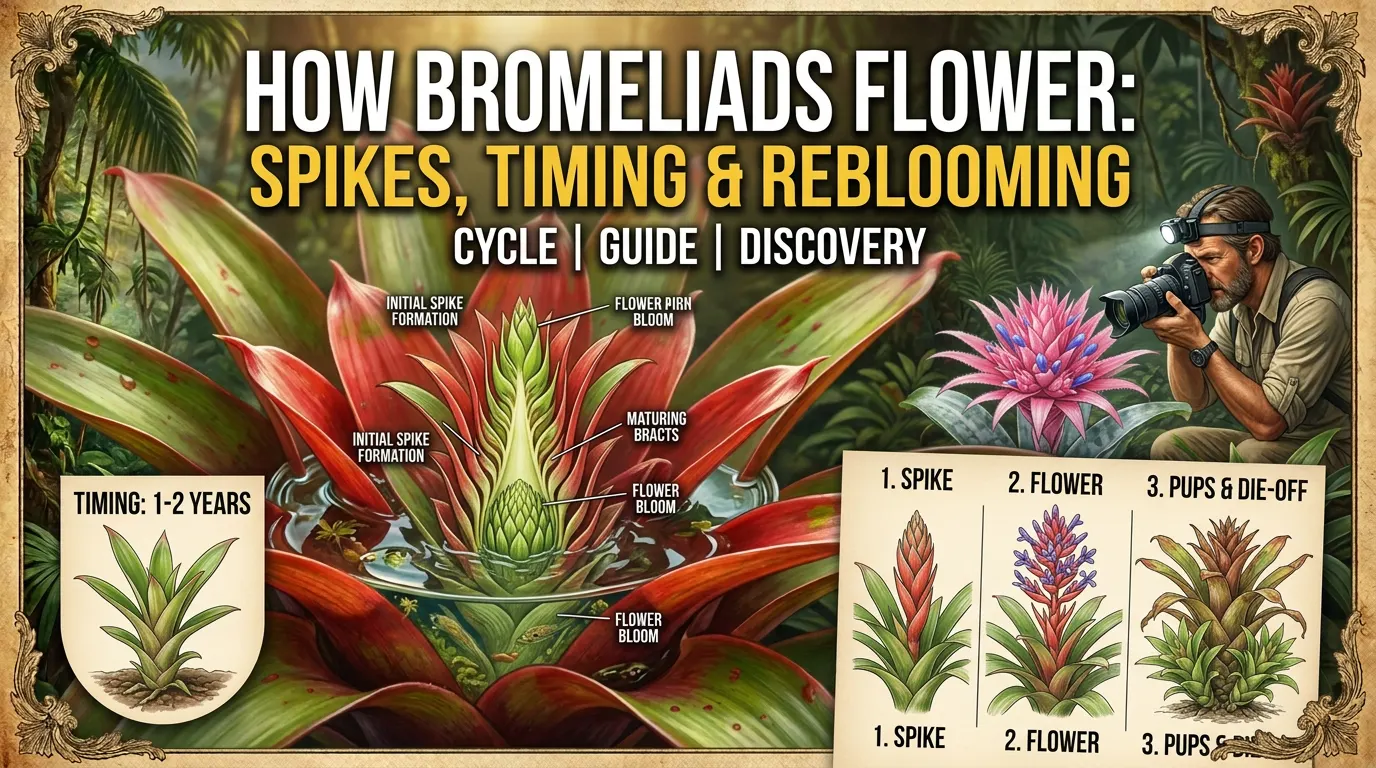
Bromeliads flower just once in the life of each rosette. A mature plant produces a flower spike or a colourful bract display that lasts for months, then slowly declines while pups grow at its base. Those pups flower in turn, usually one to three years later, sometimes longer.
Our complete bromeliad care guide explains the one-bloom cycle in a few paragraphs. This guide goes deeper: what the colourful part really is, how long each stage takes, why a healthy plant refuses to bloom, and how the well-known apple trick works, with the cautions university sources attach to it.
Quick facts: how bromeliads flower
| Question | Short answer |
|---|---|
| How often does one rosette bloom? | Once; the plant then produces pups (RHS, BSI, Clemson) |
| How long does the display last? | Several months, up to a year depending on species (University of Missouri) |
| Apple trick to flowering | About 6 to 14 weeks after treatment (bromeliads.info, Clemson) |
| Pup to first flower | About a year in one source, two to three years in another; some species take far longer |
| Mother plant decline | Over roughly one to two years (Colorado State) |
| Pup removal size | About one-third to one-half of the parent |
Is the colourful part of a bromeliad a flower or a bract?
Usually it is a bract, a modified leaf, and the true flowers are small. The RHS notes that a bromeliad display lasts several months while the true flowers are small and insignificant. The University of Missouri’s extension article describes the bracts as the colourful structures surrounding the actual flowers.
Botanically, Bromeliaceae flowers have a calyx of three sepals and a corolla of three petals, often accompanied by brightly coloured bracts. That is why a plant can look in full bloom for months: you are admiring the bracts, not the flowers themselves.

What do bromeliad flower spikes look like?
They vary by genus: some are elongated spikes, others are panicles or racemes, and some bloom from the centre of the rosette. UW-Madison’s horticulture extension lists spikes, panicles, racemes and centre-of-rosette blooms as the main forms, and says flowering can last from a few weeks to a full year depending on species.
- Vriesea: Clemson notes they flower in late winter with brightly coloured spikes that last several months.
- Aechmea and Vriesea: a UConn greenhouse trial summarised in an extension document describes them as short-day species and winter flowerers.
- Vriesea pups: Missouri Botanical Garden notes that new plants can develop within the original rosette in this genus.
Not sure which genus you own? Our guide to types of bromeliads helps you identify it.
How long does it take a bromeliad to flower?
A pup typically needs about one to three years to reach flowering size, and the display then lasts months. The exact span depends on species, light and warmth. Missouri Botanical Garden’s care factsheet says blooming timelines vary significantly by species, from annual to four or more years, and that Puya raimondii may take 20 years.
| Stage | Typical timing | Source |
|---|---|---|
| Pup grows to flowering size | About 1 year to 3 years; longer for some species | bromeliads.info, Colorado State, Missouri Botanical Garden |
| Apple-trick treatment to visible flowering | 6 to 14 weeks | bromeliads.info, Clemson |
| Colourful display | Several months, up to a year | University of Missouri |
| Mother plant declines | Over 1 to 2 years | Colorado State |
Sources: bromeliads.info, Clemson HGIC, Colorado State PlantTalk.
Do bromeliads flower more than once?
Almost never. Most rosette bromeliads are monocarpic, meaning each rosette flowers once and then redirects its energy into pups. The Bromeliad Society International’s FAQ notes an exception: some Deuterocohnia species can rebloom on perennial flower spikes for up to six years.
So “reblooming” really means growing on the next generation. Our bromeliad vs orchid comparison covers how this differs from the plants they are most often confused with.
Why is my bromeliad not flowering?

The usual reasons are immaturity, too little light, and a lack of day-to-night temperature swing. A plant has to reach flowering size first, so a young pup will not bloom no matter how well it is treated.
Bromeliads.info lists four factors that must work together: temperature fluctuation, light, humidity and water. It says that without a day-night swing of 10 to 15 degrees F (roughly 5.5 to 8 degrees C), a plant may grow plenty of foliage and stubbornly refuse to flower. UW-Madison gives a preferred range of 70 to 90 degrees F by day (21 to 32 degrees C) and 50 to 65 degrees F at night (10 to 18 degrees C).
- Age: bromeliads.info says pups typically need about a year of growth before they are ready to bloom, and other sources say two to three years.
- Light: bright indirect light helps; see our guide to bromeliad indirect light for foot-candle ranges and Indian window directions.
- Temperature: a constant air-conditioned room removes the day-night swing the sources describe.
- Water: avoid overwatering; soil should stay moist but never constantly wet.
How does the apple trick work, and is it safe?
A ripe apple releases ethylene gas, a plant hormone, and sealing a mature bromeliad in a bag with one can trigger flowering in about 6 to 14 weeks. It is a documented method on university pages, but the advice on duration varies, so treat it as a careful experiment rather than a guarantee.
What the sources say:
- Clemson says a clear airtight bag with a ripe apple for two to three days, with flowers in 6 to 14 weeks.
- The University of Missouri and bromeliads.info say 7 to 10 days.
- A UConn greenhouse study summarised in an extension document used four to five days.
- The RHS says up to two weeks in a sealed container with apples or bananas.
- The BSI says about a week, out of direct sun.
Bromeliads.info adds an important step: drain the water from the central cup before sealing the bag. A closed bag in sun can overheat, so keep it in shade and check daily. Our own suggestion, not a source claim, is to use the shorter end of the range in hot Indian weather, because trapped heat is a bigger risk than too little ethylene.
Caution: what not to do
- Use only healthy, mature plants. UConn work cited by an extension service found that immature or partly developed pups responded erratically or not at all.
- Do not leave the plant sealed in warm, bright conditions.
- Skip commercial flower-inducing chemicals. Bromeliads.info says products such as Ethrel and Omaflora are tricky to regulate, may interfere with pup development, and should be left to professionals.
- Refill the cup and return the plant to its normal spot once the bag comes off.
What happens to the mother plant and pups after flowering?
The mother rosette declines slowly while pups grow at its base. Colorado State’s PlantTalk says the decline plays out over one to two years. Separate pups when they reach about one-third to one-half of the parent’s size, and the BSI notes that removing smaller pups can encourage the mother to produce more, while leaving them attached lets them mature faster.
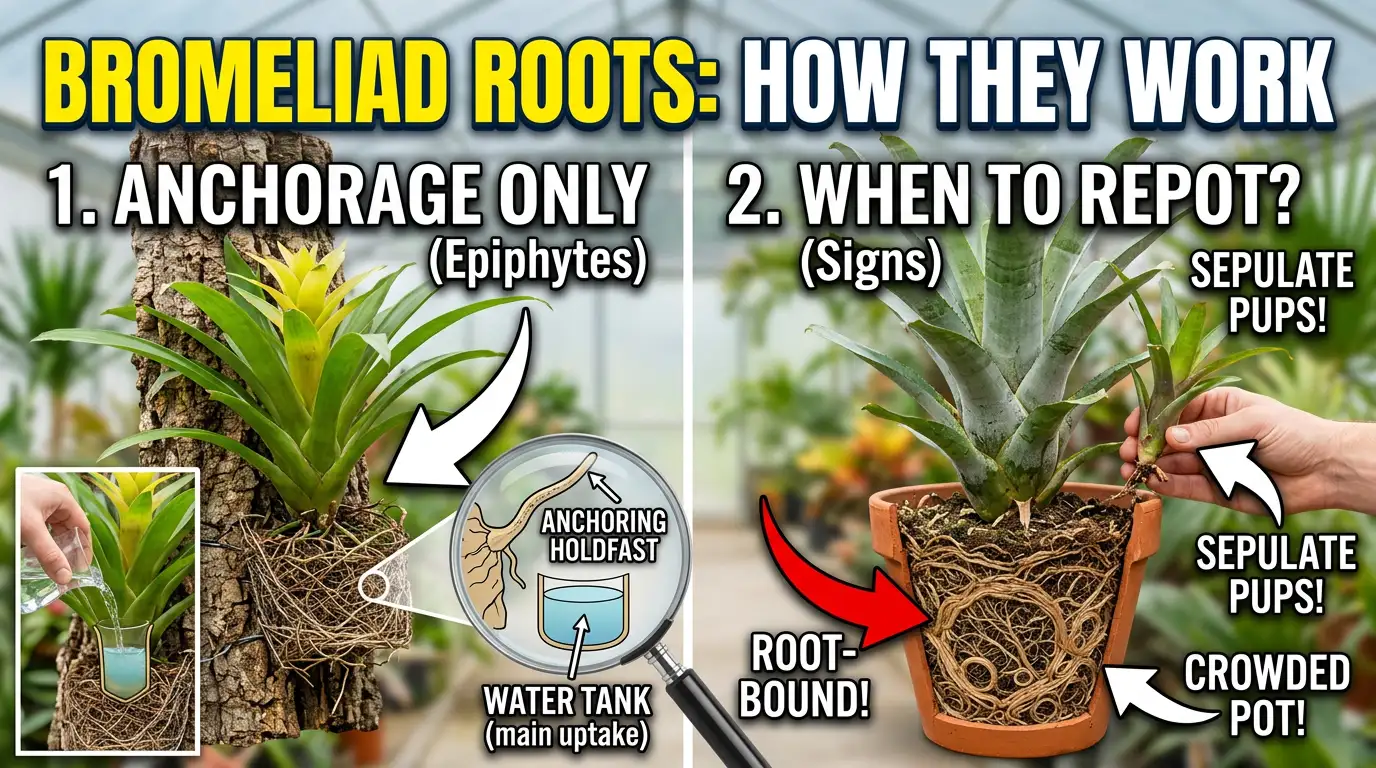
The University of Missouri adds that you can leave pups attached and flower them using the apple method. A fading bloom is not necessarily a dying plant, and our bromeliad problems guide shows how to tell the two apart. For step-by-step separation, see Fish Bazaar’s bromeliad propagation guide, and for what happens below the surface when a pup is potted up, see our guide to bromeliad roots.

Tips for flowering bromeliads in Indian conditions
The main India-specific hurdles are heat, constant air-conditioned temperatures, and monsoon humidity. These tips are our practical reading of the sources, not Indian trial data; for the regional and seasonal view, see our guide to growing bromeliads in India.
- Summer heat: the RHS suggests around 21 degrees C in summer to encourage flowering, and UW-Madison’s preferred day range tops out near 32 degrees C. Many Indian cities run 35 to 45 degrees C in April and May, so keep plants shaded and ventilated, and do not run the apple trick in a hot closed bag.
- Air-conditioned rooms: a steady 24 degrees C day and night gives no swing. Place a plant that refuses to bloom near a window or balcony for part of the day.
- Winter nights: in northern cities cool nights may supply the swing naturally, but the RHS advises bringing tender plants indoors before temperatures fall toward 10 degrees C. The RHS also says cooler air of about 12 degrees C after buds form prolongs the display.
- Monsoon: high humidity helps leaves but raises rot risk in the cup. Flush the cup regularly and keep air moving.
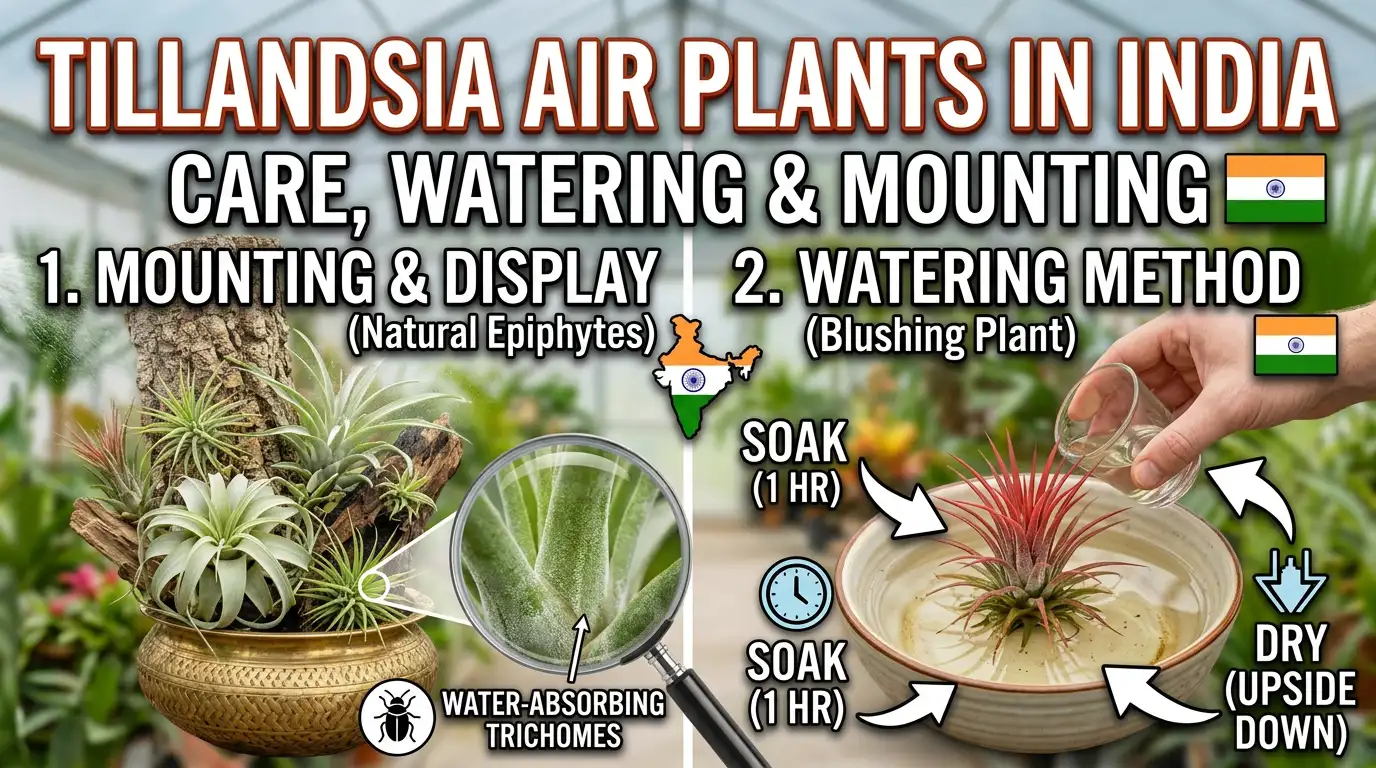
Planning a display with several plants? Our bromeliads in a terrarium guide covers how they behave in glass, and our new guide to Tillandsia air plants covers the genus that flowers once and pups in the same way.
Where to get bromeliads that will flower
Disclosure: Fish Bazaar is operated by the same team that publishes this site. Its Neoregelia and Aechmea collections list established plants, sold as sets of 10, which suits big builds and shared orders better than buying one plant. Because live plants are non-returnable there, report any damage on arrival. Prices and policies change, so check before ordering. For the shop’s own take, read its bromeliad flowering guide.
Frequently asked questions
Do bromeliads flower more than once?
Each rosette flowers once, then produces pups that flower later. A few genera such as Deuterocohnia can rebloom on perennial spikes for several years.
How long do bromeliad flowers last?
The colourful bract display lasts several months and up to a year, depending on species and conditions. The true flowers are small and easy to miss.
How long does a bromeliad take to bloom?
Pups typically need about one to three years to reach flowering size, and some species take much longer. After apple treatment, flowers appear in about 6 to 14 weeks.
Does the apple trick really work for bromeliads?
University extension pages describe it, and it works on mature plants because ripe fruit releases ethylene. It cannot make an immature plant flower.
How long should a bromeliad stay in a bag with an apple?
Sources range from two or three days up to two weeks. Drain the cup first, keep the bag out of direct sun, and use the shorter end in hot weather.
Is the bromeliad flower really a bract?
Usually yes. The bright, long-lasting colour comes from bracts, while the true flowers are small and easy to miss.
Why is my bromeliad not flowering?
It may be too young, receive too little light, or lack a day-night temperature swing of about 10 to 15 degrees F. Overwatering can also hold it back.
Do bromeliads die after flowering?
The flowered rosette slowly declines over one to two years, but it leaves pups that carry on the plant. This is normal, not a failure of care.
Can the apple trick harm my bromeliad?
It can if the plant is immature, the bag overheats, or water is left in the cup. Chemical flower inducers are best left to professionals.
This article is general horticultural information, not veterinary or professional advice. The ASPCA lists Neoregelia as non-toxic to dogs and cats, but stiff leaf edges can scratch, so check with a vet if a pet chews a plant.
References
- Royal Horticultural Society, How to grow bromeliads
- Clemson Home and Garden Information Center, Bromeliads
- UW-Madison Division of Extension Horticulture, Bromeliads
- Bromeliads.info, Bromeliad blooming: an overview
- Bromeliad Society International, Frequently asked questions
- University of Missouri IPM, Bromeliads: houseplants that endure
- Missouri Botanical Garden, Bromeliad care and culture
- Colorado State University PlantTalk, Bromeliads
- NC State Extension hortscans, Bromeliad flower induction (UConn trial summary)
- Wikipedia, Bromeliaceae
- ASPCA, Neoregelia toxicity
Related Guides
- Bromeliad Care: The Complete Guide to Growing Them Indoors
- Bromeliad Problems: Yellow Leaves, Root Rot & Common Issues
- Fish Bazaar: Bromeliad propagation guide for India
- Where to Buy Bromeliads Online in India
- Growing Bromeliads in India: Climate, Regions & Seasons
- Bromeliad Light Requirements: Indirect Light Explained
- Bromeliad Roots
- Tillandsia Air Plants in India: Care, Watering & Mounting
- Epiphytic vs Terrestrial Bromeliads




Leave a Reply