BROMELIAD GUIDE · UPDATED OCTOBER 2026
By Everydaything Team · Last updated October 2026
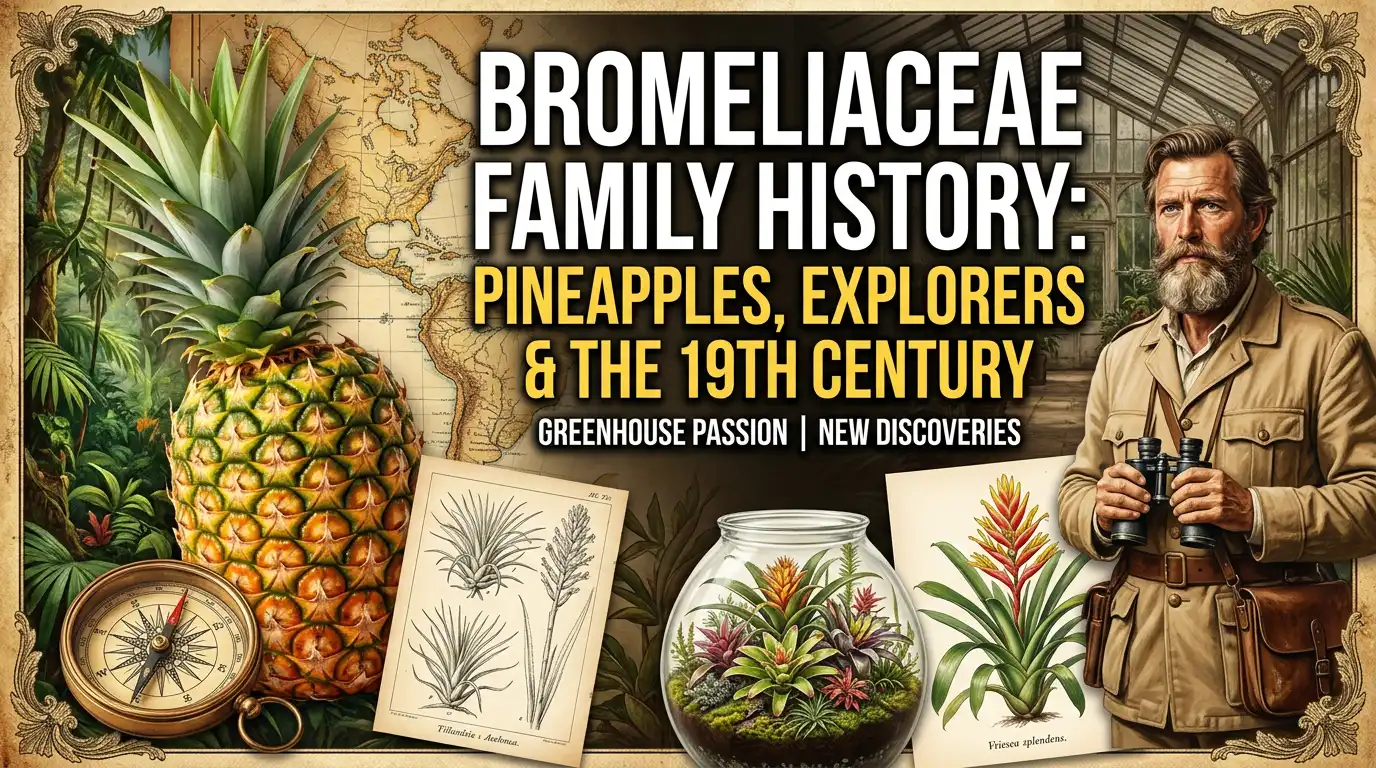
The family Bromeliaceae is the pineapple family: roughly 3,000 to 3,700 flowering plants native almost entirely to the tropical Americas. Its story runs from ancient pineapple use in the Andes, through Columbus in 1493 and the naming of Bromelia in 1703 and 1753, to the breeders of 19th-century Belgium and France.
Family Bromeliaceae timeline at a glance
| Date | Event | Source |
|---|---|---|
| 1200-800 BC | Archaeological evidence of pineapple use in Peru; later evidence in Mexico (200 BC-700 AD) | Wikipedia: Pineapple |
| 4 Nov 1493 | Columbus meets pineapples on Guadeloupe and takes the plant to Spain | Wikipedia: Pineapple |
| 1703 | Charles Plumier establishes the genus Bromelia in Nova plantarum americanarum genera | Grant catalogue |
| 1720s-1730s | Pineapples reach English and French gardeners as luxury status symbols | Wikipedia: Pineapple |
| 1753 | Linnaeus publishes Bromelia in Species Plantarum, including Bromelia ananas | Kew POWO |
| 1776 | Guzmania lingulata arrives in Europe, the second bromeliad in cultivation there | Bromeliad Society International |
| 1789 | Jussieu publishes the family name Bromeliaceae | IPNI |
| 1828 | Aechmea fasciata enters European gardens | Bromeliad Society International |
| 1840 | Vriesea splendens reaches cultivation in Europe | Bromeliad Society International |
| 1879 | Eduard Morren at Liège makes the first Vriesea cross, V. ‘Morreniana’ | Florida Council of Bromeliad Societies |
| 1880-1900 | Léon Duval in Paris introduces many Vriesea cultivars | Florida Council of Bromeliad Societies |
| 1917 | Merrill assigns the pineapple its modern name, Ananas comosus | ITF |
| 1937 | Henri Jacques-Félix finds Pitcairnia feliciana in Guinea | Wikipedia |
| 1920s-1940s | Breeding slumps after two world wars; much hybrid material is lost | Florida Council of Bromeliad Societies |
What is the family Bromeliaceae?
Bromeliaceae is a family of monocot flowering plants in the order Poales, native mostly to the tropical and subtropical Americas. Britannica counts more than 3,000 species in 56 genera, while Wikipedia gives about 3,700 species in some 80 genera. The gap is real and it is taxonomy, not carelessness: botanists keep redrawing genus boundaries as DNA evidence arrives.

If you only want the definition, pronunciation and name origin, our shorter explainer What Is a Bromeliad? covers those. This article goes deeper into where the family came from and how humans found, named, bred and, in some cases, endangered it.
How did the family get its name?
The name moved in three steps. First, Charles Plumier, a French botanist who made Caribbean plant-collecting voyages for Louis XIV, created the genus Bromelia in his 1703 Nova plantarum americanarum genera. According to Wikipedia on Plumier, that Paris book, published in 1703-04, held about 100 genera and roughly 700 species, and his journeys began in 1689, 1693 and 1695.
Second, Linnaeus adopted the name in 1753. The annotated catalogue of bromeliad generic names notes that Linnaeus took a conservative line, keeping only Bromelia and Renealmia from Plumier’s set and pushing older American names such as Caraguata and Karatas into synonymy. Third, Antoine Laurent de Jussieu published Bromeliaceae on 4 August 1789 in Genera plantarum, and the International Plant Names Index lists it as a conserved name with Bromelia as the type genus.
The honoree was the Swedish physician and botanist Olof Bromelius (1639-1705), per Wikipedia’s entry on Bromelia.
How did the pineapple become the family’s best-known crop?
The pineapple, Ananas comosus, is native to South America, and Wikipedia records archaeological evidence of use in Peru around 1200-800 BC. Its name comes from the Tupi word nanas. Christopher Columbus met the fruit on Guadeloupe on 4 November 1493 and carried it back to Spain, where it was called “piña de Indes”, or pine of the Indians.
Growing it in Europe was another matter. Pieter de la Court (1664-1739) developed greenhouse horticulture near Leiden, and by the 1720s and 1730s English and French gardeners were raising pineapples as luxury status symbols. In scientific naming, Linnaeus first called the plant Bromelia ananas and Bromelia comosa in 1753; the modern Ananas comosus dates to Merrill in 1917, according to the International Tropical Fruits Network.
Today the pineapple is the family’s only major food crop. Wikipedia reports global output of about 29 million tonnes in 2024, led by Costa Rica, the Philippines and Indonesia at roughly 3 million tonnes each. A second product, bromelain, is extracted from pineapple stems and is used in meat tenderiser. For the pineapple’s place among the wider plant family, see how it compares in our types of bromeliads guide.

What happened to bromeliads in the 19th century?
The 19th century moved bromeliads from curiosity to commodity. The Bromeliad Society International says they were once found only in royal botanical gardens or the private greenhouses of wealthy Europeans. Three plants that still sell today show the timeline: Guzmania lingulata in 1776, Aechmea fasciata in 1828 and Vriesea splendens in 1840.
Then came the breeders. Wikipedia states that from the 19th century Belgian, French and Dutch breeders hybridised bromeliads for the wholesale trade. A detailed account of Vriesea breeding from the Florida Council of Bromeliad Societies names Eduard Morren, curator of the botanical garden at Liège, as the author of the first cross in 1879. Jos. Maréchal and J. Chevalier worked from Liège as well, and Léon Duval in Paris introduced many cultivars between 1880 and 1900.
The boom did not last. After the First World War, economic depression and then the Second World War disrupted breeding, and most hybrid material was lost. Breeders restarted in the 1950s with little genetic stock; Belgian growers, notably the Deroose family, later became known for branched-inflorescence hybrids propagated by tissue culture.
Was there a “Victorian bromeliad craze”?
You will see that phrase online, but we could not find a source that frames the documented activity as a distinctly British Victorian boom. What the sources we checked do support is wealthy-collector greenhouses across Europe plus Belgian, French and Dutch commercial hybridising. We have kept to that.
Who were the explorers?
Plumier is the clearest early example, travelling to the Antilles for the French crown. In the 20th century Henri Jacques-Félix’s 1937 find in Guinea reshaped the map of the family, and the Bromeliad Society notes that the species epithet fosteriana honours the American collector Mulford Foster’s contributions to bromeliad study.
How many subfamilies does Bromeliaceae have?
Eight. The Bromeliad Society International explains that DNA research over the past decade or so reorganised the family into eight subfamilies, and Wikipedia lists the same eight. The figures below are the ones the sources give, and they will drift as research continues.
| Subfamily | What to know |
|---|---|
| Bromelioideae | The pineapple subfamily; berry-like fruits; includes Aechmea (255 species), Neoregelia (112), Billbergia (64), Cryptanthus (63) and Ananas (2). Wikipedia counts about 40 genera and 1,200 species; the Bromeliad Society’s older count is 47 genera. |
| Tillandsioideae | About 1,400 species in 25-plus genera, the largest subfamily by species; feathery winged seeds; includes Tillandsia, Guzmania and Vriesea. |
| Pitcairnioideae | Redefined after DNA work showed the old grouping was not a single lineage; now five genera and roughly 600 species, with Pitcairnia (400-plus) and Dyckia (130). |
| Puyoideae | One genus, Puya, with 218 species according to the Bromeliad Society. |
| Hechtioideae | Split from the old Pitcairnioideae; centred on the genus Hechtia. |
| Navioideae | Another group carved out of the old Pitcairnioideae, including Navia. |
| Lindmanioideae | A small subfamily listed by Wikipedia and the Bromeliad Society. |
| Brocchinioideae | A small subfamily that includes the carnivorous tank bromeliad Brocchinia reducta. |
Details on the Bromelioideae and Tillandsioideae come from their Bromelioideae and Tillandsioideae pages; the Pitcairnioideae restructuring is described on its own Wikipedia page, which also notes that Puya, Hechtia and Navia now sit in separate subfamilies.
Where in the world do bromeliads grow?
Kew’s Plants of the World Online describes a range from Virginia and Texas to central Argentina and Chile, from sea level to above 4,000 metres in the Andes, with outliers on the Galápagos and Juan Fernández Islands. A conservation-genetics review hosted on PubMed Central identifies the Atlantic Forest of Brazil, the Andes, Central America and southern Venezuela as centres of endemic species.
Why is Pitcairnia feliciana the odd one out?
Pitcairnia feliciana is the only bromeliad native outside the Americas. Wikipedia says Henri Jacques-Félix found it in 1937 on Mount Gangan near Kindia in former French Guinea, growing on the sandstone outcrops, or inselbergs, of the Fouta Djallon highlands. Its ancestor is thought to have crossed the Atlantic roughly 10 to 12 million years ago, probably as seed carried by birds, rather than being a leftover from a drifting continent. The orange-red, nectar-rich flowers suggest bird pollination, although no pollinator has been documented. The IUCN rates it Endangered.
Are bromeliads endangered?
Many are at risk, and we know less than we would like. The conservation-genetics review on PubMed Central reports that only about 7 percent of bromeliad species have been formally evaluated for threat status, and roughly 81 percent of those evaluated were considered probably threatened, mostly through habitat loss in the Atlantic Forest and Andean slopes. Britannica lists the giant Puya raimondii as endangered.
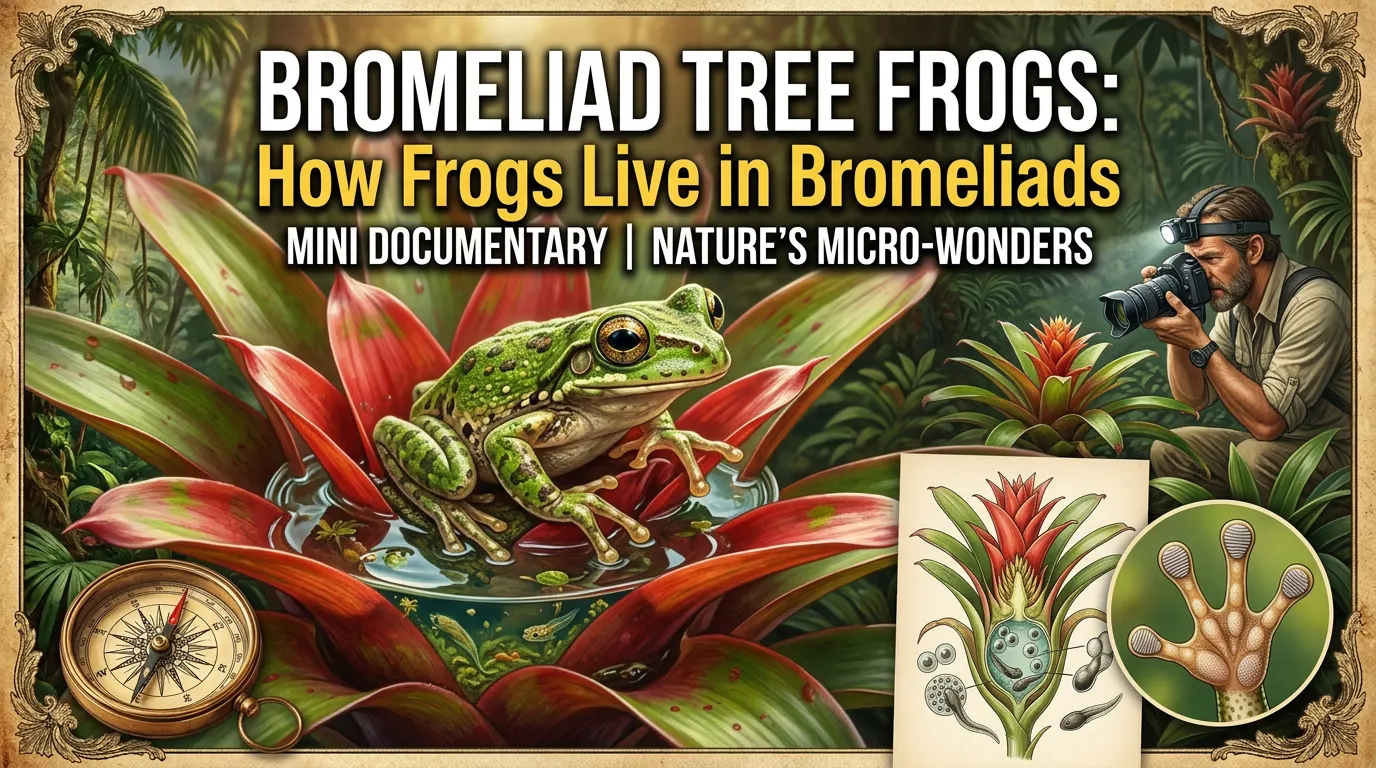
The stakes go beyond the plants. A Kent University thesis on the frog Crossodactylodes itambe, indexed in the Kent Academic Repository, found that the frog spends its whole life cycle inside bromeliads, lives in a range under 0.5 square kilometres and depends on a single endemic bromeliad species. A systematic review of 311 studies adds that Brazilian forests can store more than 40,000 litres of water per hectare in bromeliad tanks. Lose the plants and you lose a lot of tiny, water-based habitat. We cover the wild frogs in Bromeliad Tree Frogs and the captive side in our dart frog and crested gecko vivarium guide.
What does this history mean for growers in India?
Practically, three things. First, every bromeliad you grow in India is an import or the descendant of one, so ask sellers whether plants are nursery-grown. Second, most ornamental bromeliads on sale are hybrids and cultivars, the product of the breeding tradition above. Third, family-level knowledge helps with care: a tank rosette such as Neoregelia and a trichome-covered Tillandsia need different watering. Start with our complete bromeliad care guide, then read Growing Bromeliads in India: Climate, Regions & Seasons for how heat, monsoon and winter change the routine. The bromeliads in a terrarium guide covers enclosed setups.
Disclosure: Fish Bazaar is run by the same team as this site. If you want genera from the subfamilies above, Fish Bazaar lists Aechmea, Neoregelia and Tillandsia air plants, and has a companion explainer, Bromeliaceae Family History and Species Explained. Sets are sold in tens, so single-plant buyers may prefer another seller. Prices and policies change, so check before ordering.
Family Bromeliaceae: frequently asked questions
What is the family Bromeliaceae?
It is the pineapple family, a group of roughly 3,000 to 3,700 flowering plants in the order Poales, native mainly to the tropical Americas.
Who named the Bromeliaceae?
Plumier created the genus Bromelia in 1703, Linnaeus adopted it in 1753, and Jussieu published the family name Bromeliaceae in 1789.
How many species are in the family Bromeliaceae?
Estimates range from about 3,000 (Britannica, Kew at 3,086 taxa) to about 3,700 (Wikipedia), depending on the classification used.
Is the pineapple in the family Bromeliaceae?
Yes. Ananas comosus is a bromeliad and the family’s only major commercial food crop.
How many subfamilies does Bromeliaceae have?
Eight: Bromelioideae, Tillandsioideae, Pitcairnioideae, Puyoideae, Hechtioideae, Navioideae, Lindmanioideae and Brocchinioideae.
Are any bromeliads native outside the Americas?
Only one: Pitcairnia feliciana, found in Guinea, West Africa. It is rated Endangered by the IUCN.
When did bromeliads become popular houseplants?
Species such as Guzmania lingulata (1776), Aechmea fasciata (1828) and Vriesea splendens (1840) reached Europe early, and Belgian, French and Dutch breeders began hybridising bromeliads commercially in the 19th century.
Are bromeliads endangered?
Many are. A conservation review reports that only about 7 percent of species have been assessed and about 81 percent of those were considered probably threatened.
Do bromeliads grow wild in India?
No. The family is native to the Americas apart from one species in Guinea, so bromeliads in India are cultivated plants.
References
- Wikipedia: Bromeliaceae
- Wikipedia: Bromelia
- Wikipedia: Charles Plumier
- Wikipedia: Pineapple
- Wikipedia: Pitcairnia feliciana
- Wikipedia: Bromelioideae
- Wikipedia: Tillandsioideae
- Wikipedia: Pitcairnioideae
- Encyclopaedia Britannica: Bromeliaceae
- Kew Plants of the World Online: Bromeliaceae
- Kew Plants of the World Online: Bromelia
- International Plant Names Index: Bromeliaceae
- Grant, J.R.: An annotated catalogue of the generic names of the Bromeliaceae
- International Tropical Fruits Network: Pineapple name, taxonomy and botany
- Florida Council of Bromeliad Societies: Vriesea hybrids of today and yesteryear
- Bromeliad Society International: What are bromeliads?
- Bromeliad Society International: Taxonomy introduction
- Genetic diversity and conservation in Bromeliaceae based on SSR markers (PubMed Central)
- Ecosystem services provided by bromeliad plants: a systematic review (PubMed Central)
- Frogs in plants: ecology and conservation of a bromeliad-dwelling amphibian from Brazil (Kent Academic Repository)
Related Guides
- What Is a Bromeliad? Meaning, Pronunciation & Quick Facts
- Bromeliad Plant Benefits: Air Purifying Myths, Mosquitoes & Pets
- Types of Bromeliads Guide
- Bromeliad Care: The Complete Guide to Growing Indoors
- Fish Bazaar: Bromeliaceae Family History and Species Explained
- Where to Buy Bromeliads Online in India
- Growing Bromeliads in India: Climate, Regions & Seasons
- Bromeliad Tree Frogs
- Epiphytic vs Terrestrial Bromeliads
- Tillandsia Air Plants in India
- How Do Bromeliads Flower?

Leave a Reply