
BROMELIAD GUIDE · UPDATED OCTOBER 2026
By Everydaything Team · Last updated October 2026
Bromeliads in India do well indoors and on shaded balconies in most regions, even though none is known to be native here. The family is American apart from one West African species, Pitcairnia feliciana, so success depends on matching shade, water and temperature to your local season.
Are bromeliads native to India?
No bromeliad is known to be native to India. Wikipedia’s Bromeliaceae entry describes a family of roughly 80 genera and 3,700 species, almost all from the tropical Americas, with a single exception: Pitcairnia feliciana, found in West Africa and described as the only bromeliad not native to the Americas.

The exception is a good story. Wikipedia’s page on the species says it grows on sandstone outcrops in the Fouta Djallon highlands of Guinea and was collected in 1937 by the French botanist Henri Jacques-Félix on Mount Gangan near Kindia. Its ancestors probably crossed the Atlantic as seeds, perhaps carried by birds, roughly 10 to 12 million years ago, depending on the estimate. That is a scientific reading of a single reference; the evidence for exactly how it arrived is still debated.
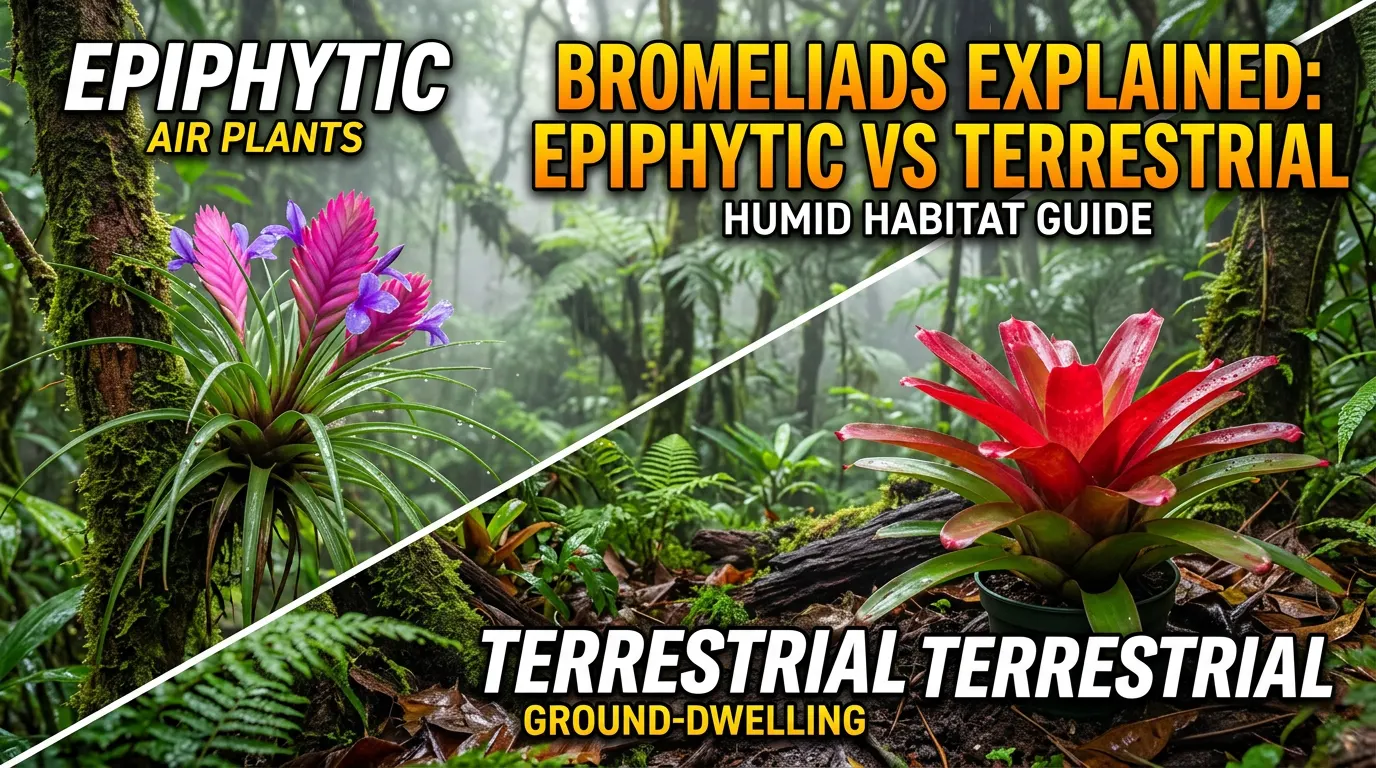
What you may see in India is a close cousin: the pineapple, Ananas comosus, is a bromeliad. India’s National Horticulture Board says the Portuguese introduced pineapple cultivation in 1548, and lists Assam, Meghalaya, Tripura, Manipur, West Bengal, Kerala, Karnataka and Goa among the main growing states (NHB pineapple profile). It prefers about 22 to 32°C, and the same page says it can grow up to 1,000 metres if frost-free. Every decorative bromeliad you buy in India, including Neoregelia, Aechmea and Tillandsia, is an introduced plant. For Fish Bazaar’s take on origins, see its article on bromeliads in their wild habitat, and for how the family’s two lifestyles work in humid habitats, read our guide to epiphytic versus terrestrial bromeliads and their humid habitat.
What temperatures can bromeliads handle?
Most bromeliads are comfortable from about 10°C at night to about 32°C by day, and struggle outside that. Sources agree on the broad picture, with small differences:
- The Royal Horticultural Society gives a winter minimum of 10°C and says to move plants outside only once nights stay above 10°C. It also warns to shade them from strong summer sun, which can scorch leaves.
- The University of Wisconsin-Madison extension lists an ideal of 70 to 90°F by day (about 21 to 32°C) and 50 to 65°F at night (about 10 to 18°C), humidity of 50 to 75 per cent, and notes freezing temperatures are fatal.
- Bromeliads.info says most prefer 60 to 80°F (about 15.5 to 26.7°C) but tolerate wider swings, and need more humidity in warm conditions.
- A trade guide in Greenhouse Management says brief dips to 45°F (about 7°C) usually do not harm growth, but temperatures above 95°F (35°C) slow or stop it and raise disease risk.
That 35°C line matters in India, where plains routinely go beyond it. The India Meteorological Department’s heat-wave criteria begin at 40°C for plains and 30°C for hilly regions (IMD heat-wave FAQ). A bromeliad can survive indoors in that weather, but it will not grow happily on an exposed terrace.
How does Indian climate change bromeliad care by region?
India’s seasons, per the India Meteorological Department scheme summarised on Wikipedia, are winter (December to February), summer (March to June), the southwest monsoon (June to September) and the post-monsoon (October to November). The same page puts the monsoon over the Malabar Coast around 1 June and at Delhi by about 29 June. Your region decides which season is the real challenge.

| Region | Climate snapshot | Main risk | What to do |
|---|---|---|---|
| Humid coast (Mumbai, Konkan, Kerala coast) | Mumbai gets about 2,213 to 2,502 mm of rain a year, humidity near 85 per cent in July, May highs of 34 to 35°C (Climate of Mumbai) | Waterlogged mix, stagnant cups, fungal rot | Fast-draining mix, rain-sheltered spot, airflow, flush cups |
| Hot-dry plains (Delhi, Rajasthan) | Delhi often reaches 40°C in May and June (Climates to Travel); Phalodi recorded 51.0°C in 2016 | Scorch, evaporation, dry air | Bright indirect light indoors, group plants, keep cups fresh |
| Deccan interior (Nashik, Pune) | Nashik averages 24.1°C a year with about 1,134 mm of rain, mostly June to September (climate-data.org) | Dry winter air, monsoon wetness | Shade in April and May, shelter in July and August |
| Hill and plateau (Ooty, Bengaluru) | Ooty averages 16.5°C a year (climate-data.org); Bengaluru 22.9°C, over 900 m up (climate-data.org) | Cool nights, overwatering in cool weather | Water less, keep in the brightest sheltered spot, check night lows |
| North Indian winter (Delhi, Punjab, UP) | Delhi’s lows run about 7 to 11°C in winter; the record is −2.2°C (1967) (Daily Jagran) | Cold below 10°C, frost | Bring indoors, away from cold glass, water sparingly |
The climate-data.org figures are annual averages from a modelled dataset, so check your own balcony with a thermometer, especially at night.
How should you care for bromeliads in the monsoon?
In the monsoon, the risk is too much water, not too little. Keep plants where rain cannot hammer them, use a fast-draining mix, and tip out cups that fill and stay full. The University of Florida’s IFAS Extension advises flushing the leaf cups periodically to prevent mosquito breeding, or using Bti (Bacillus thuringiensis israelensis) in the cups (UF/IFAS). Our bromeliad problems guide explains rot symptoms, and Fish Bazaar covers the mosquito question in do bromeliads attract mosquitoes.
Humidity in coastal cities can pass 80 per cent, above the 50 to 75 per cent range recommended by the University of Wisconsin. Airflow, rather than misting, is what you need then.
How hot is too hot for bromeliads in Indian summers?
Around 35°C in the shade is where growth starts to suffer, and direct sun on top of that scorches leaves. In March to June, move plants out of direct afternoon sun, keep cups topped with fresh water and group pots to raise local humidity. A west-facing balcony in May is usually the worst spot; an east-facing window with morning sun is gentler. This is practical advice built on the RHS and Wisconsin figures above rather than an Indian trial.
Genus matters a little. One horticultural blog says Aechmea tolerates cooler conditions better and Guzmania prefers warm, humid air, but treat that as a hint, not a rule (Cafe Planta). To compare genera, see our types of bromeliads guide.
Can bromeliads survive north Indian winters?
Indoors, yes; outdoors on a cold night, often not. With Delhi’s winter lows commonly at 7 to 11°C and the RHS winter minimum at 10°C, any bromeliad kept outside in December and January is at risk. Missouri Botanical Garden suggests bringing plants in when night temperatures fall below 55°F (about 13°C) (MBG factsheet), which is conservative but sensible. Move plants to a bright room before the first cold wave, away from window glass, and water less. Fish Bazaar’s bromeliad winter care guide covers enclosures.
Is Indian tap water safe for bromeliads?
Often yes, but it depends on its dissolved salts (TDS) and whether it has been softened. The Wisconsin extension says most tap water works but to avoid alkaline or softened water (sodium), to use distilled water for sensitive miniatures, and to flush leaf cups weekly if you use hard water. The RHS recommends rainwater or distilled water for cups.
India’s drinking-water standard IS 10500:2012 sets an acceptable TDS limit of 500 mg/L and a permissible limit of 2,000 mg/L where no alternative source exists (summary at Prepp). Safe to drink does not mean gentle on leaves. As a yardstick, one orchid society rates water under 175 ppm as excellent and above 875 ppm as unsatisfactory for orchids (St. Augustine Orchid Society). That scale is for orchids, not bromeliads, so use it only as a guide for epiphytes.
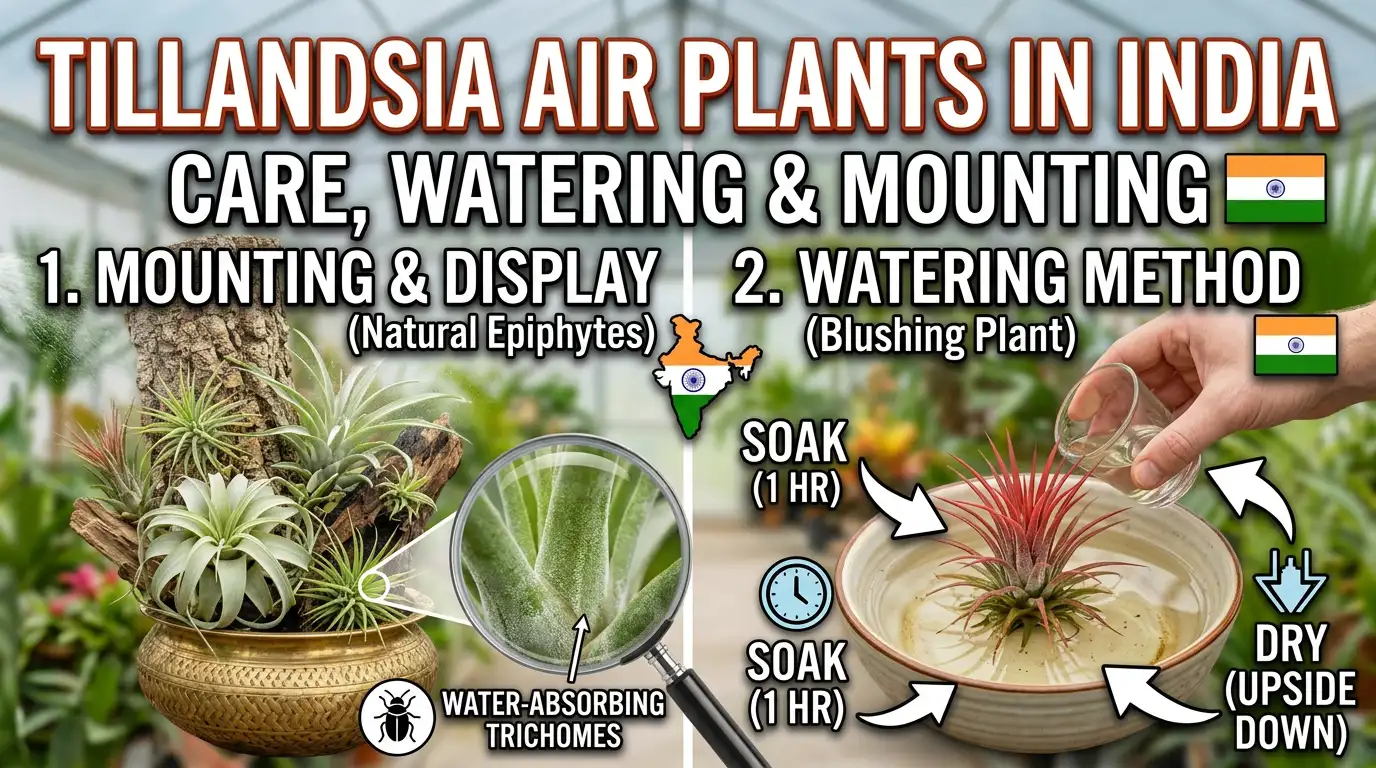
What to do in practice: measure your tap with a handheld TDS meter, collect clean mid-monsoon rainwater for cups, and flush cups regularly so salts do not build up. Tillandsia air plants are especially sensitive; Wikipedia’s genus entry advises non-calcareous water (Tillandsia).
Should bromeliads live on a balcony or indoors in India?
Indoors near a bright window suits most plants year-round; a shaded balcony works from the late monsoon to early winter. The RHS recommends a sheltered outdoor position in sun or part shade, protected from midday sun and drying winds. UF/IFAS and Missouri Botanical Garden both say bright light but not direct sun, which our guide to bromeliad light requirements and indirect light explains in practical terms. On high floors, wind dries cups fast. Use our bromeliad care guide for light and watering basics, and Fish Bazaar’s where to plant bromeliads for placement ideas.
If your balcony is too hot, dry or cold, an enclosure buffers swings. See our guides to bromeliads in a terrarium and the best bromeliads for terrariums. Fish Bazaar, run by the same team as this site, stocks compact Neoregelia, Cryptanthus and Tillandsia in its Terrarium and Paludarium Plants collection, sold as sets of 10; to compare it with other Indian sellers before you order, read where to buy bromeliads online in India.
What should you do in each Indian season?
- Winter (December to February): shelter from cold nights in the north, water less, keep out of draughts.
- Summer (March to June): shade from midday sun, keep cups fresh, avoid dispatch or repotting during heat waves.
- Monsoon (June to September): shelter from heavy rain, check drainage, flush cups.
- Post-monsoon (October to November): the gentlest season for most regions; ideal for repotting, mounting and moving plants outdoors if nights stay above 10°C.
Frequently asked questions
Are bromeliads native to India?
No bromeliad is known to be native to India. The family is native to the tropical Americas, with one known exception, Pitcairnia feliciana in West Africa.
Can bromeliads grow outdoors in India?
Yes, in shade or part shade where nights stay above 10°C and midday sun is blocked. In very hot plains or cold northern winters, indoor growing is safer.
Which Indian climate is best for bromeliads?
Warm, humid, frost-free regions such as coastal and southern India suit most bromeliads, provided drainage and airflow are good. Pineapple, a bromeliad, grows commercially in many humid states.
How do I care for bromeliads in summer heat?
Shade them from midday sun, keep cups filled with fresh water and group plants to raise humidity. Growth slows above about 35°C.
Do bromeliads survive winter in north India?
Indoors they do. Outdoors, nights below 10°C risk damage, and frost is fatal. Bring plants in before cold waves.
How often should I water bromeliads in the monsoon?
Rarely, and mostly by checking the cup and the mix. Natural rain and humidity usually supply enough; tip out stagnant cups and ensure drainage.
Is tap water or rainwater better for bromeliads?
Rainwater or distilled water is preferred by the RHS. Most tap water works, but avoid softened or very hard water, and flush cups to prevent salt build-up.
Do bromeliad cups cause mosquitoes?
They can if water stands for days. UF/IFAS advises flushing cups periodically or using Bti in the cups.
Is a balcony or an indoor window better?
An indoor window with bright indirect light is safest all year. A shaded balcony is fine from the late monsoon to early winter if wind and midday sun are blocked.
This is general gardening guidance, not veterinary advice. If you grow bromeliads in an enclosure with reptiles or amphibians, confirm species and water safety with a vet.
References
- Wikipedia: Bromeliaceae
- Wikipedia: Pitcairnia feliciana
- Wikipedia: Tillandsia
- Royal Horticultural Society: How to grow bromeliads
- University of Wisconsin-Madison Extension: Bromeliads
- UF/IFAS Gardening Solutions: Bromeliads
- Missouri Botanical Garden: Bromeliad care and culture
- Bromeliads.info: Temperature
- Greenhouse Management: Culture of Guzmania
- National Horticulture Board: Pineapple
- India Meteorological Department: Heat wave FAQ
- Wikipedia: Climate of India and Climate of Mumbai
- Prepp: IS 10500:2012 TDS limits
- St. Augustine Orchid Society: Soluble salts
Related Guides
- Bromeliad care: the complete guide
- Types of bromeliads: a guide
- Fish Bazaar: bromeliads in the wild
- Where to Buy Bromeliads Online in India: 8 Sellers Compared (2026)
- Bromeliad Price in India: What Plants Really Cost (2026)
- Bromeliad Light Requirements: Indirect Light Explained
- Epiphytic vs Terrestrial Bromeliads and Their Humid Habitat
- What Is a Bromeliad? Meaning, Pronunciation & Quick Facts
- Bromeliad Roots: How They Work, When to Repot
- Bromeliad Plant Benefits: Air Purifying Myths, Mosquitoes & Pets



Leave a Reply