AQUARIUM PLANT GUIDE · UPDATED OCTOBER 2026
By Everydaything Team · Last updated October 2026
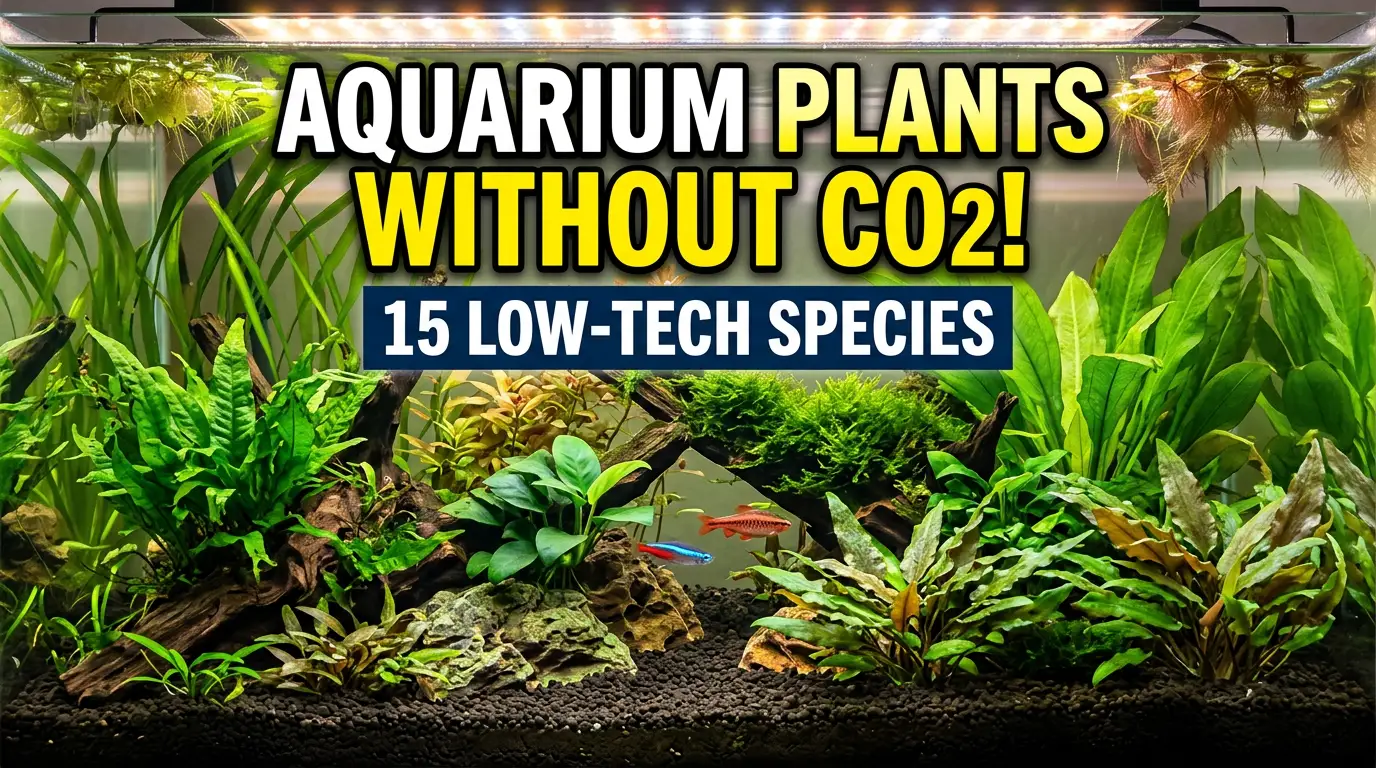
Aquarium plants without CO2 are low-tech species that grow steadily on the carbon already in the tank, without a gas cylinder or regulator. Good easy aquarium plants for this style are anubias, java fern, cryptocoryne wendtii, vallisneria, amazon sword, bacopa and ludwigia. They grow more slowly than plants in high-tech tanks, but they stay healthy with moderate light and light feeding.
This guide lists 15 low-tech species, each with a light and nutrient note. It then explains how to succeed with a non CO2 aquarium: how much light to give, how to feed, and what the Walstad idea adds. If you want the full pros and cons of CO2 for aquarium plants, read our published guide on CO2 for planted tanks as further reading.
Quick answer
- Safest picks: anubias, java fern, java moss, cryptocoryne wendtii, vallisneria and amazon sword.
- Light: aim for about 20 to 40 PAR at the substrate for 6 to 8 hours, on a timer.
- Feeding: small weekly liquid doses plus root tabs for root feeders. Fish waste alone rarely supplies enough iron.
- Patience: one guide says a well-planted low-tech tank takes two to three months to fill in.
- Avoid at first: dwarf baby tears ‘Cuba’, Fissidens, Eriocaulon and Tonina.
Which aquarium plants without CO2 are the best? 15 low-tech species compared
The table below lists 15 aquarium plants without CO2, roughly from easiest to fussiest. Light figures come from Aquasabi, Flowgrow, Gensou and AquaCalc plant profiles. Treat watts per litre as a rough guide, because modern LEDs vary.
| # | Plant | Scientific name | Light need | Nutrient route | Growth |
|---|---|---|---|---|---|
| 1 | Anubias nana | Anubias barteri var. nana | Very low to strong | Water column | Slow |
| 2 | Java fern | Microsorum pteropus | Low to high | Water column | Slow |
| 3 | Java moss | Taxiphyllum barbieri | Low to high | Water column | Medium |
| 4 | Cryptocoryne wendtii | Cryptocoryne wendtii | Low | Roots, plus water | Medium |
| 5 | Vallisneria | Vallisneria spiralis | Medium | Roots | Fast |
| 6 | Amazon sword | Echinodorus ‘Bleherae’ | Medium | Heavy root feeder | Fast |
| 7 | Marsilea hirsuta | Marsilea hirsuta | Low to high (20 to 100+ PAR) | Roots | Very slow carpet |
| 8 | Staurogyne repens | Staurogyne repens | Medium | Roots and water | Slow to medium |
| 9 | Bacopa | Bacopa caroliniana | Medium to strong | Roots and water | Moderate |
| 10 | Ludwigia | Ludwigia repens | Moderate to high | Roots and water | Fast |
| 11 | Rotala | Rotala rotundifolia | Medium | Roots and water | Fast |
| 12 | Hornwort | Ceratophyllum demersum | Medium | Water column | Fast |
| 13 | Water sprite | Ceratopteris thalictroides | Moderate to high | Water column | Very fast |
| 14 | Monte Carlo | Micranthemum ‘Monte Carlo’ | Medium to high | Roots | Slower without CO2 |
| 15 | Tiger lotus | Nymphaea lotus | Medium | Heavy substrate feeder | Fast |
If you are new to planting, start with our ranking of the best aquarium plants for beginners. It overlaps with the first six rows here.
How do aquarium plants without CO2 grow?
They grow because their light demand matches their carbon supply. An Aquarium Lesson guide explains that in low-tech tanks, carbon is the main limiting factor. Extra light then raises algae pressure instead of growth. That is why moderate light usually beats strong light in a non CO2 aquarium.
Slow species suit this setup, because they need less of everything. In addition, soil-based substrates release some carbon as they break down, according to a 2h Aquarist guide. Floating plants can also diffuse strong light. Together these tricks keep the tank balanced without gas.
Aquarium plants without CO2 that grow on wood and rock

1. Anubias nana. Aquasabi lists light from 0.25 W per litre or less up to strong light, and says no CO2 is required. Tie it to wood and keep the rhizome clear of gravel. Read the anubias aquarium plant guide for varieties.
2. Java fern. Flowgrow says it needs neither fertiliser nor CO2, although moving water helps. Growth is slow, so do not expect quick results. Our java fern care guide covers problems like black spots.
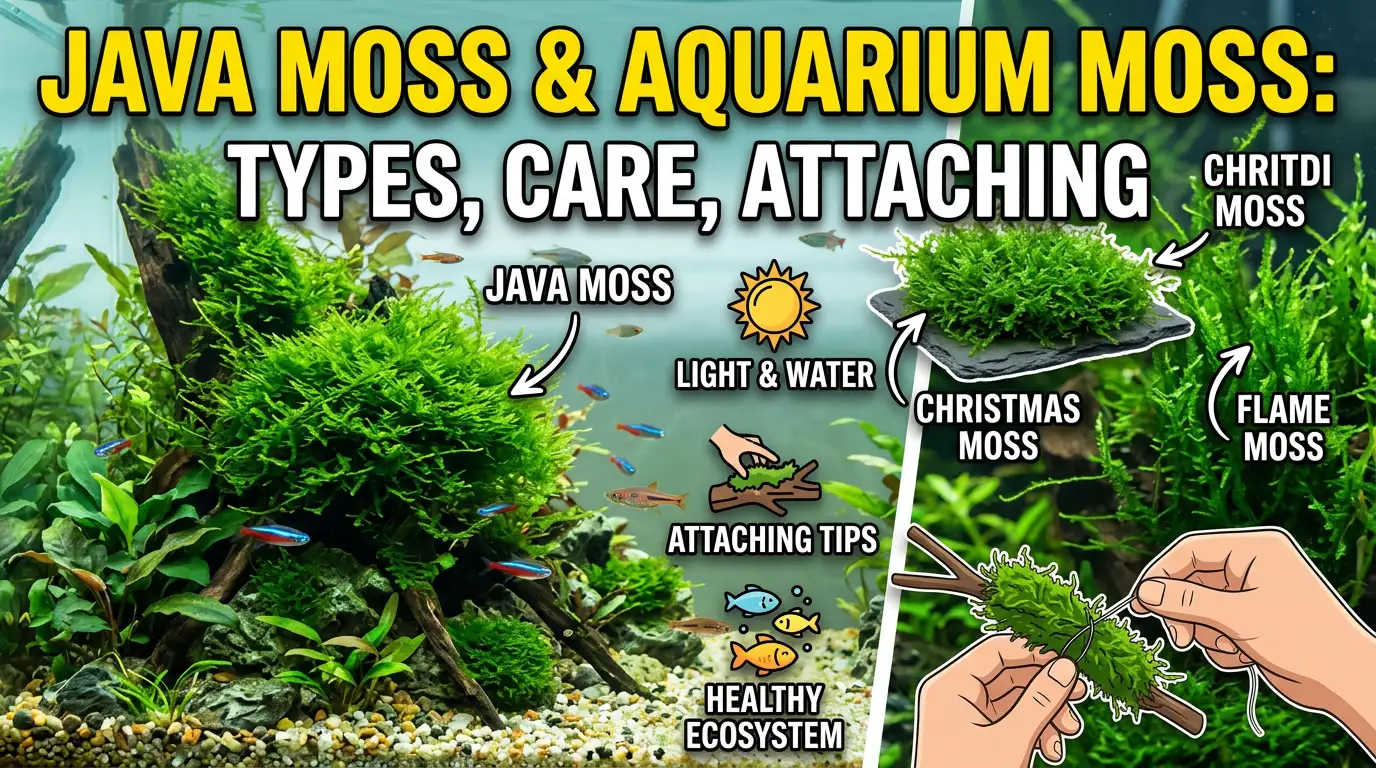
3. Java moss. Flowgrow notes that fertiliser and CO2 help but are not strictly necessary. It also grows best in cooler water near 24 °C. See our java moss and aquarium moss guide for attaching tips.
Rooted low-tech aquarium plants without CO2: crypts, swords, vallisneria and tiger lotus

4. Cryptocoryne wendtii. Aquasabi rates it low light, medium growth and no CO2. It needs time, because TFH Magazine says a full-sized plant can take several months. Expect melting after a move.
5. Vallisneria. Aquasabi lists medium light, fast growth and no CO2, plus a preference for medium to high carbonate hardness. It spreads by runners and cannot grow emersed.
6. Amazon sword. Aquasabi again lists medium light and no CO2, with a substrate at least 10 cm deep. Because it feeds through the roots, add root tabs. Our amazon sword, cryptocoryne and vallisneria care guide explains feeding.
15. Tiger lotus. Aquasabi says CO2 is beneficial but not strictly necessary, and that strong substrate fertilisation supports growth without it. It can reach 50 cm. It can also shed every leaf and resprout from the tuber, so do not throw it out.
Stem and foreground aquarium plants without CO2

7. Marsilea hirsuta. Gensou calls it the only carpet that reliably forms a lawn in a low-tech tank. It survives 20 to 30 PAR. The trade-off is patience, with four to six months to cover a 60 cm tank without CO2.
8. Staurogyne repens. Aquasabi lists medium light of at least 0.5 W per litre and says CO2 is not strictly required. It stays at 5 to 10 cm when trimmed. Growth is medium to slow.
9. Bacopa caroliniana. Aquasabi lists no CO2 needed, though it asks for at least 0.5 W per litre. It tolerates 4 to 29 °C. Buy several stems and plant them as a group.
10. Ludwigia repens. AquaCalc says red colour comes from strong light rather than CO2. Green stems usually mean too little light. Rotala rotundifolia and ludwigia both “do extremely well” in a low-tech scape, according to Buce Plant. Compare them in our stem plants guide.
11. Rotala rotundifolia. World of Aquariums says CO2 is recommended but not strictly necessary. Without gas and iron, expect green or pale pink growth rather than deep red.
14. Monte Carlo. Gensou says it performs significantly better without CO2 than dwarf baby tears. Buce Plant adds that leaves stay smaller and darker in low-tech tanks, with slower growth.
Fast floating and drifting aquarium plants without CO2
12. Hornwort. A care guide from Aquarium Breeder lists medium light and weekly liquid fertiliser, because it absorbs many nutrients. It browns above 30 °C.
13. Water sprite. Aquariadise says low light makes it stretch, so give it moderate light. Fast growth means it uses plenty of nutrients, which can starve algae. Our floating aquarium plants guide covers both of these.
Which plants struggle without CO2?
Some popular plants do poorly in no-CO2 tanks. Buce Plant names Eriocaulon, Fissidens, Hemianthus callitrichoides ‘Cuba’, Tonina and certain Rotala species as finicky without pressurised CO2. Gensou adds Glossostigma and Riccia fluitans to the hard list. Skip them until you have a stable tank.
How to succeed with aquarium plants without CO2
Keep light moderate and steady. Aquarium Lesson recommends about 20 to 40 PAR at the substrate. Keep aquarium light hours short and fixed. Start with six hours for a new tank, and extend to seven or eight only when stable. Canton Aquatics also suggests six to eight hours on a timer. Our planted aquarium lighting guide explains watts, hours and LEDs in depth.
Feed lightly, not zero. Canton Aquatics suggests weekly liquid fertiliser at half strength and root tabs every four to six weeks. It argues that fish waste alone does not supply enough iron and potassium. Compare methods in root tabs vs liquid fertiliser, and read the published best aquarium fertilizer guide. Check product labels and dose cautiously, especially with shrimp.
Plant densely and stay patient. 2h Aquarist advises at least 50% plant coverage from the start to hold algae back. Canton Aquatics expects two to three months before the tank looks full. Meanwhile, trim and replant stems to thicken them.
What is the Walstad idea for a low-tech tank?
The Walstad method is a soil-based low-tech approach that needs no CO2 injection. According to Aquarium Science, a thin layer of organic soil under sand or gravel releases CO2 as it decomposes, and it can lift CO2 from 2 to 3 ppm to 10 ppm overnight. Diana Walstad also argues that plants absorb ammonium directly.
However, the method has limits. Aquarium Science says stocking must stay low, humic matter can yellow the water, and the soil must be low in nitrogen. Never use random garden soil. Read our garden soil in aquariums guide first.
Aquarium plants without CO2 in India: heat, hard water and timers
Heat. Warm rooms can push tanks past the limits of cooler species. Java moss grows best near 24 °C, hornwort browns above 30 °C and Aquasabi lists Bacopa at up to 29 °C. Keep tanks out of direct sun, because extra light also feeds algae.
Hard water. Indian tap water varies by city. Aquasabi lists anubias, amazon sword and crypt wendtii as tolerant up to 30 °dGH, so these are practical bases for hard-water cities.
Availability. Indian online stores such as Bunnycart list anubias nana, java fern, amazon sword, water sprite and java moss. Ludwigia repens and Bacopa caroliniana also appear in Bunnycart listings. Stock changes, so confirm before you plan. Also use a plug-in timer, and check it after power cuts, because some basic timers reset.
Frequently asked questions about aquarium plants without CO2
Can aquarium plants grow without CO2?
Yes. Many species, including anubias, java fern, crypts, vallisneria and amazon sword, grow without added CO2. Growth is slower, but plants stay healthy under moderate light.
What are the best aquarium plants without CO2?
Anubias nana, java fern, java moss, cryptocoryne wendtii, vallisneria and amazon sword are the safest. Hornwort, water sprite, bacopa and ludwigia add faster growth.
What are the best low light aquarium plants?
Anubias, java fern, java moss, cryptocoryne wendtii and Marsilea hirsuta cope best with low light. Marsilea survives 20 to 30 PAR but covers the floor slowly.
How many hours of light do plants without CO2 need?
Six to eight hours a day on a timer works for most tanks. Start at six hours, and raise it slowly only if the tank stays free of algae.
Does a no-CO2 tank need fertiliser?
Yes, in small doses. Canton Aquatics suggests half-strength liquid fertiliser weekly and root tabs every four to six weeks. Check the label and go carefully if you keep shrimp.
Will aquarium plants grow in just gravel?
Epiphytes, mosses and floaters do not need substrate at all. Rooted plants can live in inert gravel if you add root tabs, but a nutrient-rich soil helps them more.
Which plants should I avoid without CO2?
Avoid dwarf baby tears ‘Cuba’, Fissidens, Eriocaulon, Tonina, Glossostigma and Riccia fluitans until you have experience. They struggle without pressurised CO2.
Is the Walstad method a no-CO2 method?
Yes. It relies on soil and slow plant growth instead of gas injection. It needs low fish stocking and a suitable low-nitrogen organic soil.
How long does a low-tech tank take to fill in?
Canton Aquatics estimates two to three months for a well-planted low-tech tank. Slow carpets such as Marsilea hirsuta can take four to six months.
Safety note: always read fertiliser labels, dose cautiously around fish and shrimp, and keep chemicals away from children and pets. This guide is general information, not professional advice.
References
- Aquarium Lesson: Low-tech aquarium lighting
- Canton Aquatics: Low-tech planted tank without CO2
- 2h Aquarist: Lush planted tanks without CO2 injection
- Buce Plant: Best plants for a low-tech scape
- Aquarium Science: Walstad aquarium
- Diana Walstad: Nitrogen uptake by aquatic plants
- Aquasabi: Anubias barteri var. nana
- Aquasabi: Vallisneria spiralis
- Aquasabi: Echinodorus ‘Bleherae’
- Aquasabi: Cryptocoryne wendtii ‘Green’
- Aquasabi: Bacopa caroliniana
- Aquasabi: Staurogyne repens
- Aquasabi: Nymphaea lotus
- Flowgrow: Microsorum pteropus
- Flowgrow: Taxiphyllum barbieri
- Gensou: Marsilea hirsuta care guide
- Gensou: Aquarium carpet plant comparison
- AquaCalc: Ludwigia repens
- World of Aquariums: Rotala rotundifolia
- Aquarium Breeder: Hornwort care guide
- Aquariadise: Water sprite care sheet
- TFH Magazine: Cryptocoryne wendtii
- Bunnycart: Anubias nana listing
Related Guides
- Best Aquarium Plants for Beginners in India (2026)
- Types of Aquarium Plants: Foreground to Background
- Planted Aquarium Lighting: Watts, Hours and LEDs
- Aquarium Plant Fertilizer: Root Tabs vs Liquid Dosing
- Anubias Aquarium Plant Guide: Care, Types and Price
- Java Fern Care Guide: Planting, Light and Problems
- Java Moss and Aquarium Moss: Types, Care, Attaching
- Floating Aquarium Plants: Duckweed, Hornwort and More
- Amazon Sword, Cryptocoryne and Vallisneria Care Guide
- CO2 for Planted Tanks: Do You Need It?



Leave a Reply