Fish & Aquariums
I get this question a lot from people whose filter hums a little too loudly for a bedroom setup. The instinct makes sense, turn it off for eight hours, save some noise and a bit of electricity. It’s also one of the more common ways people accidentally crash their own cycled tank. I’ve talked a few friends out of doing this after they described exactly the ammonia spike I expected, a day or two after their first “quiet night” experiment, and I want to walk through the actual biology so it’s clear why, not just take my word for it.
Quick answer
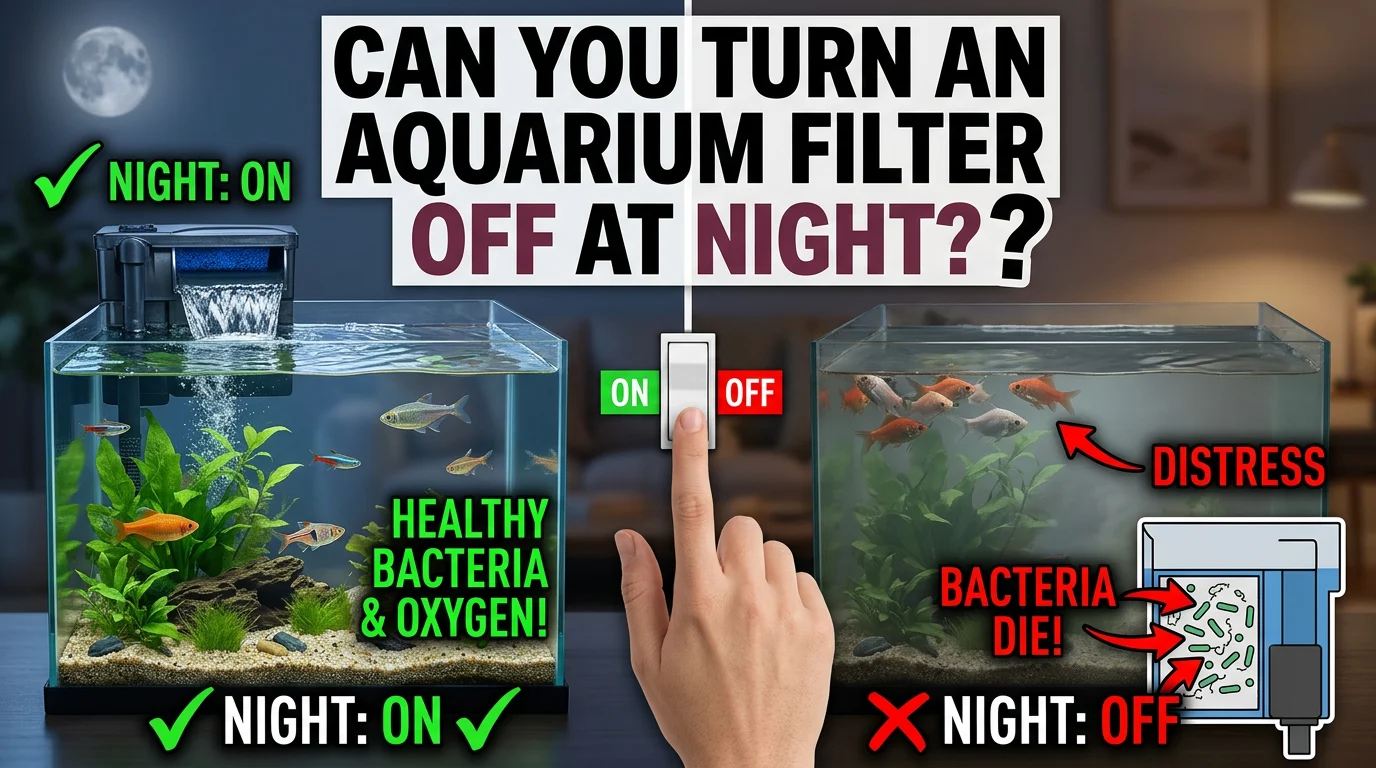
No, don’t turn your filter off at night, or for any extended period. The beneficial bacteria that process fish waste live mostly inside the filter media, and they need continuous oxygenated water flow to survive, the same colony you spent weeks cycling into existence. Even a few hours without flow can start killing off that colony in a heavily stocked tank, and a full night off is enough to meaningfully set back your cycle, sometimes triggering an ammonia or nitrite spike within a day or two.

Why continuous flow matters: the oxygen science behind it
The beneficial bacteria in your filter are aerobic, meaning they require dissolved oxygen to survive and to do their job, converting toxic ammonia into nitrite, then nitrite into much less harmful nitrate. This process is called the nitrogen cycle, and the two main bacteria groups involved (ammonia-oxidizers and nitrite-oxidizers) both live as a thin biofilm coating your filter media, gravel, and any hard surface with decent water contact. They aren’t floating loose in the water column in meaningful numbers; the vast majority of your tank’s biological filtration capacity is physically anchored inside that filter.
Surface agitation, the rippling, disturbed water surface a filter’s output creates, is what drives oxygen exchange between the air and the water. Still water has a smaller effective surface area for gas exchange relative to its volume, so oxygen diffuses into it much more slowly. A filter isn’t just moving water for the sake of movement; it’s constantly pulling water past the bacteria colony (delivering fresh oxygen and ammonia for them to process) and simultaneously agitating the surface (replenishing the oxygen supply for the whole tank, fish included). Turn the filter off, and both jobs stop at once: the bacteria are cut off from fresh oxygenated water, and the surface goes still, so the water’s overall oxygen level starts dropping too, worst at exactly the moment your fish are asleep and least able to signal distress by gasping at the surface where you’d notice.
How long can the bacteria colony actually survive without flow?
There’s no single universal number, because it depends on stocking density, filter type, media, and water temperature, warmer water holds less dissolved oxygen to begin with, so a warm tropical tank’s colony is under more pressure during a shutoff than a cooler one. But the general pattern holds across setups: a bacteria colony starts experiencing measurable die-off within a few hours of stagnant, low-oxygen conditions inside the filter, and the damage compounds the longer flow stays off. This is different from the bacteria simply going dormant and waking back up unharmed; a meaningful portion of the colony actually dies, and it takes time (days, sometimes longer) for the survivors to reproduce back to their prior capacity.
- Water flow through the filter media stops, and dissolved oxygen in that media drops quickly, faster than in the open tank because the media is denser and less exposed to the surface.
- The bacteria colony, which needs oxygen to survive and process ammonia, starts dying off the longer flow is interrupted, and unlike the fish, you get no visible warning sign that this is happening.
- When the filter comes back on, there’s a smaller (or badly damaged) bacteria colony to process the same amount of fish waste, which can cause a temporary ammonia or nitrite spike, essentially a mini version of an uncycled tank.
- In a lightly stocked tank this might be barely noticeable, since bioload and therefore ammonia production is low relative to the surviving colony’s capacity; in a heavily stocked tank it can be enough to stress or harm fish, because full-capacity bacteria were already barely keeping pace with a larger waste load.
- Repeating the shutoff nightly compounds the problem; the colony never gets a full recovery window before the next interruption, so it operates permanently under capacity, which is why a “just at night” habit tends to produce chronically elevated ammonia or nitrite rather than one clean crash.
That last point is the one people underestimate. A single accidental outage is a one-time hit the colony can usually recover from. A deliberate, repeated nightly shutoff is a different situation entirely; it’s a recurring stress the colony never fully bounces back from between cycles, which is why tanks on a “filter off at night” routine often show chronically elevated nitrite or ammonia on testing, even though nothing has obviously “gone wrong.”

What actually happens if you turn it off
In practice, a night-off habit shows up as a slow-motion version of an ammonia spike rather than a dramatic overnight fish loss. Here’s the typical progression I’ve seen described to me, and seen myself once with a smaller tank I experimented on early in the hobby out of curiosity (not something I’d recommend testing on livestock you care about):
- Night one: usually nothing visibly wrong. The colony takes a hit, but a healthy, mature colony has some reserve capacity, so ammonia may barely register on a test.
- A few nights in: ammonia or nitrite starts trending upward on tests taken the following morning, even though it clears somewhat during the “on” daytime hours, the colony is losing ground faster than it can rebuild between shutoffs.
- A week or two in, especially in a moderately-to-heavily stocked tank: fish start showing stress signs, clamped fins, reduced appetite, gasping near the surface, increased susceptibility to opportunistic issues like ich or fin rot, since chronic low-grade water quality stress is exactly the kind of thing that lets those take hold.
- If unaddressed: the tank essentially behaves like a permanently understocked-for-its-bacteria tank, it looks fine most of the time but has very little margin for error, so anything else that stresses the system (a slightly heavier feeding, a new fish, a missed water change) tips it over faster than it would in a properly cycled tank.
If noise or cost is the actual concern
| Concern | Better fix than turning it off |
|---|---|
| Filter noise at night | Check the impeller for debris buildup (a common cause of new noise), ensure the filter is sitting level and not vibrating against the tank, or consider a quieter filter type; a well-maintained filter should run close to silently |
| Electricity cost | A standard aquarium filter typically uses very little power (comparable to a small LED bulb), running it 24/7 is rarely a meaningful cost, especially against the cost of losing fish or having to re-cycle a tank |
| Worried about overfiltration | Choose an appropriately sized filter for your tank rather than an oversized one, per my filter sizing guide, filtration strength isn’t the issue here; continuous runtime is |
| Water trickling/splashing sound specifically | Lower the water level slightly so the outflow doesn’t splash as much, angle the output below the surface, or add a spray bar/diffuser to soften the flow; all quieter fixes than cutting flow entirely |
| Vibration humming through furniture or a shared wall | Add a thin foam or rubber pad under the filter or canister to dampen vibration transfer, and confirm the filter isn’t touching the tank glass or stand directly |
Most “noisy filter” complaints trace back to one of three fixable causes: something caught in the impeller, a low water level causing splash noise, or a filter that’s vibrating against a hard surface. Genuinely diagnosing which one it is usually takes five minutes and solves the actual problem, rather than trading a noise issue for a water-quality issue that’s harder to notice and more consequential to fix.
What about power outages?
An occasional short outage (a couple hours) usually isn’t catastrophic; the bacteria colony can tolerate brief interruptions better than a deliberate nightly shutoff, since it’s a one-time event rather than a repeated pattern. The colony has some built-in resilience for the odd unplanned gap; what it doesn’t tolerate well is that gap becoming routine. For anything longer, or if outages are frequent in your area, a battery-powered backup air pump to keep some water movement going is a reasonable safeguard, and it’s worth testing ammonia/nitrite after any outage longer than a few hours just to be safe.
Building a basic power-outage plan
- Battery air pump as a first line of defense. A small battery-powered air pump with an air stone won’t replace filtration, but it keeps the water surface agitated and oxygen exchanging, buying the bacteria colony and your fish time during an outage.
- Don’t feed during an extended outage. Uneaten food and normal waste both consume oxygen as they decompose and add to the ammonia load, the worst possible addition when your filtration is already offline.
- Insulate against temperature drop if it’s also cold out. A power outage in winter is really two problems at once, no filtration and no heat, so towels or foam insulation around the tank slow heat loss while you wait it out.
- Consider a small generator or UPS for longer, recurring outages. If your area loses power regularly, a basic battery backup (UPS) or generator sized for a filter and heater is a more permanent fix than reacting each time.
- Test water parameters once power is restored. Check ammonia and nitrite, and keep testing over the next couple of days rather than assuming everything reset itself the moment the filter switched back on.

Does tank size or stocking level change any of this?
Yes, meaningfully. A lightly stocked tank with a lot of water volume relative to its fish has more buffering capacity, more dissolved oxygen reserve, more water to dilute ammonia, and a bacteria colony that isn’t working at full capacity to begin with, so it has some slack. A heavily stocked tank is the opposite: the bacteria colony is often already running close to its processing limit just to keep pace with normal daily waste, so it has far less room to absorb a shutoff before ammonia becomes measurable. This is one more reason to avoid overstocking generally; it’s not just about a single moment of turning the filter off, it’s about how much margin your whole system has when something unplanned happens, since something eventually does.
Frequently asked questions
Is it different for a sponge filter versus a canister filter?
The same principle applies to any filter type carrying a bacteria colony — sponge, HOB, or canister. All of them need continuous flow to keep that colony alive. A sponge filter, run by an air pump, actually tends to recover a bit faster after a brief interruption because its media has a large surface area exposed directly to the water, but that’s a difference in degree, not a reason to treat it as safe to shut off routinely.
Can I turn off just the filter’s air pump/bubbler at night instead?
If the bubbler is separate from your main filtration and not what’s driving flow through the filter media, that’s generally fine; the main filter itself is what needs to keep running, not necessarily every accessory attached to it. A standalone decorative air stone that isn’t part of a sponge filter’s operation falls into this category.
My filter shut off accidentally overnight; what should I do?
Test ammonia and nitrite once it’s back on, and keep testing over the next couple of days. If levels rise, do a partial water change and hold off on adding any new fish until things stabilize again. Watch your fish for stress signs like gasping at the surface or clamped fins over the next day or two as well.
Will turning the filter off for a short water change hurt the bacteria colony?
No, briefly switching a filter off for the few minutes it takes to do a water change, or to avoid siphoning debris through it, is not the same category of risk as an extended nightly shutoff. The colony tolerates short, occasional interruptions like this without meaningful die-off; it’s sustained hours-long stoppages, repeated regularly, that cause the problem.
Does a bigger, more powerful filter mean I can safely turn it off for longer?
No, filter strength and runtime aren’t interchangeable. A larger filter processes more water when it’s running, but the bacteria still need continuous oxygenated flow to stay alive regardless of how powerful the unit is. Oversizing a filter doesn’t buy you safe downtime; it just means more capacity while it’s actually on.
Can I use a timer to run the filter on a partial schedule to save electricity?
I wouldn’t recommend it. Given how little a standard aquarium filter actually costs to run continuously, the electricity savings from a partial schedule are minor compared to the real risk of destabilizing your cycle. If cost is a genuine concern, it’s worth comparing your specific filter’s wattage against your local electricity rate — in almost every case the number is small enough that 24/7 operation isn’t the expense people assume it is.
If a genuinely quiet night is what you’re after, it’s worth troubleshooting the actual noise source rather than the filter’s runtime, a healthy filter shouldn’t be loud enough to need switching off in the first place.



Leave a Reply