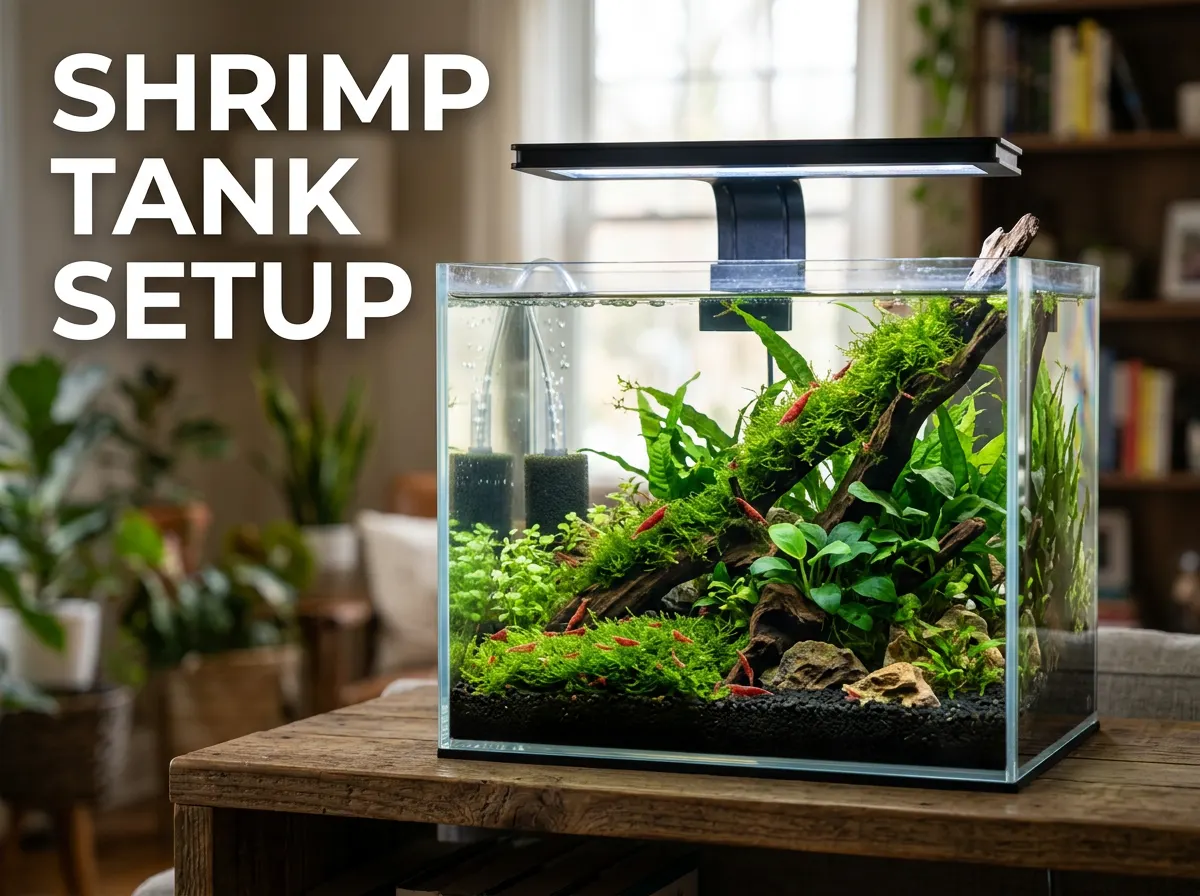
Fish & Aquariums
I lost my first small shrimp colony to a fertilizer I’d used safely in a fish tank for years; it turns out it had trace copper in it, which is essentially harmless to fish and lethal to shrimp. That’s the theme with dwarf shrimp: they get sold as “tiny, easy fish,” but they’re not fish at all, and the things that barely register with a goldfish or a guppy- copper, sudden parameter swings, a filter intake with no guard, can wipe out an entire shrimp colony overnight. Once you understand why, shrimp keeping stops feeling risky and starts feeling like a genuinely low-effort, high-reward corner of the hobby.
Quick answer
Dwarf shrimp, cherry shrimp (Neocaridina davidi) are the easiest starting point, do well in a fully cycled tank of 5 gallons or more, with stable, established water rather than any single “ideal” number chased too precisely. The single biggest danger is copper: it’s toxic to shrimp and invertebrates in amounts so small they don’t bother fish at all, and it hides in some fertilizers, some tap water pulled through old pipes, and most fish medications. Beyond that, shrimp are unusually sensitive to fast changes in pH, hardness, and temperature, which is why an established, mature tank suits them far better than a freshly cycled one and why a species-only or lightly-stocked tank with no shrimp-hungry fish is the safest way to actually build a colony rather than just keep a handful of shrimp alive.
Why shrimp aren’t just tiny, easy fish
Dwarf shrimp belong to a completely different branch of the animal kingdom than fish; they’re crustaceans, more closely related to crabs and lobsters than to anything with a spine. That distinction explains almost every way shrimp care diverges from fish care. Crustaceans breathe through gills but regulate their internal chemistry very differently than fish do, which is a large part of why they tolerate a wider range of pH and hardness than most people expect, yet collapse almost immediately when exposed to heavy metals like copper that fish barely notice. Copper is toxic to invertebrates at concentrations measured in fractions of a part per million, low enough that a fertilizer, algaecide, or tap water source labeled perfectly safe for a fish tank can still be lethal to shrimp.
The other defining trait of a crustacean is the exoskeleton, a rigid external shell instead of an internal skeleton, which means growth can’t happen gradually the way it does in a fish. Instead, shrimp periodically shed their entire shell in a process called molting and grow a new, larger one underneath, a cycle that repeats for their entire lives and that shapes almost every practical piece of shrimp husbandry, from tank decor to feeding to what “normal” behavior looks like week to week.

Choosing a species: Neocaridina vs. Caridina
Almost all dwarf shrimp sold for home aquariums fall into one of two genera, and which one you start with matters more than almost any other decision in shrimp keeping. Neocaridina davidi, sold as cherry, sakura, blue velvet, or yellow shrimp depending on the color strain, all the same species selectively bred for different pigments, is by far the more forgiving of the two and the right starting point for almost everyone. Caridina shrimp, which include crystal red/black shrimp and the Sulawesi species, are more visually striking but noticeably fussier about stable, specific water chemistry, and are better suited to someone who already has a season or two of Neocaridina experience behind them.
| Trait | Neocaridina (cherry shrimp) | Caridina (crystal/bee shrimp) |
|---|---|---|
| Difficulty | Easy, genuinely beginner-friendly | Moderate to difficult, sensitive to water chemistry swings |
| pH preference | 6.5-8.0, fairly adaptable | Narrower, usually 6.0-6.8, softer water |
| GH/KH | Tolerates moderate to fairly hard water | Needs soft water and low-to-moderate KH; often requires remineralized RO water |
| Breeding | Breeds readily in stable community-style water | Breeds well only once water is genuinely stable and correctly mineralized |
| Color range | Red, yellow, blue, orange, green, and more | Red/white “crystal,” black/white “panda,” and other high-contrast patterns |
Sulawesi shrimp and a handful of other specialty species exist further along the difficulty curve still, with narrow temperature and mineral requirements that make them a poor match for a first shrimp tank. If this is your first colony, starting with Neocaridina and getting comfortable with stable water and molting cycles before moving to anything more demanding will save a lot of frustration and a lot of dead shrimp.
Setting up the tank
- Fully cycle first. Shrimp are, if anything, less tolerant of ammonia and nitrite spikes than fish; never add shrimp to an uncycled tank. See my cycling guide for the full process.
- Let it mature past “cycled.” Many keepers wait a few extra weeks past the point a tank technically finishes cycling before adding shrimp, since they do noticeably better in mature water with an established biofilm and algae layer to graze on constantly.
- Plants and moss. Java moss especially gives shrimp somewhere to graze around the clock and somewhere to hide during molting, when they’re briefly soft-shelled and defenseless. A heavily planted tank consistently outperforms a bare one for shrimp health and breeding success.
- Sponge filter over an open power filter intake. Standard filter intakes can pull in and kill small shrimp, especially shrimplets; a sponge filter or an intake guard/pre-filter sponge avoids this entirely and is close to mandatory in a dedicated shrimp tank.
- Substrate matters more than for most fish. Inert, neutral substrates (regular gravel or sand) suit Neocaridina fine, but active, buffering substrates designed to soften and acidify water are often used for Caridina species that need consistently soft, slightly acidic conditions.
- Skip anything with copper. Check plant fertilizers, algaecides, and even some fish medications for copper content before they go anywhere near a shrimp tank; my fertilizer guide covers what to look for on a label.

Water parameters
For shrimp, stability consistently matters more than hitting an exact target number; a tank that holds slightly-off parameters steadily is safer than one that’s chasing a “perfect” number and swinging in the process. The table below covers cherry shrimp specifically; Caridina species generally want the softer, more acidic end of every range and are far less forgiving of drift.
| Parameter | Target range | Why it matters |
|---|---|---|
| Temperature | 65-80°F (18-27°C) | Cherry shrimp tolerate a wide range, but rapid swings, not the number itself, are what actually causes stress and death |
| pH | 6.5-8.0 | Wide tolerance for Neocaridina; consistency over time matters more than a specific target |
| GH (general hardness) | 4-8 dGH | Shrimp use dissolved minerals to build their exoskeleton after every molt; water that’s too soft can cause molting failures over time |
| KH (carbonate hardness) | 1-4 dKH | Buffers pH against swings; very low KH lets pH crash unexpectedly during water changes or as the tank ages |
| Ammonia / Nitrite | 0 ppm | Shrimp have essentially no tolerance for either, any detectable reading calls for an immediate water change |
| Copper | True zero | Toxic to shrimp at concentrations far below anything that affects fish; check fertilizers, medications, and tap water sources |
TDS (total dissolved solids) meters are common in the shrimp-keeping world specifically because GH and KH alone don’t tell the whole story, a cheap TDS meter gives a fast, single-number snapshot of overall mineral content that’s especially useful for anyone breeding Caridina species or remineralizing RO water, where small mineral swings genuinely matter in a way they don’t for most fish.
The molting cycle
Every dwarf shrimp molts throughout its entire life, shedding its exoskeleton and growing a new, slightly larger one underneath, more frequently as a fast-growing juvenile, tapering to roughly once a month or so as an adult. Right before a molt, shrimp often go still, hide, or stop eating for a day; immediately after, the new shell is soft and pale for several hours, during which the shrimp is essentially defenseless and will hide as much as the tank allows. This is exactly why dense plant cover and moss aren’t just aesthetic in a shrimp tank, they’re the main defense a freshly molted shrimp has against being eaten by tankmates or even other shrimp.
Finding a translucent, shrimp-shaped shell in the tank is completely normal and not a dead shrimp; it’s the discarded exoskeleton, and many keepers leave it in the tank since shrimp will often eat it to reclaim the minerals used to build it. A shrimp that molts unsuccessfully, getting stuck partway out of the old shell, is usually a sign of a mineral or calcium deficiency in the water (low GH) rather than a random accident, which is one of the main reasons GH is worth tracking even though shrimp otherwise tolerate a fairly wide hardness range.
Feeding
| Question | Answer |
|---|---|
| How often? | Every 1-2 days, small amounts. Shrimp graze constantly on biofilm and algae between meals, so they need far less deliberate feeding than fish |
| What food? | A shrimp-specific sinking pellet or wafer as a base; blanched vegetables (zucchini, spinach, carrot) a couple of times a week add variety |
| Calcium? | A calcium supplement or mineral-enriched food helps support successful molting, especially in softer water or a heavily-breeding colony |
| Biggest mistake | Overfeeding. Uneaten food fouls water fast in a small shrimp tank, and shrimp genuinely don’t need as much deliberate feeding as most keepers assume given how much they graze naturally |

Breeding biology
Cherry shrimp breed readily in stable, mature water without any deliberate intervention, which is a large part of why they’re the standard beginner species; a small starting group of 10-15 can turn into a self-sustaining colony within a few months. A female carrying eggs under the curled underside of her tail is described as “berried,” and the eggs themselves look like a small cluster of dark green, yellow, or brown grains depending on the color strain, visible with the naked eye against her translucent body.
Neocaridina shrimp carry eggs for roughly 2-4 weeks before releasing fully-formed miniature shrimp; there’s no separate larval stage, so newly hatched shrimplets look like tiny copies of the adults from the moment they emerge and can eat the same biofilm and fine foods immediately. This direct development is a big part of why Neocaridina are so much easier to breed than Caridina species or true prawns: nothing about the fry stage requires special water or specialized food. Caridina species follow the same berried-female pattern but are noticeably more sensitive to water stability during the incubation period, and a parameter swing that a Neocaridina colony would shrug off can cause a Caridina female to drop or reabsorb her eggs.
Once shrimplets hatch, they hide in moss and plant cover almost constantly for their first couple of weeks, which is normal rather than a sign of a problem; dense cover isn’t optional in a breeding colony; it’s the main reason shrimplet survival rates are as high as they are in a well-planted tank versus a sparse one.

Safe tankmates (and what will eat them)
Most fish will eat small shrimp given the chance, and almost all fish will eat shrimplets regardless of how they treat adults. If the goal is a genuinely growing colony rather than a handful of shrimp that slowly disappear, a shrimp-only tank is the safest option; the moment fish are added, breeding success drops even if the adults themselves seem fine.
| Generally compatible | Usually a bad idea |
|---|---|
| Other shrimp of the same species (mixing color strains of Neocaridina will cross-breed toward wild coloration over time) | Bettas will actively hunt shrimp, especially smaller or brightly colored ones |
| Otocinclus and other small, algae-grazing fish with little predatory interest | Larger tetras, barbs, and most cichlids happily eat shrimplets and sometimes adults |
| Nerite and mystery snails, which occupy a different ecological niche | Any fish marketed as a “shrimp-safe” community fish without checking the specific species and individual temperament first |
| A dedicated, fish-free shrimp tank (lowest-risk, best for breeding) | Assassin snails, if population control isn’t the goal, they hunt small shrimp along with other invertebrates |
Common health problems
Shrimp show illness and stress differently than fish, and because they’re small and don’t tolerate most fish medications well, prevention through stable water is far more reliable than trying to treat a sick shrimp after the fact.
Copper poisoning
A sudden colony-wide die-off with no other obvious cause, especially right after adding a new fertilizer, medication, or a large volume of tap water, points strongly to copper. There’s no real treatment once exposure has happened beyond an immediate large water change with copper-free water; the practical fix is prevention, checking every product’s label before it goes near a shrimp tank.
Failed or incomplete molts
A shrimp found stuck partway out of its old shell, or one that stops moving mid-molt, usually points to a mineral deficiency, low GH, insufficient calcium, or unstable water chemistry around the time of the molt. Supplementing with a calcium/mineral additive and keeping GH in the target range for the species reduces this significantly going forward.
Scutariella and other external parasites
Small white or pale threadlike growths near a shrimp’s eyes or antennae, most commonly Scutariella japonica, are a parasite that spreads through a colony via direct contact and shared water rather than through fish. It’s rarely fatal on its own but is unsightly and stressful, and typically requires a targeted invertebrate-safe treatment since most standard fish parasite medications are unsafe for shrimp.
Bacterial and fungal infections
A cloudy or discolored patch on the shell, or a shrimp that looks visibly “off” in color and texture without an obvious injury, can point to a bacterial or fungal issue, usually secondary to poor water quality or a stressed immune system. As with most shrimp ailments, improving water quality and stability resolves early cases more reliably than any medication, most of which aren’t formulated with invertebrate safety in mind.

Routine maintenance checklist
- Daily: quick visual check for berried females, stuck molts, or unusual behavior; confirm the sponge filter is running and not clogged.
- Weekly: small water change (10-15%), added slowly to avoid a fast parameter shift; larger, faster changes are riskier for shrimp than for most fish.
- Monthly: rinse sponge filter media gently in removed tank water (never tap water), test GH/KH if breeding is a priority, remove excess mulm from moss without stripping the biofilm entirely.
- As needed: double-check any new product, fertilizer, medication, driftwood treatment, for copper before it goes in, and top off evaporated water slowly with dechlorinated, temperature-matched water.
My full maintenance schedule covers the broader routine in more detail, for a shrimp tank specifically, the main adjustment is doing smaller, slower water changes rather than skipping them, since shrimp tolerate stable neglect far better than they tolerate a sudden, well-intentioned big change.
Frequently asked questions
Why did my shrimp die right after a water change?
This is usually a sudden parameter shift; shrimp are especially sensitive to fast changes in pH, hardness, or temperature. Match temperature closely and consider drip-acclimating new water in gradually rather than pouring it in all at once, especially for an established or breeding colony.
Is copper really that dangerous to shrimp?
Yes, it’s one of the most common accidental shrimp-killers precisely because it’s harmless to fish at concentrations found in many fertilizers and some tap water. Always check ingredient labels specifically for copper before using any product in or near a shrimp tank.
How do I know if my shrimp are breeding?
A female carrying a small cluster of dark eggs under her tail, called being “berried” is the clearest sign. In stable, established water, cherry shrimp breed readily without any special intervention, and you’ll typically start seeing tiny shrimplets in the moss a few weeks later.
Why did I find an empty shrimp shell in the tank?
That’s a molt, not a dead shrimp, shrimp shed their exoskeleton periodically to grow, leaving behind a translucent, shrimp-shaped shell. It’s completely normal, and many keepers leave it in the tank since shrimp often eat it afterward to recover minerals.
Can I keep shrimp in the same tank as my fish?
You can keep adult shrimp alongside genuinely peaceful, small-mouthed fish, but most fish will eat shrimplets regardless of how safe they are with adults. If building a growing colony matters to you, a shrimp-only tank gives far better results than any community setup.
What’s the easiest shrimp species for a first tank?
Neocaridina davidi, sold under names like cherry, sakura, or blue velvet shrimp, is the standard beginner choice. It tolerates a wider parameter range and breeds far more readily than Caridina species like crystal or bee shrimp, which are better suited to a keeper with some prior shrimp experience.
Do shrimp need a heater?
Not strictly, cherry shrimp tolerate a fairly wide temperature range (65-80°F / 18-27°C) and often do fine at room temperature in a typical home. A heater isn’t required, but stable temperature matters more than the exact number, so if your room swings widely day to night, a low-set heater is a reasonable safeguard. See my heater guide for sizing if you decide to add one.
If you’re setting up a dedicated shrimp tank, it’s worth double-checking anything you’re already using elsewhere, including fertilizer from my fertilizer guide, for copper before it goes anywhere near shrimp, and making sure the tank is fully cycled and mature before the first shrimp go in.





Leave a Reply