Fish & Aquariums
The first time I set up a cherry shrimp colony, I dropped in the same hang-on-back filter I’d used for years with community fish and didn’t think twice about it. Three weeks later, I noticed my shrimplet count dropping and finally found the culprit wedged against the intake strainer: two babies pinned flat against the slots by nothing more than ordinary suction. Nothing was wrong with the filter as a filter. It just wasn’t built with a half-centimeter-long shrimplet in mind, and that’s the lesson that reshaped how I filter every shrimp tank I’ve run since.
Quick answer
For a dedicated shrimp tank, size your filtration around intake safety first and flow rate second: a sponge filter rated for roughly double your tank’s actual gallonage (so a 20-40 gallon-rated sponge on a 10-20 gallon tank) run off an appropriately sized air pump is the gold-standard choice, because it has no powered intake that can trap or kill shrimp and offers enormous surface area for the biofilm shrimp graze on; if you’d rather run a hang-on-back or canister filter, fit a fine pre-filter sponge or intake guard over the strainer and aim for gentle, adjustable flow rather than maximum turnover, since shrimp, especially shrimplets; are stressed and injured by strong currents long before the filter’s rated GPH becomes a real hazard.
Why intake safety matters more than flow rate
Every filter box lists a flow rate in gallons per hour, and it’s tempting to shop for shrimp filtration the way you’d shop for fish filtration: match the GPH to the tank size and move on. That approach misses the actual danger. A power filter’s flow rate describes how much water it moves once it’s already inside the filter body, it says nothing about what happens at the intake, where water (and anything small enough to travel with it) gets pulled in before any of that flow rate matters. Practical Fishkeeping’s frequently-asked-questions guide on Neocaridina shrimp calls out shrimplets being drawn into internal and external power filters as “a common problem,” and specifically for babies, not adults, which is exactly what I found wedged in my own strainer.
A full-grown cherry or Amano shrimp is usually strong enough to resist an intake’s pull, or at least back away from it. A shrimplet a few days out of the saddle is not. It has no experience reading current, minimal swimming strength, and a body small enough to slip through a standard intake strainer’s slots before ever touching the impeller behind them. That’s the mechanism that matters for shrimp tank filter sizing: not “how much water moves,” but “what can get sucked toward the intake before it’s strong enough to escape.” Once you frame the problem that way, the rest of the sizing decisions, sponge filters, guards, flow adjustments, start to make sense as a single connected strategy rather than a list of separate tips.
Sponge filters: the gold-standard choice, and why
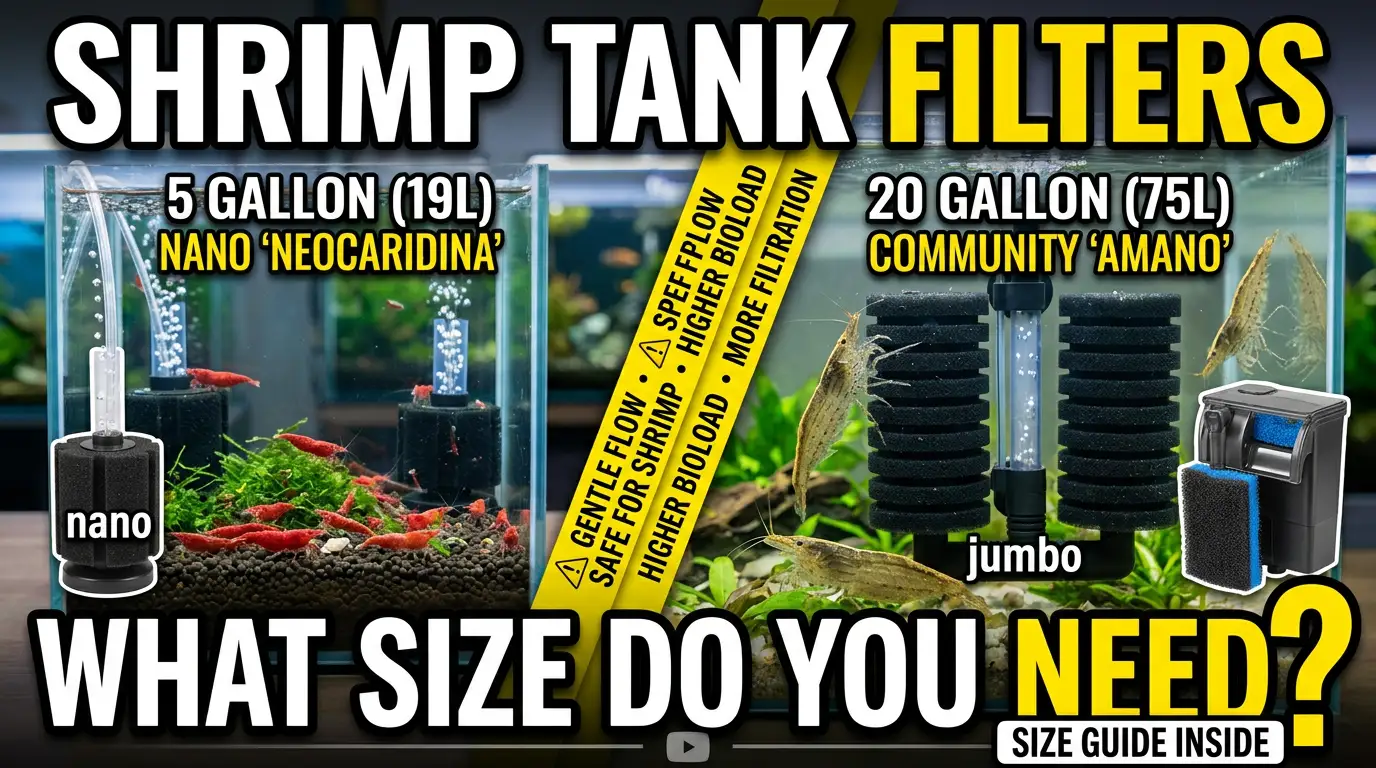
A sponge filter solves the intake problem structurally instead of patching it. There’s no impeller pulling water through a narrow strainer; an air pump pushes bubbles up a lift tube, and that rising column of bubbles drags tank water through the surrounding foam by gentle diffusion. Aquarium Co-Op’s guide to sponge filtration describes the design as “gentle enough to avoid sucking up fish fry, shrimp, and other slow-moving creatures”, which is precisely the failure mode that cost me those shrimplets with a conventional filter. There’s no strainer to squeeze through and no suction strong enough to trap something that small against it, because the pulling force is diffuse across the entire sponge surface rather than concentrated at one narrow opening.
The second reason sponge filters dominate serious shrimp keeping has nothing to do with safety and everything to do with biology. Foam is enormously porous, and every one of those pores becomes real estate for beneficial nitrifying bacteria, the same bacteria doing the actual work of converting toxic ammonia and nitrite into far less harmful nitrate. Aquarium Co-Op notes that drawing water through the porous foam “gives beneficial bacteria a place to grow,” and a coarse or medium-pore sponge offers dramatically more surface area for that colonization than the thin cartridge or floss pad in most hang-on-back filters. For a shrimp colony, which is more sensitive to ammonia and nitrite spikes than most fish, that extra biological capacity is a real margin of safety, not a nice-to-have.
There’s a third benefit that’s easy to underrate until you’ve kept shrimp for a while: the sponge itself becomes a grazing surface. Biofilm and microorganisms colonize the foam constantly, and shrimp spend a large share of their day picking at exactly that film. A sponge filter isn’t just filtering the water; it’s quietly generating a renewable food source your colony works over every day, on top of whatever you’re feeding directly.
How to size a sponge filter and air pump for your tank
Sponge filters are usually sold by the tank size they’re “rated” for, and the single best sizing habit is to buy one rated meaningfully above your actual tank volume rather than matching it exactly. Because the sponge relies on gentle diffusion rather than a motor pushing a fixed flow rate, oversizing the sponge itself doesn’t create dangerous current the way oversizing a powerhead would; it just gives you more surface area for bacteria and more margin if bioload increases later. A sponge rated for double your tank’s gallonage is a reasonable rule of thumb for a shrimp-only setup.
The air pump is the other half of the equation, and it’s where people most often under-size. The pump has to move enough air to lift water reliably through the sponge without you cranking the airline valve wide open (which increases turbulence and surface disturbance more than it increases real filtration). A single-outlet pump is generally adequate for one sponge filter on a small tank; once you’re running a second sponge, a taller tank, or want the reserve capacity to add a filter later, step up to a dual-outlet pump or a small air-driven system with a check valve on each line.
| Tank size | Sponge filter size | Air pump | Notes |
|---|---|---|---|
| 5-10 gallons | Small/nano sponge (rated ~10-20 gal) | Single-outlet, low-output | One sponge is plenty; keep flow gentle for shrimplets |
| 10-20 gallons | Medium sponge (rated ~20-40 gal) | Single- or dual-outlet | Most common shrimp-tank setup; one sponge usually covers it |
| 20-40 gallons | Large sponge, or two medium sponges | Dual-outlet | Two smaller sponges beat one giant one for even flow and easier cleaning |
| 40-55 gallons | Two large sponges | Dual-outlet or small air compressor | Split filtration across two locations to avoid dead spots |
| 55+ gallons / tall tanks | Multiple sponges, stacked units for depth >22 in. | Air compressor with manifold | Stack sponge units for tanks taller than about 22 inches so lift is sufficient |
As a rough turnover target, aim for the filter to move somewhere around three to four times the tank’s actual water volume per hour in a shrimp-only setup — enough to keep the water well-oxygenated and circulated without creating current strong enough to exhaust shrimplets. If you’re running a heavily planted tank with light bioload, you can sit at the lower end of that range; if you’re stocking densely or mixing in a few small fish, lean toward the higher end and consider a second sponge rather than a single oversized one.
Making a HOB or canister filter shrimp-safe
Plenty of keepers still want to run a hang-on-back or canister filter on a shrimp tank, for the extra flow in a larger or heavily-stocked setup, or simply because they already own one. That’s workable, but the intake needs to be modified before shrimp go in, not after you notice the first one missing. Practical Fishkeeping’s Neocaridina FAQ lays out several field-tested fixes, in roughly ascending order of how much flow they cost you:

- Fine-pored foam over the strainer. A pre-filter sponge that slips over the intake tube is the standard fix, it’s sold specifically for this purpose and physically stops anything shrimp-sized from reaching the strainer slots, while still letting water through.
- A stocking or fine mesh secured with an elastic band. Practical Fishkeeping specifically mentions “a fine stocking foot secured with an elastic band” as a low-cost, effective barrier when you don’t have a purpose-made pre-filter sponge on hand.
- Reducing the filter’s flow rate. Many HOB and canister filters have a flow control valve; turning it down reduces the pull at the intake as well as the output current, which lowers risk on both ends.
- Adding filter wool or floss to slow flow further. Packing extra media into the intake path decreases flow rate even on filters without a dedicated valve, at the cost of needing more frequent cleaning.
- Layering floss between the canister body and the stocking. For canister filters specifically, this doubles up the barrier at the point furthest from the tank, which matters because canister intakes are usually hidden and easy to forget about during routine maintenance.
Worth noting: shrimp that do end up inside a canister filter’s media chamber aren’t necessarily doomed. Practical Fishkeeping observes that shrimp surviving inside external canisters can actually thrive there, grazing on the beneficial bacteria colonizing the media, but that’s a lucky accident, not a filtration strategy, and it doesn’t help the shrimplets that don’t survive the trip through the impeller to get there.
Flow rate: how much current is actually too much
Even once the intake is safe, flow rate still matters, just not in the way most filter marketing implies. Shrimp aren’t strong swimmers relative to fish, and shrimplets in particular spend their first weeks clinging to plants, sponge surfaces, and substrate rather than swimming freely through open water. A current strong enough to constantly dislodge them costs energy they need for growth and molting, and in a worst case can pin them against decor or a filter outlet for extended periods.
The practical fix is the same whether you’re running a sponge filter or a powered one: aim the outlet so the strongest current runs along one side of the tank rather than directly across open swimming space, and give shrimp calm zones near the substrate and among plants where they can move without fighting flow. A sponge filter’s diffuse output already runs gentle by design; on a HOB or canister filter, a spray bar or a flow-reducing nozzle spreads the same GPH over a wider area and cuts the concentrated force of a single narrow outlet dramatically. If your tank has a heavy plant load — which most well-run shrimp tanks do, dense stem plants and moss also break up current naturally, which is one more reason a properly cycled, well-planted setup tends to have an easier time keeping shrimplets calm than a bare tank with the same filter.
Matching filtration to bioload as your colony grows
Shrimp colonies don’t stay static, and filtration that was adequate for ten adults can fall behind once that colony triples in a few months. Watch for the same warning signs you’d track on any bioload increase: ammonia or nitrite readings that used to sit at zero creeping upward between water changes, a sponge that needs squeezing out far more often than it used to, or visibly slower shrimp activity after feedings. Any of those is a signal to add a second sponge filter rather than swap to a larger, more powerful single unit; splitting filtration across two locations improves circulation evenly across the tank and gives you redundancy if one sponge needs a deep clean.
This is also where routine tank care and filter sizing intersect. A sponge filter that isn’t rinsed regularly loses flow gradually as it clogs with detritus, which can mask a genuine undersizing problem; you might assume the filter is fine because nothing changed, when really it’s been quietly losing capacity for weeks. Working sponge maintenance into a broader aquarium maintenance schedule, a quick squeeze-out in old tank water every week or two, alongside routine gravel cleaning, keeps the filter performing at the capacity you actually sized it for.
Frequently asked questions
What size sponge filter do I need for a 10-gallon shrimp tank?
A medium sponge filter rated for roughly 20-40 gallons, run on a single- or dual-outlet air pump, comfortably covers a 10-gallon shrimp tank and leaves margin as the colony grows.
Can shrimp get pulled into a sponge filter?
Not in the way they can with a powered filter’s intake. A sponge filter draws water through gentle diffusion across the entire foam surface rather than concentrated suction at one narrow opening, so there’s no strainer slot for a shrimplet to be pinned against.
Is a hang-on-back filter safe for a shrimp tank?
It can be, as long as the intake is fitted with a pre-filter sponge or a fine mesh/stocking barrier before shrimp go in, and the flow is turned down rather than left at maximum. Without that guard, shrimplets are commonly pulled in and killed.
How many times per hour should a shrimp tank filter turn over the water?
Roughly three to four times the tank’s total volume per hour is a reasonable target for a shrimp-only tank, enough for good oxygenation and circulation without creating current strong enough to stress shrimplets.
Do I need a pre-filter sponge on a canister filter for shrimp?
Yes. Canister intakes are usually hidden behind the tank and easy to forget about, which makes them one of the most common places shrimplets are lost. A pre-filter sponge, plus a layer of floss between the canister body and the stocking, is the standard safeguard.
Can I run two sponge filters in one tank?
Yes, and it’s often better than one large sponge — two smaller units spread filtration and circulation across the tank more evenly, reduce dead spots, and let you clean one at a time without ever leaving the tank unfiltered.
What air pump size do I need for a sponge filter?
A single-outlet pump is generally enough to drive one sponge filter on a small to medium shrimp tank. Once you add a second sponge, run a taller tank, or want capacity in reserve, move up to a dual-outlet pump or a small air compressor.
If you’re planning a new shrimp setup from scratch, it’s worth reading through our full shrimp tank setup guide and our breakdown of shrimp tank water parameters alongside this one, and if gravel cleaning around a sponge filter has you wondering how to manage substrate without disturbing shrimplets, our guide to using an aquarium gravel cleaner covers exactly that. Stable, well-filtered water is also a major factor in how long a colony lives, a point covered in our aquarium shrimp lifespan guide, and inadequate filtration is one of the recurring themes in our roundup of common shrimp diseases and how to treat them.



Leave a Reply