Fish & Aquariums
The first August I kept shrimp, I came home from a long weekend to find the tank thermometer reading 84°F and a colony of cherry shrimp that had gone strangely still, clustered low near the sponge filter instead of grazing across the glass like normal. Nothing had “broken,” there was just no air conditioning running while I was away, and a small, unheated 10-gallon tank near a window had quietly baked for three days straight. That scare is what got me paying attention to the calendar instead of just the thermometer, because a shrimp tank doesn’t actually care what season it is outside, it only cares whether the conditions inside its four walls of glass are still the stable ones the colony settled into.
Quick answer
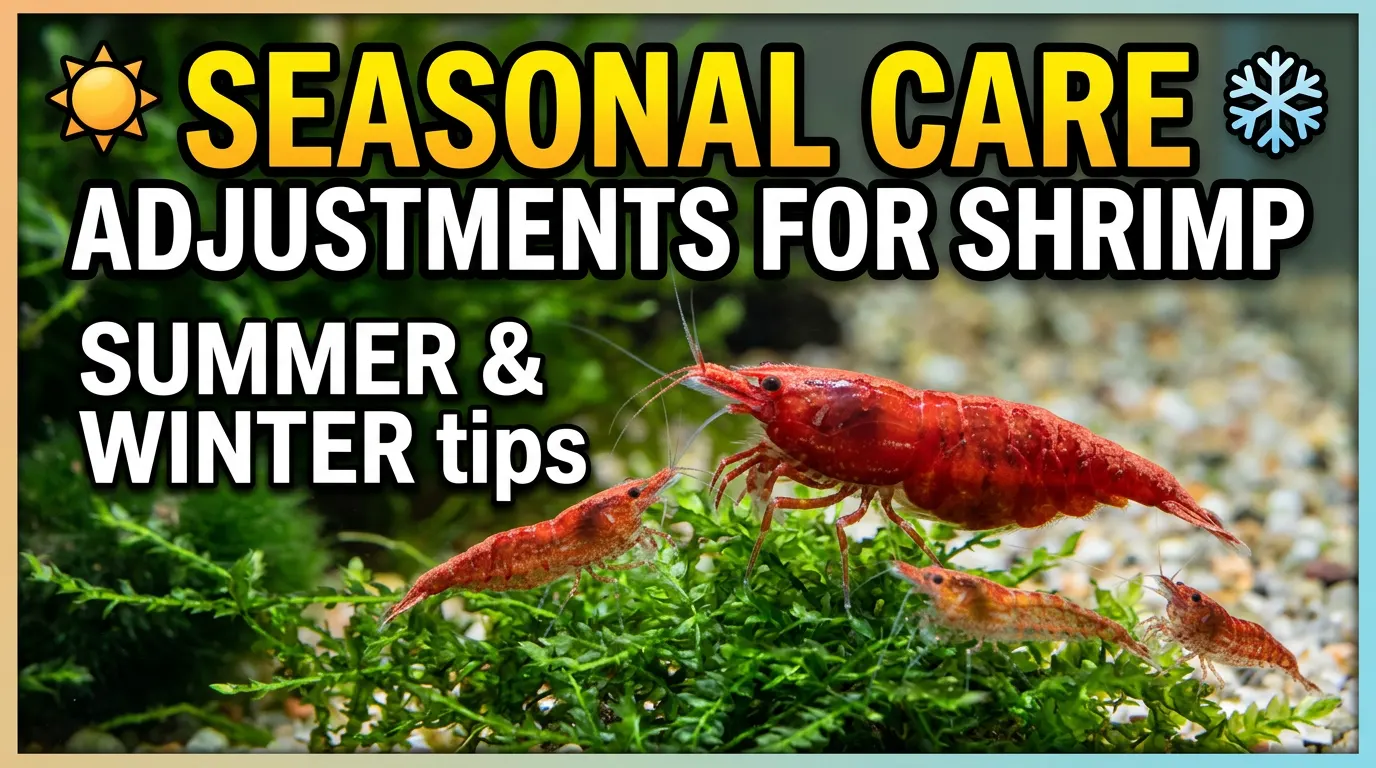
Shrimp tanks need real seasonal adjustments even indoors, because room conditions swing with the weather more than most keepers assume. In summer, watch for overheating in any room without air conditioning, since evaporation speeds up as water warms, which concentrates minerals and dissolved solids (GH/TDS) faster and calls for more frequent, smaller top-offs with plain dechlorinated water rather than a full water change. In winter, an unheated or lightly-heated tank can drift down with a cold room overnight, so it’s worth confirming a heater and thermostat are still working correctly before the cold sets in and trimming feeding back slightly, since shrimp metabolism slows in cooler water the same way it does for fish. Breeding activity in Neocaridina and Caridina shrimp often slows on its own during these less stable stretches, which is a normal seasonal response rather than a sign of a sick colony, and a tank that gets direct window light will typically need its lighting or algae routine adjusted as day length and sun angle shift through the year. None of this replaces the core husbandry covered in my shrimp tank setup guide, it’s a set of small, calendar-driven tweaks layered on top of it.
Why an indoor tank still feels the seasons
It’s easy to assume that once a tank is inside a climate-controlled home, the outside weather stops mattering. In practice, very few homes hold a genuinely constant temperature year-round, HVAC systems get turned off overnight, thermostats get set back to save money, windows get opened on a nice day and left open after the temperature drops, and rooms without dedicated heating or cooling can swing by ten degrees or more between a summer afternoon and a winter night. A shrimp tank has some thermal buffering simply because water changes temperature slower than air, but a small tank, one without much water volume to buffer against, will still track a swinging room fairly closely over a day or two.
Shrimp are also more exposed to this than most home aquarium fish, because so many shrimp-only setups skip a heater entirely. That’s a completely reasonable choice, cherry shrimp genuinely tolerate a wide range, roughly 65-80°F (18-27°C), and often do fine at stable room temperature, as I cover in the heater FAQ of my shrimp tank setup guide. The tradeoff is that an unheated tank has no floor and no ceiling built in the way a heated tank does; it simply follows the room, which is exactly why a seasonal check-in matters more for shrimp keepers than it does for someone running a heated, thermostat-controlled community fish tank.
Summer considerations: heat, evaporation, and top-offs
The single biggest summer risk for a shrimp tank isn’t a slightly warm reading, it’s a room with no air conditioning climbing well past what the colony is used to, especially during a multi-day heat wave when there’s no overnight cooldown to reset things. Warm water also holds less dissolved oxygen than cool water, so a hot spell stacks two stressors on shrimp at once: less oxygen available right when their own oxygen demand, tied to metabolism, is highest. Aquarium Co-Op’s guide to cooling aquarium water during a heat wave lays out several practical, low-cost responses for exactly this situation, including running a small fan blowing across the open water surface to boost evaporative cooling, floating a sealed bottle of frozen water in the tank temporarily, turning off any tank lighting that adds its own heat during the hottest part of the day, and moving a tank out of direct summer sun if it’s near a window.
The second summer issue is quieter and easier to miss: evaporation itself speeds up as water and room temperatures rise, and only water evaporates, the minerals, salts, and other dissolved solids left behind become more concentrated in whatever water remains. That means GH, KH, and TDS can all creep upward through a hot summer stretch purely from evaporation, with no water change or feeding change involved at all. The fix isn’t a bigger water change, it’s simply topping off more often with plain, dechlorinated water (no minerals added back in), which dilutes the concentration back down rather than adding to it the way a mineral-heavy top-off would. In practice this often means moving from a weekly top-off habit to checking levels every few days during the hottest stretch of summer, and it pairs naturally with the smaller, more frequent water-change philosophy I cover in my shrimp tank water change guide, since both are really about avoiding a slow, invisible drift in tank chemistry.
Winter considerations: cold rooms, heater checks, and slower feeding
Winter risk runs in the opposite direction but follows the same logic: a room that gets genuinely cold overnight, especially in a house that sets the thermostat back at night or in a drafty spot near a window or exterior wall, can pull an unheated tank down further and faster than most keepers expect. Cherry shrimp tolerate the lower end of their range reasonably well, but a tank that regularly dips toward the bottom of, or below, that 65-80°F window through the winter is a reasonable candidate for a small, low-wattage heater, sized and set up as described in my aquarium heater guide, even if it ran fine without one all summer.
If a tank already has a heater, winter is exactly the season when a quiet malfunction gets exposed, since a heater that’s been idling all summer in a warm room may not have actually kicked on and held a temperature in months. A short seasonal check before the cold really sets in catches most of this before it becomes an emergency:

- Confirm it’s actually heating. Watch or feel for the heater cycling on as the room cools in the evening, rather than assuming it’s working because the light is on or it’s plugged in.
- Cross-check with a separate thermometer. A heater’s built-in dial or display can drift out of calibration over a year of use; a simple stick-on or digital thermometer elsewhere in the tank is the only way to confirm the actual water temperature.
- Watch for a stuck-on heater as closely as a dead one. A thermostat that fails “on” can overheat a tank just as dangerously as one that fails “off,” so a temperature check catches both failure modes, not just the obvious one.
- Check the room, not just the tank. A heater sized for a room that stays near 70°F may be undersized once that same room regularly drops into the 50s overnight with a door or window left cracked.
Feeding is the other winter adjustment, and it follows straightforwardly from shrimp being ectotherms: their metabolism is directly tied to water temperature, the same relationship that drives standard fall and winter feeding cutbacks for pond fish and other cold-blooded aquatic animals. In a room that’s noticeably cooler through winter, even one still within the safe range, shrimp process food more slowly and simply need less of it; cutting back toward the lighter end of the routine described in the feeding table of my shrimp tank setup guide, and leaning more on the biofilm and algae shrimp graze on constantly, avoids the uneaten food and fouled water that overfeeding into a slower colony tends to cause.
Why breeding activity often slows down on its own
A colony that was steadily producing berried females all summer and then seems to pause through a cold snap or an unusually hot stretch isn’t necessarily doing anything wrong, and it isn’t automatically a sign of a health problem either. Breeding in Neocaridina and Caridina shrimp responds to overall tank stability as much as to any single number, and a season that brings bigger day-to-night temperature swings, more frequent top-offs, or a shifted feeding routine is, almost by definition, a less stable stretch for the tank even when every individual parameter stays within a technically safe range.
This lines up with what’s generally understood about crustacean reproduction responding to environmental cues rather than running on a fixed internal clock: less consistent temperature and light conditions are a natural signal to slow down reproductive investment, not unlike how many aquatic species time breeding around more stable, favorable stretches of the year in the wild. A female that’s already berried can be more exposed during an unstable season too, since a fast parameter shift is a well-documented way to cause a female to drop or reabsorb eggs, which I cover in more detail in the breeding-sensitivity section of my water change frequency guide. The practical takeaway is the same either way: a quieter breeding season during a rough patch of weather is usually the colony responding sensibly to instability, and it typically picks back up once conditions settle rather than needing any active intervention.
Seasonal algae and lighting shifts near a window

A tank that sits anywhere near a window doesn’t just get warmer in summer, it gets meaningfully more light too, both because days are longer and because the sun sits at a higher angle and throws direct light further into a room than it does in winter. That combination of more hours and more direct intensity is a classic recipe for an algae bloom, since algae generally needs the same two inputs a planted tank’s own plants need: light and nutrients, and a shrimp tank’s constant, low-level bioload usually keeps nutrients available in the background regardless of season. General aquascaping guidance on placing a tank near a window, echoed in guides like Buce Plant’s advice on keeping a window-adjacent tank algae-free, points to a few consistent fixes: a sheer curtain or shade over the window during the brightest months, keeping the tank’s own light on a modest, fixed schedule instead of letting natural light add to it unchecked, and treating any visible green tint or fast-forming film on the glass as an early cue to scale one of those back rather than waiting for a full bloom.
Winter tends to swing the other way: shorter days and a lower sun angle usually mean less incidental light reaches a window-adjacent tank, which can actually reduce algae pressure but also means a tank’s own lighting timer may need to run slightly longer or brighter through the darkest months if the goal is to keep plant growth (and the biofilm shrimp graze on) consistent year-round. Checking a tank against a window every few months as the seasons turn, rather than setting the light once and never revisiting it, is a small habit that keeps both algae and plant health from drifting too far in either direction.
A simple seasonal maintenance checklist adjustment
None of these seasonal tweaks replace the routine maintenance schedule covered in my shrimp tank setup guide, they layer small adjustments onto specific line items depending on the time of year. The table below is a simple way to see, at a glance, what shifts and what stays the same as the seasons change.
| Routine task | Summer adjustment | Winter adjustment |
|---|---|---|
| Temperature check | Check daily during any heat wave; watch for readings pushing past the top of the safe range | Check a couple of times a week; watch for overnight lows near the bottom of the safe range |
| Top-offs | More frequent, plain dechlorinated water only, to dilute evaporation-driven mineral concentration | Roughly normal frequency; evaporation slows in a cooler room |
| Water changes | Keep to the usual small, slow schedule; avoid adding cold water straight from the tap | Same schedule; match temperature closely so new water isn’t noticeably colder than the tank |
| Heater/thermostat check | Confirm it isn’t stuck “on” and overheating during warm spells | Confirm it actually cycles on and holds temperature before the cold sets in |
| Feeding amount | Normal amount; watch that uneaten food doesn’t spoil faster in warmer water | Slightly reduced; lean more on biofilm and algae grazing as metabolism slows |
| Lighting duration | Consider shading a window-adjacent tank; watch for faster algae growth | May need a slightly longer or brighter light cycle if natural light drops off |
| Breeding expectations | Normal to steady, provided temperature stays stable | Normal to see a natural slowdown during unstable cold snaps |
Anyone who travels regularly should treat this table as one more thing to check before leaving, since a heat wave or cold snap hitting while nobody’s home to notice a stuck heater or a fast-evaporating tank is a much bigger risk than the same event with someone checking daily; my shrimp vacation care guide goes into the broader precautions worth taking before any trip that spans a seasonal transition.
Frequently asked questions
Do shrimp tanks really need different care in summer versus winter?
Yes, mainly because most homes don’t hold a perfectly constant temperature year-round. Summer brings a real risk of overheating and faster evaporation, which concentrates minerals faster, while winter brings colder rooms, heater reliability concerns, and slower shrimp metabolism, so the checks worth doing shift with the season even if the tank itself never moves.
Can shrimp survive winter at room temperature without a heater?
Often, yes, since cherry shrimp tolerate a fairly wide range down to around 65°F. The risk isn’t room temperature itself, it’s a room that swings well below that range overnight or during a cold snap; if that happens regularly, a small, properly sized heater is a reasonable safeguard rather than a requirement for every setup.
Why does my shrimp tank’s TDS or hardness rise faster in summer?
Warmer water and warmer rooms evaporate faster, and evaporation only removes water, not the minerals and dissolved solids left behind, so they become more concentrated in what remains. Topping off more often with plain dechlorinated water, rather than water with minerals added, dilutes that concentration back down instead of adding to it.
Should I feed my shrimp less in winter?
Generally yes, a little. Shrimp are ectotherms, so their metabolism slows in cooler water the same way it does for most aquatic animals, and a colony in a noticeably cooler room simply needs less food, with biofilm and algae grazing covering more of the gap than in summer.
Why did my shrimp stop breeding when the weather changed?
A pause in breeding during an unstable seasonal stretch is usually normal rather than a sign of illness. Breeding responds to overall tank stability, and a season with bigger day-to-night swings or more frequent top-offs is a less stable environment even when every parameter stays technically safe, so a quieter breeding period often resolves on its own once conditions settle.
My tank gets window light. Does that cause more algae in certain seasons?
It can, since longer days and a higher summer sun angle both add more light to a window-adjacent tank at the exact time of year nutrients are already steady from the colony’s bioload. A sheer curtain or shade during the brightest months, alongside a fixed lighting schedule for the tank itself, keeps that extra seasonal light from tipping things toward a bloom.
What’s the single most important seasonal check for a shrimp tank?
Confirming actual temperature with a separate thermometer, not just trusting a heater’s dial or assuming an unheated tank is fine because it always has been. Most seasonal problems, overheating, a cold snap, or a heater failing in either direction, show up as a temperature reading before they show up as visibly stressed shrimp.
If you’re setting up a shrimp tank for the first time, my shrimp tank setup guide and aquarium heater guide cover the baseline decisions these seasonal adjustments build on, and the water change frequency guide and vacation care guide are worth pairing with this one for the routine and travel situations that tend to collide with a seasonal transition. If your goal is keeping the whole routine as light as possible year-round, our low-maintenance shrimp guide covers how far that effort can realistically shrink, and our guide to transporting shrimp safely covers the same heat and cold risks covered above for anyone moving shrimp during an extreme-weather stretch.



Leave a Reply