Fish & Aquariums
The first time I saw a tiny white “spike” sticking off a cherry shrimp’s rostrum, I genuinely thought a piece of plant debris had gotten stuck to her face. It hadn’t. It was Scutariella japonica, and within a week three more shrimp in the tank were wearing the same little tiara. I’d already reached for the fish medicine cabinet before I remembered a hard rule of shrimp keeping: almost everything in there can kill an invertebrate faster than the disease will. That scare is basically why this guide exists.
Quick answer
Most visible shrimp “diseases” fall into a handful of categories, external epibionts like Scutariella japonica and Vorticella, bacterial or fungal shell infections, parasitic growths such as Ellobiopsidae-type organisms, and two much more serious internal conditions, muscle necrosis and Internal Yellow (Milky) disease, and the single most important fact to know before treating any of them is that copper, formalin, malachite green, and most broad-spectrum fish parasite treatments are toxic to shrimp at the doses used for fish, so prevention through stable water quality, strict 30-day quarantine of new stock, and targeted, invertebrate-safe methods (brief salt dips, manual removal, praziquantel in limited cases) beats reaching for a bottle almost every time.
Why prevention beats treatment for shrimp
Shrimp are not small fish. They’re crustaceans, and the physiology that makes so many fish medications work, disrupting gill function, nervous transmission, or cell membranes in ways fish can tolerate but invertebrates can’t, is exactly why those same medications are so dangerous to shrimp. Practical Fishkeeping’s freshwater shrimp FAQ is blunt about this, warning that shrimp are “very sensitive to heavy metals, such as copper, and to pollutants including ammonia and nitrite,” and that “some fish disease treatments, algicides and snail eradication chemicals can contain copper in levels high enough to kill shrimps.” Copper’s danger to crustaceans isn’t hobbyist folklore, either, it’s documented in aquaculture and veterinary extension literature, including University of Florida IFAS Extension publications on copper toxicity in invertebrate-stocked systems, which note that copper accumulates in tissue and remains toxic at concentrations that barely register on a fish-safe test kit.
Formalin and malachite green, the active ingredients in many whitespot and fungus treatments, sit in the same danger zone. The guide at Cherry Shrimps UK on shrimp-safe medications puts it plainly: these ingredients are “risky to outright lethal for shrimp,” and copper-based snail killers or algicides catch shrimp in the crossfire even when shrimp were never the target. That’s the core reason every experienced breeder pushes prevention first, stable, cycled water, consistent parameters, gentle filtration, and a real quarantine period for new arrivals, because once shrimp are sick, the treatment options that would actually work on the pathogen are frequently the same options that kill the patient.
Common shrimp diseases at a glance
| Disease / symptom | Likely cause | Treatment & outlook |
|---|---|---|
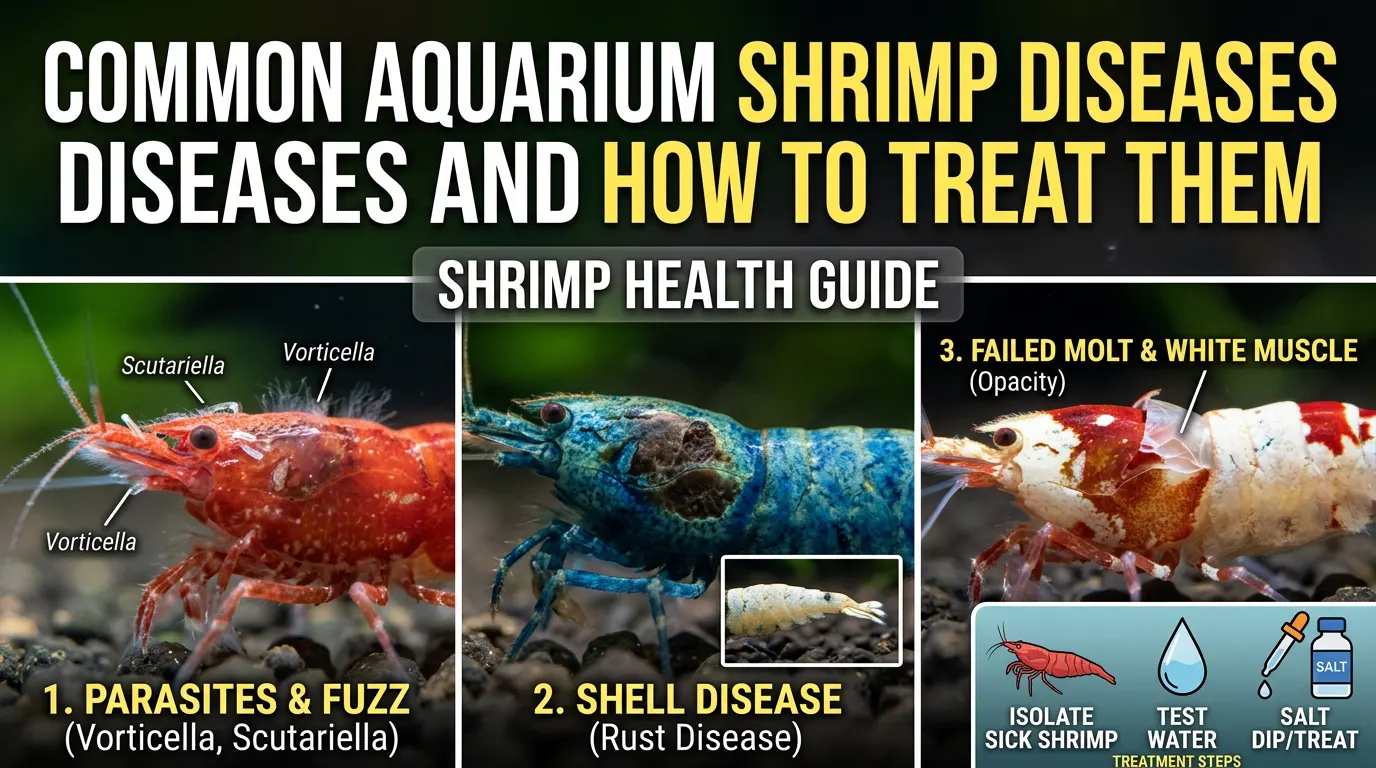
| White threadlike growths near eyes/rostrum | Scutariella japonica (an epibiontic flatworm, not a true internal parasite) | Not usually fatal alone; salt dips, manual removal, and strict water changes manage it; heavy infestations can damage gills |
| Fuzzy white/greyish growths, often on head or gills | Vorticella (a ciliate protozoan that thrives on excess organics) | Improve water quality first; short salt dips or a mild hydrogen peroxide dip can help; usually resolves once the tank is cleaner |
| Cloudy, discolored, or lesioned shell patches | Bacterial or fungal (oomycete) shell infection, often secondary to injury or stress | Isolate affected shrimp; improve water quality; external infections are treatable early, internal ones rarely are |
| Green or yellowish filaments on swimming legs | Ellobiopsidae-type parasitic growth (often cited as Cladogonium ogishimae) | No reliable cure; typically progresses to death; cull and quarantine tankmates as a precaution |
| White, opaque, “cooked-looking” tail or muscle tissue | Muscle necrosis, usually triggered by stress, temperature shock, or poor water quality | Stabilize parameters immediately; often fatal once visible, especially if it spreads past the tail |
| Shrimp turns uniformly milky/pale yellow-white, dies quickly | Internal Yellow disease / Milky disease, linked to internal parasitic infection (often described as a Myxosporea-type organism) | No effective treatment currently known; remove and isolate immediately, disinfect equipment, watch tankmates closely |
Scutariella japonica: the “spiked tiara” parasite
This is probably the single most common thing shrimp keepers mistake for a serious disease, and it’s the one our earlier post on cherry shrimp basics already touched on briefly; this section goes deeper. Scutariella japonica is a tiny whitish flatworm, roughly 1-2mm, that attaches near the eyes, rostrum, and antennae. The Shrimp Farm’s guide to Scutariella describes the look vividly: the worms make shrimp look “like they’re wearing a tiny, spiked tiara,” and white dots clustered behind the head, above the legs, are usually egg masses sitting in the gill chambers rather than the worms themselves. Technically, Scutariella and related genera like Caridinicola are epibionts, organisms that live on a host’s surface rather than feeding directly on its tissue, which is why The Shrimp Farm notes they “aren’t usually deadly” on their own.
The risk is indirect: a heavy infestation can clog gills, interfere with molting, and stress a shrimp enough that something else finishes the job. Treatment leans holistic rather than chemical. Aquarium Breeder’s shrimp disease writeups and The Shrimp Farm both point to the same toolkit: meticulous water changes, removing molted exoskeletons promptly (since eggs and juvenile worms cling to shed shells and this interrupts their life cycle), optional short salt dips, and antimicrobial botanicals like Indian almond leaf or alder cones to support the water. As The Shrimp Farm puts it, “holistic treatment is becoming more popular than traditional nuclear tactics, like antiparasitic medication”, which tracks with the broader point that fish-grade dewormers are a poor trade against a parasite that rarely kills outright.
Vorticella: the fuzzy white growths
Vorticella looks alarming and is often mistaken for a fungal infection, but it’s actually a single-celled ciliate, a protozoan with tiny hair-like cilia that give colonies a fine, fuzzy, cotton-like appearance, usually around the head and gills. The Shrimp Farm’s Vorticella guide is careful to note it’s “not a fungus or true parasite” but another epibiont, one that ranges in color from white or translucent to greenish or yellowish depending on what it’s picked up from the water column.

Vorticella is fundamentally an opportunist. It blooms where there’s excess organic matter and bacterial load for it to feed on, overfeeding, infrequent water changes, and dirty filter media are the usual culprits. In a genuinely clean tank it’s mostly cosmetic; in a neglected one, heavy colonies can impede feeding and gill function enough to be dangerous, and it does spread through molts and general water contact between shrimp. The practical fix mirrors Scutariella’s: fix the water quality problem first, since that’s the actual root cause, then use brief salt dips on visibly affected shrimp, and in more stubborn cases a very dilute hydrogen peroxide dip (roughly 1ml of 3% solution per gallon, used briefly and with caution) has been reported effective by hobbyists. Harsher options like formalin or copper-based treatments do exist for Vorticella in fish-only contexts, but they’re explicitly not recommended for tanks with ornamental shrimp.
Bacterial and fungal infections, and Ellobiopsidae-type growths
Cloudy patches, discolored blotches, or lesions on the shell are usually a sign of a bacterial or fungal (technically oomycete, a “fungus that’s not really a fungus”) infection taking hold, often after an injury, a bad molt, or prolonged stress from poor water quality. The Shrimp Farm’s disease encyclopedia rates external bacterial infections as serious, describing “brownish lesions on its carapace” that can progress to larger black patches as bacteria break down the shell’s chitin. Oomycete infections show up as fuzzy masses, frequently between the swimming legs, and are rated among the deadliest conditions a shrimp can develop. The uncomfortable truth from that same source is that once bacteria get past the shell and into the shrimp’s internal cavity, “treatment is not a realistic option”, internal infection can turn a shrimp pink (septicemia) or milky white, and by that point isolation and prevention of spread matter more than trying to cure the individual animal.

A related but distinct problem is the growth commonly (and inaccurately) nicknamed “green fungus,” caused by an organism frequently labeled Ellobiopsidae in hobbyist writing, though The Shrimp Farm’s deeper dive clarifies that the actual culprit behind most freshwater cases is a parasitic green alga in the genus Cladogonium, not a true Ellobiopsidae species (those infect marine crustaceans). It shows up as elongated green filaments on the swimming legs, smooth and green early on, then yellowish and more textured as it matures and releases spores. Unlike Scutariella or Vorticella, this one is a genuine internal parasite: it penetrates the exoskeleton into muscle tissue, and The Shrimp Farm describes the outcome as typically fatal, if sometimes slow. Reported experimental responses include hydrogen peroxide treatments, botanical additions, and salt dips, but no source claims a reliable cure, and results vary enormously between tanks.
Muscle necrosis and Internal Yellow disease: the two you really don’t want to see
These are the two conditions in this guide that keepers should be able to recognize instantly, because by the time you see them, the window for doing anything meaningful is usually already closing. Muscle necrosis presents as a patch of white, opaque, almost “cooked-looking” tissue, typically starting in the tail muscle and sometimes spreading forward. Acuario Pets’ writeup on shrimp muscular necrosis is direct about the stakes, calling it “a serious and often deadly condition,” and distinguishing it clearly from the gradual color fading that comes from stress hormones or a poor diet; necrosis is opaque, localized, and doesn’t fade in and out. It’s most often triggered by acute stress: a temperature swing, an oxygen crash, a sudden parameter shift, or shipping stress, which is one more argument for keeping Neocaridina-type shrimp in the stable 68-75°F range and never letting ammonia or nitrite creep up, the same stability points covered when we looked at why shrimp keep dying in otherwise “normal-looking” tanks. Once necrosis is visible, there’s no treatment that reverses it; the priority shifts to stabilizing the whole tank so it doesn’t happen to anything else.

Internal Yellow disease, also documented under names like Milky disease, Milk shrimp disease, or Cotton shrimp disease, is the one every serious keeper should be able to identify on sight, because it is genuinely contagious in a way most of the conditions above are not. Affected shrimp turn a uniform pale, milky yellow-white across most of the body rather than fading gradually from the head, and Aquarium Breeder’s guide to dwarf shrimp diseases and parasites is stark about the outlook: it attributes the condition to an internal parasite (described in hobbyist and aquaculture-adjacent literature as a Myxosporea-type organism) that “literally eats the shrimp from the inside,” notes that it “infects almost all body of the shrimp at once,” and states plainly that “effective treatment is currently not known for the shrimp” and that “shrimp with these symptoms usually die within a short time.” Because it spreads between tankmates, the only responsible response is immediate removal and isolation of the affected shrimp, thorough disinfection of nets and equipment that touched it, and close observation of the rest of the colony for several weeks afterward; the same contagious-disease logic we go through in more detail in our roundup of what actually kills shrimp.
A practical, invertebrate-safe quarantine and treatment approach
Given how limited the actual treatment options are for several of these conditions, the real leverage point is a consistent quarantine and prevention routine, applied every time new shrimp, plants, or hardscape enter the house. Here’s the checklist I actually use:
- Quarantine every new shrimp for at least 30 days. Use a bare-bottomed or easy-to-inspect container so you can spot Scutariella, Vorticella, or shell discoloration early, before it ever reaches your main colony.
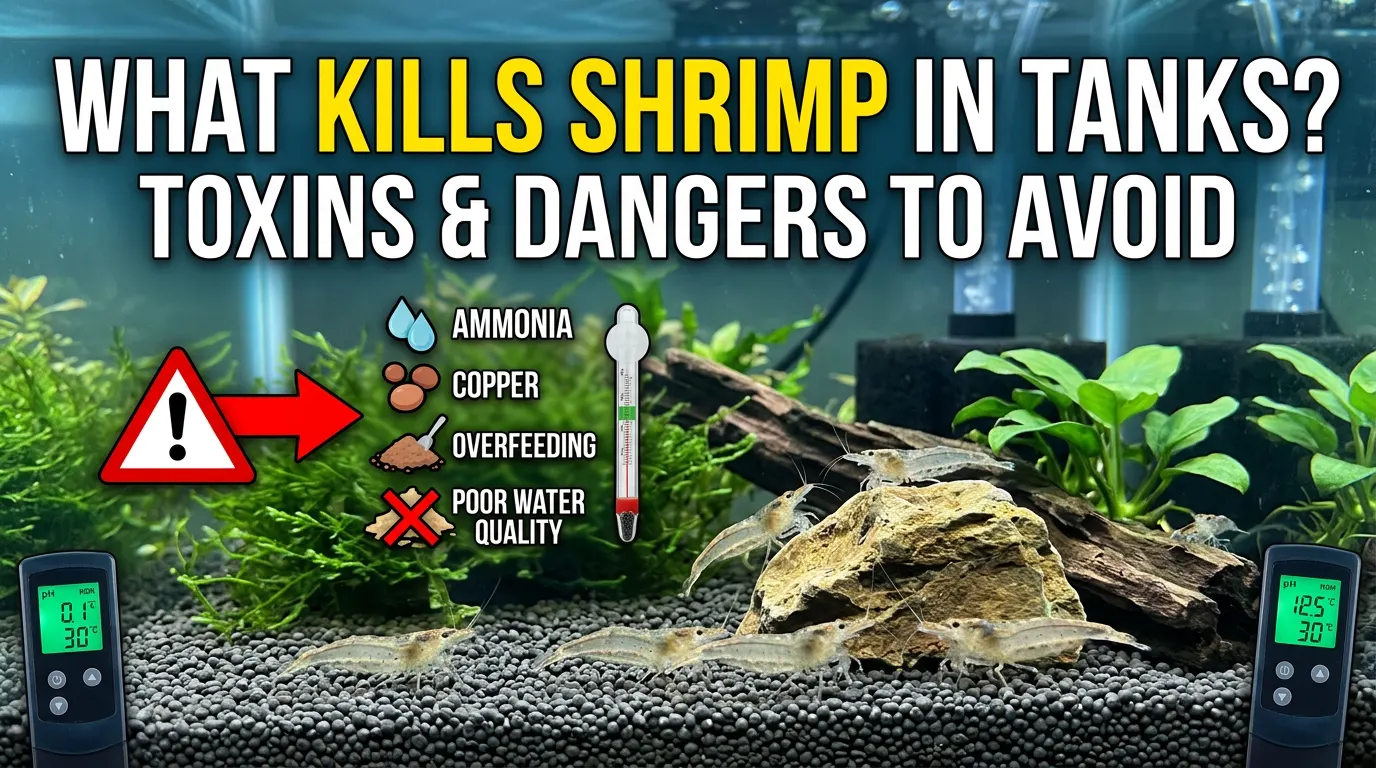
- Never dose a shrimp tank with copper, formalin, or malachite green. Check every product label, including snail killers, algicides, and general “parasite” treatments, since copper is present in far more products than the name suggests.
- Reserve salt dips for brief, targeted use only. A short 30-60 second dip in a separate cup of salted tank water can help dislodge external epibionts like Scutariella or Vorticella; salt should never be added to the main tank at treatment strength.
- Remove shed exoskeletons promptly. Old molts can harbor Scutariella eggs and organic matter that feeds Vorticella, so pulling them out interrupts both problems at once.
- Prioritize stable water parameters over any single treatment. Consistent temperature, low ammonia and nitrite, and gradual water changes prevent far more disease than any medication cures; this is the same stability principle that shows up across our shrimp health coverage.
- Isolate and don’t hesitate to cull when internal disease is suspected. Conditions like muscle necrosis and Internal Yellow disease have no reliable treatment; removing the affected shrimp fast protects the rest of the colony far more than trying to save one animal.
- Disinfect nets, tools, and hands between tanks. Cross-contamination is how contagious conditions like Internal Yellow disease spread between otherwise healthy systems.
None of this guarantees a shrimp colony that never sees disease, that’s not realistic, and anyone who promises it is overselling. But it does mean that when something does show up, you’re far more likely to be dealing with a manageable epibiont like Scutariella than an unstoppable internal parasite, simply because stable water and real quarantine keep shrimp immune systems capable of shrugging off the minor stuff before it becomes major.
Frequently asked questions
Is Scutariella japonica dangerous to my shrimp?
Usually not fatal on its own, it’s an epibiont, not an internal parasite, and light infestations are mostly cosmetic. Heavy infestations can clog gills and stress shrimp enough to cause secondary problems, so it’s still worth treating with water changes, salt dips, and prompt removal of shed exoskeletons rather than ignoring it.
Can I use regular fish medication on shrimp diseases?
No, not as a default. Most fish parasite treatments, whitespot cures, and snail killers contain copper, formalin, or malachite green, all of which are toxic to shrimp and other invertebrates even at doses fish tolerate fine. Always check the active ingredients and, when in doubt, treat in a separate hospital tank without shrimp rather than medicating the shared system.
What does muscle necrosis look like in shrimp?
Muscle necrosis appears as a patch of white, opaque, almost cooked-looking tissue, most often starting in the tail. It’s different from the gradual, patchy color fading caused by stress or poor diet, and it’s typically triggered by acute stress such as a temperature swing, oxygen crash, or sudden parameter change. Once visible, it’s usually fatal and has no established treatment.
Is Internal Yellow disease contagious to other shrimp?
Yes. Internal Yellow disease, also called Milky or Cotton shrimp disease, is linked to an internal parasitic infection that spreads between tankmates. Affected shrimp usually die within a short time, and there’s currently no known effective treatment, so immediate isolation and equipment disinfection are the best responses.
How do I tell Vorticella apart from a fungal infection?
Both look like fuzzy white growths, which is why they’re easy to confuse. Vorticella is a ciliate protozoan tied to excess organic matter and poor water quality, and it tends to improve quickly once the tank is cleaned up. True fungal or oomycete infections tend to be more persistent, can appear alongside shell damage or lesions, and are considered more dangerous overall.
What’s the single best way to prevent shrimp diseases?
Quarantine every new shrimp, plant, or piece of hardscape for at least 30 days before adding it to an established tank, and keep water parameters stable in the meantime. Most of the conditions covered here either enter a tank through new stock or take hold because of stress from unstable water, prevention through quarantine and stability does more than any treatment available after the fact.
Are green filaments on a shrimp’s legs always eggs?
Not necessarily. Round clusters that hatch around the 28-day mark are almost always eggs, but green filaments that persist well past that window, or that reappear right after a molt, are more likely to be an Ellobiopsidae-type parasitic growth such as Cladogonium. That distinction matters because the parasitic version is typically fatal and has no reliable cure, unlike normal egg-carrying.
For more on keeping a colony alive in the first place, see our posts on why shrimp keep dying and what kills shrimp, our general shrimp care guide, and our earlier note on cherry shrimp care, which first mentioned Scutariella japonica before this post expanded on it in full. A shrimp going off its food is often the first visible clue something’s wrong, so our guide to why shrimp stop eating pairs well with this one, and our guide to shrimp behavior helps tell a genuinely sick shrimp apart from one that’s simply molting or grazing normally.
References
- Frequently Asked Questions on Freshwater Shrimps – Practical Fishkeeping
- Shrimp-Safe Medications & What Never to Dose – Cherry Shrimps UK
- Scutariella Japonica (Nose Worms) in Shrimp – The Shrimp Farm
- Vorticella (White “Fungus”) on Shrimp – The Shrimp Farm
- Ellobiopsidae (Green Fungus) on Shrimp – The Shrimp Farm
- Understanding Dwarf Shrimp Diseases and Parasites – Shrimp and Snail Breeder



Leave a Reply