Fish & Aquariums
The first time I dropped a chunk of Malaysian driftwood into my Neocaridina tank, I wasn’t thinking about how it would look, I just wanted somewhere for biofilm to build so my shrimp had something to graze between feedings. Within a week the wood had picked up a faint amber tint from tannins and a fuzzy brown film the shrimp picked over constantly, and only afterward did I notice it had also become the best-looking thing in the tank. That’s the pattern I keep coming back to with shrimp tank decor: the pieces that look the most natural are almost always the ones doing the most work, as grazing surfaces, molting cover, and quiet buffers against sudden changes in the water. I’ve torn out and rebuilt that layout three times since, and every version that actually worked started with function first and decoration second.
Quick answer
Good shrimp tank decor is functional first and decorative second: driftwood and moss-covered wood or lava rock give shrimp biofilm to graze on and secluded pockets to retreat into right after molting, while any hardscape should be checked for glued-on metal fittings, sharp edges, and calcareous content (limestone, coral, some sandstones) that can push up carbonate hardness and pH without warning, which matters most for soft-water species like Caridina cantonensis. Pair dark substrate and dark hardscape with a simple layout, a stone-led Iwagumi arrangement or a lightly planted jungle-style tank, to make brightly colored shrimp visually pop, and keep at least a third of the footprint open as swimming space and grazing surface rather than crowding it with ornaments.
Decor that works as hard as it looks
It’s easy to shop for shrimp tank decor the way you’d shop for a fish tank ornament: pick whatever looks good on the shelf. Shrimp keepers tend to flip that order around, because in a shrimp-only or shrimp-heavy tank, decor is doing biological work all day long. According to the shrimp-keeping site Shrimp and Snail Breeder, driftwood is valuable less for its shape than for what grows on it: bacteria and fungi break the wood down into a slimy biofilm layer that shrimp graze on constantly, mirroring the biofilm-and-algae diet they’d be eating in the wild. The same wood leaches tannins that have mild antimicrobial properties and soften the water slightly, and its crevices give shrimp “secluded places after molting when they are especially vulnerable”, exactly the kind of cover that reduces losses to cannibalism or predation from tankmates during the soft-shell window.
Rock and hardscape do a similar double duty. A well-placed piece of spiderwood, lava rock, or seiryu stone breaks sightlines, gives shrimp somewhere to perch and feed away from filter flow, and once it’s colonized by biofilm and algae, becomes another grazing station. The mistake I made early on was treating hardscape as pure set-dressing and packing it too tightly against the glass, which left almost no flat surface for biofilm to establish and no clear lane for shrimp to move between spots. Leave gaps, and let the “ugly” filmy patches stay; that film is the point, not something to scrub off.
Moss-covered structures: grazing and molting cover in one piece
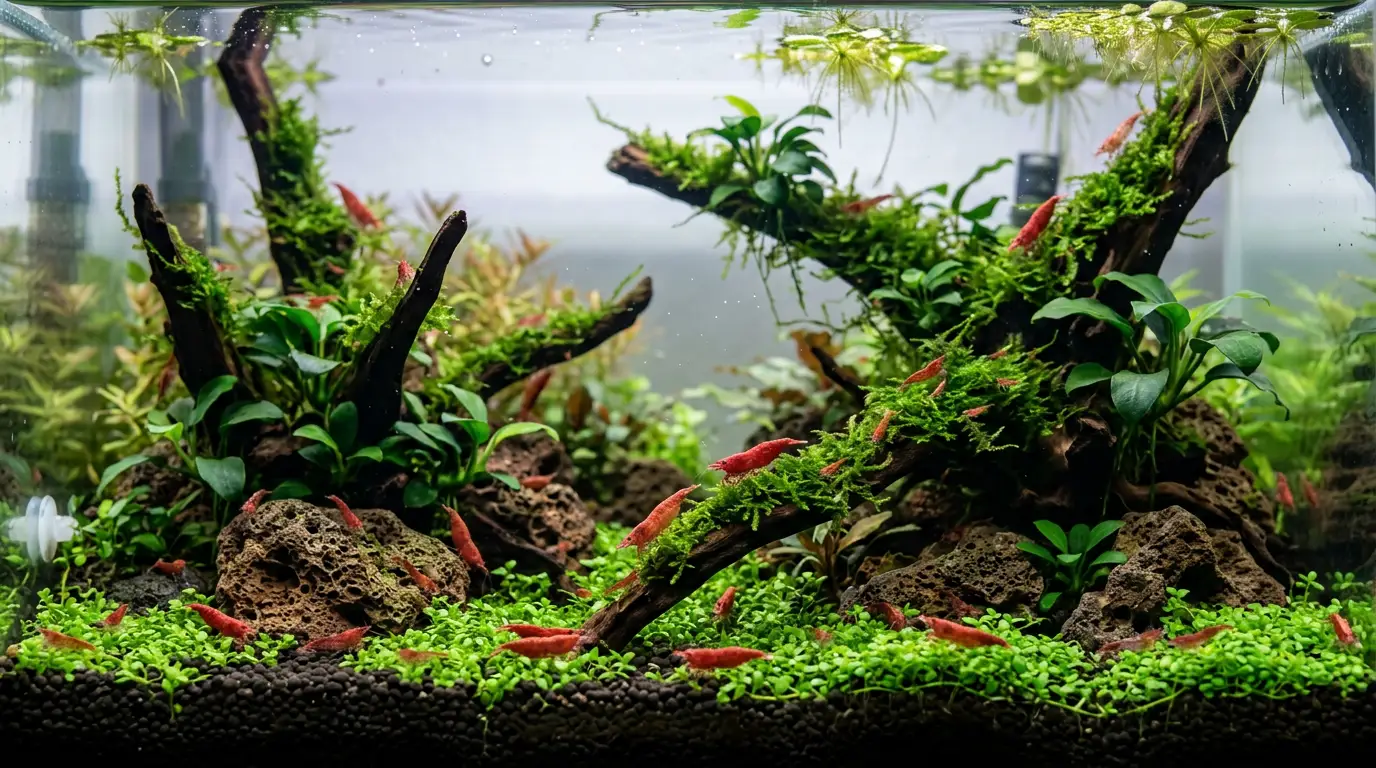
If there’s one piece of shrimp tank decor that does the most jobs at once, it’s moss tied or glued onto wood or rock. Java moss, Christmas moss, and similar species carpet a surface in a dense mat that traps detritus, biofilm, and microfauna, infusoria, biofilm bacteria, tiny worms, that shrimp, especially very young shrimplets, pick through constantly. That same dense mat then doubles as molting cover: a freshly molted shrimp can wedge itself deep into a moss clump where a curious fish or a hungry adult shrimp can’t easily reach it. Our guide to the best plants for shrimp tanks goes into which moss and plant species hold up best and grow fastest for this purpose, but the short version is that almost any low-light moss will do the job as long as you give it something to attach to and enough time to fill in before you judge how it looks.
Practically, moss-on-hardscape ages very well. Bare wood or rock can look stark for the first month or two; moss softens hard edges, hides the tie-down thread or superglue dots, and keeps improving in appearance as it thickens, which lines up neatly with it becoming more useful to the shrimp at the same time.
Safe materials: what to check before anything goes in the tank
Shrimp are far more sensitive to trace contaminants than most fish, so the vetting process for shrimp tank decor is stricter than what you’d apply to a community fish tank. Copper is the biggest single risk: it’s a required micronutrient at truly trace levels, but the aquarium retailer FlipAquatics cites a safe range for shrimp of roughly 0.02–0.03 ppm, a threshold that’s easy to blow past with copper-based fertilizers, some medications, or metal components hidden inside “aquarium-safe” decor. Our guide to what kills shrimp in tanks covers copper and other silent killers in more detail, it’s worth reading before you add anything with a metal clip, weighted base, or magnetic mount, since those parts are the most common hidden copper or zinc sources in ornaments.

Rock is the other category that needs checking, but for a different reason: hardness, not toxicity. The aquascaping retailer Aquasabi notes that calcareous stones can “release some lime into the water in a soft water aquarium with low or zero carbonate hardness,” and that soft-water species; Bee Shrimp, Taiwan Bees, and other Caridina varieties, “do not like the presence of carbonate hardness at all.” Aquasabi points to the classic vinegar test (a few drops on a dry rock; visible fizzing means it’s calcareous and will harden the water) as a quick way to screen candidate rocks before they go anywhere near a soft-water tank. Hardier Neocaridina shrimp, by contrast, tolerate harder water fine, so a fizzing rock isn’t automatically off-limits, it just needs to match the species you’re keeping.
- No exposed metal. Check clips, weighted bases, magnetic mounts, and glued joints for metal parts; even small amounts of copper or zinc can accumulate to harmful levels in a shrimp-only tank.
- Test unknown rock with vinegar. A few drops that fizz mean the rock is calcareous and will raise carbonate hardness and pH over time, fine for Neocaridina, risky for soft-water Caridina.
- Skip painted or dyed decor. Bright dyed gravel, painted resin ornaments, and cheap “aquarium safe” trinkets can leach dyes or sealants that aren’t rated for long-term invertebrate exposure.
- Cure driftwood properly. Scrub off loose bark, then soak or boil new wood to leach excess tannins and kill anything hitchhiking on it before it goes in the tank.
- Avoid sharp or flaking edges. Broken ceramic, rough-cut slate, and cheap resin caves can develop sharp edges that injure a soft-bodied, freshly molted shrimp.
- Rinse, don’t soap. Any decor should be rinsed in plain water only, soap and detergent residue is highly toxic to shrimp even in tiny amounts.
Decor at a glance: type, function, and safety notes
Here’s how the most common shrimp tank decor options compare once you weigh looks against the job each one actually does.
| Decor type | Main function | Safety notes |
|---|---|---|
| Driftwood (Malaysian, spiderwood, Cholla) | Biofilm grazing surface, tannin release, molting hideouts | Cure by soaking/boiling first; uncured wood can crash a cycle |
| Lava rock | Porous grazing surface, biological filtration, hiding spots | Generally inert and safe for soft-water tanks; rinse well before use |
| Seiryu / Ohko stone | Hardscape structure, Iwagumi focal points | Calcareous, raises hardness/pH; vinegar-test before adding to soft-water tanks |
| Slate | Flat grazing surfaces, cave roofs, terracing | Usually inert; check edges for sharpness after cutting |
| Moss on wood or rock | Grazing surface, molting cover, biofilm and infusoria trap | Use plain cotton thread or aquarium-safe glue only |
| Plastic or resin ornaments | Visual interest, occasional shelter | Confirm no metal fittings or dyes; avoid sharp mold seams |
Aquascaping styles that suit a shrimp tank
Two aquascaping traditions map especially well onto shrimp keeping, and they sit at opposite ends of the density spectrum. The first is the Japanese nature-aquarium style, and its most stripped-down version, Iwagumi, is built almost entirely around stone. As the aquascaping resource The 2Hr Aquarist explains, an Iwagumi layout uses an odd number of stones (traditionally three, five, or seven) arranged around a dominant oyaishi (main stone), a supporting fukuishi, and smaller soeishi and suteishi accent stones, because “even numbers invite symmetry, and symmetry is what makes an Iwagumi look static and boring rather than natural.” Add a low carpet of moss or a fine-leaved plant like dwarf hairgrass and you get exactly the kind of open, structured layout that shows off shrimp: plenty of exposed stone for grazing and perching, clear sightlines for watching them work the tank, and enough moss cover for molting shrimp to disappear into when they need to.
The opposite approach is jungle style, where hardscape all but disappears under dense planting. Aquarium Co-Op describes jungle aquascaping as growing plants “as densely as possible while still maintaining an aesthetically pleasing aquarium,” with hardscape used early on and then deliberately swallowed by growth. Practical Fishkeeping’s guide to underwater jungle tanks, built by aquascaper George Farmer, makes a similar case for the shrimp-relevant benefits: “the huge plant mass and overshadowing effects give fish a real sense of security,” alongside the higher oxygen levels and nutrient uptake that come with heavy planting. For shrimp, that translates into more grazing surface than any hardscape-only layout can offer, more cover from predatory tankmates, and a more forgiving margin for water-quality swings. The trade-off is that individual shrimp are harder to spot in a jungle tank than they are against the open stone of an Iwagumi, a real consideration if the whole point of your tank is watching brightly colored shrimp move around.
Color contrast: making shrimp colors pop
Whichever aquascaping style you lean toward, the substrate and hardscape colors you choose will do more for how vivid your shrimp look than almost any other single decision. Dark substrate and dark hardscape, black sand, dark aquasoil, charcoal-colored lava rock, driftwood; create contrast against bright red, blue, orange, or yellow shrimp, making their coloration read as far more saturated than the same shrimp would look over pale gravel. Pale or light-colored substrate tends to wash out strong colors and can also stress some shrimp into displaying duller, more defensive coloration, since many species instinctively darken or pale to blend with their surroundings. We cover the biology behind shrimp pigmentation and why some individuals color up more than others regardless of substrate; in our guide to shrimp colors and patterns, which is worth reading alongside this one if you’re planning a tank specifically to show off a colorful shrimp strain.
In practice, this means an Iwagumi-style layout with dark seiryu or lava stone over black sand is one of the most effective color-contrast setups you can build, while a jungle-style tank gets a similar effect from dark aquasoil peeking through green planting. Either way, the principle is the same: put bright shrimp against a dark backdrop, and let plain hardscape and substrate do the visual heavy lifting instead of competing with colorful ornaments.
A simple beginner aquascape layout
You don’t need an award-winning aquascape to hit every functional and aesthetic goal above. A layout I’d recommend to anyone setting up their first dedicated shrimp tank: start with a dark, inert substrate (or our recommended substrate options if you’re choosing between soil and sand), then build a simple three-stone Iwagumi-style grouping off-center using the rule of thirds, one larger stone, one medium, one small, all vinegar-tested if you’re keeping soft-water Caridina. Lean one piece of driftwood diagonally across the back third of the tank, angled so it partially overlaps the stone grouping, and tie a moss species onto both the wood and the smallest stone so the two hardscape elements visually connect. Finish with a low carpeting plant or a patch of Java fern in the open front area, and leave the remaining open space as swimming and grazing room rather than filling it with more decor.
That single grouping gives you grazing surface (wood, moss, stone), molting cover (moss and the shadowed underside of the driftwood), color contrast (dark hardscape against bright shrimp), and a clean, uncluttered look that will only improve as the moss fills in over the following weeks.
Frequently asked questions
Does shrimp tank decor need to be functional, not just decorative?
Yes, ideally. Driftwood, moss, and porous rock all grow biofilm that shrimp graze on and provide cover shrimp use during molting, so decor that only looks good but offers no grazing surface or hiding spots is missing most of the benefit purely ornamental pieces can offer.
Is driftwood safe for shrimp tanks straight out of the packaging?
Not usually. New driftwood should be scrubbed to remove loose bark and soaked or boiled to leach excess tannins and eliminate anything hitchhiking on it; uncured wood can also decay too fast and disrupt the nitrogen cycle in a new tank.
Which rocks are safe for a shrimp tank?
Inert rocks like lava rock, most slate, and quartz are generally safe and won’t change water chemistry. Calcareous rocks such as limestone, coral, and some sandstones can fizz in a vinegar test and slowly raise carbonate hardness and pH, which is risky for soft-water Caridina species but usually tolerated fine by hardier Neocaridina shrimp.
Can copper in decor or equipment kill shrimp?
Yes. Shrimp are extremely sensitive to copper, with a commonly cited safe range of only about 0.02–0.03 ppm. Copper can enter a tank through metal fittings on decor, some plant fertilizers, tap water, and medications, so all of these are worth checking before adding anything to a shrimp tank.
What’s the difference between Iwagumi and jungle-style shrimp tanks?
Iwagumi is a minimalist, stone-led layout built around an odd number of rocks with a low plant carpet, which gives shrimp lots of open grazing surface and makes them easy to see. Jungle style is dense planting that hides most of the hardscape, giving shrimp more cover and grazing area overall but making individual shrimp harder to spot.
Does substrate color really affect shrimp color?
It affects how vivid shrimp appear rather than their underlying pigmentation. Dark substrate creates contrast that makes bright shrimp colors read as more saturated, while pale substrate can wash out coloration and, in some species, encourage paler defensive coloring.
What’s a good beginner aquascape layout for a first shrimp tank?
A simple three-stone Iwagumi-style grouping paired with one piece of driftwood and moss tied onto both the wood and a stone covers grazing surface, molting cover, and color contrast in a single layout that’s easy to maintain and only improves as the moss fills in.
References
- Shrimp and Snail Breeder – Driftwood in Shrimp Tank
- FlipAquatics – Is Copper Bad for Shrimp?
- Aquasabi – Suitable Stones as Hardscape in a Shrimp Tank
- The 2Hr Aquarist – Iwagumi Aquascape Setup Guide
- Aquarium Co-Op – 3 Types of Planted Aquariums
- Practical Fishkeeping – How to Set Up an Underwater Jungle Aquarium
For more on setting the rest of the tank up around this kind of layout, see our guides to shrimp tank setup, the best substrate for shrimp tanks, and the best plants for shrimp tanks, plus our breakdown of what kills shrimp in tanks and our guide to shrimp colors and patterns if you’re building a layout specifically to show off a colorful strain.







Leave a Reply