Fish & Aquariums
The first time I watched one of my cherry shrimp climb out of its own see-through shell, still shaped exactly like a shrimp down to the eyestalks, I was convinced it had died mid-molt. It hadn’t; it had simply outgrown itself again, the way it does every few weeks for its entire life. A decade of keeping shrimp tanks later, I still run into facts about these animals that never make it into a standard care guide, so this is the list I wish someone had handed me back when I assumed a shrimp was basically a tiny, spineless fish.
Quick answer
Aquarium shrimp are crustaceans, not fish, more closely related to crabs and lobsters, and most of what makes them unusual traces back to that fact: they grow by shedding their entire exoskeleton for their whole lives, they can regrow a lost leg or antenna over successive molts, and they navigate mainly by touch and chemical sense through their antennae rather than by sight. The single most surprising fact about aquarium shrimp for most keepers is that Amano shrimp, one of the most popular algae-eating species in the hobby, cannot complete their life cycle in freshwater at all, their larvae need brackish or full-strength salt water to survive, which is exactly why home breeding attempts almost always fail even in an otherwise perfect tank.
1. Shrimp Are Crustaceans, Not Fish
Despite getting shelved in the “easy starter fish” section of most pet stores, aquarium shrimp aren’t fish at all, they’re crustaceans, in the same broad group as crabs, lobsters, and crayfish. Practical Fishkeeping makes this distinction explicitly in its introduction to the group, noting that “although they both live underwater, shrimp are very different to fish.” Shrimp are built on a completely different plan: a rigid outer shell in place of an internal skeleton, gills tucked underneath that shell, and none of a fish’s spine or scales. That difference is exactly why so much ordinary fish-tank wisdom doesn’t transfer to shrimp, and why substances that barely register with a fish, like trace copper in some fertilizers, can wipe out an entire shrimp colony.
2. They Shed Their Entire Exoskeleton for Their Whole Lives
Because a shell can’t stretch, shrimp grow the same way every crustacean does: by molting. PetMD explains that “aquarium shrimp grow by regularly shedding their exoskeletons in a process known as molting,” a cycle that starts in the shrimplet stage and never really stops. Young, fast-growing shrimp can molt every couple of weeks; adults settle into a slower, roughly monthly rhythm, but the process continues for as long as the shrimp is alive. Right after a molt the new shell is still soft, which is why PetMD points out that “after molting, shrimp are especially vulnerable” and tend to hide until it hardens.
3. Some Species Move Backward Just as Easily as Forward
Shrimp locomotion runs in both directions. On the substrate, cherry shrimp and their relatives reverse direction on their walking legs with no real preference for forward over backward, and in open water they rely on a much faster system entirely: the caridoid escape reaction, a defensive tail-flip that flexes the abdomen and telson to fire the shrimp backward away from danger. According to the summary of the underlying research, this escape movement is “generated within two hundredths of a second… from the original trigger stimulus,” driven by giant interneurons that bypass the slower signaling a normal muscle contraction would need. PetMD sums up the everyday result of that same reflex simply: shrimp “are especially skilled at swimming backward.”
4. Their Eyes Are Compound, Stalked, and See the World Very Differently Than Ours
Aquarium shrimp don’t focus a single image through one lens the way a human or a fish does. Like other crustaceans, they see through compound eyes made of many individual light-sensing units, mounted on flexible stalks that can swivel independently of the head, giving them a wide field of view for catching motion without turning their whole body. Marine biology educators at Shape of Life describe this compound design as prioritizing rapid motion detection over sharp image resolution, which suits a small, constantly hunted animal far better than fine detail would; it’s the same basic eye plan, just far less elaborate, that makes the mantis shrimp’s vision famous among biologists.
5. Every Cherry Shrimp Color You’ve Seen Was Bred From a Plain Brown Wild Shrimp
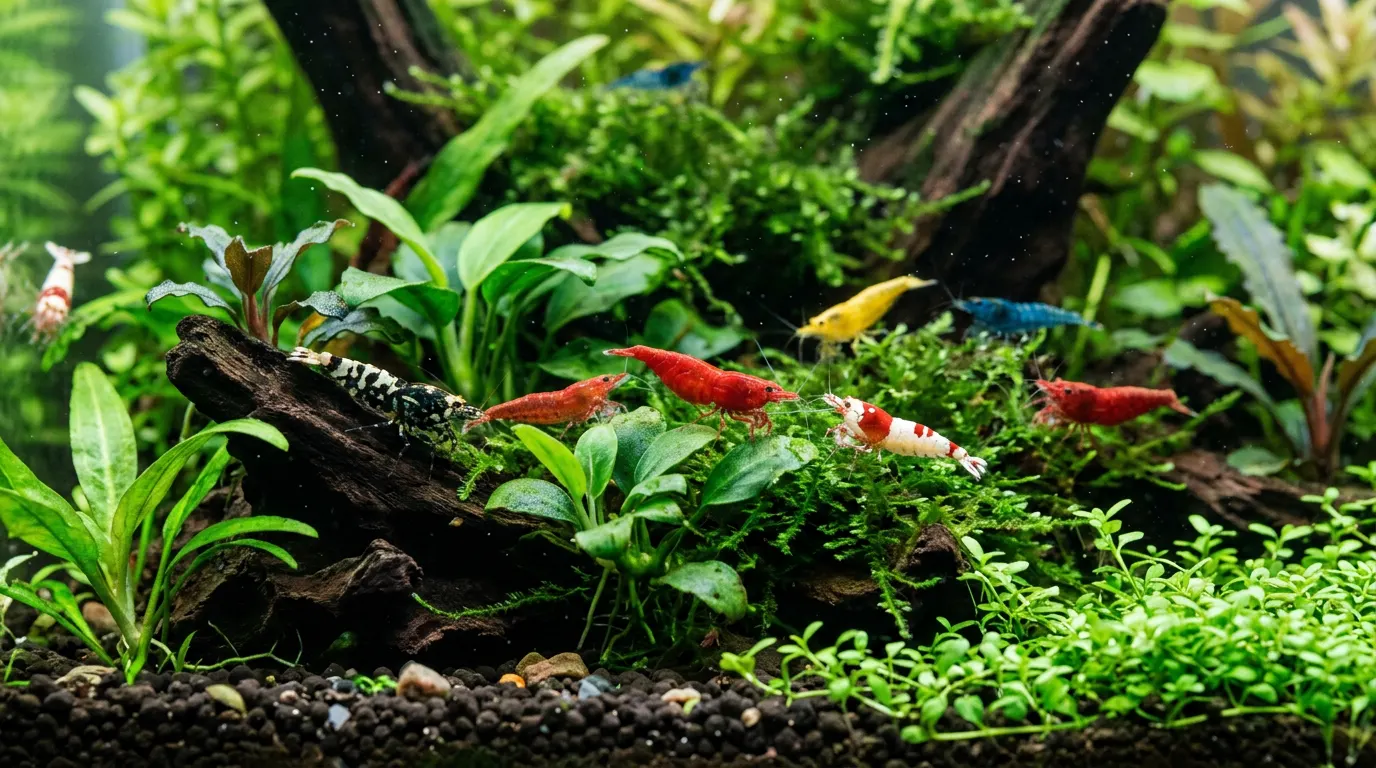
The neon reds, blues, yellows, and “painted” patterns sold today all trace back to one drab wild species, Neocaridina davidi, whose natural coloring is “brown, green-brown, or translucent”, camouflage for hiding among leaf litter in East Asian streams. According to Errly Aquatics’ history of Neocaridina breeding, breeders in the 1990s and early 2000s began noticing occasional wild-caught individuals with a deeper red tint and selectively bred only the reddest of those across many generations, establishing what became the Red Cherry Shrimp line and proving the species was “genetically responsive to selective breeding.” Every color strain since, from Blue Dream to Snowball to Rili, was developed the same way, through “selective breeding over many generations, choosing shrimp with the most desirable coloration”, which is also why my red cherry shrimp care guide spends so much time on color grading instead of treating “cherry shrimp” as one single look.
6. Amano Shrimp Need Salt Water to Breed in the Wild, a Detail Most Keepers Never Learn
Amano shrimp are one of the most popular algae-eaters in the hobby and also one of the hardest species to breed at home, for a reason that surprises most keepers: their larvae can’t survive in freshwater at all. In the wild, as The Shrimp Farm’s breeding guide explains, female Amano shrimp release larvae that wash downstream into brackish and then full-strength salt water, where they spend a planktonic stage of roughly one to two months feeding on marine microfauna before metamorphosing into miniature shrimp and swimming “upstream into brackish, then into freshwater for the rest of their lives.” Without that salt water phase, the larvae simply can’t feed, since they “are much too small to eat any regular foods,” which is exactly why breeding this species successfully “was actually thought impossible for a good while” and remains rare even in an otherwise healthy freshwater tank. It’s worth knowing before assuming an Amano vs. Neocaridina colony will multiply the same easy way cherry shrimp do.
7. A Lost Leg or Antenna Isn’t Gone for Good
Shrimp can regenerate lost limbs, claws, and antennae, and the process is tied directly to molting. A protective membrane “quickly seals off the wound” almost immediately, undifferentiated cells then cluster beneath it, and over successive molts that tissue mass “expands, forming a visible limb bud containing the regenerating tissues” before finally differentiating into working muscle, nerve, and shell. The timeline depends heavily on age: young shrimp with fast growth rates can finish “within several days or weeks,” while an adult’s regeneration “takes much longer and can be completed in several months to years.” Either way, the limb can’t regrow between molts at all, since the rigid exoskeleton blocks new growth until the next shed.
8. Shrimp “See” the World Mostly Through Their Antennae, Not Their Eyes
Despite those wide-angle compound eyes, shrimp lean far more heavily on their two pairs of antennae to navigate, feed, and communicate. The longer pair works largely as a touch-and-chemical sensor, feeling out obstacles and picking up dissolved chemical cues in the water, while the shorter pair carries dense chemoreceptors used to detect food and other shrimp nearby. That chemical sense is dramatic enough to see play out in a tank: Practical Fishkeeping notes that once a female molts and releases pheromones into the water, “all the males in the tank behave a little crazy,” homing in on a scent trail long before they’d ever spot her by sight.
9. Lifespan Varies Wildly by Species, Some Barely Make a Year, Others Live a Decade
“How long do shrimp live” doesn’t have one answer, because average and maximum lifespan differ enormously across the species commonly kept in home aquariums, shaped partly by size and partly by how fast each species reproduces.
| Species | Typical lifespan | Maximum reported |
|---|---|---|
| Neocaridina (cherry shrimp) | 12-18 months | Around 2 years |
| Ghost shrimp | 12-18 months | Around 3 years |
| Amano shrimp | 2-3 years | 5+ years |
| Bamboo shrimp | 6-7 years | Around 7 years |
| Cameroon fan shrimp | 8-10 years | Around 10 years |
Consistently stable water, an appropriate temperature, and minimal stress push any species toward the top of its range, while unstable parameters or repeated failed molts tend to shorten it well below average.
10. Shrimp Are Nature’s and Your Tank’s Clean-Up Crew
In the wild and in a home aquarium, shrimp are opportunistic omnivores that quietly do an outsized amount of ecological housekeeping. PetMD describes their diet as running from “algae, dead and living plants, worms, including decaying worms” to leftover fish food and even other dead shrimp, and some species go a step further by removing “parasites, dead tissue, and other debris from the fish’s body,” acting as a genuine cleaning service for their tankmates. That scavenging role scales up in nature too, where decapod crustaceans as a group are recognized for the outsized part they play in breaking down organic matter and cycling nutrients through aquatic ecosystems. In a tank, that translates into a few concrete jobs shrimp handle better than almost anything else you can add:

- Biofilm grazing. Shrimp constantly pick at the thin microbial layer that forms on hardscape, glass, and plant leaves, a food source most fish never touch.
- Leftover food cleanup. Uneaten pellets and flakes that sink out of a fish’s reach rarely go to waste in a tank with a healthy shrimp population.
- Decaying plant matter. Shrimp readily eat dying leaves and soft plant tissue before it breaks down and fouls the water.
- Light algae control. They won’t replace a dedicated algae-eating fish or snail on their own, but a colony makes a visible dent in soft algae growth over time.
Frequently asked questions
Are aquarium shrimp actually a type of fish?
No. Aquarium shrimp are crustaceans, more closely related to crabs and lobsters than to any fish, which is why so much of their biology, an external shell instead of an internal skeleton, growth through molting, gills housed under that shell — works completely differently from a fish’s.
How often do aquarium shrimp molt?
It varies by age. Young, fast-growing shrimp can molt every couple of weeks, while adults typically settle into roughly a once-a-month cycle for the rest of their lives, since molting never really stops.
Can I breed Amano shrimp in a regular freshwater tank?
Not successfully in almost all cases. Amano shrimp larvae need brackish or full-strength salt water to survive their planktonic stage, so while adults mate and carry eggs in freshwater just fine, the larvae die within days in a standard freshwater aquarium without a dedicated marine rearing setup.
Did wild shrimp always come in bright colors like red and blue?
No. The wild ancestor of cherry shrimp and most Neocaridina color strains is a plain brown, green-brown, or translucent shrimp; every bright color sold today came from decades of selective breeding that started with picking out unusually colorful individuals.
Can shrimp really regrow a missing leg?
Yes. Lost legs, claws, and antennae regenerate through a multi-stage healing process tied to the molt cycle, though the timeline depends heavily on age, young shrimp can finish in days to weeks, while older adults may take several months.
Do shrimp rely on their eyesight to find food?
Not primarily. Their compound eyes are better suited to detecting motion than to seeing fine detail, so shrimp lean more heavily on their antennae to smell, taste, and feel their way to food and to each other.
If any of this has you rethinking what’s actually living in your tank, the next step is making sure their home matches what these animals need rather than what a fish would want — my full shrimp tank setup guide walks through cycling, filtration, and water chemistry from scratch, and if you’re still choosing a first species, my best shrimp for beginners guide compares the easiest options against ones better left for later. Curious how a few of these traits play out day to day? My guides to whether shrimp really work as a cleanup crew, how many shrimp you can actually keep in one tank, and which fish make safe tank mates for shrimp dig deeper into some of the facts above.
References
- An Introduction to Shrimp – Practical Fishkeeping
- Aquarium Shrimp Facts: Care, Diet, and Behavior – PetMD
- Caridoid Escape Reaction – Wikipedia
- Neocaridina Shrimp Breeding: History to Modern Color Lines – Errly Aquatics
- Breeding Amano Shrimp – The Shrimp Farm
- Detailed Guide to Regeneration in Crustaceans – Shrimp and Snail Breeder







Leave a Reply