Sleep & Wellness
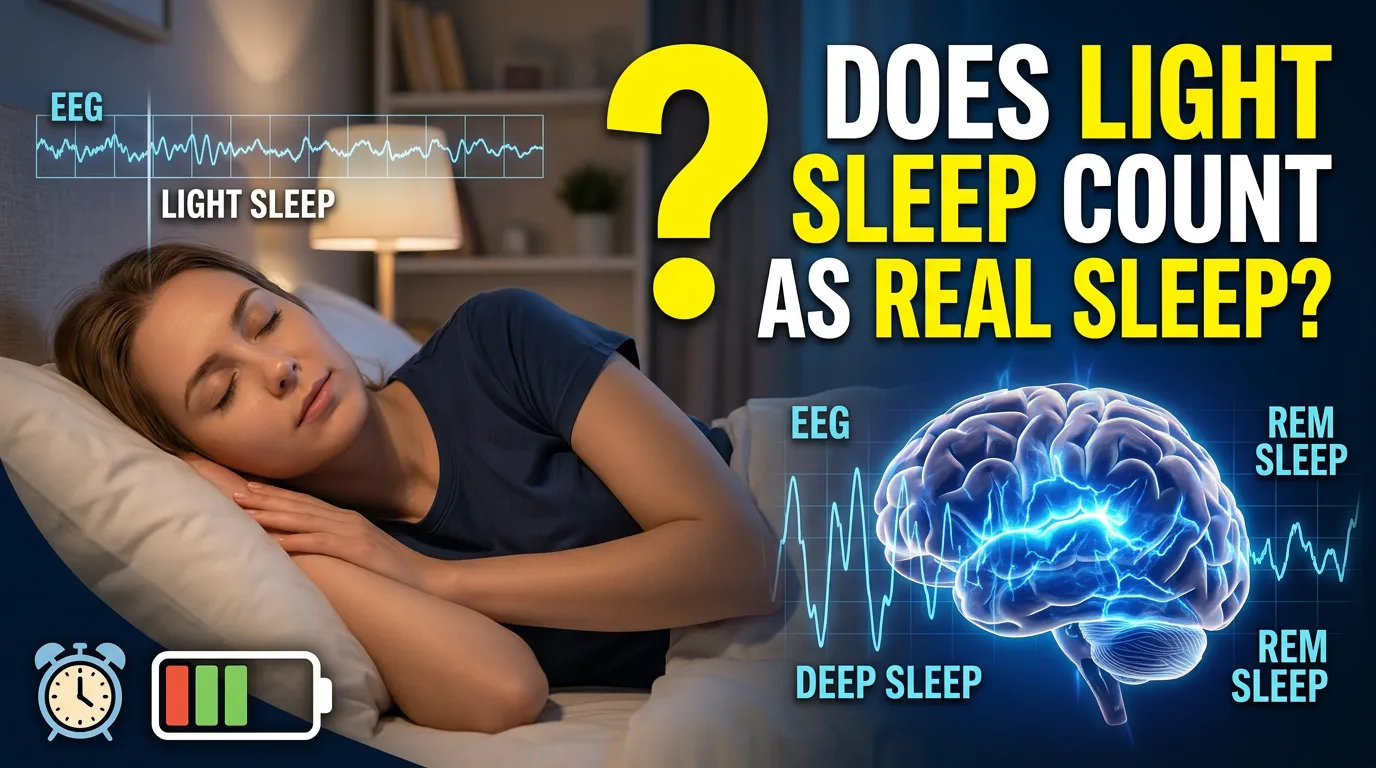
If you’ve ever checked a sleep tracker and seen that most of your night was logged as “light sleep,” with only a small sliver of “deep sleep” and REM, it’s natural to feel a little disappointed, as if your body spent most of the night doing nothing useful. That reaction is understandable, but it’s based on a misunderstanding of what light sleep actually is. Light sleep isn’t a lower-quality filler stage your brain falls back on when it can’t manage “real” sleep; it’s a defined, necessary part of normal sleep architecture that most healthy adults spend roughly half their night in. This guide explains what light sleep actually is, what it does for your brain and body, why it makes up so much of a typical night, and how to read your own sleep-stage data without over-worrying about a number that’s doing exactly what it’s supposed to.
Quick answer: does light sleep count as real sleep?
Yes. Light sleep, made up of stages N1 and N2 in modern sleep science, is genuine, physiologically active sleep, not a watered-down version of “real” rest. During light sleep your body temperature drops, your heart rate and breathing slow, your muscles relax, and your brain begins the process of organizing and consolidating information from the day. It’s also the stage that occupies the largest share of a typical night, with most adults spending around half of their total sleep time in stage N2 alone. Deep sleep (N3) and REM sleep get more attention because they’re associated with specific, dramatic functions like growth hormone release and vivid dreaming, but light sleep is the connective tissue that makes the rest of a healthy sleep cycle possible, losing it fragments your entire night, even if you technically still get some deep and REM sleep.
What actually happens during light sleep
Sleep scientists divide non-REM sleep into three stages, N1, N2, and N3, plus REM sleep, and they cycle through this sequence roughly every 90 minutes throughout the night. Light sleep refers specifically to the first two non-REM stages.

Stage N1: the doorway into sleep
N1 is the brief transition between wakefulness and sleep, typically lasting only a few minutes. Your muscles begin to relax, brain wave activity starts slowing from the faster patterns of wakefulness, and it’s still easy to be woken up during this stage, sometimes people don’t even realize they briefly drifted into N1. If nothing disturbs you, N1 quickly gives way to N2.
Stage N2: where your brain actually spends most of the night
N2 is a deeper stage of light sleep. Your body temperature drops, your heart rate and breathing slow further, and your eye movements stop. Brain activity slows overall, but N2 is marked by characteristic short bursts of electrical activity called sleep spindles and K-complexes, which researchers believe play a role in protecting sleep from external disturbances and in helping the brain process and file away newly learned information. N2 tends to get longer as the night goes on, and across a full night, it’s common for N2 alone to account for close to half of total sleep time, making it, by volume, the single largest stage of sleep for most adults.
Why light sleep takes up so much of the night
Roughly speaking, a typical adult’s night breaks down into about half in N2 light sleep, a smaller portion in N1, roughly 10 to 25% in deep N3 sleep concentrated in the earlier sleep cycles, and around 20 to 25% in REM sleep concentrated later in the night. That proportion isn’t a flaw in how your body sleeps, it’s the expected, healthy structure of a night’s sleep, sometimes called sleep architecture. Deep sleep and REM sleep are important precisely because they’re more limited and concentrated; light sleep functions as the connective, transitional stage that your brain cycles through between them, and through which you pass multiple times per night as you move between deeper stages, briefly toward wakefulness, and back down again.
Why light sleep isn’t “wasted” time
The framing that light sleep is somehow less valuable usually comes from consumer sleep trackers, which summarize a night into simple percentages and implicitly encourage people to chase a bigger deep-sleep number. But sleep researchers don’t treat light sleep as a lesser stage, it serves distinct, necessary functions of its own.
It’s where memory processing begins
Memory consolidation, the process of moving information from short-term into more stable, long-term storage, isn’t confined to deep sleep or REM alone. The sleep spindles that characterize N2 sleep are associated with strengthening newly formed memories and are thought to help transfer information between brain regions involved in short-term and long-term memory storage. Because N2 makes up such a large share of the night, it plays an outsized cumulative role in this process simply due to how much time your brain spends there.
It supports physical recovery, just less intensely than deep sleep
While the most pronounced physical restoration, including the bulk of nightly growth hormone release, happens during deep, slow-wave sleep, light sleep still involves lowered heart rate, reduced blood pressure, and relaxed muscles compared to being awake. That downshift in physiological activity contributes to overall recovery, even if it’s not the primary site of the more intensive repair processes associated with N3.
It’s the necessary bridge between sleep cycles
A healthy night of sleep isn’t one long, uninterrupted block of one stage; it’s a repeating cycle that moves from light sleep into deep sleep and then into REM, roughly every 90 minutes, several times a night. Light sleep is the stage your brain passes through both on the way down into deeper sleep and on the way back up toward lighter stages or brief awakenings between cycles. Without adequate light sleep serving as that connective transition, the whole cycling structure that allows you to get sufficient deep and REM sleep across the night would be disrupted. In that sense, light sleep isn’t competing with deep sleep and REM for importance, it’s part of the mechanism that makes getting enough of both possible in the first place.
Brief awakenings during light sleep are normal, not a malfunction
Because light sleep is, well, lighter, it’s also the stage where brief awakenings are most likely to happen, rolling over, noise from outside, or simply a natural arousal between sleep cycles. Most healthy sleepers have several brief awakenings a night that they don’t even remember in the morning. This is completely normal and doesn’t mean your sleep is broken; it’s part of how sleep architecture is designed to work, giving your brain repeated checkpoints to sense whether the environment is safe before continuing into deeper sleep.
How light sleep compares to deep sleep and REM sleep
It’s easier to appreciate what light sleep does when you see it next to the other stages rather than in isolation.

- Light sleep (N1 + N2) – the largest share of total sleep time, roughly half the night; lower brain-wave frequency than wakefulness but not the slowest of the night; involved in early-stage memory processing and the transition between deeper stages; easiest stage to be woken from.
- Deep sleep (N3, slow-wave sleep) – the smallest share of the night, concentrated in the first half; the most physically restorative stage, associated with the bulk of nightly growth hormone release, tissue repair, and immune support; hardest stage to be woken from.
- REM sleep – roughly a quarter of the night, concentrated in the second half and increasing with each cycle; associated with vivid dreaming, emotional processing, and further memory consolidation, particularly of complex or emotionally charged information; the brain is highly active, closer to a waking state, while most large muscles are temporarily paralyzed.
None of these stages is more “real” sleep than the others, they’re different phases of the same overall process, each doing work the others don’t. If you want a closer look at how deep sleep and REM sleep specifically divide their responsibilities, our guide on deep sleep vs. REM sleep breaks that comparison down in more detail.
Should you worry about a high light-sleep percentage on your tracker?
Sleep trackers have made sleep-stage percentages far more visible to everyday people than they were a decade ago, which is genuinely useful, but it also invites a specific kind of anxiety: seeing “light sleep: 55%” and assuming something is wrong. A few things are worth knowing before you draw that conclusion.
- Consumer trackers estimate sleep stages indirectly, usually from movement and heart-rate patterns rather than the brain-wave monitoring used in a clinical sleep study, so their stage percentages are approximations, not lab-grade measurements. Night-to-night and device-to-device variation is expected.
- A roughly 50% light-sleep share is normal, not high. Given that N2 alone typically accounts for close to half of total sleep time, a tracker showing that your night was “mostly light sleep” is often just accurately describing a completely typical night, not flagging a problem.
- Total sleep time and consistency matter more than the exact stage split. Sleep researchers generally place more weight on whether someone is getting enough total sleep, on a consistent schedule, than on optimizing the precise percentage of each individual stage, since stage proportions naturally shift somewhat from night to night depending on stress, alcohol, exercise, and age.
- Watch patterns, not single nights. If your deep-sleep and REM percentages are trending unusually low across many nights, alongside daytime symptoms like excessive sleepiness, that pattern is more meaningful than any one night’s numbers, and worth discussing with a doctor rather than trying to self-correct through tracker data alone.
What can genuinely reduce the quality of your light sleep
While a large share of light sleep is normal, light sleep quality itself can be degraded by common, fixable habits, the same ones that undermine sleep quality generally:
- Alcohol close to bedtime, which fragments sleep and increases brief awakenings, particularly in the second half of the night.
- An inconsistent sleep schedule, which disrupts the smooth cycling between stages that a stable circadian rhythm supports.
- A noisy, too-warm, or too-bright bedroom environment, since light sleep is the stage most easily disrupted by external stimuli.
- Chronic stress or anxiety, which can increase the frequency of brief nighttime awakenings during lighter sleep stages.
- Sleep disorders such as sleep apnea, where repeated breathing interruptions pull the brain out of deeper stages and back into light sleep or brief wakefulness, artificially inflating the light-sleep share of the night in an unhealthy way.
That last point is an important distinction: there’s a difference between a normal, healthy amount of light sleep and an abnormally high light-sleep percentage caused by something actively preventing you from reaching or staying in deeper stages. Good sleep hygiene habits, a consistent schedule, a cool and dark room, and limiting alcohol before bed, support healthy sleep architecture overall, which in turn supports normal light sleep rather than an inflated, disorder-driven version of it.
Common myths about light sleep, debunked
A lot of the anxiety around light sleep comes from a handful of persistent myths that don’t hold up against how sleep architecture actually works.
Myth: light sleep is basically the same as being awake
It isn’t. Even in the lightest non-REM stages, your brain-wave patterns, heart rate, breathing, and muscle tone are all measurably different from wakefulness. You’re less responsive to your surroundings, your body temperature is dropping, and your brain is doing active processing work, including early memory consolidation. The fact that it’s easier to wake someone from light sleep than from deep sleep doesn’t mean the stage itself is superficial; it just reflects where it sits on a spectrum of arousal thresholds.
Myth: you should aim to minimize light sleep and maximize deep sleep
This idea has been amplified by fitness and sleep trackers that display deep sleep prominently, but it misrepresents how sleep is structured. You can’t simply reallocate time from light sleep to deep sleep by trying harder or optimizing harder, sleep architecture is regulated by your brain based on sleep pressure, circadian timing, and overall sleep history, not by intention. Attempting to “fix” a normal light-sleep percentage usually just adds unnecessary stress around sleep, which itself is a well-known way to make sleep worse.
Myth: if you don’t remember your sleep, it wasn’t light sleep
Some people assume that because they don’t remember tossing and turning or briefly waking up, they must have had unusually deep, uninterrupted sleep throughout. In reality, most people have multiple brief arousals during light sleep every night that leave no memory trace at all, memory formation itself is reduced in these transitional moments. Not remembering interruptions is normal and doesn’t necessarily mean you spent less time in light sleep than someone who does recall waking briefly.
How light sleep changes with age and life stage
Sleep architecture isn’t static across a lifetime, and light sleep’s share of the night shifts along with it.
- Infants and young children spend a larger proportion of sleep in REM and active sleep states relative to adults, but as the brain matures through childhood, the proportions gradually shift toward the adult pattern dominated by light and deep non-REM sleep in a stable cyclical structure.
- Adults generally settle into the roughly 45-55% light, 10-20% deep, and 20-25% REM split described earlier, though the exact numbers vary by individual and by night.
- Older adults tend to see deep sleep decline the most noticeably with age, while light sleep often makes up an even larger relative share of the night, alongside more frequent brief awakenings. This is a well-documented, normal part of aging rather than a sign of poor sleep quality on its own, though it can make total sleep feel less consolidated.
Understanding that this shift is a normal biological pattern, not something going wrong, can help take some of the pressure off older adults who notice their sleep tracker showing more light sleep and less deep sleep than it used to.
Frequently asked questions
Is it bad to have mostly light sleep and very little deep sleep?
Having a large share of light sleep on its own is not necessarily bad, it’s expected, since light sleep typically makes up roughly half of a healthy night. It becomes more of a concern when deep sleep is consistently very low across many nights, especially alongside symptoms like poor concentration, unrefreshing sleep, or excessive daytime sleepiness, since that pattern can point toward a sleep disorder, high stress, alcohol use, or a disrupted sleep schedule rather than simply how your particular sleep architecture is organized.
Why does my sleep tracker say I barely get any deep sleep?
Deep sleep naturally occupies a smaller share of the night than light sleep, often somewhere around 10 to 20% of total sleep time for adults, and that share tends to shrink further with age. Consumer trackers also estimate sleep stages from movement and heart-rate signals rather than direct brain-wave monitoring, so their deep-sleep percentages can be imprecise and vary from device to device. A low but nonzero deep-sleep reading is often within a normal range rather than a sign of a problem.
Can you feel rested from mostly light sleep?
You can feel reasonably rested from a night that’s mostly light sleep if your total sleep time was adequate and your deep and REM sleep, while smaller in proportion, were still sufficient and undisrupted. Since a roughly even split favoring light sleep is the normal structure of sleep architecture, feeling rested has more to do with total sleep duration, consistency, and whether your sleep was continuous, rather than trying to shrink the light-sleep percentage specifically.
Does napping only give you light sleep?
Short naps, typically under 30 minutes, do tend to consist mostly of light sleep, since that’s the stage your brain enters first and deep sleep generally takes longer to reach. That’s actually part of why short naps are recommended for a quick alertness boost without the grogginess that can come from waking up out of deep sleep. Longer naps can progress into deep sleep and even REM, which is why naps stretching much beyond 30 to 45 minutes sometimes leave people feeling groggy if they’re woken mid-deep-sleep.
Does alcohol reduce light sleep or just deep sleep and REM?
Alcohol affects the whole night’s sleep architecture, not just deep sleep and REM. While alcohol is well known for suppressing REM sleep in the first part of the night, it also tends to fragment sleep overall as it’s metabolized, increasing brief awakenings and shifting more of the second half of the night toward lighter, more disrupted sleep. So rather than simply trading deep sleep or REM for light sleep, alcohol generally degrades the overall quality and continuity of light sleep too.
How much light sleep is normal per night?
For most healthy adults, light sleep (stages N1 and N2 combined) makes up roughly 45 to 55% of total sleep time, with N2 alone usually accounting for close to half of the night on its own. That means if you sleep 8 hours, spending around 4 hours in light sleep is a completely typical, healthy outcome rather than a sign that something is going wrong.
As with most sleep science, individual variation is real, sleep-stage proportions shift somewhat with age, stress, alcohol use, and overall health, and a single unusual night rarely means much on its own. If you consistently feel unrefreshed despite getting what looks like a reasonable amount of total sleep, or you notice a persistent, dramatic shift in your sleep-stage patterns, it’s worth bringing that up with a doctor or sleep specialist rather than trying to diagnose it from tracker percentages alone.





Leave a Reply