Government & Documents
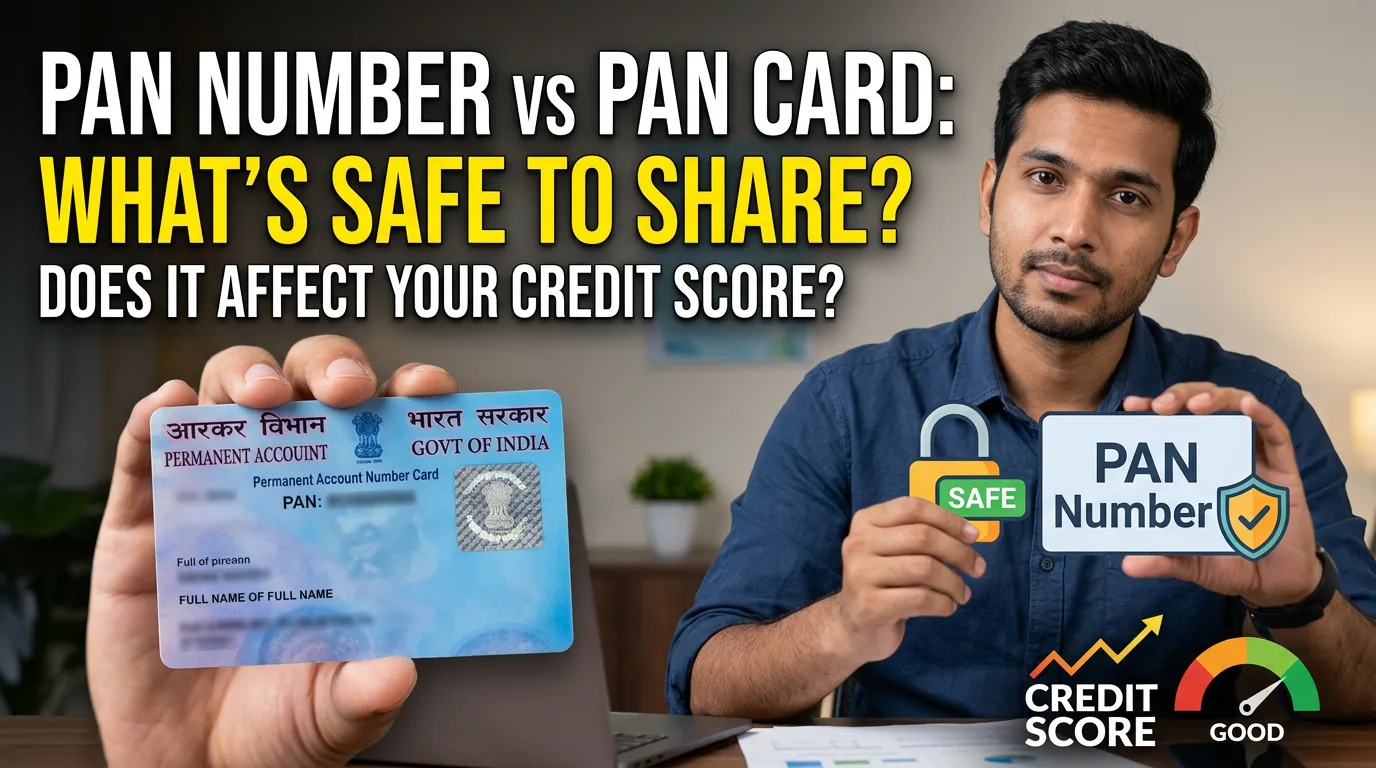
People often use “PAN number” and “PAN card” interchangeably, but they are not the same thing to hand over, and they carry different levels of risk. The ten-character code is just an identifier; the physical or digital card is a full identity document with your photo, signature, and date of birth on it. That distinction matters a lot in practice, whether you’re filling in a KYC form, applying for a loan, or wondering whether typing your PAN into yet another website could somehow dent your credit score. This guide covers exactly what each one is, what’s reasonable to share and where, and the honest answer on whether PAN has anything to do with your CIBIL score.
Quick answer: is it safer to share your PAN number or your PAN card?
Your bare PAN number is far lower risk to share than a copy of your PAN card. The number alone is an identifier, similar to an account number, and cannot be used to log into any portal, authorize a payment, or pull up your personal details, since PAN-to-identity lookups are restricted to authorised institutions like banks and government departments. A PAN card copy is a different matter: it additionally shows your photograph, signature, date of birth, and parent’s name, which is the exact combination of details used in most PAN-linked identity fraud. As for credit scores, sharing either one, by itself, does not change your CIBIL score at all. PAN is used by credit bureaus purely to locate and consolidate your credit history under one identity; it has no scoring weight of its own. The real risk to your score comes not from sharing PAN, but from PAN misuse, someone using a leaked card copy to take a loan or open a credit line in your name without your knowledge.
PAN number vs PAN card: what’s actually different
A PAN number is simply the ten-character alphanumeric code itself, five letters, four numbers, one letter, the kind of thing you can safely type into a form field without exposing anything beyond that string of characters. A PAN card is the physical (or digital e-PAN) document issued by the Income Tax Department that displays that number alongside your full name, father’s or parent’s name, date of birth, photograph, and signature. When a website, bank form, or employer only needs the number typed in for KYC or tax reporting, sharing the number is sufficient and appropriately low-risk. When an institution specifically needs a card copy, usually for identity verification during account opening, loan applications, or formal background checks, that request comes with meaningfully more exposure, since the image itself becomes something that can be copied, forwarded, or misused if it ends up in the wrong hands.

Everything printed on a physical PAN card, and why each detail matters
It helps to actually break down what’s on the card, because each element carries a different kind of risk if it leaks, not just “more information is worse.”
- PAN number. Low risk alone. It identifies you to tax and financial systems but authenticates nothing by itself.
- Full name and father’s/parent’s name. Used together, this pair is a common identity-verification combination for call-centre and low-security KYC checks.
- Date of birth. A frequently used security-question answer and part of several “identity confirmation” flows, from re-issuing a SIM to resetting an account password.
- Photograph. Lets a fraudster visually match a stolen or forged secondary ID to “you” convincingly enough to pass a casual human check.
- Signature. A specimen signature is genuinely dangerous in the wrong hands, the single detail most useful for forging it on a loan application, cheque, or document.
- Newer PAN 2.0 QR code. Recent cards carry a dynamic QR code that, when scanned by an authorised system, pulls up your name, photo, signature, and date of birth, the same sensitive fields, just machine-readable.
Seen this way, a PAN card copy isn’t one risk, it’s five or six stacked together, which is exactly why institutions that only need the number for a routine purpose shouldn’t be asking for the card image at all, and why it’s worth pausing when one does.
When it’s fine to share just the number
Most everyday situations only require the number: filling in payroll or HR onboarding forms, providing it for TDS purposes to an employer, linking it to a mutual fund or demat account, or entering it into your income tax return. These are all cases where the number is used purely as a linking identifier between you and a specific financial record, and none of them require or benefit from a scanned image of the card. If a form field is simply labeled “PAN” and asks for the code itself, typing in the number is standard practice and does not meaningfully increase your exposure to fraud. If you’re specifically weighing a recruiter’s request, PAN Card vs Aadhaar Card: Which Should You Share First During a Job Application? covers the ordering question in more depth, and PAN Card Job Scams: Red Flags, Verification Steps, and How to Protect Your Data goes into what a legitimate hiring process actually needs versus what a scam tends to ask for.
When a card copy is genuinely being asked for, and how to hand it over safely
A card copy is reasonably requested for things like opening a new bank account, applying for a loan or credit card, a formal employment background verification file, or a KYC refresh that specifically asks for supporting identity documents rather than just the number. In these cases, share the copy only through the institution’s official channel, a verified company email, an applicant-tracking portal, or a bank’s own app or branch process, never over a personal WhatsApp number or an unofficial email address. A commonly recommended precaution is to write a short note across a visible but non-critical part of the image, such as “For [Company/Bank] KYC use only – [date]”, before sending it, which makes the copy far less useful if it is ever reused outside its intended purpose.

A practical way to redact a PAN card image before sharing it
If a scan is genuinely unavoidable, there’s a middle ground between sending the raw image and refusing outright: mask the parts of the card that aren’t actually needed for the stated purpose. Most institutions asking for a PAN card as proof of your PAN number only need the number and your name to be legible, not a crisp copy of your photo, signature, or QR code.
- Open the image in any basic photo editor (even your phone’s built-in markup tool works, no special software is needed).
- Cover the photograph with a solid black or white box, leaving the name, PAN number, and date of birth fields untouched if those are what’s actually required.
- Cover the signature panel the same way; a signature specimen is rarely what a KYC check is actually verifying when it asks for a “PAN copy.”
- Cover or cross out the QR code on newer PAN 2.0 cards, since it carries the same sensitive fields in scannable form.
- Add the purpose-and-date watermark mentioned above across an empty part of the card before exporting the final image.
- Ask first whether a masked copy is acceptable. Many KYC processes genuinely only need the number and name verified against other documents, and a quick question, “can I share a version with the photo and signature covered?”, is a reasonable one to ask before you send anything.
This isn’t appropriate for every situation, a bank opening a new account under regulatory KYC rules will usually need an unredacted copy, since the photograph is part of how they confirm the account holder’s identity, but for a great many lower-stakes requests, a masked copy is a reasonable middle ground that most requesters have no real objection to.
Does PAN affect your credit score directly?
No. PAN does not determine or move your CIBIL score by itself. Credit bureaus use PAN as a unique identifier that links your loans, credit cards, and repayment history across different lenders into a single, accurate credit report, reducing the profile mismatches that would otherwise happen if bureaus relied only on name and address. Your actual score is calculated from your credit behaviour, on-time payments, credit utilisation, the number and age of your credit accounts, not from the PAN itself. In other words, PAN is a lookup key for your credit file, not an input into the scoring formula.
Where PAN misuse actually does hit your credit score
The indirect risk is real, and it comes from misuse rather than sharing. If a copy of your PAN card, especially paired with other documents like an address proof, ends up with a fraudster, it can be used to take out a loan, open a credit card, or make a high-value purchase on credit without your knowledge. Because PAN card fraud rarely involves money moving directly out of your bank account, it is often discovered late, sometimes only when you apply for a genuine loan and either get rejected or offered a worse rate because of an unfamiliar default sitting on your credit report. This is the actual mechanism by which PAN-related fraud damages a credit score: not the number being seen, but an unauthorised credit account being opened and then going unpaid.
How to actually check your credit report for signs of PAN misuse
India has four licensed credit bureaus, CIBIL (TransUnion CIBIL), Experian India, Equifax India, and CRIF High Mark, and each gives individuals one free full credit score and report per calendar year, not just a teaser score. It’s worth pulling from more than one, since lenders don’t all report to every bureau, and a fraudulent account may not surface if you only check one.
- CIBIL: request your free annual Score and Report directly from cibil.com, covering your score, payment history, a 36-month record of lender enquiries, and active/inactive accounts.
- Experian India: offers one free report per year through its own consumer portal, useful since some lenders report exclusively or primarily to Experian.
- Equifax India: also provides an annual free report; worth checking since coverage across the four bureaus isn’t identical.
- CRIF High Mark: increasingly used by NBFCs and smaller lenders, making it a useful check for accounts that might not surface elsewhere.
When reviewing any of these reports, look specifically for: a loan, credit card, or account you don’t recognise; a hard inquiry from a lender you never approached; your personal details (address, employer, phone number) showing something unfamiliar, which can indicate an application made in your name; and any account marked delinquent or defaulted that you never opened. Checking your own report, a “soft inquiry,” never lowers your score, no matter how often you do it, so there’s no downside to checking all four periodically.
What to do, step by step, if you find an unfamiliar loan or account on your PAN
- Document everything immediately. Screenshot or download the report showing the account, including the lender’s name, account number, and amount.
- Contact the lender or NBFC directly. Reach their grievance or fraud department, explain the account was opened fraudulently, and request it be investigated and disputed, with written acknowledgment.
- Raise a dispute with the credit bureau that reported it. CIBIL, Experian, Equifax, and CRIF High Mark each have an online dispute process for fraudulent entries; the bureau investigates with the lender and corrects the report if upheld.
- File a complaint on the National Cyber Crime Reporting Portal. At cybercrime.gov.in, file a financial fraud report, creating an official record that both the lender and bureau will want as part of your dispute.
- Escalate to the RBI Banking Ombudsman if unresponsive. If the bank or NBFC doesn’t resolve your dispute in a reasonable window, RBI’s ombudsman scheme exists for grievances that go nowhere internally.
- Recheck your report after resolution. Confirm the entry is actually removed or corrected on all four bureaus, not just the one where you first spotted it.
How to check if your PAN has been misused, and protect your score
- Pull your credit report periodically. Check your score and report through CIBIL, Experian, Equifax, or CRIF High Mark, and look for any loan, credit card, or inquiry you don’t recognise.
- Review your Form 26AS and AIS. These income tax portal statements show TDS entries and high-value transactions linked to your PAN, which can reveal financial activity you didn’t authorise.
- Share the number, not the card, whenever a form allows it. If a website or form only needs the code typed in, there’s no reason to upload a scanned copy of the card as well.
- Send card copies only through verified channels. A bank’s own app, an official company email, or an in-person branch visit are appropriate; a personal chat app or unofficial email address is not.
- Watch for unfamiliar hard inquiries. A credit inquiry you didn’t initiate is often the earliest visible sign that your PAN or identity documents have been used to apply for credit elsewhere.
Frequently asked questions
Is it safe to give just my PAN number to a website or app?
Generally yes, if the site is legitimate and only asks for the number for a standard purpose like KYC, tax reporting, or account linking. The bare number cannot be used to log into your accounts or move money, so typing it into a genuine form carries far less risk than uploading a photo or scan of the physical card.
Can checking my CIBIL score using my PAN lower my score?
No. Checking your own credit score, sometimes called a “soft inquiry,” does not affect your score at all, regardless of how many times you check it. Only “hard inquiries,” where a lender pulls your report because you’ve applied for new credit, can have a small, temporary effect on your score.
What should I do if I find a loan on my credit report that I never took?
Contact the lender named on the report immediately to dispute it, and simultaneously raise a dispute with the credit bureau (CIBIL, Experian, Equifax, or CRIF High Mark) that generated the report. If it appears to involve identity theft, also file a complaint at the government’s cybercrime portal or your local cyber cell, since a formal report is often needed to get the entry corrected or removed.
Does linking PAN with Aadhaar change my credit score?
No. PAN-Aadhaar linking is an income tax compliance requirement and has nothing to do with how credit bureaus calculate your score. It does not add, remove, or adjust any figure in your credit report.
Is an e-PAN as safe to share as a physical PAN card?
An e-PAN carries the same personal details as a physical card, photo, signature, date of birth, so it should be treated with the same caution. Share it only through verified channels, and avoid posting or forwarding it through unofficial or unsecured means, just as you would with a physical card copy.
Do I need to check all four credit bureaus, or is one enough?
Checking just one is better than checking none, but the four bureaus don’t have identical lender coverage, some NBFCs and smaller lenders report to only one or two of them. If you’re specifically checking for signs of PAN misuse rather than just monitoring your own score, pulling all four free annual reports gives a meaningfully more complete picture.
Is it okay to send a photo of my PAN card with the photo and signature blacked out?
For most routine KYC or verification requests where only the number and name need to be confirmed, yes, a masked copy is a reasonable middle ground, and most legitimate requesters have no objection if you ask first. For account-opening processes where the bank is regulatorily required to visually verify your identity, an unredacted copy is usually still necessary.
References
- Income Tax India – Apply for PAN
- BankBazaar – Checking your CIBIL score with your PAN card
- RBL Bank – Everything to know about PAN card fraud
- Income Tax India – When penalty under Section 272B may be imposed
- ClearTax – PAN 2.0: key features, benefits, and QR code details
- CIBIL – Free CIBIL Score & Report
- National Portal of India – Report financial fraud through the National Cyber Crime Reporting Portal
Related Guides
- What Happens to Your PAN Number After You Share It With a Recruiter?
- Can You Get a Job Without a PAN Card? What to Do If You Don’t Have One Yet
- Is It Safe to Share Your Aadhaar Card With Your Employer?
- PAN Card vs Aadhaar Card: Which Should You Share First During a Job Application?
- PAN Card Job Scams: Red Flags, Verification Steps, and How to Protect Your Data
- How to Get a Duplicate PAN Card: Lost, Damaged, or Reprint
- How to Link Your PAN Card to Your Bank Account






Leave a Reply