Sleep & Wellness
If you’ve typed “best magnesium glycinate for sleep” into a search bar, you’ve probably landed on ten different “top 10” roundups that all recommend the same five brands for vague reasons. This isn’t that. This is a buying guide built around one real decision: which format of magnesium glycinate actually fits how you’ll take it, and which label details separate a well-made product from a weak one.
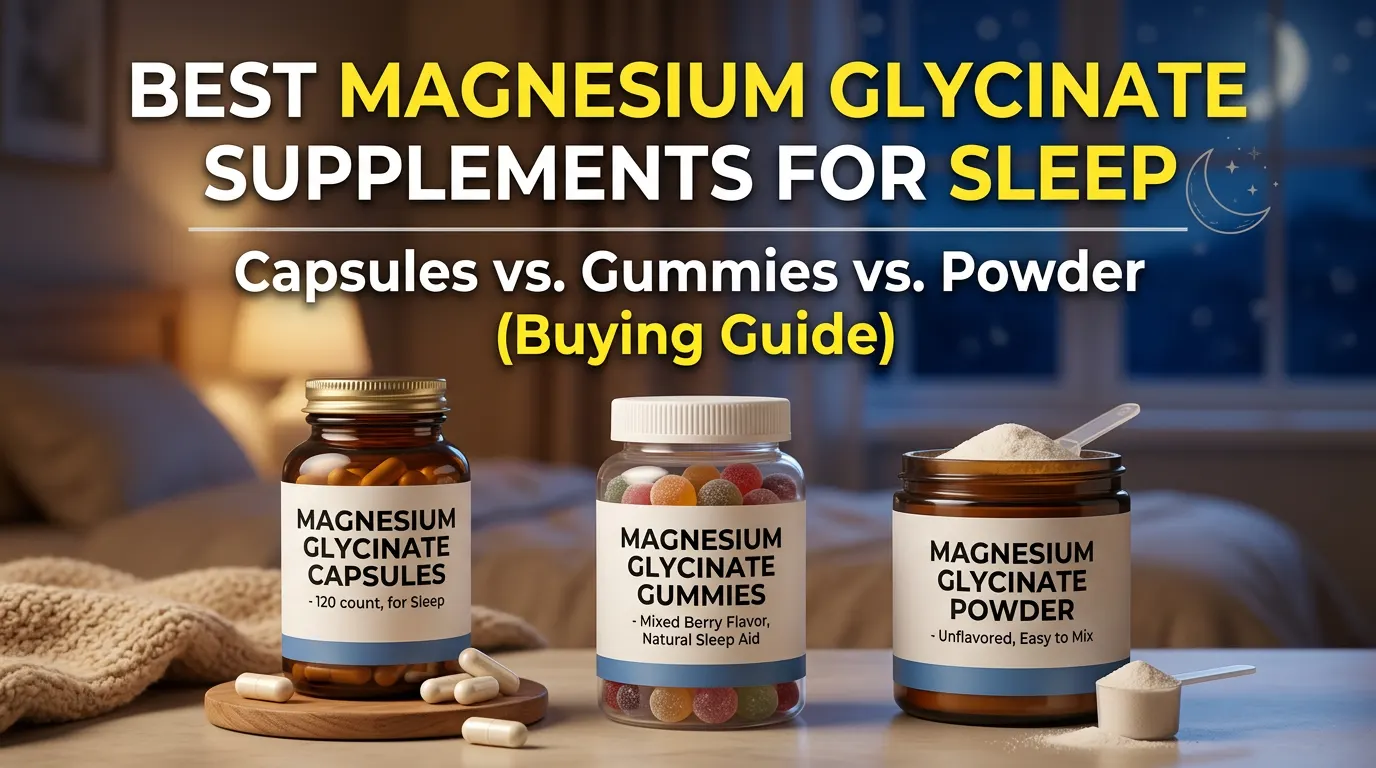
Magnesium glycinate shows up on shelves as capsules, gummies, flavored powders, and liquid drops and the format you pick affects your dose accuracy, your sugar intake, how fast it kicks in, and what you’ll actually pay per effective dose. We’re not re-litigating whether magnesium glycinate works for sleep (we cover that in our magnesium glycinate efficacy guide) or how magnesium glycinate compares chemically to citrate or threonate (see our forms comparison). This guide is about shopping: capsule vs. gummy vs. powder vs. liquid, what the label is actually telling you, and which real, currently-sold products are worth considering for each format.
Quick answer
There is no single “best” format, only the best format for how you take supplements. If you want precise, repeatable dosing with no sugar, a capsule is the most reliable choice. If you hate swallowing pills or want an easier daily habit, a gummy works, but check the elemental magnesium per serving and sugar content carefully, since gummies often require more pieces to hit an effective dose. If you want to adjust your dose gradually, mix it into tea or water before bed, or avoid capsules’ fillers entirely, a powder gives the most flexibility. Liquid/drop formats sit between powder and gummies: fast-absorbing and adjustable, but typically the most expensive per milligram of elemental magnesium. Whichever format you choose, look for the elemental magnesium figure (not just “magnesium glycinate” total weight), a recognizable chelate source, and ideally third-party testing such as NSF Certified for Sport or USP Verified.
Capsule vs. gummy vs. powder vs. liquid: the real differences
Before comparing specific products, it helps to understand what actually changes between formats, because the differences aren’t just “pill vs. not a pill.”

Dosing precision
Capsules are manufactured to a fixed elemental magnesium amount per capsule, so two capsules today contain the same dose as two capsules next month. Gummies are dosed the same way in theory, but because people are more likely to “round up” and eat an extra gummy for taste, effective dosing is less controlled in practice. Powders and liquids are the most flexible; you can use a half scoop or a few extra drops to fine-tune your dose, but that flexibility only works if you’re also willing to actually measure, rather than eyeball, the serving.
Added sugars
This is the single biggest trade-off with gummies. To make magnesium glycinate, which has a mildly bitter, mineral taste, palatable in chewable form, manufacturers typically add sugar, glucose syrup, or sugar alcohols. A couple of grams of added sugar nightly isn’t a major health concern for most adults, but it adds up if you’re also taking other gummy supplements, and sugar alcohols (sorbitol, maltitol) in larger doses can cause digestive upset in sensitive people, separate from magnesium’s own well-known laxative effect at high doses. Capsules and unflavored powders avoid this issue entirely; flavored powders and liquid drops often use stevia or monk fruit instead of sugar, which is worth checking on the label.
Taste
Capsules have no taste to manage since you’re not supposed to open them. Gummies are designed to taste good, that’s their whole value proposition. Powders and liquids vary widely: some are genuinely unflavored and mix invisibly into water or tea, while others (especially unflavored magnesium bisglycinate powders) have a noticeable bitter or mineral aftertaste that mixing with juice or a flavored drink can mask.
Absorption speed
Liquids and dissolved powders generally reach your bloodstream faster than solid capsules or gummies, because there’s no capsule shell or gummy matrix to break down first. In practice, this difference matters more for people who want to time a dose close to bedtime and feel it faster, rather than for overall how much magnesium your body ultimately absorbs, total absorption is driven more by the chelate form and your individual gut than by capsule vs. liquid.
Cost per effective dose
This is where label-reading pays off directly. A bottle advertising “1,000mg magnesium glycinate” per serving sounds like more than a bottle advertising “200mg elemental magnesium,” but they may deliver a similar actual magnesium dose, magnesium glycinate compound weight is roughly 14% elemental magnesium, so 1,000mg of the compound works out to around 140mg of actual elemental magnesium. Always calculate cost per 100mg of elemental magnesium, not cost per capsule or per bottle, when comparing formats and brands.
Convenience and shelf life
Capsules and gummies travel well, need no measuring, and have long shelf lives once sealed. Powders require a scale or scoop and a glass of water, which is a minor extra step but not a dealbreaker for most routines, just don’t leave an opened powder tub somewhere humid, since magnesium salts can clump. Liquid drops are the most portable of the “flexible dosing” formats but the bottle is more fragile for travel (TSA liquid limits, leak risk) than a pill bottle.
| Format | Dosing precision | Added sugar | Taste | Portability | Typical cost |
|---|---|---|---|---|---|
| Capsule | High, fixed per capsule | None | None (swallowed whole) | Excellent | Low–moderate per effective dose |
| Gummy | Moderate, easy to over/under-eat | Usually 1–4g per serving | Pleasant, flavored | Excellent | Moderate–high per effective dose |
| Powder | High if measured; flexible | None (unflavored) to low (flavored, often stevia/monk fruit) | Variable, unflavored can be bitter | Good (needs water/liquid) | Low per effective dose, often the best value |
| Liquid/drops | High, adjustable by drop count | Usually none, often sweetened with stevia | Variable, often mild | Fair (bottle, liquid travel limits) | High per effective dose |
What the label actually needs to tell you
Format aside, the label itself is where most buying mistakes happen. Four things matter more than the brand name on the front of the bottle.
Elemental magnesium vs. total compound weight
This is the most common source of confusion in the magnesium category, and it’s worth checking on every product you consider (we go into the math in detail in our dosage and timing guide). In short: “500mg magnesium glycinate” and “500mg elemental magnesium” are two completely different doses, the first is roughly 14% magnesium by weight, the second is the full amount. Reputable brands state the elemental magnesium figure explicitly on the Supplement Facts panel (often phrased as “Magnesium (as Magnesium Bisglycinate) … 200mg”). If a label only states compound weight with no elemental breakdown, that’s a minor red flag for transparency, not necessarily a sign the product is bad, but it makes comparing products much harder.
Chelation quality
“Glycinate” and “bisglycinate” are used interchangeably by most brands and refer to the same chelate (magnesium bound to the amino acid glycine). What varies is the manufacturing source. Albion Minerals, marketed under the TRAACS® (The Real Amino Acid Chelate System) name, is the most widely cited branded chelate supplier in the industry and is often called out explicitly on labels and in ingredient lists because Albion’s chelates are independently patented and tested for a true 1:2 mineral-to-glycine ratio. A product listing “TRAACS” or “Albion” in its ingredients isn’t required for a product to be effective, but it is a useful signal that the manufacturer sourced a well-documented raw material rather than an unspecified generic chelate.
Third-party testing and certification
Dietary supplements in the US are not FDA-approved before they reach shelves, so third-party certification is the closest thing to an independent quality check a shopper can look for. Two marks come up most often in this category:
- NSF Certified for Sport® – tests for label accuracy and screens for substances banned by major athletic organizations; it’s the gold standard for athletes but also a useful general quality signal for anyone, since it requires facility audits and batch testing.
- USP Verified – the United States Pharmacopeia mark confirms the product contains the ingredients listed on the label in the declared amounts, is free of harmful contaminant levels, and is manufactured according to good manufacturing practices.
Neither certification is legally required, and plenty of perfectly good supplements carry neither (certification programs cost manufacturers money and time). But when two similarly priced products are otherwise comparable, the certified one removes a layer of guesswork.
Allergens and fillers
Check for common allergens used as capsule or gummy bases: gelatin (not vegan; look for “veggie capsule” or “vegetarian capsule” if that matters to you), soy or corn-derived fillers, artificial dyes in gummies, and added flavors that may contain tree nut or coconut derivatives in rare cases. Powders marketed as “unflavored” are usually the cleanest option for anyone managing multiple sensitivities, since there’s little room to hide additives in a product that’s just the mineral chelate plus maybe an anti-caking agent.
Which format fits which person
Rather than naming one universal “best” product, here’s how to match the format to your actual situation.
- You want a precise, no-fuss nightly dose and don’t mind swallowing a pill: a capsule is your best bet. No sugar, no measuring, and the elemental magnesium per capsule is fixed and labeled.
- You hate swallowing pills, or you’re buying for a family member who struggles with capsules: a gummy is the practical choice, but check how many gummies you need to eat to hit your target elemental dose, some products need 2–4 gummies for an effective amount, which also multiplies the sugar intake.
- You want to start at a very low dose and increase gradually, mix it into a bedtime drink, or avoid capsule fillers entirely: a powder gives you the most control, especially one with a clearly labeled elemental magnesium amount per scoop.
- You want the fastest-acting option and don’t mind a premium price or travel limitations: liquid drops work, though per-milligram cost tends to be the highest of the four formats.
Whatever you choose, start at the low end of a typical dose and give it a few nights before adjusting; our dosage and timing guide covers how much and when to take it.
Real picks, by format
These are specific, currently-sold products, one per major format, chosen because their labels disclose elemental magnesium content clearly and, where applicable, carry third-party certification. They’re starting points for comparison shopping, not a claim that they’re the only good options.
Capsule pick

Gummy pick

A note on price and “value”
Resist comparing bottles by price alone. Divide the price by the total elemental magnesium in the container (servings × elemental mg per serving) to get a true cost per 100mg of elemental magnesium, then compare that figure across capsule, gummy, and powder options. Powders and basic capsules typically come out cheapest per effective dose; gummies and liquid drops typically cost more for the same amount of actual magnesium, which is a reasonable trade-off if the format gets you to actually take it consistently, consistency matters more than shaving a few cents off a nightly dose.
Frequently asked questions
What is the best magnesium glycinate supplement for sleep?
There’s no single best product, the best choice depends on the format that fits your routine. A capsule like Thorne Magnesium Glycinate offers precise, sugar-free dosing; a USP Verified gummy like Nature Made’s suits people who dislike pills; and a certified powder like Thorne Magnesium Bisglycinate suits people who want flexible, adjustable dosing.
Are magnesium glycinate gummies as effective as capsules?
The magnesium itself works the same way regardless of format. The practical difference is dosing: gummies often require eating several pieces to reach an effective elemental magnesium amount, and it’s easier to under- or over-dose by eyeballing gummies than by taking a fixed-dose capsule.
What should I look for on a magnesium glycinate label?
Look for the elemental magnesium amount per serving (not just total compound weight), the specific chelate source if listed (such as Albion/TRAACS), any third-party certification (NSF Certified for Sport or USP Verified), and the allergen/filler list if you have sensitivities.
Is powder or capsule magnesium glycinate better absorbed?
Dissolved powder may act slightly faster since there’s no capsule shell to break down first, but overall absorption is driven more by the glycinate chelate form itself than by whether it starts as a powder or a capsule. Most people won’t notice a meaningful difference in effectiveness, only in how quickly it seems to kick in.
Do magnesium glycinate gummies have a lot of sugar?
Many do — typically a few grams of added sugar per serving, since sugar helps mask magnesium’s mineral taste. Sugar-free gummy options exist and usually use sugar alcohols or non-nutritive sweeteners instead; check the Nutrition Facts panel rather than assuming based on marketing claims like “naturally sweetened.”
Can I just dissolve magnesium glycinate powder in any drink?
Most unflavored magnesium glycinate powders dissolve fine in water, tea, or juice. Avoid very hot liquids if the label doesn’t address heat stability, and check whether the powder is flavored already before adding it to something else, since combining two strong flavors can be unpleasant.
What does “TRAACS” or “Albion” mean on a magnesium label?
Albion Minerals is a major supplier of patented, tested mineral chelates sold under the TRAACS® name. A label listing Albion or TRAACS magnesium bisglycinate is disclosing its specific raw material source, which is generally a sign of a well-documented, quality-controlled ingredient rather than an unspecified generic chelate.
Is NSF Certified for Sport better than USP Verified?
They test for different things and neither is strictly “better.” NSF Certified for Sport adds screening for substances banned in competitive athletics on top of label-accuracy and contaminant testing, making it most relevant to athletes; USP Verified focuses on confirming label accuracy, ingredient purity, and manufacturing quality for general consumers. Either mark is a meaningfully positive signal compared to no third-party testing at all.
Why do some capsule bottles list a much higher magnesium number than others?
This usually comes down to whether the number refers to the total weight of the magnesium glycinate compound or to the elemental magnesium it actually provides. A bottle listing “1,000mg magnesium glycinate” and one listing “140mg elemental magnesium” may contain almost the same real dose, since magnesium glycinate is only around 14% elemental magnesium by weight.
This article is for educational purposes only and is not a substitute for professional medical advice, diagnosis, or treatment. Talk to your doctor or pharmacist before starting any new supplement, especially if you take medications or have an existing health condition.
References
- NIH Office of Dietary Supplements – Magnesium (Consumer Fact Sheet)
- NIH Office of Dietary Supplements – Magnesium (Health Professional Fact Sheet)
- U.S. FDA – Added Sugars on the Nutrition Facts Label
- Mayo Clinic Press – Types of Magnesium Supplements: Best Use and Benefits
- NSF Certified for Sport – Program Overview
- USP Verified Mark – Verification Services
- Nature Made – High Absorption Magnesium Glycinate Gummies (product label)
- iHerb – Thorne Magnesium Glycinate, 90 Capsules (120mg per Capsule)
- iHerb – Thorne Magnesium Bisglycinate Powder (label/Supplement Facts)






Leave a Reply