Hiring & Recruiting Costs
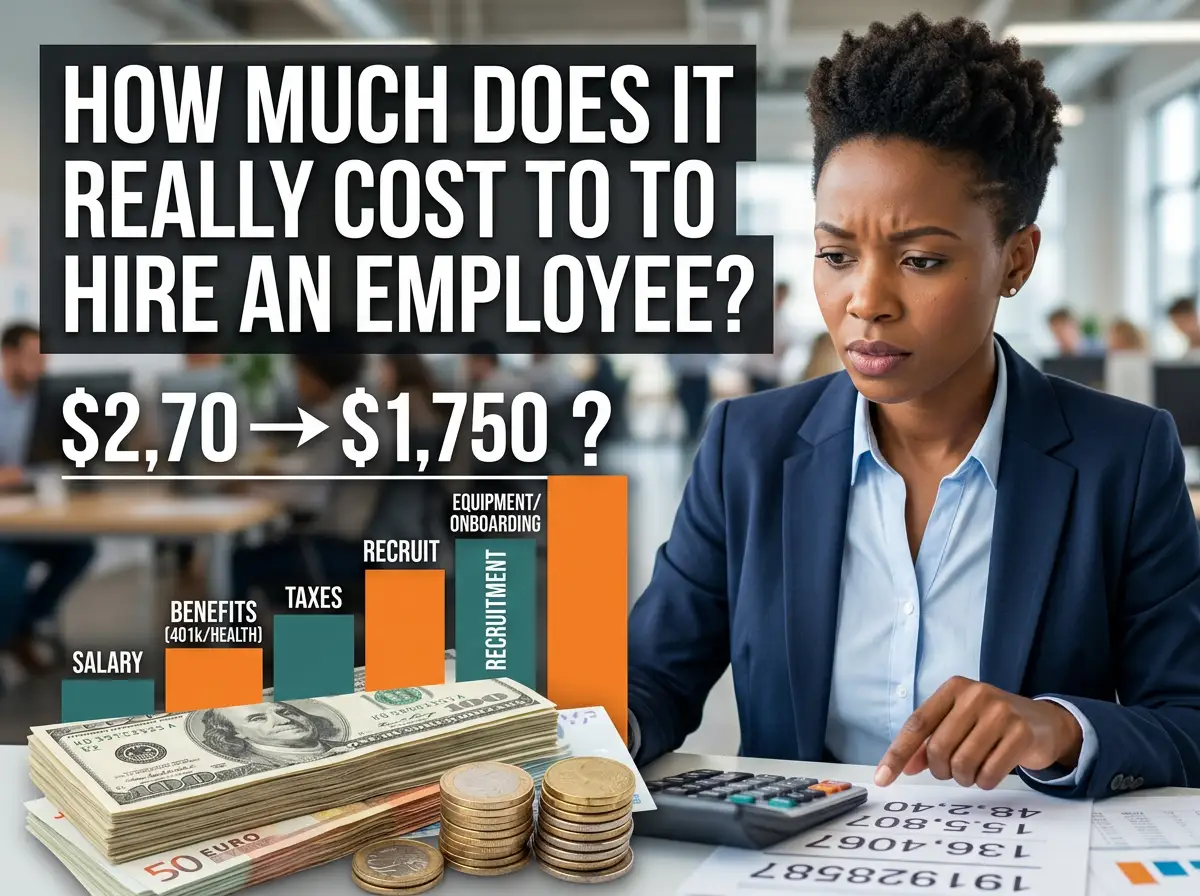
Hiring one non-executive employee in the US costs an average of $5,475 in direct recruiting expenses alone, according to SHRM’s 2025 Talent Acquisition Benchmarking Report, and that’s before you count salary. Executive hires cost far more to recruit, averaging $35,879 per hire. Once you add payroll taxes, benefits, and onboarding on top of the direct recruiting cost, the true first-year cost of an employee typically runs 1.25x to 1.4x their base salary. On a $60,000 salary, that’s roughly $75,000 to $84,000 in year-one cost to the business.
This number matters even if you’re not the one doing the hiring. It explains a lot about why job offers feel the way they do, why companies hesitate before adding headcount, and why understanding it gives you leverage in a salary negotiation. It’s also the starting point if you’re comparing options, see hiring someone new vs. training an existing employee and why employers pay recruiters on top of all this.
The average cost-per-hire, and why it keeps climbing
SHRM’s 2025 Talent Acquisition Benchmarking Report puts the average direct cost-per-hire for a nonexecutive role at $5,475, up roughly 33% from the $4,129 figure in SHRM’s 2015 benchmarking data, and up further still from the roughly $4,700 SHRM reported in its 2022 “Real Costs of Recruitment” research. That figure covers job advertising, applicant tracking software, recruiter time, background checks, assessments, interview logistics, and administrative overhead for a single hire, it does not include the new employee’s salary or benefits.
The steady climb tracks with a tighter, more competitive labor market for skilled roles and rising costs for job boards, background screening, and recruiting software and AI tools. For harder-to-fill or specialized positions, direct cost-per-hire can run well above even this updated average.
Executive hires cost roughly 6.5x as much to recruit
The gap between filling a nonexecutive role and an executive one is much bigger than most people assume. SHRM’s 2025 data puts the average cost-per-hire for an executive position at $35,879, more than six times the nonexecutive average. That gap reflects retained search fees (often 20%-30% of first-year compensation for senior roles), longer and more confidential search processes, more extensive vetting and reference checking, and the outsized cost of getting a senior hire wrong. It’s a useful number to keep in mind if you’re a small business owner budgeting for your first leadership hire: the nonexecutive averages in this article will dramatically understate what a VP- or C-suite-level search actually costs.
The real number: 1.25x to 1.4x of salary in year one
Cost-per-hire is only the recruiting piece. The bigger number is the all-in first-year cost of the employee once they’re on payroll: payroll taxes, benefits, onboarding, and training layered on top of base salary. Across those combined categories, the true first-year cost of an employee typically lands between 1.25x and 1.4x of their base salary.
That multiplier is why a $60,000 salary line item can actually cost a business $75,000 to $84,000 in its first year, and it’s the single most important number for anyone estimating what it takes to add a position, whether you’re a founder building a hiring budget or an employee trying to understand why a raise request gets more scrutiny than the raw dollar amount suggests.

Benefits are a much bigger slice than most people assume
According to the Bureau of Labor Statistics’ Employer Costs for Employee Compensation data, benefits alone typically make up about 30% to 35% of total employee compensation. That includes health insurance, retirement contributions, paid leave, and legally required costs like Social Security and Medicare matching. For a worker who sees a base salary number on their offer letter, it’s easy to underestimate that the employer is often paying nearly a third more on top of that figure just in benefits, separate from the direct recruiting and onboarding costs.
Time-to-fill: the hidden cost of an empty seat
The average time-to-fill a role in the US runs around 44 days, and specialized or senior roles routinely take longer. Every one of those days is a vacancy with its own cost: lost output, overworked teammates covering the gap, delayed projects, and in customer-facing roles, potential lost revenue. That’s a cost that doesn’t show up on the cost-per-hire line item but is very real to a business, and it’s a big part of why companies are often willing to pay a recruiter or staffing agency a placement fee to shorten that window. More on that logic in why companies use recruiters if it costs so much.
All the cost components, in one place
| Cost category | What it includes | Typical range |
|---|---|---|
| Direct cost-per-hire (nonexecutive) | Job ads, ATS, recruiter time, screening, admin | ~$5,475 average (SHRM, 2025) |
| Direct cost-per-hire (executive) | Retained search, extended vetting, confidential process | ~$35,879 average (SHRM, 2025) |
| Payroll taxes | FICA, FUTA, SUTA | Roughly 7-10% of wages |
| Benefits | Health insurance, retirement match, paid leave | ~30-35% of total compensation (BLS) |
| Onboarding & training | Ramp-up time, manager/mentor time, tools | Varies by role complexity |
| Vacancy cost | Lost output/revenue during the ~44-day average fill time | Varies by role |
| All-in first-year cost | Combined total vs. base salary | 1.25x-1.4x of salary |
Why a bad hire is the most expensive line item of all
Every cost category above assumes the hire works out. When it doesn’t, the company effectively pays for the search twice: the original cost-per-hire, the wasted salary and benefits paid to someone who didn’t work out, the disruption to the team, and then the entire cost-per-hire and vacancy period again for the replacement search. SHRM-cited turnover research puts the total cost of replacing an employee at anywhere from one-half to two times their annual salary once lost productivity, training, and recruiting are all counted, a wide range that widens further for specialized or senior roles. This risk is a major reason employers will pay a premium, a recruiter’s fee, a more thorough interview process, a longer notice period, to reduce the odds of a bad hire in the first place.
Why this number matters if you’re negotiating pay or starting a business
If you’re negotiating a raise or a job offer, understanding the 1.25x-1.4x multiplier reframes the conversation: your employer isn’t comparing your ask to your base salary alone; they’re comparing it to the fully loaded cost of replacing you versus retaining you and replacing you is expensive, given SHRM’s $5,475 average cost-per-hire plus a 44-day average vacancy, before even counting the risk of a bad replacement hire. If you’re planning to hire your first employee for a small business, budget on the 1.25x-1.4x multiplier from day one rather than the salary figure alone, so you aren’t caught short on payroll tax and benefits costs.
It’s also worth remembering that these figures are averages across all roles and industries. A hard-to-fill technical, executive, or licensed position will typically push both the direct cost-per-hire and the time-to-fill well past the averages, since sourcing qualified candidates takes longer and often requires paying a premium for specialized recruiting help or advertising in narrower channels. A high-volume, entry-level role, by contrast, usually fills faster and cheaper than the averages suggest. Use the numbers above as a baseline to sanity-check a hiring budget, not as a fixed rule for every position.
Frequently asked questions
What is the average cost to hire an employee in the US?
Direct cost-per-hire averages $5,475 for nonexecutive roles as of SHRM’s 2025 Talent Acquisition Benchmarking Report, and $35,879 for executive roles. The true all-in first-year cost, once salary, benefits, payroll taxes, and onboarding are included, typically runs 1.25x to 1.4x the employee’s base salary.
Why has cost-per-hire gone up so much over the last decade?
Cost-per-hire has climbed roughly 33% since 2015, from $4,129 to $5,475 for nonexecutive roles per SHRM’s benchmarking data, driven largely by pricier job advertising, recruiting software, and background screening, along with a more competitive market for skilled candidates.
Why is hiring an executive so much more expensive than hiring a regular employee?
Executive searches typically involve retained search firm fees, longer and more confidential processes, and far more extensive vetting, which is why SHRM’s data puts the average executive cost-per-hire at $35,879, more than six times the nonexecutive average of $5,475.
How much do benefits add on top of salary?
Per BLS Employer Costs for Employee Compensation data, benefits make up roughly 30% to 35% of total employee compensation on average, covering health insurance, retirement contributions, and paid leave on top of wages.
How much does a bad hire actually cost?
Widely cited SHRM-referenced turnover research puts the full cost of replacing an employee, recruiting, lost productivity, and training combined, at roughly one-half to two times their annual salary, on top of restarting the entire cost-per-hire and vacancy cycle.
Is it cheaper to hire someone new or train an existing employee?
It depends on the role and the skill gap involved. See hiring vs. training an existing employee for a full cost comparison of both paths.
Employer costs are only half the picture. Job seekers absorb real costs of their own during a search, see why it’s so expensive to find a new job. And if a recruiter is involved, understand why companies use recruiters despite the fee and confirm that staffing agencies never bill the candidate for their services.






Leave a Reply