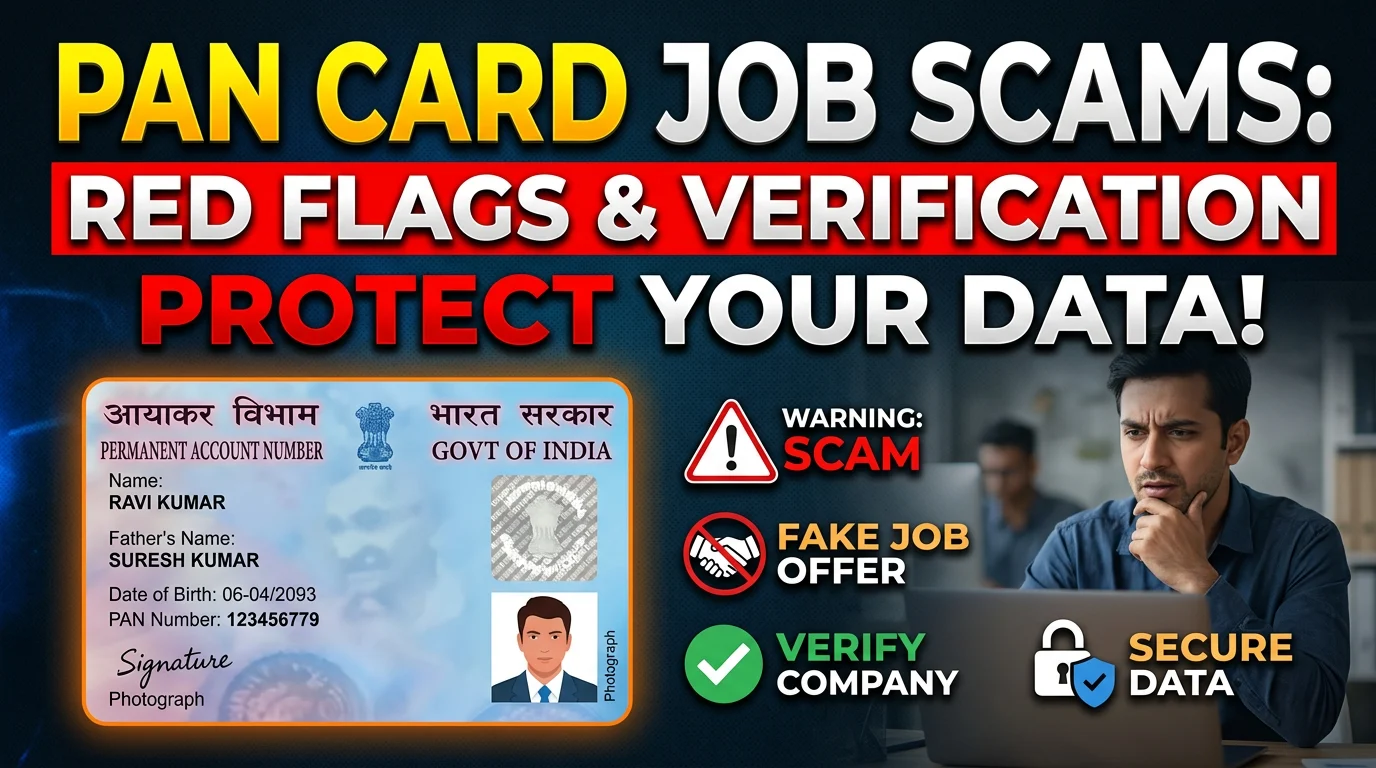
Job Scams
A LinkedIn message lands from a “senior HR manager” at a company you have heard of. The role pays well above market rate, the interview is a single fifteen-minute WhatsApp video call, and by the end of that call you are asked to fill out an “onboarding form” that wants your PAN card copy, your Aadhaar number, your bank account details, and a small “registration fee” to activate your employee ID. Every year, thousands of Indian job seekers hand over exactly this information to people who are not recruiters at all, and the fallout ranges from a wasted afternoon to months spent untangling fraudulent loans taken out in their name. PAN card job scams work precisely because they borrow the language and paperwork of real hiring, so the document itself is not the problem, the context around the request is. This guide breaks down the actual patterns these scams follow, the specific red flags that separate them from genuine recruitment, exactly how to verify a recruiter before you share anything, and the concrete steps to take if you have already sent your PAN to someone who should not have it.
Quick answer: how do PAN card job scams actually work?
Most PAN card job scams follow a simple script: a fraudulent “recruiter” reaches out through WhatsApp, a job board’s chat function, or a cold email, offers a role that sounds attractive and requires almost no real vetting, then asks for your PAN, Aadhaar, bank details, and often a small fee, all within the first conversation, before any legitimate interview process has taken place. The document collection is rarely the endpoint on its own; it is typically a step toward one of three things, using your identity to open a bank account, a wallet, or a loan in your name, reselling your personal data to other scam operations, or extracting a direct upfront payment disguised as a “security deposit,” “training kit fee,” or “verification charge.” The giveaway is almost never the PAN request itself, since that can be legitimate, but the speed, the channel, and the bundling of the request with pressure to act immediately.
The most common PAN-related job scam patterns
These patterns repeat constantly across job portals, WhatsApp groups, and social media, and recognizing the shape of them is more useful than memorizing any single example.

The instant-offer, pay-a-fee scam
You are offered a role, often remote data entry, content moderation, or “brand ambassador” work, almost immediately after a short chat, with no real skills assessment. Once you show interest, you are asked for your PAN and Aadhaar for “compliance,” followed by a request for a refundable “security deposit” or “training material fee” to be paid via UPI before you can start. The job itself typically never materializes, and the fee is never refunded.
The fake staffing agency
A “recruitment consultancy” you cannot find any independent trace of, no verifiable office address, no consistent employee presence on LinkedIn, reaches out claiming to place candidates at large, recognizable companies. They ask for a full document set, PAN, Aadhaar, bank passbook photo, and sometimes a passport-size photo, framing it as “pre-verification” required by their client. There is no client; the documents are the product.
The look-alike company email
The email address closely resembles a real company’s domain but is subtly wrong, a hyphen added, a letter swapped, or a slightly different top-level domain, while the email signature, logo, and tone are copied convincingly from the real employer. Because the branding looks right, candidates are far more willing to hand over PAN and Aadhaar details than they would be to an obviously random address.
The data-harvesting application form
A job posting on a lesser-known site or a forwarded WhatsApp link leads to a form asking for far more than any real application would need at that stage, PAN, Aadhaar, bank account and IFSC code, and sometimes net banking user IDs, all before you have spoken to a single human being. The “job” here may not exist at all; the form itself, and the data it collects, is the entire scam.
The work-from-home task scam
Common on Telegram and WhatsApp, this version offers payment for simple tasks like liking videos or rating products, asks for PAN and bank details to “process payouts,” and eventually asks you to deposit your own money into a linked wallet to “unlock” a larger payout, a pattern more closely related to investment fraud but frequently bundled with the same PAN and Aadhaar collection step.
Red flags checklist
- You are asked for a PAN card copy, Aadhaar, and bank details before any real interview, sometimes within the very first WhatsApp message.
- Any request for money, a “registration fee,” “security deposit,” “training kit charge,” or “refundable token amount,” at any stage of hiring. Legitimate employers in India do not charge candidates to be hired.
- The recruiter’s email domain does not exactly match the company’s real website, or all communication happens over WhatsApp, Telegram, or a personal Gmail address.
- The recruiter or agency has no verifiable LinkedIn history, or the profile was created recently with minimal activity and few genuine connections.
- Heavy pressure to respond within minutes or hours, with language implying the offer will be withdrawn if you delay or ask questions.
- The role, pay, and process are disproportionately easy relative to the salary on offer, no technical round, no manager interview, no verifiable job description.
- The company cannot be found on the Ministry of Corporate Affairs portal, or its listed address and the recruiter’s claims do not match.
- You are asked for documents or fees over a chat app rather than an official company email or applicant portal.
How to verify a recruiter or company before sharing anything
A few minutes of checking can save weeks of cleanup later, and none of these steps require any special access or paid tools.

Check the company’s registration
India’s Ministry of Corporate Affairs maintains a free public Master Data search where you can look up any registered company by name and confirm whether it actually exists, its registration status, and its registered address. A recruiter claiming to represent a company that does not appear here, or whose address bears no relation to the one being cited, is an immediate warning sign.
Verify the recruiter as a person
Search for the individual by name and claimed job title on LinkedIn. A real recruiter working at a real company for any length of time typically has a consistent employment history, genuine connections at that company, and posts or interactions that predate your conversation with them by months or years, not a profile created the same week they contacted you.
Go to the official careers page directly
Rather than trusting a link sent to you, navigate to the company’s official website independently and check its careers or jobs section for the role in question. If the role is not listed, or the company has no careers page at all despite claiming to be a large, established employer, that mismatch is worth taking seriously.
Call back through a public number
Find the company’s official phone number through its website or a search engine, not one given to you by the recruiter, and call to confirm that the person and the role genuinely exist. Legitimate HR departments will confirm this without hesitation; a scam operation has no real switchboard to route your call to.
Use a government job portal as a reference point
The National Career Service portal, run by the Ministry of Labour and Employment, lists verified job postings from registered employers and can serve as a useful sanity check for whether a role or company appears through official channels, separate from unsolicited outreach.
What to do if you have already shared your PAN with a scammer
Acting quickly narrows the window in which stolen documents can be misused, and each of the steps below is free and does not require a lawyer to start.

- Report it immediately on the National Cyber Crime Reporting Portal, or call the national cybercrime helpline at 1930. File a report even if no money has been lost yet; an early report creates a record that matters if fraudulent activity surfaces later.
- Report the listing or profile to whichever job board, LinkedIn, or messaging platform the scam originated from, using their built-in fraud reporting tools, so the same profile cannot target other candidates.
- If money was paid, report the transaction to your bank immediately and file a complaint on the RBI’s Sachet portal, which is built specifically for financial fraud complaints involving unregistered entities.
- Check your Form 26AS and Annual Information Statement on the Income Tax e-filing portal periodically for any TDS entries, loans, or financial activity you do not recognize being reported against your PAN.
- Pull your credit report and check for any loan or credit card applications you did not make; TransUnion CIBIL and the other credit bureaus have a formal consumer dispute process for flagging and correcting fraudulent entries.
- Keep every message, email, and payment record related to the interaction. This documentation is what investigators and dispute processes will actually ask for.
For a deeper look at exactly what a stolen PAN can be used for and how long the exposure realistically lasts, see our guide on what happens to your PAN number after you share it with a recruiter.
Why these scams specifically target job seekers
Job seekers are, structurally, an easier target than most groups scammers approach. Someone actively looking for work is emotionally invested in the outcome, more willing to overlook small inconsistencies, and often under real financial pressure that makes an unusually generous offer feel plausible rather than suspicious. Job seekers are also primed by genuine hiring processes to expect requests for personal documents, which is exactly the expectation fraudulent recruiters exploit. None of this reflects poorly on anyone who has been targeted; it reflects a scam design that is built around normal, reasonable trust in a process that is supposed to be safe.
Are tech and IT recruitment scams different?
Scams targeting tech and IT job seekers tend to layer in more convincing technical detail, referencing real technology stacks, real client names, or a “coding assessment” hosted on a lookalike domain, precisely because this audience is used to fast-moving, remote-first hiring and multiple recruiter touchpoints from staffing vendors. The underlying pattern is unchanged: premature document requests, upfront fees, and pressure to move quickly, dressed in more technically fluent language. Genuine staffing vendors working with tech employers will always be able to name a specific, verifiable client role, and their outreach will trace back to a real, findable company.
Best practices to protect your data during a job search

- Never pay to get a job. No legitimate employer or recruitment agency in India charges candidates a fee, deposit, or “registration charge” of any kind to be considered, interviewed, or hired.
- Separate identity verification from data handover. Confirming a recruiter’s identity costs you nothing and takes a few minutes; sharing documents with an unverified party can cost far more to undo.
- Use a dedicated email for job applications so you can more easily track which parties have your information and revoke access to that inbox later if needed.
- Never share OTPs, passwords, or full bank account credentials with anyone during a hiring process, regardless of how official the request sounds.
- Prefer applying through official channels, a company’s own careers page, a well-known job portal, or a government platform like the National Career Service, over unsolicited outreach.
- Trust the pattern, not the polish. Professional-looking logos, email signatures, and offer letters are trivial to fake; a verifiable employment history and a real, callable office are not.
- When in doubt, slow down. Genuine opportunities can withstand a day or two of verification; scams rely on you not taking that time.
Frequently asked questions
How can I tell if a job offer asking for my PAN is fake?
Look at the sequence and the channel: a fake offer typically asks for your PAN, Aadhaar, and bank details very early, often on WhatsApp or through a recruiter with no verifiable history, sometimes alongside a request for a fee. A genuine offer asks for documents after a real interview process, through official company email, from a recruiter you can independently confirm through LinkedIn and a callback to the company’s public number.
What should I do immediately after realizing I shared my PAN with a scammer?
File a report on the National Cyber Crime Reporting Portal or call the 1930 helpline right away, even before any misuse has occurred. Then check your Form 26AS and Annual Information Statement on the Income Tax e-filing portal, and pull your credit report to look for unfamiliar loan or credit card activity, disputing anything you do not recognize through the credit bureau’s formal process.
Can someone take a loan using just my PAN card?
PAN alone is usually not sufficient for a fully fraudulent loan, since lenders generally require additional verification such as Aadhaar-based e-KYC, a selfie, or bank statements, but PAN combined with Aadhaar and bank details significantly raises the risk, particularly with less rigorous digital lending apps. This is exactly why bundled requests for PAN, Aadhaar, and bank details together are treated as a much higher-risk pattern than any one document alone.
Is it safe to apply for jobs on WhatsApp groups?
WhatsApp groups themselves are not inherently unsafe, but they are a common distribution channel for job scams because they lower the friction of unsolicited outreach and make it harder to verify who is actually posting. Treat any opportunity found through a WhatsApp group with the same verification steps you would use for a cold email, checking company registration, the recruiter’s identity, and the official careers page before sharing anything.
Do legitimate recruiters ever ask for a fee?
No. Legitimate employers and recruitment agencies operating in India are paid by the hiring company, not by candidates, and do not charge job seekers for registration, training kits, background verification, or any other part of the hiring process. Any request for payment tied to being hired should be treated as a firm red flag regardless of how it is framed.
Where can I verify if a company is real before sharing my PAN?
The Ministry of Corporate Affairs’ Master Data search lets you look up any registered company in India by name to confirm it exists and check its registered address, free of charge. Combine that with a LinkedIn check on the recruiter and a direct call to the company’s publicly listed number before sharing any personal documents.
References
- National Cyber Crime Reporting Portal, Government of India – Job Fraud Brochure
- National Cyber Crime Reporting Portal – File a Cyber Crime Complaint
- Reserve Bank of India – Sachet Portal for Financial Fraud Complaints
- Naukri.com – How to Report a Fake or Scam Job
- Naukri.com – How to Avoid Job Search Scams
- Ministry of Corporate Affairs, Government of India – Master Data Services (Verify Company Registration)
- National Career Service, Ministry of Labour and Employment – Official Government Job Portal
- TransUnion CIBIL – Consumer Dispute Resolution
- Income Tax Department e-Filing Portal – Verify Your PAN
- The Week – New Cyber Scam Warning: Your Job Application Could Make You a Money Mule
Related Guides
- Is It Safe to Share Your PAN Card With a Recruiter? What’s Normal vs a Red Flag
- PAN Card vs Aadhaar Card: Which Should You Share First During a Job Application?
- What Happens to Your PAN Number After You Share It With a Recruiter?
- Can You Get a Job Without a PAN Card? What to Do If You Don’t Have One Yet
- PAN Number vs PAN Card: What’s Safe to Share, and Does It Affect Your Credit Score?
- Is It Safe to Share Your Aadhaar Card With Your Employer?







Leave a Reply