PAN Card
You have just finished a promising phone screen, and before the recruiter even schedules your first interview, an email lands asking for a scanned copy of your PAN card, your date of birth, and sometimes your Aadhaar number as well. It feels premature. You have not met anyone from the company, you have not seen an offer, and you are being asked to hand over a document tied directly to your income tax records and financial history. Is this normal recruitment process, or is it the first sign of something you should walk away from? The honest answer is that it depends heavily on who is asking, what stage of the process you are at, and exactly what they are asking for. Genuine employers in India do use PAN for entirely legitimate reasons: background verification, statutory payroll setup, and Tax Deducted at Source (TDS) compliance are all real, common, and legally grounded uses of your PAN. But the same document, in the wrong hands, is also a useful tool for identity fraud, fake loan applications, and shell-company scams that specifically target job seekers because they are motivated, trusting, and often unwilling to push back on a company that might hire them. This guide walks through what is genuinely normal, what should make you pause, and how to protect yourself without sabotaging a legitimate opportunity.
Quick answer: is it safe to share your PAN with a recruiter?
Sharing your PAN with a recruiter can be completely normal, but timing and context matter more than the fact of sharing it at all. Legitimate employers commonly need your PAN for background verification (BGV), Employees’ Provident Fund and payroll setup, and TDS compliance under the Income Tax Act, so being asked for it somewhere in the hiring process is not inherently suspicious. What is worth scrutinizing is a request for a full PAN card copy very early, before you have even had a first interview or received any offer, especially from a recruiter you cannot independently verify. A legitimate ask for your PAN number closer to onboarding, for payroll and TDS setup, is low-risk. A stranger asking for a scanned PAN card copy, your date of birth, and often your Aadhaar within the first message or call, before any real vetting has happened on either side, is a much more common pattern in identity-fraud and fake-job scams than in genuine hiring.
Why recruiters and companies ask for your PAN in the first place
PAN, the Permanent Account Number issued by India’s Income Tax Department through Protean eGov Technologies (formerly NSDL) and UTIITSL, is a ten-character alphanumeric identifier tied to your tax record. It shows up in recruitment for a handful of specific, legitimate reasons, and understanding them makes it much easier to tell a normal request from a suspicious one.

Applicant tracking and identity matching
Larger companies, and increasingly mid-sized ones, run candidates through an applicant tracking system (ATS) that needs a reliable way to de-duplicate records and confirm that the person who applied is the same person showing up for each interview round. PAN is a convenient unique identifier for this because, unlike a name or phone number, it cannot easily be shared between two people. Some ATS platforms ask for PAN at the application stage purely for this internal matching purpose, not because they intend to use it for anything financial yet.
Background and identity verification (BGV)
Most mid-size and large employers in India run a background verification check before confirming an offer or shortly after you join, usually through a third-party BGV vendor. PAN is one of several documents used to confirm your identity and, in some cases, to cross-check things like past employment history or education records where the reporting agency links records through PAN. This is a genuinely standard part of hiring for full-time roles at established companies, and it is very similar in spirit to how Aadhaar gets used in employer background checks, which we cover in a separate guide if you want the comparison.
Payroll setup and TDS compliance
Once you are actually being paid, your employer is legally required to deduct tax at source (TDS) from your salary and report it against your PAN to the Income Tax Department. Quoting an incorrect PAN, or none at all, triggers a much higher TDS deduction rate under the Income Tax Act, so payroll teams need a verified PAN before your first salary run, not before your first interview. This is the single most defensible, unambiguous reason a company needs your PAN, and it is also the reason the timing of the request matters so much: this need only arises once you are actually being onboarded as an employee, not while you are still one candidate among dozens being screened.
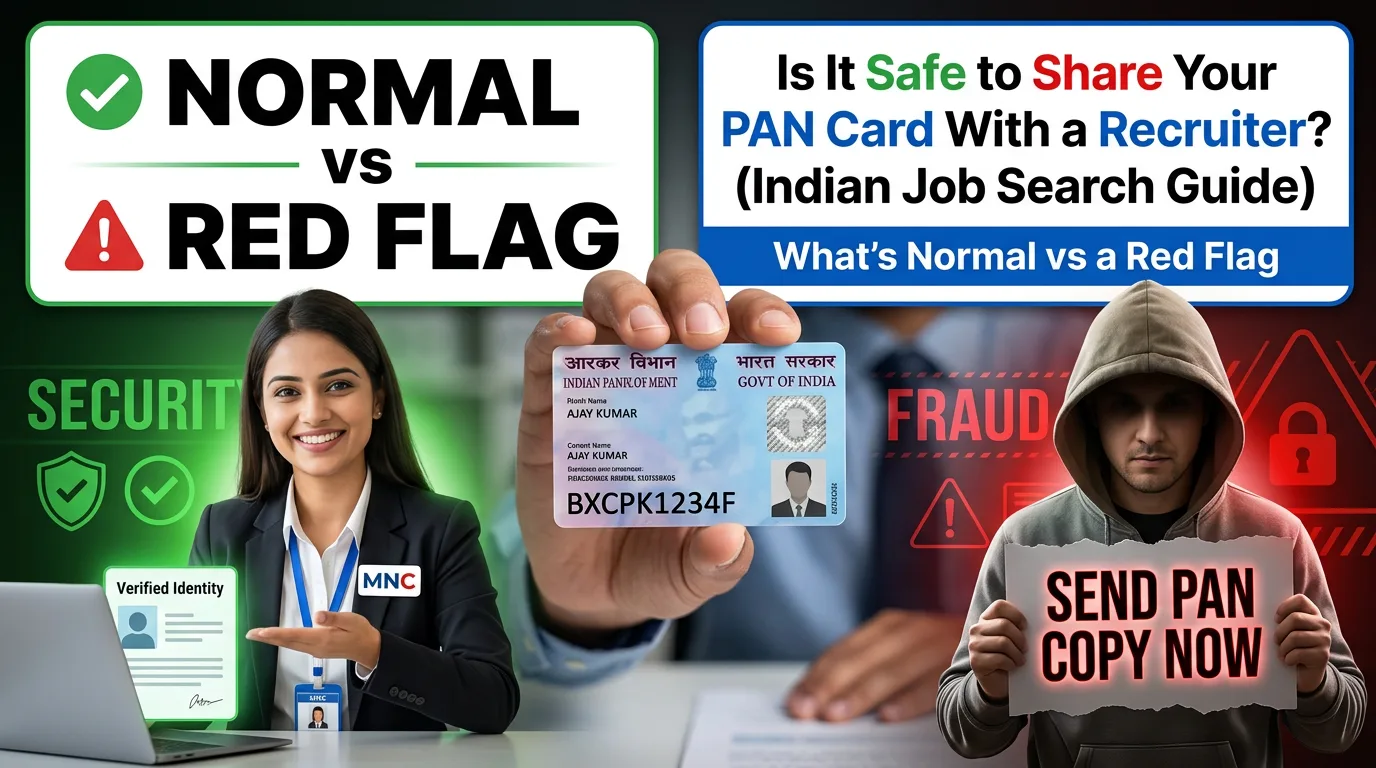
What’s normal and what’s a red flag
Because the same document serves both legitimate HR functions and fraud, the details of a request matter far more than the mere fact that PAN was mentioned.
Signs the request is legitimate
- The request comes after at least one verifiable interview round, ideally after a verbal or written offer.
- It comes from a company email domain that matches the employer’s actual website, not a generic Gmail or Yahoo address.
- The recruiter or HR contact is a real, searchable person on LinkedIn with a consistent employment history at that company.
- You are asked for your PAN number and possibly a copy for BGV or payroll, not for your PAN card’s original physical document, login credentials, or e-filing password.
- The request is bundled with other standard onboarding paperwork (offer letter, salary structure, bank details form) rather than standing alone as the very first thing asked of you.

Signs the request is suspicious
- You are asked for a PAN card copy, Aadhaar, and bank details before any interview has taken place, sometimes within the first message on WhatsApp or a job board chat.
- The recruiter cannot be found on LinkedIn, or their profile was created very recently with little activity.
- Communication happens entirely over WhatsApp or personal email, with no official company email ever used.
- There is pressure to respond immediately, with language suggesting the “slot” or “offer” will be lost if you delay.
- The role, salary, or process feels unusually easy relative to the pay being offered, a pattern we cover in more depth in our guide to PAN card job scams and how to verify a recruiter.
Why tech companies specifically ask for PAN before interviews
One pattern that confuses a lot of candidates, and comes up constantly in forums like Blind and Glassdoor, is those tech companies, or their third-party recruitment vendors, asking for PAN details unusually early, sometimes before a first technical round is even scheduled. There are a few legitimate explanations. Large tech employers and IT services firms process enormous applicant volumes and often outsource initial screening to external staffing agencies, which use PAN as a de-duplication key across multiple client accounts they are hiring for simultaneously, to avoid submitting the same candidate to a client twice under different names or spellings. Some also use it to check whether you are already an active employee or a recently separated employee of a group company or client they have a non-compete or non-poach understanding with, which is a real, if unglamorous, HR use case. That said, this is also exactly the pattern fraudulent “recruiters” impersonate, because it has become common enough that candidates rarely question it. The distinguishing factor is still verifiability: a real staffing vendor working for a real tech company will have a traceable presence, a proper company email, and will be able to name the specific client role they are recruiting for when you ask.
Timing: should you share PAN before or after an offer?
As a general rule, the closer a PAN request sits to an actual offer or onboarding, the more legitimate it typically is. A request for your PAN number alone, for internal record-matching or preliminary BGV initiation, after you have cleared at least one substantive interview round, is reasonably normal. A request for a full scanned copy of your PAN card, especially combined with Aadhaar, bank account details, or a processing fee of any kind, before you have received a written or even verbal offer, is a pattern worth treating with real caution. If you are unsure where you stand, it is entirely reasonable to ask the recruiter directly what stage this request corresponds to and to hold off providing a document copy until you have that in writing, ideally over official company email rather than a chat app.
Is PAN verification required before an interview?
No. There is no legal or standard industry requirement that a candidate’s PAN be verified before an interview takes place. Interviews are meant to assess fit and skill; PAN verification belongs to the identity and compliance side of hiring, which properly happens once an employer has decided it actually wants to move forward with you, whether that is right before an offer or as part of onboarding paperwork afterward. If a recruiter insists that PAN verification must happen before they will even schedule an interview, and cannot explain why in specific terms, that is worth treating as one of the softer red flags on the list above rather than an industry norm.
What information is essential vs optional on a job application
Most legitimate job applications genuinely need only a fairly narrow set of information at the application stage: your name, contact details, resume, and answers to role-specific screening questions. Government ID numbers, whether PAN or Aadhaar, are not typically essential at the point of application itself.

- Usually essential at application: name, phone number, email, resume or CV, relevant work authorization status, expected compensation range.
- Usually essential closer to offer or onboarding: PAN, bank account details for payroll, address proof, educational certificates for verification.
- Rarely, if ever, legitimately needed: Aadhaar OTP, net banking passwords, PAN e-filing portal passwords, upfront “processing” or “training” fees of any kind.
If a job application form asks for your PAN number as a mandatory field before you have even submitted a resume, it is not automatically fraudulent, some ATS platforms are simply configured that way for large-volume hiring, but it is a reasonable moment to check the company’s legitimacy independently rather than assuming the form’s design reflects best practice.
Is a DOB and PAN combination normal to share?
Being asked for your date of birth alongside your PAN is common and not unusual on its own, since your DOB is one of the fields used to verify a PAN against the Income Tax Department’s database, similarly to how the department’s own online PAN verification tool works. Where this combination becomes more concerning is when it is bundled with several other sensitive identifiers at once very early in the process, PAN, Aadhaar, DOB, bank account number, and a copy of your address proof, all requested together before any real interview has happened. Individually, none of these fields is alarming; together, requested prematurely by an unverified party, they add up to nearly everything needed to attempt identity fraud or open a financial account in your name.
Contract and temporary roles vs full-time positions
The pattern of PAN requests differs somewhat by employment type. For full-time positions, PAN is typically collected once, during onboarding, and used consistently thereafter for TDS and Form 16 purposes for as long as you remain employed. For contract, temporary, or gig-style engagements, especially through staffing agencies or aggregator platforms, you may be asked for your PAN more frequently, sometimes once per assignment or per client engagement, because each engagement may be treated as a separate contractual relationship for tax purposes, and TDS under Section 194J or 194C may apply differently than salaried TDS under Section 192. This is a legitimate structural difference, not a red flag by itself, but it does mean contract workers should be more deliberate about confirming which specific engagement a PAN request relates to each time, since the higher frequency of requests also gives more opportunities for a fraudulent request to blend in.
Startups vs large corporates: do they ask for different things?
Large corporates tend to have standardized HR systems, dedicated compliance teams, and third-party BGV vendors, which generally means PAN requests come at predictable stages (post-offer, pre-onboarding) through consistent, well-documented channels. Startups, particularly early-stage ones without a dedicated HR function, sometimes ask for documents earlier or more informally simply because their process is less structured, not necessarily because anything is wrong. The practical difference for you as a candidate is verification effort: a large corporate is easy to verify through its official careers page, a switchboard number, and a visible HR team on LinkedIn, while a small or very new startup may require a bit more digging, checking its registration on the Ministry of Corporate Affairs portal, its funding history, or simply asking direct questions about who specifically will be handling your documents and why.
Best practices to protect your PAN during a job search
- Verify before you share. Confirm the recruiter’s identity through LinkedIn, the company’s official website, and, where possible, a callback to a publicly listed company number rather than a number given only in the outreach message.
- Match the request to the stage. A PAN number for internal matching after a real interview is different from a full document copy before any vetting has happened.
- Use official channels only. Share sensitive documents over verified company email or a secure applicant portal, not WhatsApp, personal Gmail, or third-party chat apps.
- Never share OTPs or passwords. No legitimate employer needs your PAN e-filing password, Aadhaar OTP, or net banking credentials at any stage of hiring.
- Ask what it is for and how long it will be kept. A legitimate HR contact can tell you plainly whether a request is for BGV, payroll, or ATS matching, and roughly how long the record will be retained.
- Keep a copy of what you sent, and to whom. If something goes wrong later, having a clear record of what was shared, when, and via which channel makes it far easier to act quickly, including reporting it, a process detailed further in our guide on what happens to your PAN number after you share it with a recruiter.
- When in doubt, offer a masked or partial option first. Some employers will accept confirmation of your PAN’s last few characters for early-stage matching, saving the full document copy for after an offer is issued.
Frequently asked questions
Is it normal for a recruiter to ask for my PAN card?
Yes, in many cases. Recruiters and HR teams commonly need your PAN for background verification, payroll setup, and TDS compliance, so being asked for it somewhere in the process is not automatically a red flag. What matters is timing and verifiability: a request that comes after a real interview, from a verifiable company contact using official email, is a normal part of hiring. A request for a full PAN copy from an unverified source before any interview has happened is a much more common pattern in scams than in genuine recruitment.
Can a company legally ask for my PAN before hiring me?
There is no law that prevents a company from asking for your PAN at any stage of the hiring process, including before an offer, and there is also no law that requires you to provide it immediately upon request. You are entitled to ask why it is needed at that stage and to decline until you have more clarity, particularly if the request is not accompanied by a verifiable interview process, an official offer, or a traceable company representative.
Is it safe to give my PAN number and date of birth together?
On its own, sharing your PAN number alongside your date of birth is common and reasonably low-risk, since both fields are used together for standard PAN verification against the Income Tax Department’s records. It becomes more concerning only when this combination is bundled with several other sensitive identifiers, such as Aadhaar, bank details, and address proof, all requested together very early by a party you have not been able to verify independently.
Should I share my PAN before or after I receive a job offer?
As a general practice, sharing your PAN number for basic verification after at least one real interview round is reasonable, while holding off on a full document copy until you have a written offer is a sensible default. Payroll and TDS setup genuinely only require your PAN once you are being onboarded, so there is rarely a legitimate operational need for a full PAN card copy earlier than that.
Do startups ask for different documents than large corporates?
Not fundamentally, but the process often looks less structured at smaller or early-stage startups that lack a dedicated HR or compliance function, which can mean documents are requested earlier or more informally than at a large corporate with standardized BGV vendors. This difference in structure is not itself a red flag, but it does mean it is worth doing a bit more independent verification of a small or unfamiliar company before sharing sensitive documents.
What should I do if a recruiter asks for my PAN on the first call?
Ask what specifically it will be used for at this early stage, and it is reasonable to decline providing a full document copy until you have verified the recruiter’s identity and the company independently, through LinkedIn, the official careers page, or a callback to a publicly listed number. If the recruiter cannot clearly explain the purpose or becomes pushy about immediate compliance, treat that as a meaningful warning sign rather than standard hiring practice.
References
- Income Tax Department, Government of India – PAN Card India: PAN Services & Information
- Income Tax Department e-Filing Portal – Verify Your PAN
- Protean eGov Technologies (formerly NSDL) – PAN Card & TIN Services
- UTIITSL – PAN Card Application, Correction & Status Services
- The Tribune – Aadhaar, PAN Card Copies of Job Aspirants Misused for Financial Transactions in Thane; Probe Launched
- Keka HR – Digital Personal Data Protection Act, 2023: Key Rules for Employers
- Wikipedia – Digital Personal Data Protection Act, 2023 (India)
Related Guides
- PAN Card Job Scams: Red Flags, Verification Steps, and How to Protect Your Data
- PAN Card vs Aadhaar Card: Which Should You Share First During a Job Application?
- What Happens to Your PAN Number After You Share It With a Recruiter?
- PAN Number vs PAN Card: What’s Safe to Share, and Does It Affect Your Credit Score?
- PAN Card Requirements for Self-Employed Professionals and Freelancers
- Is It Safe to Share Your Aadhaar Card With Your Employer?






Leave a Reply