Sleep & Wellness
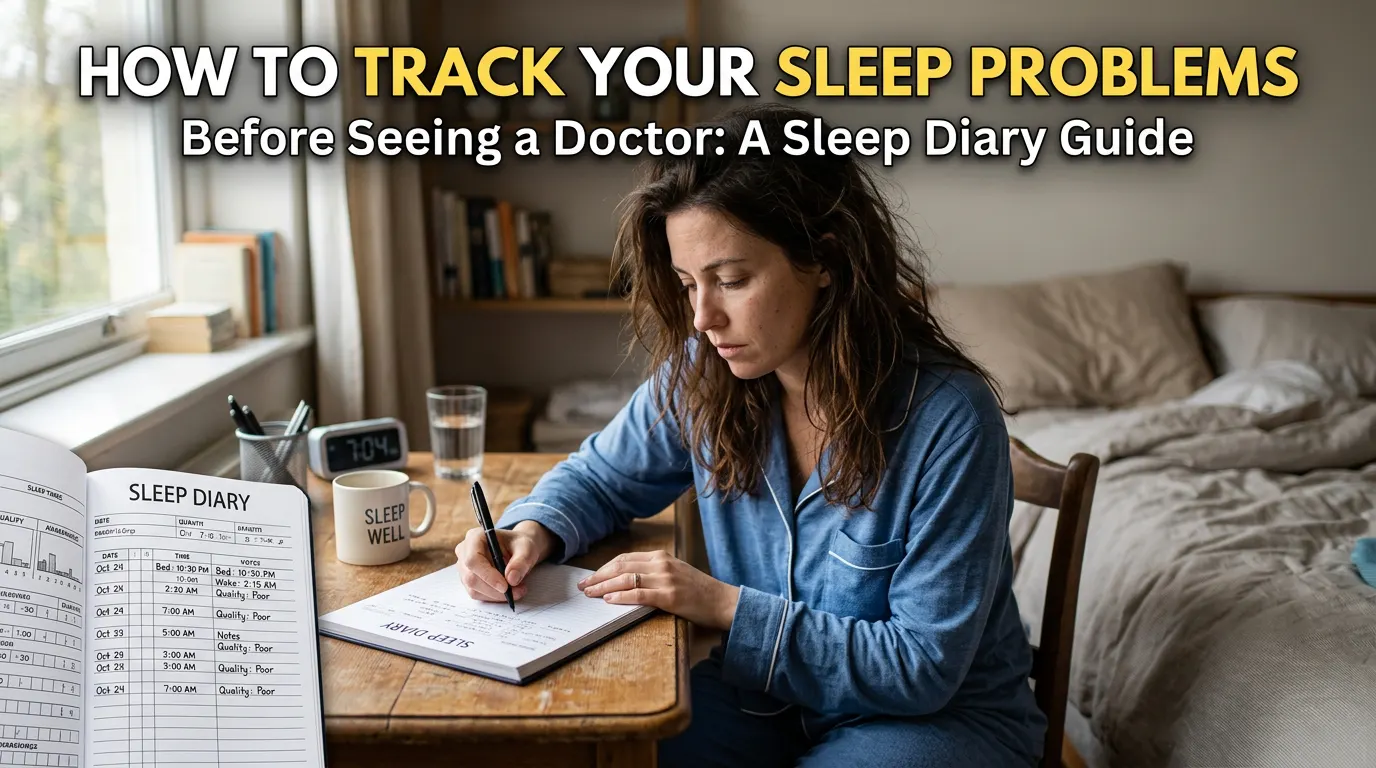
“How have you been sleeping?” is one of the hardest questions to answer accurately from memory. Most people respond with something like “not great” or “I wake up a lot,” which is true but nearly useless to a physician trying to figure out what’s actually wrong. Sleep is invisible while it’s happening, and you genuinely cannot recall most of what your night looked like, let alone summarize a representative pattern on the spot in an exam room. A sleep diary (or sleep log) solves this by turning a vague impression into a dated, specific record: what time you got into bed, how long it took to fall asleep, how many times you woke up, when you finally got up, and how you felt the next day. Kept consistently for one to two weeks before an appointment, it’s one of the simplest and most clinically useful things a patient can bring to a first conversation about sleep problems. This guide covers exactly what to record, the format doctors actually use, how long to keep it, what a few real days of entries look like, and how it compares to letting a wearable track sleep for you.
Quick Answer
A sleep diary is a daily log of your sleep patterns and habits: bedtime, time spent trying to fall asleep, every night waking and roughly how long it lasted, final wake time, naps, caffeine and alcohol timing, medications, a subjective quality rating, and how you felt during the day. Most sleep clinicians ask patients to keep one for at least one to two weeks before a visit, since a single night reveals almost nothing but two weeks shows real patterns — whether a problem is nightly or occasional, tied to weekends or stress, and getting better or worse. This kind of day-by-day record is more reliable than describing your sleep from memory, and it gives a doctor something concrete to work from instead of a vague complaint. It complements, but doesn’t replace, sleep tracking devices, and it’s one of the most useful things you can hand over at the start of an appointment about persistent sleep trouble.
Why a diary beats describing your sleep from memory
The core problem a sleep diary solves is a memory problem, not a sleep problem. People are demonstrably bad at estimating things like how long it took them to fall asleep or how many times they woke, especially the morning after, still foggy from a bad night. A one-time description at an appointment, “I sleep maybe five or six hours and wake up a few times,” compresses weeks of variable nights into one imprecise sentence. It can’t show whether trouble happens every night or three nights a week, whether it’s stable or worsening, whether weekends look different from weekdays, or whether it started after a specific event like a new job, a new medication, or menopause.
A sleep diary replaces that guesswork with dated entries made close to when they happened, what researchers call prospective self-monitoring, as opposed to retrospective recall reconstructed weeks later. Because it isn’t filtered through memory, it’s considerably less distorted than a verbal summary. Whether a problem fits insomnia, a circadian mismatch, or something else entirely often only becomes visible once two straight weeks of nights are laid out side by side, rather than compressed into a single sentence.
What to record every day
A useful sleep diary doesn’t need to be complicated, and most clinical versions fit on a single page per week. Here’s what’s actually worth writing down each day, and why each item matters.

- Bedtime and time you tried to fall asleep. These aren’t always the same, since reading or scrolling in bed for 20 minutes first is common and worth noting; the gap separates total time in bed from your actual sleep opportunity.
- How long it took to fall asleep (sleep latency). A rough estimate, “about 30 minutes,” “over an hour,” is exactly what clinical diaries ask for. A consistently long latency is one of the defining features doctors look for in insomnia.
- Number and length of night wakings. Note how many times you woke (excluding your final waking) and roughly how long each lasted. Frequent, prolonged awakenings point to a different problem than trouble falling asleep in the first place.
- Final wake time and time you got out of bed. A wake time drifting later across the week, or one dramatically earlier than intended, can point toward a circadian rhythm issue rather than classic insomnia.
- Naps. Roughly when and for how long. Naps directly affect how much sleep pressure has built up by bedtime, so a late or long nap can fully explain a night of trouble falling asleep.
- Caffeine and alcohol, with timing. Timing matters as much as amount, caffeine can linger in your system for hours, and alcohol tends to fragment sleep and suppress REM as it’s processed overnight, even though it feels sedating at first.
- Medications and supplements. List anything taken that day or evening, with timing, since several common medication classes can interfere with sleep and a doctor can’t factor that in without knowing.
- A subjective sleep quality rating. A simple scale (very poor to very good) works fine. Two nights with similar total sleep time can feel completely different depending on how fragmented they were, so this number matters alongside the raw timing.
- Daytime symptoms. Alert, foggy, irritable, unusually sleepy, needing extra caffeine, struggling to concentrate. This is what connects your nighttime numbers to real-world impact, and it’s often what determines whether a pattern counts as a clinical problem at all.
The Consensus Sleep Diary: the format this is based on
If the list above looks like a form your doctor’s office might hand you, that’s not a coincidence. Sleep researchers worked for years with inconsistent, home-grown diary formats that made results hard to compare across clinics, until insomnia researchers led by Colleen Carney published the Consensus Sleep Diary in the journal Sleep in 2012, explicitly designed to standardize prospective sleep self-monitoring. It’s become the closest thing to an industry standard in sleep medicine research and is widely cited in clinical guidance for evaluating insomnia.
The core version asks for essentially the same nine items described above: time into bed, time you tried to fall asleep, sleep onset latency, number of awakenings, total time awake overnight, final wake time, time out of bed, a sleep quality rating, and a comments field. It was deliberately kept general enough to be useful “for all sleep disorders as well as for good sleepers,” not just insomnia, and it fits a full week of nightly entries on a single page. If your doctor’s office hands you a one-page weekly grid before your visit, there’s a good chance it’s a version of this diary or something closely modeled on it.
How long you should actually track before an appointment
There’s some variation across clinics, but the pattern in sleep medicine guidance is consistent: track for at least one week, and ideally two, before your appointment. Some sleep centers hand out a diary specifically designed for the two weeks immediately before a scheduled visit, and general sleep health guidance frames “at least one week” as the minimum, with two weeks or longer recommended depending on your situation.
A single night of data is nearly worthless for diagnosis, since everyone has occasional bad nights for reasons unrelated to any underlying disorder, a stressful day, an unfamiliar bed, a late meal. A week starts to smooth out that noise; two weeks goes further, capturing a full weekday/weekend cycle at least twice, which matters because a lot of sleep problems look different on workdays than on days off. If your symptoms are intermittent or your doctor is trying to rule out a circadian rhythm issue specifically, they may ask you to extend tracking to three or four weeks to capture a longer drift pattern a shorter window would miss. If your appointment is sooner than two weeks away, some data still beats none, even four or five honest days give a doctor more to work with than a verbal description alone, so start as soon as you know a visit is coming rather than waiting to have a “full” set before beginning.
What a few days of a sleep diary actually look like
The format is easier to understand filled in than described. Here’s a realistic example of three consecutive nights from someone dealing with fairly typical sleep-onset trouble and some middle-of-the-night waking:
| Date | Bedtime / tried to sleep | Time to fall asleep | Night wakings | Final wake / out of bed | Naps | Caffeine / alcohol | Quality rating | Daytime notes |
|---|---|---|---|---|---|---|---|---|
| Mon | 11:15 pm / 11:30 pm | ~50 min | 2 times, ~35 min total | 6:20 am / 6:35 am | None | Coffee 8 am, 11 am; wine at 8:30 pm | Poor | Foggy until noon, needed extra coffee |
| Tue | 11:00 pm / 11:10 pm | ~25 min | 1 time, ~10 min | 6:15 am / 6:20 am | 15 min at 2 pm | Coffee 8 am only; no alcohol | Fair | More alert, mild afternoon slump |
| Wed | 12:10 am / 12:20 am | ~70 min | 3 times, ~50 min total | 6:25 am / 6:45 am | None | Coffee 8 am, 1 pm; wine at 9 pm | Very poor | Irritable, fell asleep briefly at desk |
Even from just these three rows, a pattern emerges that a verbal summary would flatten entirely: sleep latency and quality both worsened on the night with later caffeine and alcohol close to bedtime, while the alcohol-free night with an earlier caffeine cutoff produced faster onset and fewer, shorter wakings. Across two full weeks, real trends become visible: is a bad night always preceded by alcohol or late caffeine, or does it happen just as often on otherwise “clean” nights, which would point toward something the diary alone can’t explain. This format is simple enough to recreate in a plain notebook, a notes app, or a basic spreadsheet, no downloadable template required.
Sleep diary vs. a wearable sleep tracker
It’s a fair question: if your watch or ring already logs sleep automatically, why write anything down by hand? A diary and a wearable measure genuinely different things, and they work best together rather than as substitutes. Our deeper look at sleep tracking devices and whether they actually work covers the accuracy research in detail, but the short version is directly relevant here: consumer trackers tend to estimate total sleep time reasonably well, but validation studies have found considerably larger error rates for sleep staging and, notably, for detecting brief periods of wakefulness, exactly the kind of night waking a diary is built to capture from your own subjective experience.
A diary also records things no wearable can: whether you drank alcohol and when, whether you took a medication, how a night felt subjectively, and how you functioned the next day. A tracker might mark a stretch as “asleep” when you actually remember lying there anxious, or miss a middle-of-the-night waking entirely if you stayed still. That gap is exactly why sleep clinicians have long relied on hand-kept diaries as a standardized tool while treating wearable data as a helpful but separately-validated supplement. If you already use a tracker, bring a printed summary alongside your written diary so a doctor sees both the subjective and device-based picture. Neither one, alone or combined, is a diagnostic test the way a sleep study is; both simply characterize a pattern well enough that a doctor knows what, if anything, needs formal testing.
How this documentation helps a doctor diagnose more accurately
Primary care visits that touch on sleep are often short, which means the conversation depends heavily on how much useful information you bring in. A two-week diary changes what’s possible in that window in a few concrete ways. First, it can support or rule out an insomnia diagnosis directly: chronic insomnia is generally defined by trouble falling or staying asleep, or waking too early, at least three nights a week for three months or more despite an adequate opportunity to sleep, and a diary is one of the most direct ways to demonstrate that frequency rather than just asserting it. Second, it can reveal a behavioral or timing-driven pattern that isn’t a disorder at all, late caffeine, inconsistent bed and wake times, long naps, dragging down otherwise normal sleep capacity, a very different conversation than a diagnosed disorder. If you’re unsure which side of that line your own sleep falls on, our self-check framework for telling a sleep disorder apart from bad habits walks through how a diary like this gets used to make that distinction before you even get to a doctor.
Third, a diary can point toward when further testing makes sense. If your log shows fairly normal sleep timing but you’re still reporting severe daytime sleepiness, that mismatch is itself a useful clue, pointing away from simple insomnia and toward something a diary can’t capture, like sleep-disordered breathing, typically confirmed with a sleep study rather than symptom tracking. Coming in with two weeks of concrete data, instead of “I don’t sleep well,” is exactly the kind of preparation our companion guide on what questions to ask your doctor about sleep recommends, since a detailed log paired with a clear list of questions tends to produce a far more concrete next step than a vague complaint alone.

Tips for actually keeping it up for two weeks
- Fill it in close to when it happened. Log daytime fields as the day goes and nighttime fields right after waking, while details are still fresh.
- Keep it low-friction. A notes app, a sticky note on the nightstand, or a printed page all work; what matters is filling it in every day for the full stretch.
- Estimate rather than skip. You’ll rarely know sleep latency or wake counts to the minute, and that’s expected. A reasonable estimate is exactly what the format is built for.
- Don’t change your habits just because you’re tracking. The point is to see your actual pattern, not an artificially improved one for the week you happen to be logging.
- Bring it with you, don’t just describe it. Hand over the physical or printed log rather than summarizing it verbally; the raw data, including nights that don’t fit a tidy narrative, is more useful than your own interpretation of it.
Common mistakes that make a sleep diary less useful
- Starting too close to the appointment. A few nights beats nothing, but won’t reliably distinguish a nightly problem from an occasional bad week; start as soon as you know a visit is coming.
- Only logging the bad nights. Skipping ordinary or good nights skews the picture; a doctor needs the full pattern, not a highlight reel of your worst nights.
- Leaving out caffeine, alcohol, and medication timing. These are common, fixable contributors to disrupted sleep, invisible in the data without timestamps.
- Rounding everything to a tidy number. Real sleep is messy; suspiciously round entries every single night are less credible than honest, variable estimates.
- Waiting for “perfect” data before making an appointment. If symptoms are already affecting your daily functioning or safety, book the appointment and start the diary in parallel, don’t delay one for the other.
When to see a doctor rather than just keep tracking
A sleep diary is a preparation tool, not a diagnosis, and it isn’t meant to delay care when something more urgent is going on. See a doctor promptly, rather than waiting to finish a full two-week log, if you’ve fallen asleep or nearly fallen asleep while driving, if a partner has witnessed loud snoring with gasping or breathing pauses, if daytime sleepiness is affecting your safety at work or on the road, or if sleep trouble has already persisted most nights for several weeks despite a reasonably consistent routine. In those cases, bring whatever entries you do have rather than waiting to accumulate more.
Frequently asked questions
How many days of a sleep diary do I actually need before seeing a doctor?
At least one week is generally the useful minimum, with two weeks recommended by many sleep clinics, since a single week can still be skewed by one unusual night while two weeks captures a fuller pattern across weekdays and weekends. If your appointment is sooner, bring whatever days you have rather than waiting.
What is the Consensus Sleep Diary?
A standardized sleep-tracking format developed by insomnia researchers led by Colleen Carney and published in the journal Sleep in 2012, created to replace the many inconsistent home-grown versions used before it. Its core version asks for nine daily items: time into bed, time you tried to fall asleep, sleep onset latency, number of night wakings, total time awake overnight, final wake time, time out of bed, a subjective quality rating, and a comments field. Many printed diaries handed out by clinics today are based on this format.
Can I just use my Fitbit, Oura Ring, or Apple Watch data instead of writing a diary?
Wearable data is a useful supplement but not a substitute. Consumer trackers estimate total sleep time reasonably well but are considerably less reliable at detecting brief night wakings and at breaking sleep into accurate stages, and they can’t capture alcohol timing, medication use, or how you subjectively felt. Bringing both a written log and a printed tracker summary gives your doctor a more complete picture than either alone; see our deeper look at sleep tracking device accuracy for more.
What if my sleep diary shows a totally different pattern on weekends?
That’s worth noting explicitly rather than averaging away. A significant weekday-versus-weekend gap in bedtime or wake time is itself a meaningful clue, sometimes pointing toward accumulated sleep debt, sometimes toward a circadian mismatch. Record it honestly rather than trying to smooth it out before your appointment.
Should I bring my sleep diary even if my sleep problems seem minor?
Yes. It costs a few minutes a day, and even for a minor or intermittent complaint it replaces guesswork with specifics, helping a doctor quickly rule out anything more serious rather than defaulting to generic advice. It’s also a useful baseline for judging whether a later treatment or habit change actually helped.
Does a sleep diary replace a sleep study?
No. A diary is a self-reported record of your patterns and habits, while a sleep study (polysomnography) is a clinical test measuring brain activity, breathing, and oxygen levels overnight. A diary often helps a doctor decide whether a sleep study is warranted, but it isn’t a diagnostic replacement for one. Our guide on what a sleep study actually tests for covers what that next step looks like.
One last note worth repeating: a sleep diary is a preparation and communication tool, not a diagnosis in itself. It’s meant to make your conversation with a doctor more productive, not to replace one. If your sleep problems are severe, persistent, or affecting your safety, don’t wait to finish two weeks of tracking before reaching out for care.
References
- Carney et al., Sleep (Oxford Academic, 2012) — The Consensus Sleep Diary: Standardizing Prospective Sleep Self-Monitoring
- Sleep Foundation — Sleep Diary: How and Why You Should Keep One
- WebMD — How to Keep a Sleep Diary: Tracking Your Sleep Habits
- National Sleep Foundation — NSF Sleep Diary
- Sensors (MDPI) — Evaluating Accuracy in Five Commercial Sleep-Tracking Devices Compared to Research-Grade Actigraphy and Polysomnography
- Sleep Education (American Academy of Sleep Medicine) — Insomnia Sleep Disorder







Leave a Reply