Sleep & Wellness
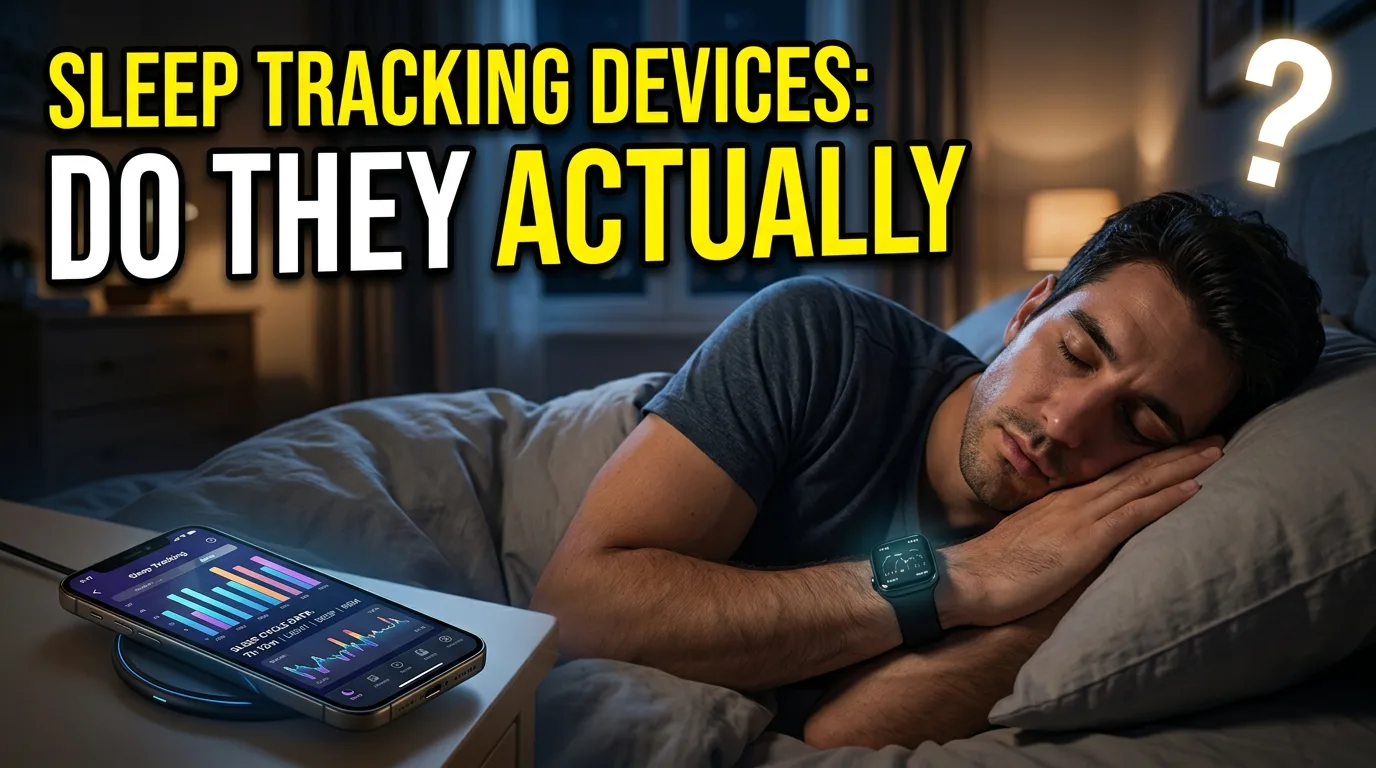
Smart rings, fitness watches, and under-mattress sensors have turned sleep from something you simply experience into something you get a nightly report card on: a sleep score, a breakdown of light, deep, and REM sleep, a “readiness” number, and a graph of every time you supposedly stirred. It’s a genuinely appealing idea: objective data about something as invisible as your own sleep. But how accurate are these consumer sleep trackers, really, compared to the gold-standard test used in sleep medicine? The honest answer is more nuanced than either the marketing (“clinical-grade accuracy”) or the skepticism (“it’s all guesswork”) suggests. This guide walks through how sleep trackers actually estimate sleep, what the validation research shows they’re good at versus unreliable for, and a newer concern researchers call orthosomnia, when obsessing over sleep tracker data starts to hurt the very sleep it’s supposed to help.
Quick answer: do sleep tracking devices actually work?
Partly, and it depends on what you’re asking them to measure. Consumer sleep trackers, wearables, rings, and bedside sensors tend to be reasonably good at estimating total sleep time and general bedtime/wake patterns compared to actigraphy and, in many validation studies, compared to polysomnography (the clinical overnight test that records brain waves, eye movement, and muscle activity). Where they’re considerably less reliable is sleep staging: breaking your night down into light, deep, and REM sleep, and detecting brief periods of wakefulness. Validation studies consistently find larger errors in these categories, particularly for wake detection. Trackers are a reasonable tool for spotting broad trends in your sleep over weeks and months; they are not a diagnostic instrument, they can’t detect sleep apnea or other disorders reliably, and for some people, checking sleep scores obsessively can itself become a source of sleep-disrupting anxiety, a pattern researchers have started calling orthosomnia.
How sleep trackers actually estimate your sleep
Almost every consumer sleep tracker, whether it’s a wrist-worn fitness band, a smart ring, or a smartwatch, relies primarily on the same core sensor technology: an accelerometer to detect movement (a method called actigraphy) combined with a photoplethysmography (PPG) sensor that shines light into your skin to estimate heart rate and heart rate variability. Some devices add skin temperature and blood oxygen sensors. From that combination of movement and physiological signals, an algorithm infers when you likely fell asleep, when you woke up, and, using changes in heart rate variability and movement patterns, makes a statistical guess at which broad sleep stage you were probably in during each interval.
This is fundamentally different from how sleep is actually defined and measured clinically. Polysomnography, the gold-standard test conducted in a sleep lab, directly measures brain wave activity via EEG, along with eye movement and muscle tone, which is what real sleep-stage boundaries are defined by in sleep medicine. A wearable never sees your brain waves; it’s making an educated, statistically modeled inference from movement and heart signals that merely correlate with sleep stages. That gap between what’s directly measured and what’s inferred is the source of almost every accuracy limitation discussed below.
What validation research actually shows
Several published studies have directly compared popular consumer sleep trackers against polysomnography or research-grade actigraphy in controlled settings. The overall pattern that emerges is consistent across most of this research.
Total sleep time: generally decent
For the relatively simple question of “about how long did I sleep,” most modern consumer trackers perform reasonably well. One multicenter validation study testing 11 different wearable, nearable, and “airable” consumer sleep trackers found that nearly every device could estimate total sleep time comparably to research-grade actigraphy, with mean absolute percentage errors in roughly the 5–14% range depending on the device. That’s not perfect, but it’s in a genuinely useful ballpark for tracking whether you’re getting roughly seven hours a night or roughly five.
Sleep stage breakdowns: considerably less reliable
Accuracy drops noticeably once you look at the light/deep/REM breakdown that most sleep apps proudly display. In the same line of validation research, error rates for light and deep sleep estimates commonly land in the range of roughly 19–27%, and REM sleep estimates tend to be moderately to poorly accurate as well, often overestimated. Wake detection, correctly identifying the brief periods you were actually awake during the night, was consistently the worst-performing category across devices, with error rates in some studies ranging from roughly 59% up to well over 100%, meaning trackers can dramatically over- or under-count how much you were actually awake. Researchers have also documented a pattern of “proportional bias,” where devices tend to overestimate short durations of a given stage and underestimate long ones, which further undermines the reliability of any single night’s detailed stage breakdown.
What this means in practice
Put simply: if your tracker tells you that you slept 7 hours and 10 minutes last night, that number is probably in the right neighborhood. If it tells you that you got exactly 1 hour and 42 minutes of deep sleep and 38 minutes of REM sleep, treat that level of precision skeptically; the underlying measurement technology isn’t built to support that level of granularity on a single night, even though the app presents it with total confidence. Trends over weeks (is your average total sleep time going up or down; is your bedtime drifting later) tend to be more trustworthy than any single night’s detailed stage chart.
Are some sleep trackers more accurate than others?
Yes, accuracy varies meaningfully by device and even by generation of the same product, since companies continually update their algorithms. Wrist-worn wearables (fitness bands and smartwatches) and finger-worn rings tend to perform similarly to each other in most head-to-head validation research, since they rely on similar underlying sensors. Bedside and under-mattress sensors (sometimes called “nearables”) use a different approach, tracking movement and sometimes breathing or heart rate through the mattress or a bedside unit rather than a body-worn sensor, and have shown mixed results, sometimes performing worse on total sleep time than wrist-worn devices in comparative studies, though this varies by product and study. Because algorithms are proprietary and frequently updated, and because most published validation studies test specific models at a specific point in time, it’s more useful to think in terms of the whole category’s limitations (good at duration, weak at staging and wake detection) than to assume any single specific device or brand has definitively solved the sleep-staging problem.
Types of consumer sleep trackers
Sleep tracking hardware generally falls into a few categories, each with a slightly different sensor approach and trade-offs.
| Type | How it senses sleep | Typical trade-offs |
|---|---|---|
| Wrist-worn wearables (fitness bands, smartwatches) | Wrist accelerometer plus PPG heart rate sensor | Widely validated; accuracy can be affected by fit, skin tone, and wrist movement unrelated to sleep |
| Smart rings | Finger-based PPG sensor plus motion sensor | Often more comfortable overnight than a watch; similar underlying accuracy profile to wrist wearables |
| Bedside and under-mattress sensors | Ballistocardiography or radar/motion sensing through the mattress, no body contact | No device to wear, but can be less accurate at distinguishing your movement from a partner’s or a pet’s |
| Smartphone apps (using the phone’s microphone or accelerometer on the mattress) | Sound and vibration analysis | No extra hardware cost, but generally the least validated and most easily disrupted by a shared bed |
What can throw off your tracker’s accuracy
Beyond the inherent limits of inferring sleep from movement and heart signals, several everyday factors can make a device’s readings even less reliable on a given night:

- A loose or improper fit. A watch or ring that’s too loose can produce unreliable heart rate and movement readings, throwing off both sleep-onset detection and stage estimates.
- Alcohol. Alcohol changes heart rate variability patterns overnight, which can distort algorithm-based sleep stage estimates independent of how you actually slept.
- Sharing a bed. Bedside and under-mattress sensors in particular can have difficulty separating your movement and breathing from a partner’s or a pet’s.
- Irregular heart rhythms or certain medications. Since many devices lean heavily on heart rate variability to infer sleep stage, anything that affects your heart rhythm can reduce the reliability of stage estimates.
- Being awake but still in bed. Lying still while awake, reading, or scrolling your phone in bed can sometimes be misread as light sleep, since stillness is one of the main signals these devices rely on.
Orthosomnia: when tracking your sleep starts hurting it
Beyond the technical accuracy question, there’s a behavioral one that sleep clinicians have increasingly flagged: for some people, obsessively monitoring sleep tracker data can itself become a source of sleep problems. The term for this, orthosomnia, was introduced in a 2017 case study published in the Journal of Clinical Sleep Medicine by researchers at Rush University Medical College and Northwestern University’s Feinberg School of Medicine, who described patients who had become so fixated on “perfecting” their sleep tracker numbers that the anxiety of chasing a better score was itself keeping them awake.
In the original case reports, some patients spent excessive time in bed specifically trying to improve their tracked sleep metrics, which paradoxically worsened their actual sleep. Their concern about the data, not a classic underlying sleep complaint, was what kept them awake. This connects directly back to the accuracy limitations above: because tracker-reported sleep stages and wake counts carry meaningful error, a person anxiously reacting to a “bad” deep sleep number or a high number of reported awakenings may be responding to statistical noise as much as to any real change in their sleep.
Orthosomnia isn’t a formal clinical diagnosis, but it’s a recognized and increasingly discussed pattern as sleep tracking has become mainstream. If checking your sleep score has become a daily source of stress, if you find yourself in bed longer than you need to be purely to try to improve a number, or if a “bad” sleep score makes you feel more tired than you did before you checked it, that’s worth treating as a sign to change your relationship with the data, not a sign to buy a more precise device.
How to use a sleep tracker in a way that actually helps
- Focus on trends, not single nights. A week-over-week or month-over-month average of total sleep time and bedtime consistency is far more meaningful than any one night’s detailed breakdown.
- Treat sleep stage percentages as rough estimates, not facts. Given the documented error rates for light, deep, and REM sleep, a night-to-night change in these numbers is more likely to reflect measurement noise than a real change in your sleep architecture.
- Use it to notice patterns tied to your habits – for example, whether your reported sleep tends to look different on days you exercised, drank alcohol, or had caffeine late, rather than chasing an abstract “perfect” score.
- Don’t let the score dictate your mood or your day. If a low sleep score makes you feel unnecessarily anxious or fatigued, it’s reasonable to check it less often, or not at all, and rely instead on how you actually feel.
- Don’t use it to self-diagnose a sleep disorder. A tracker cannot reliably detect conditions like sleep apnea, and irregular or poor tracked sleep should prompt a conversation with a doctor rather than a home diagnosis.
- Remember it isn’t polysomnography. If you have a genuine, persistent sleep complaint, a home sleep test or an in-lab sleep study ordered by a doctor is a fundamentally different, clinically validated tool, not a more expensive version of your ring or watch.
What sleep trackers are genuinely useful for
None of this means sleep trackers are useless; it means they’re useful for a narrower purpose than the marketing implies. They’re a reasonable, low-effort way to notice whether your total sleep time is consistently falling short of what you need, whether your bed and wake times are drifting or inconsistent, and whether certain lifestyle changes (a new exercise routine, cutting late caffeine, adjusting your bedroom temperature) seem to correlate with better-reported sleep over time. Some people also find the accountability of a visible daily habit motivating in the same way a step counter can encourage more walking, independent of whether every underlying number is perfectly precise. Used this way, as a rough, directional signal rather than a clinical readout, a sleep tracker can be a genuinely helpful part of a broader sleep hygiene routine.
When to see a doctor instead of relying on your tracker
A consumer sleep tracker is a wellness aid, not a diagnostic medical device, and it isn’t designed or validated to identify sleep disorders. If you consistently feel exhausted during the day regardless of what your tracker reports, if you or a partner notice loud snoring, gasping, or pauses in breathing during sleep, if you’re regularly struggling to fall or stay asleep, or if your tracked sleep data is itself becoming a source of significant stress, those are all reasons to talk to a doctor or sleep specialist rather than trying to solve the problem through the app. A clinical evaluation, which may include a home sleep apnea test or an in-lab polysomnography study, can assess things a consumer tracker fundamentally cannot.
Frequently asked questions
Are smart rings like Oura more accurate than smartwatches like Fitbit or Apple Watch for sleep?
In most published validation research, rings and wrist-worn wearables show broadly similar strengths and weaknesses, since they rely on comparable underlying sensors (movement plus heart rate/heart rate variability via light-based sensors). Neither category has been shown to reliably solve the sleep-staging accuracy gap compared to polysomnography. Individual models and software versions vary and are updated frequently, so it’s more useful to expect the same general pattern, decent total sleep time, less reliable stage and wake detection, from any consumer device rather than assuming one brand has cracked clinical-grade accuracy.
Can a sleep tracker detect sleep apnea?
Some consumer devices now offer features that flag possible breathing disturbances or estimate blood oxygen trends, and these can sometimes surface a helpful early signal. However, none of these consumer tools are a substitute for a proper sleep apnea evaluation, which typically involves a home sleep apnea test or an in-lab polysomnography study interpreted by a clinician. If your tracker flags a concerning pattern, or if you or a partner notice snoring, gasping, or breathing pauses during sleep, the appropriate next step is a doctor’s evaluation, not relying on the tracker’s own interpretation.
Why does my tracker say I got very little deep sleep when I feel fine?
This is a common experience, and it’s largely explained by the accuracy limitations discussed above: validation studies have found error rates of roughly 20% or more for deep sleep estimates specifically, since consumer devices are inferring sleep stage from movement and heart signals rather than directly measuring brain waves. A single night’s deep sleep number carries meaningful uncertainty, so a low reading on a night you otherwise feel rested is more likely to reflect measurement error than an actual problem; how you feel is a legitimate data point too, not something the tracker overrides.
What is orthosomnia?
Orthosomnia describes a pattern where a person becomes so preoccupied with achieving “good” sleep tracker numbers that the resulting anxiety itself disrupts their sleep. The term was introduced in a 2017 case study from Rush University Medical College and Northwestern University’s Feinberg School of Medicine, describing patients whose fixation on their tracker data was worsening their sleep more than any underlying sleep problem. It’s a useful reminder to treat tracker data as a rough guide rather than a strict target to chase every single night.
Should I trust my sleep score?
A composite “sleep score” is typically a proprietary blend of total sleep time, estimated sleep stages, and sometimes heart rate variability or movement data, each carrying its own measurement uncertainty. It’s reasonable to use a sleep score as a loose, directional signal, is this week trending better or worse than last week, but not as a precise, clinically meaningful number to obsess over night to night. If checking your score is adding stress rather than useful insight, that’s a sign to check it less often rather than a sign something is medically wrong.
Do sleep trackers get more accurate over time as the technology improves?
Manufacturers do continually update their sensors and algorithms, and total-sleep-time accuracy in particular has generally been solid for several years across most mainstream devices. However, the core limitation for sleep-stage and wake detection is partly structural: wearables infer sleep stages from movement and heart signals rather than directly measuring the brain activity that clinically defines those stages. Meaningful improvement is possible and ongoing, but as of the most recent published validation research, sleep staging and wake detection remain notably less reliable than total sleep time estimates across the consumer device category as a whole.







Leave a Reply