Sleep & Wellness
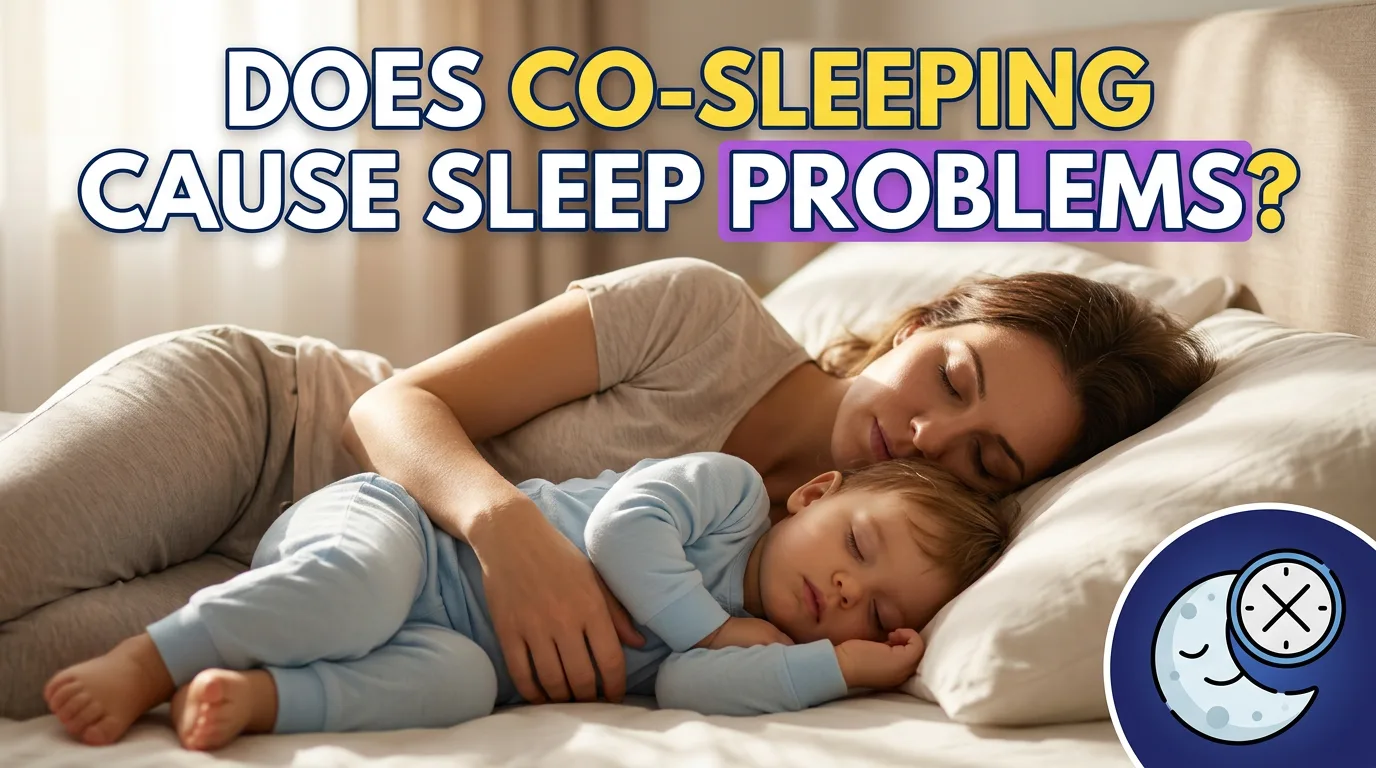
Depending on which survey you read, somewhere between 40 and 90 percent of families with young children end up sharing a bed or a room with a child at some point, whether that was the plan or not. For some households it’s an intentional choice rooted in culture, breastfeeding logistics, or a simple preference for closeness at night. For others it’s what happens after the third 2 a.m. wake-up, when carrying a crying toddler back to their own room again starts to feel less like parenting and more like an endurance event. Either way, once co-sleeping becomes routine, a familiar question tends to follow: is this arrangement actually working, or is everyone just quietly exhausted? This guide is not about whether bed-sharing is medically safe for infants, that’s a distinct question with clear guidance from pediatric authorities, covered in full in our guide to Sleep Problems in Infants: What’s Normal and What’s Not. This one is about something different: what sharing sleep space does to the quality of sleep parents and children actually get, how that plays out across cultures where co-sleeping is simply normal family life, and what to weigh if you’re the parent lying awake wondering whether the setup that once felt right is now the reason nobody in the house is well-rested.
Quick Answer
Co-sleeping, whether that means bed-sharing or simply room-sharing, reliably fragments sleep for both parents and children, though it doesn’t necessarily shrink total sleep time as much as people assume. Overnight monitoring studies have found that bed-sharing parents and infants wake each other more often and spend more time in lighter sleep stages than solitary sleepers, even when their total hours logged look similar. For children, that same pattern of frequent partial wakings, combined with learning to associate falling asleep with a parent’s presence, can make the eventual move to independent sleep more effortful later on. None of this makes co-sleeping a mistake: it’s the normal, majority practice across much of the world, including in India, and plenty of families report that it works well for them. It’s mainly worth reconsidering when a parent is chronically and seriously sleep-deprived, or when a child who is developmentally ready to sleep independently still can’t settle without a parent present in a way that’s genuinely straining the household.
What “co-sleeping” actually covers
“Co-sleeping” gets used loosely, but sleep researchers generally split it into two arrangements. Room-sharing means a child sleeps on their own separate surface, a crib, bassinet, or floor bed, inside a parent’s room. Bed-sharing means a child sleeps on the same surface as a parent, whether that’s a bed, a couch, or a shared mattress. The distinction matters enormously for infant safety, since bed-sharing with a baby under 12 months carries documented suffocation and overlay risks that room-sharing does not, which is exactly why the American Academy of Pediatrics recommends room-sharing without bed-sharing for at least the first six months and ideally the first year. It matters less for the sleep-quality questions this guide focuses on, since both arrangements can fragment sleep once a child is mobile enough to kick, wake, or simply be aware of a parent nearby. If you’re trying to sort out whether your baby’s current sleep setup and waking pattern is medically normal or worth flagging to a pediatrician, that groundwork, including the full AAP and NICHD safe-sleep checklist, is covered in Sleep Problems in Infants: What’s Normal and What’s Not rather than repeated here. What follows assumes you’ve made peace with the safety side already, or are co-sleeping now, and want to understand what it’s doing to everyone’s actual sleep.
How co-sleeping affects parents’ sleep quality
Ask a co-sleeping parent whether they slept well, and the honest answer is often “sort of.” That vague answer turns out to reflect something real and measurable, not just anecdote.

More arousals, not necessarily less sleep
Some of the most-cited overnight sleep-lab research on this topic, led by biological anthropologist James McKenna and colleagues, monitored bed-sharing and solitary-sleeping mother-infant pairs and found a consistent pattern: bed-sharing pairs woke and briefly aroused each other far more often across the night than pairs sleeping apart. A parent sharing a bed with a young child is registering every squirm, kick, and repositioning at some level, and the body responds with brief arousals even when the parent doesn’t fully wake or remember it by morning. Notably, that research also found bed-sharing didn’t necessarily shrink total sleep time by much; instead, it shifted the composition of the night toward more, shorter interruptions and more time in lighter sleep stages, with less consolidated deep sleep. That distinction explains a pattern many co-sleeping parents recognize: technically logging seven or eight hours “in bed asleep” while still waking up feeling like they barely slept, since fragmented sleep, even at a normal total duration, doesn’t restore the body and brain the way consolidated sleep does.
Physical disruption and the cumulative toll
Beyond that lab-documented arousal pattern, there’s a more mundane physical reality: sharing a mattress with a small, frequently moving person means less usable space, more temperature swings, and a much higher chance of being kicked or woken by a child talking in their sleep. Parents often sleep in a more rigid, cautious position to avoid disturbing a bed-sharing child, which limits the natural repositioning that supports comfortable rest. None of that is dangerous on its own, but it compounds over months or years into a baseline of lower-quality sleep that’s easy to normalize simply because it’s been the routine for so long. Recent American Academy of Sleep Medicine survey data found that roughly 46 percent of parents report co-sleeping with a child under 18 at least sometimes, and a 2025 integrative review of parental experiences with shared sleep found that many families slide into the arrangement unintentionally, driven by exhaustion and being unprepared for how demanding infant sleep actually is, rather than choosing it deliberately from the start. That distinction, chosen versus drifted-into, tends to predict how parents feel about it: an arrangement a couple actively wants feels sustainable, while one that happened by accident and never got revisited tends to breed quiet resentment and worsening fatigue.
How co-sleeping affects children’s sleep quality
The sleep-quality picture for children who co-sleep mirrors the parental one in some ways and diverges in others.

Children wake more too, but recover differently
Children who bed-share also experience more nighttime arousals than solitary sleepers, for many of the same reasons: a parent’s movement, breathing, and body heat register even in sleep. Babies and toddlers naturally cycle between lighter and deeper sleep stages roughly every 45 to 60 minutes, so brief awakenings at those transitions are normal for every child, co-sleeping or not; what differs is what happens next. A child used to falling asleep independently often self-settles within those brief arousals without ever fully waking. A child whose falling-asleep routine involves a parent’s presence, whether physical contact or simply the parent being audibly there, is more likely to fully wake and vocalize when that condition isn’t immediately available at 2 a.m., even in the same bed. This is the same mechanism covered in How to Stop Contact Naps and Improve Baby Sleep, just playing out overnight instead of at nap time: children learn to fall asleep the way they’re used to falling asleep, and that condition becomes what they look for at every sleep-cycle transition.
The independent-sleep skill gets less practice
This is the part of the sleep-quality conversation most specific to co-sleeping: a child who consistently falls asleep next to a parent gets fewer nightly opportunities to practice falling asleep without one. That’s not a character flaw, it’s simply how associative learning works. It only becomes a practical problem once independent sleep is developmentally expected and desired, whether because a parent needs their bed back, a sibling is arriving, or the child would benefit from resettling solo during the wake-ups that happen at every age. Families working through a child’s inability to sleep through the night, co-sleeping or not, will likely recognize the pattern in Why Is My Child Not Sleeping Through the Night?, since sleep associations, of which a co-sleeping habit is one common example, are among the most frequent underlying causes.
It isn’t universally worse, and context matters
It would be inaccurate to frame this as proof that co-sleeping is simply bad for children’s sleep. Much of the disrupted-sleep research comes from samples where solitary sleep is the cultural default and co-sleeping is adopted reactively, mid-crisis, rather than planned for from birth with the right setup. Families and cultures where co-sleeping is the expected norm from day one, with a floor bed or a larger shared mattress built into the plan, often report far less of the friction described above, partly because the household’s expectations and routines are built around it rather than fighting a mismatch. The sleep-quality cost of co-sleeping is real, but it isn’t fixed; how much it disrupts a given family depends heavily on setup, consistency, and whether everyone involved actually wants the arrangement.
Co-sleeping is the global norm, not the exception
It’s worth stating plainly, because so much English-language parenting content treats independent infant sleep as the obvious default: solitary infant and child sleep is, historically and globally, the unusual arrangement, not the other way around. Anthropological and cross-cultural research suggests that roughly two-thirds of the world’s population practices some form of co-sleeping, and estimates for many Asian countries, including India, Japan, and China, put the share of families who co-sleep in some form at somewhere between 60 and 90 percent. In much of India specifically, sharing a bed or a room with young children has never been treated as a discrete parenting “method” requiring justification, it’s simply what family sleeping arrangements have looked like for generations, shaped by joint-family living spaces, the practical convenience of nighttime breastfeeding, and a cultural framing of nighttime closeness as ordinary caregiving rather than a developmental risk.
This context matters for how families should read the sleep-quality research above. Studies documenting more fragmented sleep for bed-sharing parents and children describe a real physiological pattern, not a moral failing, and that pattern shows up across cultures where co-sleeping is the norm just as it does where it’s the exception. But the emotional experience of co-sleeping is shaped heavily by whether it’s treated as a normal, expected part of family life or as something to defend, hide, or apologize for. Research comparing parents in co-sleeping cultures with those in cultures where solitary infant sleep is the unquestioned default has found lower rates of maternal distress and social criticism tied to the sleeping arrangement itself among the former. That doesn’t change the physical mechanics of shared sleep, arousals are arousals, but it means the guilt that sometimes piles on top of ordinary sleep fragmentation is largely a cultural add-on, not an unavoidable feature of co-sleeping itself. If you’re raising a family where co-sleeping is simply how it’s done, the trade-offs here are worth understanding on their own terms, not as evidence the underlying choice was wrong.
Practical guidance if your family chooses to co-sleep
If co-sleeping is the right fit for your family, whether by culture, preference, or circumstance, there’s a meaningful amount you can do to reduce the sleep-quality cost without abandoning the arrangement. A few evidence-informed adjustments tend to help the most:

- Get the physical setup right first. A larger sleep surface and, for infants under one, the safe bed-sharing precautions detailed in Sleep Problems in Infants: What’s Normal and What’s Not reduce both safety risk and the physical crowding that drives much of the nighttime disruption.
- Give each sleeper their own bedding. Separate blankets and pillows cut down on the tugging and repositioning that fragment sleep for everyone on a shared surface.
- Keep a consistent bedtime routine regardless of where sleep happens. A predictable wind-down, bath, book, dim lights, helps a child’s body settle faster even when the sleep surface is shared.
- Build in some independent settling practice, even within a shared room. A child who falls asleep on their own side of a bed, rather than only in physical contact with a parent, tends to self-resettle more easily overnight. The gradual approach in How to Stop Contact Naps and Improve Baby Sleep applies here too.
- Address snoring or restlessness directly. If a parent or child is a notably disruptive sleeper, treat that on its own merits rather than assuming co-sleeping itself is the entire problem.
- Get both partners genuinely on board. An arrangement one partner merely tolerates tends to breed resentment. If this is live tension in your household, When You and Your Partner Disagree About Sleep works through resolving it rather than letting it simmer.
- Protect some individual sleep time if you can. Occasionally sleeping apart, or alternating who sleeps with the child, prevents the chronic sleep debt described above from concentrating on one person.
When a co-sleeping arrangement might be worth reconsidering
Co-sleeping doesn’t have an expiration date, and plenty of families sustain it happily for years without it causing any real problem. That said, a few specific patterns are worth treating as a genuine signal to reconsider or adjust the arrangement, rather than something to push through indefinitely.
- Chronic, severe parental sleep deprivation. If a parent has run on badly fragmented sleep for months, with noticeable effects on mood, health, or safety at work or driving, that’s a real cost worth weighing against the setup’s benefits, not something to accept as unavoidable.
- A child who is developmentally ready for independent sleep but genuinely can’t manage it. There’s a real difference between a young child who still benefits from co-sleeping and an older child who is distressed or unable to manage sleepovers or ordinary nights apart because independent sleep has never been practiced. If your child’s inability to settle alone is limiting their own life, Why Is My Child Not Sleeping Through the Night? is a good place to start untangling which sleep associations are driving it.
- The arrangement is a source of ongoing conflict rather than a shared choice. If co-sleeping continues mainly because it’s easier than the fight required to change it, that’s worth naming directly rather than letting it quietly erode the relationship.
- A new safety concern arises. A new sibling, a change in a parent’s health or medication, or an infant entering the picture are good reasons to revisit the safe-sleep specifics in Sleep Problems in Infants: What’s Normal and What’s Not, since bed-sharing safety calculus changes with age and household composition.
None of these signals mean co-sleeping was a mistake up to that point. They’re simply indicators that the arrangement that fit your family a year or two ago may not fit it anymore, which is a completely normal thing for a family routine to outgrow.
If you decide to make a change
If you do decide the arrangement needs to shift, the approach differs by age, but the underlying principle is the same throughout: consistency beats intensity. For infants and younger toddlers, that means every sleep period, naps included, happens in the intended independent space rather than sending mixed signals, with the transition taking anywhere from several nights to a few weeks depending on how gradual an approach you choose. For toddlers and preschoolers, involving the child in the change, building an affectionate bedtime routine, and staying consistent about walking them back to their own bed rather than folding after a few hard nights tends to work better than an abrupt switch. For school-age children who have co-slept for years, acknowledge that you’re asking them to break a long-standing habit, offer a comfort object, and rule out an underlying anxiety issue with a pediatrician if the resistance is extreme. At every age, expect some regression as normal, not a sign the plan is failing, and revisit How to Stop Contact Naps and Improve Baby Sleep or Why Is My Child Not Sleeping Through the Night? for the more granular mechanics of building independent sleep skills.
Frequently Asked Questions
Does co-sleeping actually ruin your sleep?
Not necessarily in terms of total hours, but it reliably makes sleep more fragmented for both parents and children, with more brief arousals and less consolidated deep sleep than solitary sleeping. Whether that translates into feeling “ruined” the next day depends a lot on how disruptive a given child or partner is as a bed-mate, how the sleep space is set up, and how long the pattern has gone on for.
Is it bad for a child to co-sleep with parents?
It isn’t inherently bad, and it’s the majority practice across much of the world. The main sleep-related trade-off is that children who consistently fall asleep next to a parent get less practice falling asleep independently, which can make the eventual transition to solo sleep, whenever a family chooses to make it, somewhat more effortful. That’s a manageable trade-off, not evidence of harm, for most families.
At what age should co-sleeping stop?
There’s no medically mandated cutoff age for room-sharing or bed-sharing with an older, mobile child; the American Academy of Pediatrics’ specific safe-sleep timeline (room-sharing without bed-sharing) applies to infants under 12 months for SIDS-risk reasons. Beyond infancy, the decision is a family one, and plenty of cultures continue co-sleeping arrangements well into childhood without issue. It’s worth reconsidering when it’s no longer something the whole family wants, or when a child’s inability to sleep independently is limiting their own life.
Is co-sleeping normal in Indian culture?
Yes. Co-sleeping and room-sharing with young children are longstanding, common practices across much of India and many other Asian countries, shaped by joint-family living arrangements, breastfeeding convenience, and a cultural view of nighttime closeness as ordinary caregiving rather than a parenting choice that needs special justification. Framing it as inherently wrong or as a Western-style parenting failure doesn’t match either the global prevalence data or the cultural context it exists within.
Why does my toddler wake up more when co-sleeping?
Toddlers naturally cycle through lighter and deeper sleep stages roughly every 45 to 60 minutes, with brief arousals at each transition. A toddler used to falling asleep with a parent nearby is more likely to fully wake and seek that same condition again at each of those transitions overnight, compared with a toddler who has practiced falling asleep independently and can typically resettle without fully waking.
Can co-sleeping cause problems between partners?
It can, particularly when the arrangement was never a genuinely shared decision, or when it significantly reduces a couple’s time and space together. Research specifically looking at co-sleeping arrangements and marital or co-parenting satisfaction has found mixed results overall, some couples report real strain, especially around intimacy, while others report no meaningful effect once other stressors are accounted for, which suggests the impact has more to do with whether both partners actually agree with the arrangement than with sharing a bed with a child in itself.
This guide covers general sleep-quality patterns and is not a substitute for individualized medical advice. For infant safe-sleep guidance specifically, including when bed-sharing carries elevated risk, see Sleep Problems in Infants: What’s Normal and What’s Not and talk to your pediatrician about what’s appropriate for your child’s age and health.
References
- The Natural Child Project – Bedtime Story: James McKenna’s Co-Sleeping Research
- American Academy of Sleep Medicine – New Data Reveals That Half of Parents Co-Sleep With Their Child
- Frontiers in Public Health – Beyond the Rules: An Integrative Review of Parental Perspectives on Safer Infant Sleep in Shared Environments
- The Better India – Co-Sleeping: Why India’s Parenting Tradition Is Going Global
- American Academy of Pediatrics – Evidence Base for 2022 Updated Recommendations for a Safe Infant Sleeping Environment
- Motherly – Research Shows Co-Sleeping Won’t Ruin Your Marriage





Leave a Reply