
Credit Cards
“Easiest credit card to get” is one of the most-searched credit card phrases there is, and for good reason, if you have a low credit score, no credit history at all, or a modest income, getting rejected once is often enough to make you stop applying entirely. The good news is that “easy approval” isn’t a myth or a scam category. It’s a real, well-defined set of card types built specifically for approval rather than rejection, and understanding how they work is the fastest way to actually get one.
This guide walks through exactly which categories of cards approve people with bad credit, thin files, or low income, what a realistic credit limit looks like at each stage, and how to check your odds before you apply and rack up an unnecessary hard inquiry.
Quick answer: what’s the easiest credit card to get approved for?
For most people with bad credit, no credit history, or low income, a secured credit card is the single most reliable approval path, because a refundable cash deposit, not your credit score — is what the issuer relies on. Below that, store or retail credit cards and cards specifically marketed for “fair” or “building” credit approve more freely than general-purpose bank cards, though usually with a smaller limit and a higher APR. If you have no credit history at all rather than bad credit, becoming an authorized user on a trusted person’s well-managed account, or taking out a credit-builder loan, can establish a file before you ever apply for a card of your own. None of these approve “instantly” in a legally guaranteed sense, but online applications for secured and starter cards commonly deliver a decision within a minute or two.
Why some cards approve so much more easily than others
Every credit card issuer is pricing risk. A traditional unsecured card with no deposit and a large credit line is a real financial risk to the bank if you don’t repay, so approval leans heavily on your credit score and income. Issuers reduce that same risk in a few different ways, and each way creates a different “easy approval” category:

- Collateral instead of credit history – a secured card’s deposit removes most of the issuer’s downside, so the approval bar drops dramatically.
- Higher pricing instead of stricter screening – store and retail cards often approve a wider range of applicants because they charge meaningfully higher interest to offset the added risk. A CFPB analysis of retail credit cards found that roughly 90% of retail cards carried a maximum APR above 30%, compared to a much smaller share of general-purpose cards, and that approval rates for applicants with scores in the 620–720 range ran about 20 percentage points higher on retail cards than on general-purpose cards.
- Smaller credit lines instead of large ones – a $300–$500 starter limit caps the issuer’s exposure even if you default.
- No credit check at all – becoming an authorized user, or a credit-builder loan structured as savings-first, sidesteps traditional underwriting entirely.
What credit score do you actually need?
FICO Scores run from 300 to 850 and break into five commonly used bands: below 580 is “poor,” 580–669 is “fair,” 670–739 is “good,” 740–799 is “very good,” and 800+ is “exceptional.” Here’s what’s realistic at each level:
| Credit score range | Realistic card category |
|---|---|
| No score / no history (“credit invisible”) | Secured card, authorized user, or credit-builder loan |
| Below 580 (“poor,” including around 500) | Secured card is by far the most reliable option; some subprime unsecured cards exist but often carry fees that make a secured card the better deal |
| 580–669 (“fair”) | Store/retail cards, cards marketed for “fair credit” or “building credit,” secured cards |
| 670+ (“good” and above) | Most mainstream unsecured cards, including no-annual-fee options |
If your score is around 500, a secured card is genuinely the most dependable route, the deposit does the underwriting work that your score can’t, so approval odds are high as long as you can supply the funds. This is also the most direct answer to “what credit card will accept a 500 credit score”: look at secured cards first, not general unsecured “bad credit” cards, several of which charge steep account-opening fees that eat into the credit line before you’ve spent a dollar.
Secured cards: the most dependable approval path
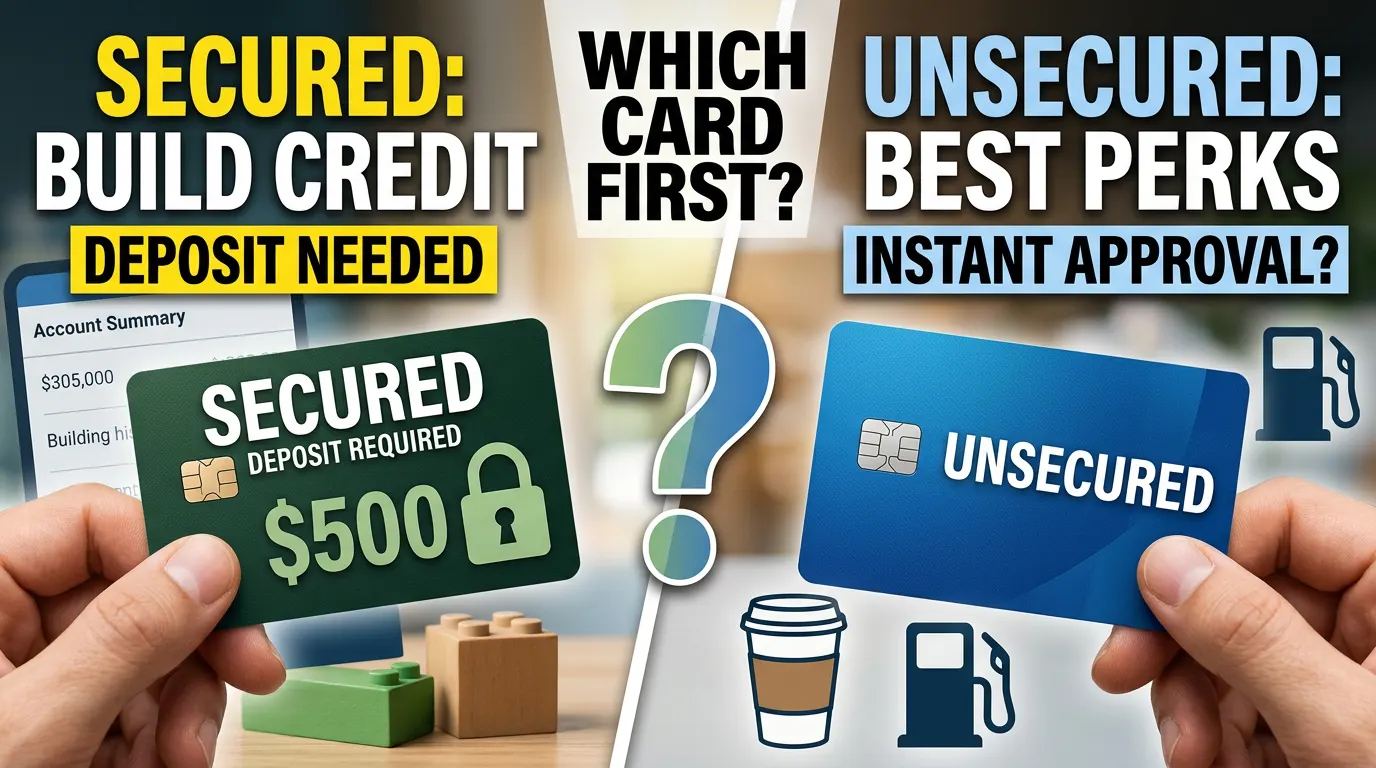
A secured card requires a refundable security deposit, which typically becomes your credit limit, put down $300 and you generally get a $300 limit, though a few issuers allow a limit modestly above the deposit. The deposit is held as collateral and is returned when you close the account in good standing or when the issuer upgrades you to an unsecured card, provided your balance is paid off. Because approval is based on your ability to fund the deposit rather than a credit check alone, secured cards are the backbone of nearly every “easiest card to get” list, and they report to all three major credit bureaus exactly like unsecured cards, the deposit only affects how the card is funded, not how it’s reported. We cover the full mechanics, pros, and cons in Secured vs. Unsecured Credit Cards: Which Should You Get First?
Watch for fees on “guaranteed approval” unsecured cards
A category of unsecured cards markets itself directly at bad-credit applicants without requiring a deposit. Some are perfectly reasonable starter products; others carry an account-opening fee, a program fee, and a monthly maintenance fee that can consume a large share of an already-small credit limit before you’ve made a single purchase. Because these fees are usually charged to the card itself, they can also push your utilization ratio uncomfortably high right out of the gate, which works against the exact goal, building credit, that you’re applying for the card to accomplish. Before accepting one of these offers, add up every disclosed fee for the first year and compare that total cost against simply funding a secured card deposit of the same size; in most cases, the secured card is both cheaper and easier to be approved for.
Store and retail cards: easier, but read the fine print
Retail cards, issued in partnership between a bank and a specific store or chain, are often the easiest unsecured cards to qualify for, precisely because the issuer accepts more risk in exchange for a captive customer relationship and much higher pricing. That trade-off matters: a store card can be a reasonable stepping stone, but it’s rarely the cheapest way to carry a balance, and limits tend to be small. For a full comparison of when a store card makes sense versus a major bank card, see Store Credit Cards vs. Major Bank Credit Cards: Which Is Actually Better?
No credit history at all? You’re not automatically “bad credit”
Having no credit history is a different problem from having bad credit, even though both often get rejected for similar reasons. The CFPB estimates that around 26 million American adults are “credit invisible,” meaning they have no file at any of the three nationwide credit bureaus, and millions more have a file too thin to generate a score. If that’s your situation, a secured card still works, but so do two other approaches that don’t require a deposit at all:

- Authorized user status: Being added to a family member’s or partner’s account with a strong payment history can add that account’s history to your own credit file, with no application or income requirement on your part. It works best when the primary cardholder keeps a low balance and never misses a payment, a late payment on their end can hurt your file too.
- Credit-builder loans: Offered by many credit unions and community banks, these small installment loans hold your “borrowed” funds in a locked account while you make payments, then release the money to you once the loan is paid off. You never touch the funds until the end, but every on-time payment is reported, building payment history from zero.
Can you get approved “instantly”?
Many online applications for secured and starter cards do return a decision, approved, denied, or “pending review”, within a minute or two of submitting the form, which is where the idea of “instant approval” comes from. That said, no card can legally guarantee approval before reviewing your application, and a “pending” result simply means the issuer needs to verify something (usually income or identity) before deciding. If you want to gauge your odds without a hard inquiry, use a prequalification or preapproval tool where available: these rely on a soft credit check, which the CFPB confirms does not affect your credit score, unlike a full application, which triggers a hard inquiry that can cause a small, temporary dip.
Can you get a $1,000 credit limit with bad credit?
It’s possible, but the path matters. With a secured card, a $1,000 limit is achievable simply by funding a $1,000 deposit, assuming the issuer allows deposits at that level, this is the most direct route to a four-figure limit regardless of your score. With an unsecured starter or store card, a $1,000 starting limit is less common with a low score; many bad-credit unsecured cards open with a limit in the low hundreds and increase over time with on-time payments. If a specific limit matters more to you than which type of card you get, a secured card gives you the most control over the outcome.
Credit unions: an underused approval path
Credit unions are member-owned, not-for-profit institutions, and that structure often translates into more flexible underwriting than a large national bank offers. Many credit unions issue their own secured and starter credit cards with lower fees and more willingness to manually review an application that an automated system might reject, a real person looks at your specific situation rather than a strict score cutoff. Joining is usually easy: many credit unions have broad membership eligibility based on where you live, work, or a small one-time donation to an affiliated nonprofit. If you’ve been denied by a large bank, a local credit union is one of the most overlooked next steps, and it’s often where credit-builder loans are offered as well.
A realistic step-by-step approach
- Pull your free credit reports at AnnualCreditReport.com to confirm your actual score range and check for errors before applying.
- Use prequalification tools wherever offered, since they use a soft inquiry and won’t ding your score while you compare options.
- Start with a secured card if your score is below 580 or you have no file at all, it’s the highest-odds approval path bar none.
- Consider a store card if you have fair credit and shop at that retailer regularly, understanding the APR tradeoff.
- Ask a trusted family member about authorized-user status if you’d rather not apply for anything yourself yet.
- Apply for one card at a time. Multiple hard inquiries in a short window can itself become a reason for denial, which is covered in Why Your Credit Card Application Got Denied.
Frequently asked questions
What credit card will accept a 500 credit score?
A secured credit card is the most reliable option at a 500 score, since approval is based mainly on your ability to fund a refundable deposit rather than your score alone. Some unsecured “bad credit” cards exist at this range too, but they often carry high fees that make a secured card the better value.
What is the quickest credit card to get?
Online applications for secured cards and starter unsecured cards typically return a decision within a minute or two. No card can guarantee instant approval before reviewing your application, but these categories have the fastest typical turnaround and the highest approval odds for limited credit.
Which credit cards approve you instantly?
No issuer can legally promise guaranteed approval, but secured cards and many store or retail cards offer the fastest online decisions and the highest approval odds for applicants with limited or damaged credit.
Can I get a $1,000 credit card with bad credit?
Yes, most directly through a secured card, where funding a $1,000 refundable deposit typically results in a $1,000 credit limit regardless of your score. Reaching a $1,000 limit on an unsecured bad-credit card is less common right away and usually happens gradually with on-time payments.
What is the easiest card to get with bad credit?
A secured credit card is generally the easiest to get approved for with bad credit, since the deposit serves as collateral in place of a strong credit history. Store cards and cards specifically marketed for fair or rebuilding credit are the next-easiest unsecured options.
How do I get a credit card if no one will approve me?
If you’ve been denied for unsecured cards, apply for a secured card instead, ask a family member with good credit to add you as an authorized user, or look into a credit-builder loan from a credit union. All three build a positive payment history that improves your odds for an unsecured card later.
References
- CFPB – Issue Spotlight: The High Cost of Retail Credit Cards
- CFPB – Report Finds 26 Million Consumers Are Credit Invisible
- myFICO – What Is a Credit Score?
- Experian – How Secured Credit Card Deposits Work
- CFPB – What Is a Credit Inquiry?
- Experian – Will Being an Authorized User Help My Credit?
Related Guides
- Secured vs. Unsecured Credit Cards: Which Should You Get First?
- Can You Get a Credit Card Without a Job? Approval Requirements Explained
- Why Your Credit Card Application Got Denied (and How to Fix It)
- Store Credit Cards vs. Major Bank Credit Cards: Which Is Actually Better?
- How Credit Cards Affect Your Credit Score (and How Long Building Credit Really Takes)
- How to Choose the Right Credit Card for Your Lifestyle: A Complete Checklist




Leave a Reply