Fish & Aquariums
A friend once asked me to “just watch” her three guppies for two weeks. I came back to twenty. Nobody warns you about this clearly enough before you buy guppies, they’re hardy, colorful, genuinely great beginner fish, and they will absolutely fill your tank if you keep both sexes together and don’t plan for it.
Quick answer
Guppies do well in a tank of 10 gallons or more, kept in small groups (a ratio of roughly 2-3 females per male keeps aggression on any one female down), in water around 74-82°F (23-28°C), they need a heater in most climates. They’re livebearers, meaning females give birth to free-swimming fry rather than laying eggs, which is the single fact that explains most of what makes guppy-keeping different from egg-laying community fish. They’re not fussy about water hardness or pH within a normal range, eat almost anything, and are one of the easier community fish for a first tank. The one thing to plan for deliberately: females that have been near a male are essentially always pregnant, and will keep having fry roughly monthly unless you separate the sexes or accept the population growth.
Where guppies come from, and why they’re livebearers
Guppies (Poecilia reticulata) are native to freshwater streams, ponds, and coastal waters across Venezuela, Trinidad, and parts of the northern coast of South America, where they live in warm, often nutrient-rich, variable water, sometimes brackish near river mouths, sometimes crowded into shallow pools that heat up and cool down with the weather. That background is why guppies tolerate such a wide range of home aquarium conditions better than most freshwater fish: they evolved dealing with change, not stability.
Guppies belong to the family Poeciliidae, the livebearers, along with mollies, platies, and swordtails. Unlike egg-laying fish, a female guppy is fertilized internally and carries developing embryos until they’re born as small, fully-formed, free-swimming fry, no eggs, no nest, no parental incubation period. A single mating can fertilize a female for several broods in a row because she stores sperm internally, which is exactly why a female that’s had any contact with a male keeps producing fry for months afterward even if you remove every male from the tank immediately. Understanding this is the key to managing guppy population, and it’s covered in more detail in the breeding section below.

Fin types and color strains
Wild guppies are fairly plain, but decades of selective breeding for the aquarium trade have produced an enormous range of tail shapes and color patterns, almost entirely in males, since females are bred more for body size and brood health than for fins and color. Knowing the common names helps when you’re shopping, since store labels rarely explain what they mean.
Common tail types
- Delta/fantail: a wide, triangular tail that fans out, one of the most common types sold as a general-purpose “fancy guppy.”
- Veil tail: a long, flowing, pointed tail with a distinctly draped look.
- Lyretail: the top and bottom tail rays extend outward and curve, giving a lyre-shaped silhouette.
- Swordtail (guppy swordtail, not to be confused with the separate swordtail species): one or two extended points trailing off the tail’s edge.
- Round tail: closer to the wild-type shape, a simple rounded fin, hardier and more agile than the heavily finned show varieties.
Common color strains
Breeders have named dozens of color and pattern combinations, but a few show up constantly in pet stores: cobra (a fine, snakeskin-like body pattern), tuxedo (a dark band across the rear half of the body contrasting with a lighter front half), moscow (a solid, often metallic, deep color across the whole body), grass (fine speckled patterning across the tail), and mosaic (large, irregular blotches of color across the tail). None of this affects care requirements; it’s purely selective breeding for appearance; but heavily finned show strains do tend to be a little more delicate and slightly less agile swimmers than plainer, hardier feeder-strain guppies, which is worth factoring in if you’re choosing tankmates or a strongly flowing filter.
Tank setup basics
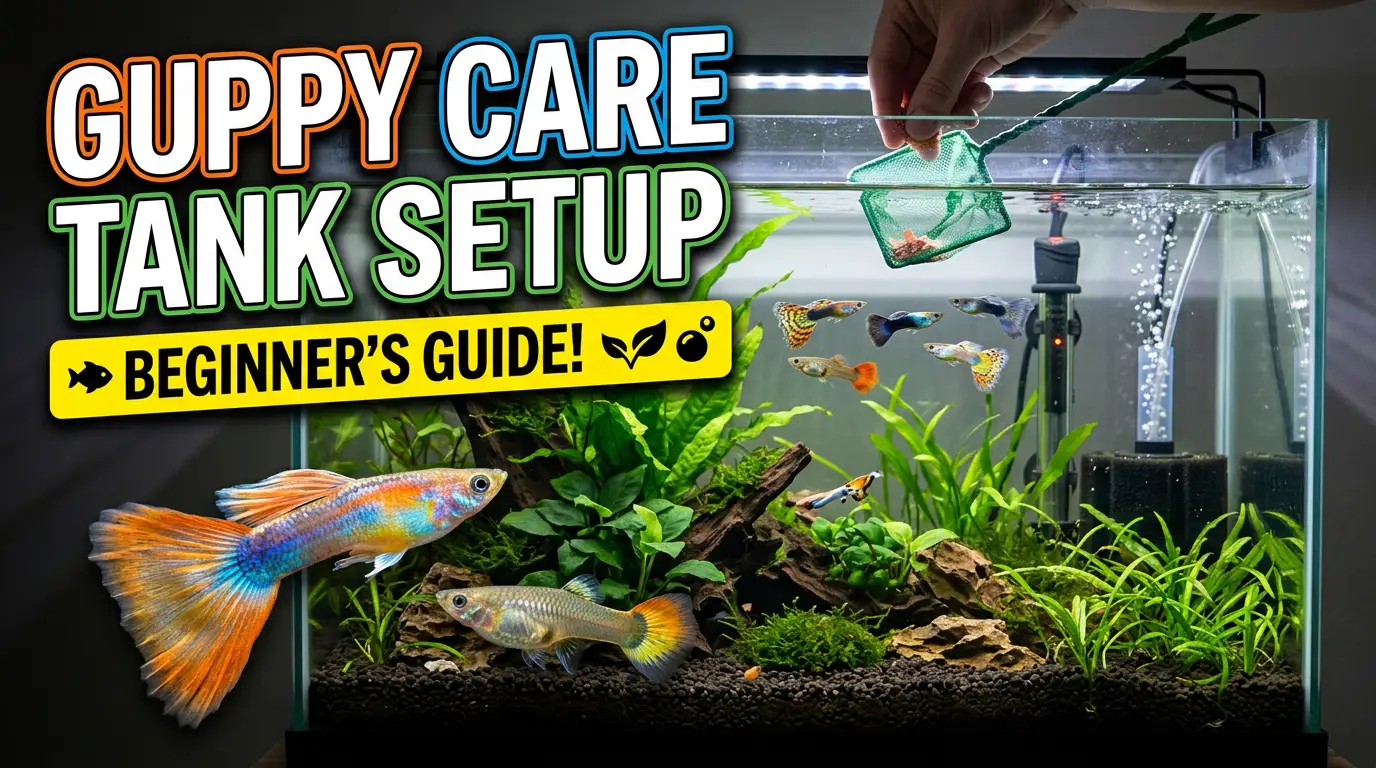
- Tank size: 10 gallons minimum for a small group, more if you’re planning to let them breed and want fry to survive
- Heater: yes, in most homes, guppies are tropical fish and need stable warmth; see my heater guide for sizing
- Filter: a gentle flow matters more than raw power; guppies and especially fry are weak swimmers, so a sponge filter or a filter outflow with reduced flow is often better than a strong canister output
- Plants: dense, low plants like java moss or floating plants give fry somewhere to hide from adults, which matters if you’re not trying to prevent breeding entirely
- Water surface: a tight-fitting lid isn’t as critical as with jumpier fish, but guppies can and occasionally do jump, especially when startled, so a lid with minimal gaps is still worth having
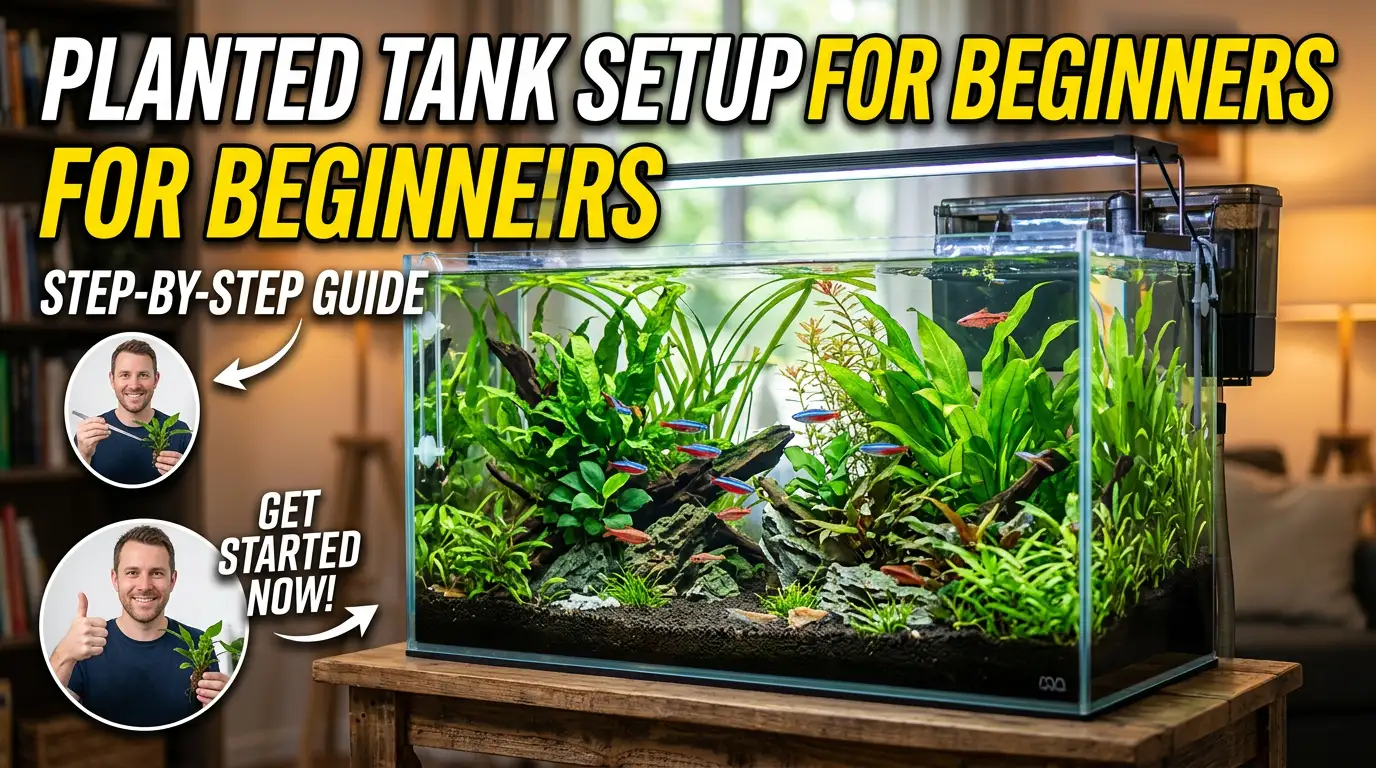
Set the tank up and fully cycle it before adding guppies, same as any fish; they’re hardy once established, but not immune to ammonia and nitrite in an uncycled tank. My beginner setup guide walks through the whole process from empty tank to cycled and ready to stock.

Water parameters
Guppies are one of the more forgiving community fish on water chemistry, but a few numbers are still worth knowing, especially if you plan to breed them intentionally.
| Parameter | Target range | Why it matters |
|---|---|---|
| Temperature | 74-82°F (23-28°C) | Guppies are tropical fish; cooler water slows metabolism, digestion, and breeding, and weakens immune response over time |
| pH | 7.0-8.0 | Guppies generally do best in neutral to slightly alkaline water, unlike many soft-water tetras, though they adapt to a wider range without major issues |
| General hardness (GH) | Moderate to hard | Guppies tolerate harder water well and often show better health and coloration in it than in very soft water |
| Ammonia / Nitrite | 0 ppm | As with any fish, any detectable reading means the tank isn’t fully cycled or is overstocked/overfed |
| Nitrate | Under 20-40 ppm | Guppies tolerate nitrate reasonably well compared to more sensitive species, but sustained high levels still stress fish and fry over time |
Feeding
Guppies aren’t picky; a quality tropical flake or small pellet as a base, with occasional live or frozen food (brine shrimp, daphnia) for extra color and conditioning, especially if you’re breeding them intentionally. Feed small amounts once or twice a day; like most fish, overfeeding is a bigger risk than underfeeding.
A few feeding details worth knowing beyond the basics: guppies graze on algae and biofilm naturally, so a tank with some established growth on the glass or decor supplements their diet even when you’re not actively feeding. If you’re conditioning a pair for breeding, a few days of extra protein-rich food (live or frozen brine shrimp or daphnia) before introducing them tends to encourage healthier, larger broods. And if you’re raising fry, they need much smaller, more frequent meals than adults; crushed flake, powdered fry food, or baby brine shrimp fed 3-4 times a day supports faster, healthier growth than trying to feed fry the same schedule as adults.
Breeding biology: what actually happens
A female guppy’s gestation period runs roughly 21-30 days from fertilization to birth, and she can carry multiple broods from a single mating thanks to internal sperm storage, so isolating her from males doesn’t guarantee her next birth is the last one. As she nears the end of a pregnancy, a dark, roughly triangular patch called the “gravid spot” near the base of her tail darkens and enlarges, a genuinely useful visual signal that birth is close, usually within a few days once it’s very dark and the belly looks squared-off rather than round.
Birth itself happens over a period of minutes to a couple of hours, with fry released one at a time, fully formed and able to swim and feed immediately; there’s no larval stage and no parental care afterward. A single brood typically ranges from a handful of fry up to 50 or more in a large, well-fed female, and broods tend to get larger as a female matures. Immediately after birth, adult guppies, including the mother, will eat fry given the chance, which is instinctive rather than a sign of a “bad” parent; it’s simply how the species has always operated in the wild, where fry that can’t quickly find cover don’t survive regardless of what the parents do.

Managing the breeding question
| If you want… | Do this |
|---|---|
| No breeding at all | Keep a single-sex group (all male, or all female) — male-only groups are the more common choice since males have the more vibrant colors and tails |
| Controlled breeding | Keep a low male-to-female ratio, expect fry regularly, and either rehome extras or add more tank space over time |
| Fry to actually survive | Add dense plant cover or a breeder box/separate nursery tank — adult guppies, including the parents, will eat fry in an open tank |
| To stop an unplanned population boom | Separate sexes immediately, but remember a previously exposed female can still give birth to one or more further broods from stored sperm before the population truly levels off |
Tankmates
Guppies are peaceful, community-friendly fish that do well with a wide range of similarly calm species, as long as tankmates aren’t aggressive fin-nippers or large enough to see guppies and their fry as food.
| Generally compatible | Usually a bad idea |
|---|---|
| Corydoras catfish and other peaceful bottom-dwellers | Fin-nipping species (tiger barbs, some tetras) that target long-finned male guppies |
| Other livebearers — mollies, platies (similar water needs, though they can interbreed with guppies in some cases) | Larger cichlids or other predatory fish that will eat adult guppies |
| Peaceful small tetras and rasboras | Aggressive or territorial bettas, though many individual bettas do fine with guppies |
| Nerite or mystery snails | Any fish requiring cold water, since guppies need consistent warmth |
| Cherry shrimp, in a tank with enough plant cover for shrimplets to hide | A tank without an intentional plan for fry, if population control matters to you |
Common health problems
Guppies are hardy, but a handful of issues come up often enough to be worth recognizing early, since most guppy illness is manageable if caught quickly.
Fin rot
Fin rot shows up as ragged, discolored, or receding fin edges, most common on the long-finned male strains and usually linked to poor water quality, fin-nipping tankmates, or physical damage from sharp decor. Improving water quality with more frequent water changes resolves early cases; more advanced infections may need an aquarium-safe antibacterial treatment.
Ich (white spot disease)
Small white spots resembling grains of salt across the body and fins, often paired with flicking against decor, point to ich, one of the most common freshwater parasites. Gradually raising the temperature (which speeds the parasite’s life cycle so treatment can catch it) alongside an ich-specific medication and consistent water changes clears most cases.
Guppy disease / bent spine
A curved or “bent” spine, sometimes paired with lethargy and weight loss, is often associated with a bacterial condition sometimes called “guppy disease” in the hobby, though it can have several underlying causes including poor water quality, genetics from inbred stock, or bacterial infection. There’s no single reliable home treatment once the spine has visibly curved, so prevention through good water quality and buying from healthy, well-kept stock matters more than trying to cure it after the fact.

Frequently asked questions
How do I tell males and females apart?
Males are smaller, more brightly colored, and have a longer, more elaborate tail fin. Females are larger, plainer, and have a rounder body, especially noticeable when pregnant, showing a dark “gravid spot” near the tail end of the belly.
Can guppies live with bettas?
It depends heavily on the individual betta, some tolerate guppies fine, others see the guppies’ flowing tails as a rival and become aggressive. If you try it, have a backup tank ready in case it doesn’t work out, and watch closely for the first few days.
My guppy just had babies, what do I do?
If you want the fry to survive, move them (or the pregnant female, before she gives birth) to a separate container or a heavily planted section of the tank, since adult guppies will eat fry given the chance. If you’re not planning to raise them, it’s fine to let nature take its course, though this does mean the population won’t grow from that batch.
Why does my female guppy keep having babies even with no male in the tank?
Female guppies store sperm internally after mating and can produce several broods from a single fertilization, sometimes over multiple months. If she had any contact with a male before you separated her, additional births can keep happening for a while even with no male currently present.
How many fry does a guppy have at once?
Broods typically range from a handful up to 50 or more fry, generally increasing in size as the female matures and grows larger. Larger, older, well-fed females tend to produce noticeably bigger broods than young or small females.
How long do guppies live?
Typically 2-3 years with good care, sometimes a bit longer. Water quality, temperature stability, and diet are the main factors affecting lifespan, a guppy in a stable, well-maintained tank consistently outlives one in fluctuating or poor conditions.
Do guppies need a heater in a warm climate?
Usually yes, unless ambient room temperature stays reliably within the 74-82°F (23-28°C) range around the clock, including overnight. Most homes see enough temperature drop, especially at night or with air conditioning, that a heater with a reliable thermostat is the safer default.
Guppies are a genuinely good starter fish, just go in knowing what you’re signing up for on the breeding front, and decide on your sex ratio before you buy, not after.



Leave a Reply