Sleep & Wellness
If your doctor has recommended a nighttime sleep study, it’s natural to picture something a little intimidating: a maze of wires, a strange bed, a stranger watching you sleep. The reality is more routine than most people expect, even though it does look unusual from the outside. A nighttime sleep study, formally called polysomnography (PSG), is the gold-standard test in sleep medicine for seeing what’s actually happening in your brain and body while you’re unconscious: how you move through sleep stages, whether your breathing holds steady, how your heart behaves overnight, and whether something is quietly waking you up dozens of times a night without you ever fully realizing it. It’s one of the only medical tests built specifically to study you while you sleep, which is exactly why it looks the way it does sensors everywhere, a technologist keeping watch, and a full night spent in an unfamiliar bed. This guide walks through exactly what happens, from the moment you arrive at a sleep lab to the morning you leave, so there are no surprises.
Quick answer: what happens during a nighttime sleep study?
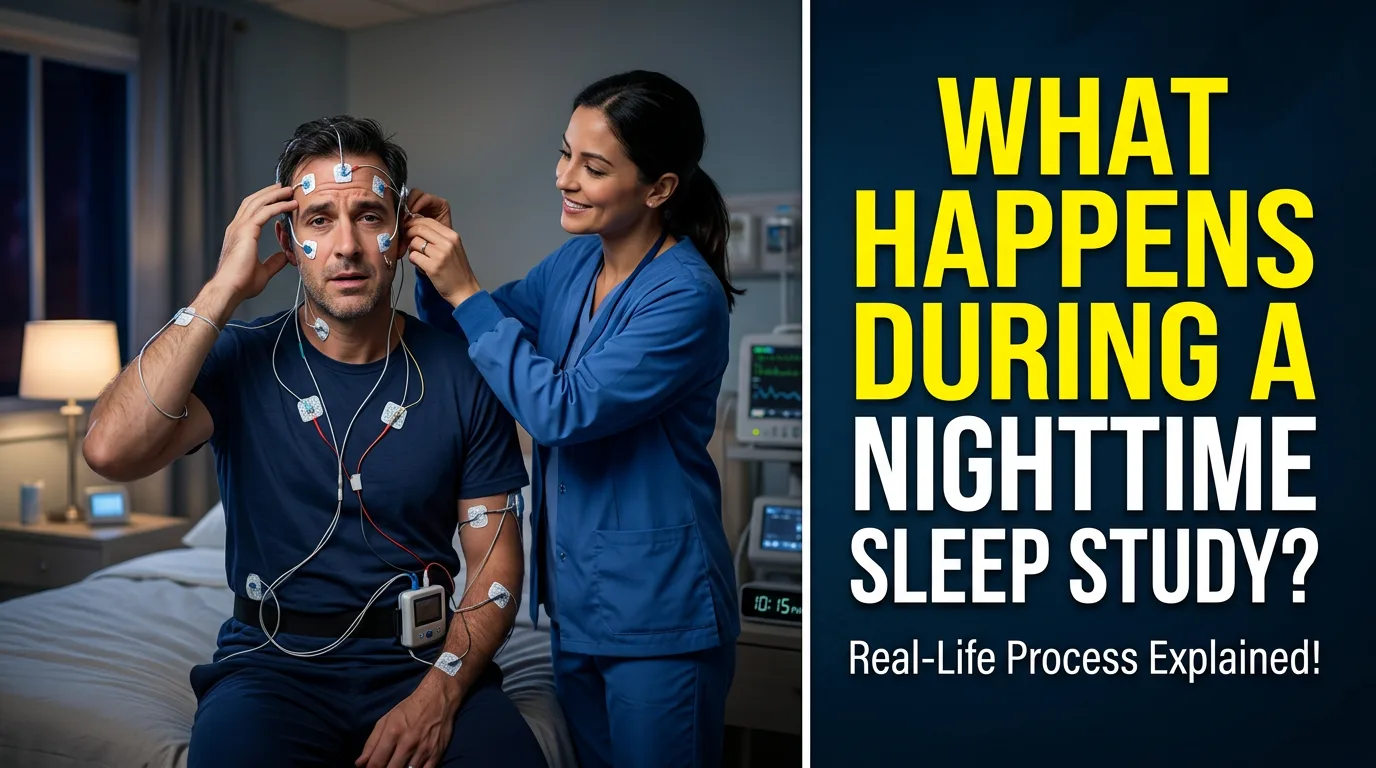
During an in-lab nighttime sleep study (polysomnography), a sleep technologist attaches a set of small, painless sensors to your scalp, face, chest, and legs to record your brain waves, eye movements, muscle activity, heart rhythm, breathing effort, airflow, and blood oxygen levels while you sleep in a private room, typically for about 7 to 9 hours. A technologist monitors the live data feed from a separate room overnight, can step in if a sensor slips or if you need a CPAP mask fitted partway through the night, and in the morning removes all the equipment before a sleep physician scores and interprets the full recording, usually over the following one to two weeks.
Before you arrive: how a nighttime sleep study is set up
A sleep study is ordered by a doctor, usually after a patient reports loud snoring, gasping or choking during sleep, excessive daytime sleepiness, unusual movements at night, or unexplained fatigue despite a full night in bed. It’s typically scheduled at a dedicated sleep center, which might be part of a hospital, a standalone clinic, or occasionally a hotel-style room built specifically for testing. Most sleep centers ask you to avoid caffeine and alcohol for at least 8 hours before your appointment, skip napping on the day of the study, and take your regular prescription medications unless your doctor tells you otherwise. You’re also usually asked to shower beforehand but avoid applying lotions, oils, or heavy hair products afterward, since sensors need to stick directly to clean skin and scalp. Most patients bring their own pajamas, toiletries, a phone charger, something to read, and a change of clothes for the next morning, the goal is to recreate your normal bedtime routine as closely as possible, just in a lab instead of your bedroom.
Checking in: what happens when you arrive at the sleep lab
Most sleep studies begin in the early evening, often somewhere between 7 and 10 p.m., depending on the center’s schedule and your usual bedtime. After check-in, you’re shown to a private room that’s typically designed to feel more like a hotel room than a hospital ward, a real bed, a bathroom, and sometimes a television to help you unwind before the sensors go on. You’ll change into your own sleepwear, and a technologist will go over the process, answer questions, and let you get comfortable before the setup begins. This part of the evening is deliberately unhurried; rushing the setup tends to make people more anxious about the whole experience, so most labs build in plenty of time before lights-out.

The sensors: what gets attached to your body, and why
This is the part people picture most vividly, and it’s worth demystifying. A full polysomnogram uses somewhere between 15 and 25 individual sensors, all attached with a mild adhesive paste, gel, or tape — nothing is inserted under the skin, and the process is not painful, though it can take the technologist 30 to 60 minutes to place everything correctly. Here’s what each group of sensors is actually doing.
Brain wave sensors (EEG)
A handful of small metal-disc electrodes, coated in an electrically conductive gel, are attached to your scalp in specific positions. These pick up the electrical activity of your brain, which is how technologists and physicians determine exactly which sleep stage you’re in at any given moment, light sleep, deep slow-wave sleep, or REM sleep, rather than simply guessing based on how still you look.
Eye movement sensors (EOG)
A couple of adhesive electrodes are placed near the corners of your eyes to track eye movement. Rapid eye movements are one of the defining signatures of REM sleep, so this channel helps confirm what the brain-wave data is already suggesting.
Muscle activity sensors (EMG)
Small sensors are placed under your chin and on each shin. Chin muscle tone drops sharply during REM sleep, which is another marker used to confirm sleep stage, while the leg sensors pick up involuntary limb twitches that can point toward periodic limb movement disorder or restless legs, conditions that can fragment sleep without a person ever fully waking up.
Heart monitoring (ECG/EKG)
A small number of adhesive electrodes on your chest track your heart rate and rhythm throughout the night, since sleep-disordered breathing can cause the heart rate to spike and drop in a distinctive pattern tied to breathing pauses.
Breathing sensors: airflow and effort
A thin cannula sits just under your nose to measure airflow through your nose and mouth, while elastic belts wrap around your chest and abdomen to measure the physical effort of breathing. Together, these two signals are what let a scoring technologist tell the difference between an apnea (breathing stops completely) and a hypopnea (breathing becomes shallow but doesn’t fully stop), a distinction that matters for diagnosing sleep apnea accurately.
Oxygen sensor (pulse oximeter)
A small clip on your fingertip (occasionally an earlobe) uses light to continuously estimate your blood oxygen saturation. Sharp dips in oxygen level, especially ones that line up with breathing pauses, are one of the clearest signs of clinically significant sleep apnea.
A few additional touches round out the setup: a microphone or snore sensor to capture how loudly and how often you snore, a small position sensor to log whether you’re sleeping on your back, side, or stomach (since apnea often gets worse on your back), and a low-light infrared camera in the room so the overnight technologist can see, not just hear, what’s happening. Before you go to sleep, the technologist will typically ask you to do a short “biocalibration”: blink, look left and right, clench your jaw, take a few different types of breaths, and flex your feet, so every channel can be confirmed as working correctly while you’re still awake.
What actually happens while you sleep
Once the lights go out, your job is simply to try to sleep as close to normally as you can, most labs will tell you this directly, because the data is still useful even if you don’t sleep exactly the way you do at home. A wired connection or wireless transmitter sends every sensor’s signal to a monitoring station, usually staffed by a sleep technologist sitting in a separate room down the hall, watching the live data streams and the camera feed simultaneously, often for several patients at once.
How closely are you actually being watched?
Contrary to what people often imagine, a technologist isn’t staring at a live video feed of you all night without interruption. Instead, the system is set up to flag unusual readings, a sensor that’s come loose, an oxygen level that’s dropped, an unusually long pause in breathing, so the technologist can check in, note the event, and intervene only if something needs attention, such as reattaching a sensor that’s slipped off. The audio and video recording exists mainly so that anything unusual (a seizure-like movement, sleepwalking, acting out a dream) can be reviewed and correlated with the sensor data later, not so a stranger can casually watch you sleep.
Bathroom breaks and getting up during the night
You are not stuck in bed all night. If you need to use the bathroom, you can call out or use an intercom, and the technologist will come in, briefly unhook the wires from the central junction box (the sensors themselves usually stay attached to your body), and reconnect everything once you’re back in bed. It adds a short interruption, but it’s a completely normal, expected part of the night and won’t ruin the study.
Split-night studies and CPAP titration
Some nighttime sleep studies are designed as split-night studies. If the first few hours of recording show clear, significant obstructive sleep apnea, the technologist may wake you partway through the night to fit a CPAP (continuous positive airway pressure) mask and spend the second half of the night gradually adjusting the air pressure, a process called CPAP titration, to find a setting that keeps your airway open and resolves the breathing pauses. The goal of a split-night study is to combine diagnosis and initial treatment testing into a single visit rather than requiring you to come back for a separate titration night. Not everyone qualifies for a split-night study; it generally depends on how much sleep apnea shows up in the first portion of the night and how much time remains to properly titrate CPAP pressure afterward.
In-lab studies vs. home sleep apnea tests
Not every sleep study happens in a lab. Home sleep apnea tests (HSATs) use a simplified, portable version of the same idea: a small device you apply yourself at home, typically measuring airflow, breathing effort via chest and abdomen belts, blood oxygen, and sometimes body position and heart rate, with no EEG, EOG, or EMG channels at all. That’s a meaningful trade-off. Because a home test can’t record brain waves, it can’t actually confirm you were asleep, can’t distinguish sleep stages, and can’t diagnose conditions that depend on brain activity, like narcolepsy, periodic limb movement disorder, or REM sleep behavior disorder, it can really only screen for obstructive sleep apnea in a person who is otherwise a good candidate.
For that reason, home sleep tests are generally recommended only for people with a high pretest likelihood of moderate-to-severe obstructive sleep apnea and no other major medical complications, and they’re specifically discouraged for anyone with suspected central sleep apnea, significant heart or lung disease, or a safety-sensitive job like a pilot, commercial driver, or first responder, where an inconclusive negative result carries real stakes. An in-lab, technologist-attended polysomnogram remains the more complete and more accurate test, and it’s still considered the reference standard against which home tests are measured.
The morning after: waking up and sensor removal
Most sleep studies wrap up between 5:30 and 7 a.m., though the exact wake-up time varies by center. A technologist will come in, remove every sensor, and give you a few minutes to wash the adhesive residue and any leftover gel out of your hair and off your skin, bringing a small comb or your own shampoo can make this easier. Unless you’ve also been scheduled for a same-day Multiple Sleep Latency Test (a separate daytime nap study sometimes used to help diagnose narcolepsy or evaluate excessive sleepiness), you’re free to shower, get dressed, eat breakfast, and go about a completely normal day, including driving yourself home in almost all cases.
How sleep study results are read and scored
The night in the lab is really just the data-collection half of the process. Afterward, a credentialed sleep technologist reviews the entire recording in 30-second intervals, called epochs, manually classifying each one as a specific sleep stage and flagging every breathing event, oxygen drop, limb movement, and arousal, following standardized scoring criteria set by the American Academy of Sleep Medicine (AASM). That scored data is then reviewed and formally interpreted by a board-certified sleep physician, who is often (though not always) a pulmonologist, neurologist, or psychiatrist with additional sleep medicine training.
Understanding the apnea-hypopnea index (AHI)
The single number most people hear about after a sleep study is the apnea-hypopnea index, or AHI, the total number of apneas and hypopneas counted, divided by the total hours of actual sleep. In general clinical use, an AHI under 5 events per hour is considered normal, 5 to 15 is classified as mild sleep apnea, 15 to 30 as moderate, and above 30 as severe. AHI isn’t the only number that matters, though; your physician will also weigh how low your oxygen levels dropped, how fragmented your sleep architecture was, your symptoms, and your overall health when deciding on a diagnosis and treatment plan, rather than looking at AHI in isolation.
How long results take
Turnaround time varies by sleep center, but it commonly takes anywhere from a few days to about two weeks for scoring and physician review to be completed. Most centers then schedule a follow-up appointment, in person or by phone, to walk through the results, explain the diagnosis if one is found, and discuss next steps, which might include CPAP therapy, an oral appliance, a referral to another specialist, or, in some cases, reassurance that nothing concerning was found.
Why choosing an accredited sleep center matters
Sleep study quality can vary between facilities, which is part of why the American Academy of Sleep Medicine maintains an accreditation program for sleep centers. An AASM-accredited facility has met specific standards for equipment, staff training, and scoring practices, which is a reasonable thing to check for when your doctor refers you to a particular lab, or when you have a choice between facilities. It doesn’t mean a non-accredited lab can’t do good work, but accreditation is a straightforward, verifiable signal of quality in a field where most patients have no way to judge the technical side of the process themselves.
Frequently asked questions
Is it normal to barely sleep during a sleep study?
Yes, and it’s extremely common. Sleeping in an unfamiliar bed, covered in sensors, in a building full of strangers is understandably harder for a lot of people than sleeping at home, sleep researchers even have a name for the opposite effect, the “first-night effect,” where sleep is often somewhat disrupted the first time you’re monitored in a new environment. The good news is that a sleep study doesn’t require a perfect night’s sleep to be useful. Technologists and physicians are trained to interpret studies with less-than-ideal amounts of sleep, and even a few hours of recorded sleep is often enough to identify significant patterns like repeated breathing pauses or abnormal limb movements. If you’re especially anxious about this, mention it to the sleep center in advance; some patients are offered a short-acting sleep aid that doesn’t meaningfully interfere with the data being collected.
Can I move around or sleep in my normal position during the study?
Yes. Sensor wires are deliberately given enough slack to let you turn over, change position, and sleep the way you normally would, including on your side or stomach. In fact, being able to sleep in your usual position is important, since some sleep apnea is position-dependent and shows up mainly when someone sleeps on their back.
Will I be able to see or hear what’s being recorded?
Not in real time. The raw data streams into the technologist’s monitoring station, not to a screen in your room, and formal scoring and interpretation happen after the study is complete. If you’re curious, it’s completely reasonable to ask your sleep center or physician to walk you through your results and what they mean once the report is ready.
What conditions can a nighttime sleep study actually diagnose?
A full in-lab polysomnogram can help diagnose obstructive and central sleep apnea, periodic limb movement disorder, REM sleep behavior disorder, and other parasomnias, and it can help confirm whether treatments like CPAP are working effectively. Conditions like narcolepsy typically require an additional daytime test, the Multiple Sleep Latency Test, performed the day after the overnight study, since narcolepsy is diagnosed partly by how quickly and how abnormally someone enters REM sleep during scheduled daytime naps.
Do I need to stay overnight, or can a sleep study be done at home?
It depends on what your doctor is trying to rule in or out. If obstructive sleep apnea is the main concern and you don’t have complicating health conditions, a home sleep apnea test may be appropriate and more convenient. If your doctor suspects a broader sleep disorder, needs a highly accurate reading, or your job requires a definitive result, an in-lab, technologist-attended study is generally the more thorough and reliable option.
Is a sleep study painful or dangerous?
No. Every sensor used in a standard polysomnogram is external and attached with adhesive, tape, or a gel paste; nothing is injected, inserted, or invasive. The most common complaints are mild skin irritation from the adhesive or some initial discomfort simply getting used to sleeping with wires attached, both of which typically resolve quickly once the sensors are removed the next morning.
One last thing worth saying plainly: this guide describes the general process of a nighttime sleep study, not medical advice specific to your situation. Every sleep center runs things slightly differently, and only a doctor or an accredited sleep specialist who has reviewed your history and your actual results can tell you what your findings mean and what to do next. If you’re dealing with symptoms like loud snoring, gasping at night, or persistent daytime fatigue, the right next step is a conversation with your doctor or a referral to an accredited sleep center, not a checklist alone.




Leave a Reply