Sleep & Wellness
Search “how much sleep do I need,” and you’ll get a dozen different numbers depending on who’s answering. A wellness influencer might tell you 8 hours is non-negotiable. A wearable app might flag your 40 minutes of deep sleep as a problem. And then there’s the guy who swears he only needs 4 hours a night and seems to function just fine. So what’s actually true? The honest answer is that sleep need is not one-size-fits-all, but it also isn’t a total mystery, decades of research from sleep laboratories, national health surveys, and clinical sleep medicine have produced real, evidence-based ranges for how much sleep people need at every stage of life, and real data on how those numbers hold up in practice.
This guide pulls together the most current, citable sleep-duration research from the CDC, the American Academy of Sleep Medicine (AASM), the Sleep Research Society, and the National Sleep Foundation’s expert consensus panel into one complete chart and explainer. We’ll cover exactly how much sleep is recommended from infancy through older adulthood, whether 6 hours is really “enough,” the viral 10-3-2-1-0 bedtime rule, what actually happens to deep sleep as you age, and how sleep habits differ around the world, including in Japan, one of the most sleep-deprived countries on record. We’ll close with quick, direct answers to the specific questions people search for most.
Quick answer
Most healthy adults (ages 18–64) need at least 7 hours of sleep per night, according to a joint consensus statement from the American Academy of Sleep Medicine and the Sleep Research Society. Sleep needs are higher earlier in life, school-age children need roughly 9–12 hours and teenagers need 8–10 hours, and they level off around 7–9 hours for adults of all ages, including people over 65. Individual variation exists, chronic short sleep (regularly under 6 hours) is linked to measurable health risks for most people, and anyone with ongoing sleep problems should talk to a doctor rather than rely on general averages alone.
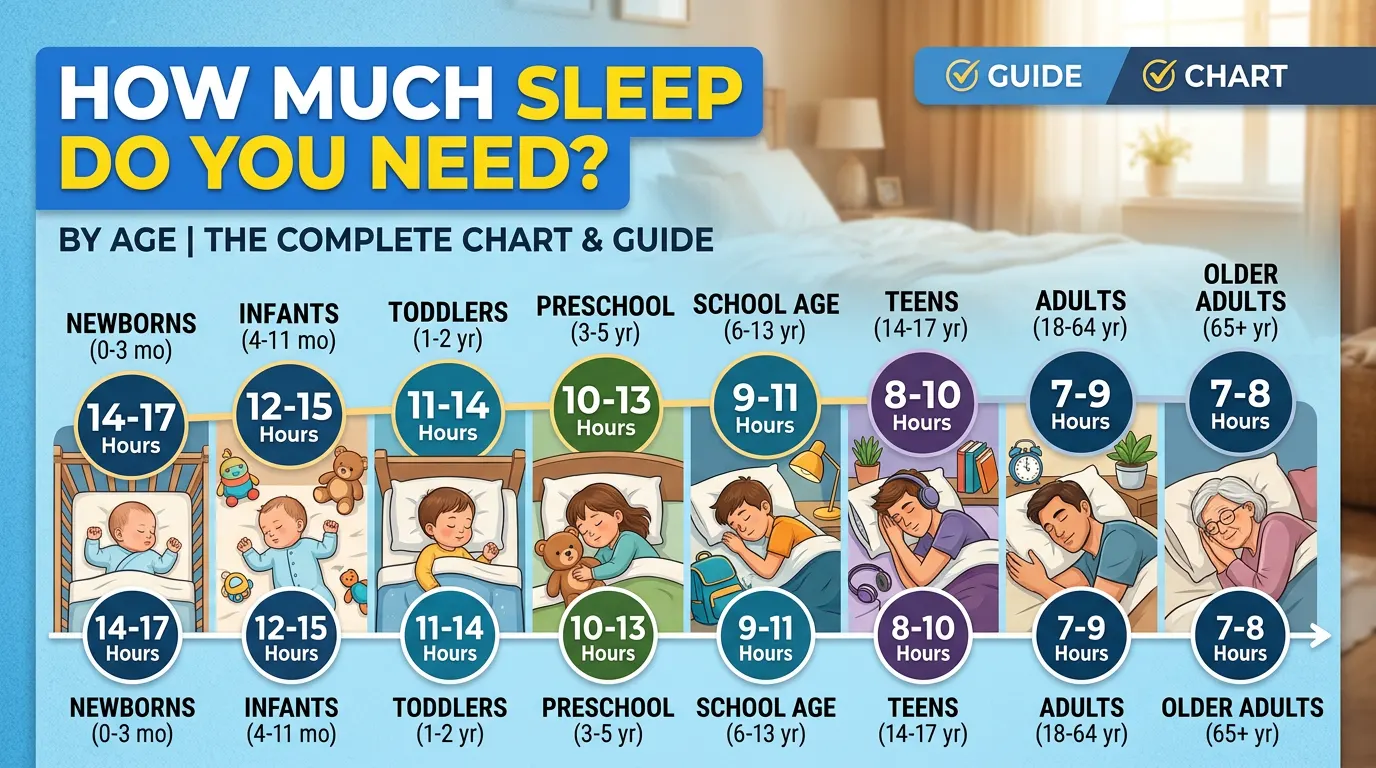
How much sleep do you need by age? The full chart
The most widely cited age-based sleep chart comes from a multidisciplinary expert panel convened by the National Sleep Foundation, which reviewed hundreds of studies and published updated sleep duration recommendations in the journal Sleep Health. Those ranges are still the reference point used by the Sleep Foundation, the AASM, and most major health systems today, including Cleveland Clinic and Mayo Clinic patient education materials. Here’s the full breakdown, from newborns to older adults.
| Age group | Age range | Recommended sleep (per 24 hours) |
|---|---|---|
| Newborn | 0–3 months | 14–17 hours (no official range exists due to limited research, but this is the typical span) |
| Infant | 4–12 months | 12–16 hours, including naps |
| Toddler | 1–2 years | 11–14 hours, including naps |
| Preschool | 3–5 years | 10–13 hours, including naps |
| School-age | 6–12 years | 9–12 hours |
| Teen | 13–18 years | 8–10 hours |
| Adult | 18–64 years | 7–9 hours (7 or more is the minimum health target) |
| Older adult | 65 years and up | 7–8 hours (need doesn’t drop; sleep often becomes lighter and more fragmented) |

A few things stand out in this chart. First, sleep need drops steadily through childhood and adolescence, but it doesn’t keep shrinking forever; it essentially plateaus in adulthood. Second, older adults are not supposed to need dramatically less sleep than younger adults; the common belief that people “need less sleep as they age” is a myth. What actually changes with age is sleep quality and architecture, more on that below, not the underlying biological need for roughly 7–8 hours. Third, for teenagers specifically, the CDC and AASM both note that most high schoolers fall well short of the 8–10 hour target on school nights, largely because of early start times and screen use, which is worth keeping in mind if you’re wondering why a teen in your house seems perpetually tired.
It’s also worth noting what this chart isn’t. It’s a population-level guideline built from averages across large, healthy samples, not a diagnostic cutoff for any one individual. Two adults can both be in good health while naturally sleeping 7 hours and 9 hours respectively, the range exists precisely because normal variation is real. Where the research is much more consistent is at the extremes: consistently sleeping far below the recommended range, at any age, is associated with worse outcomes, while sleeping within the range (even toward the lower end) is generally considered adequate as long as you wake up feeling rested and function well during the day. Daytime sleepiness, difficulty concentrating, and reliance on caffeine to get through the afternoon are more useful personal signals than chasing an exact number on a chart.
Is 6 hours of sleep enough for most adults?
For the large majority of adults, no, 6 hours falls short of the recommended minimum, and it isn’t a small margin. The American Academy of Sleep Medicine and Sleep Research Society’s official position, published in the Journal of Clinical Sleep Medicine, is that adults should sleep 7 or more hours per night on a regular basis to support optimal health, and that “sleeping less than 7 hours per night on a regular basis is associated with adverse health outcomes,” including weight gain, impaired immune function, increased risk of hypertension, diabetes, depression, and cardiovascular disease, along with impaired attention, memory, and next-day performance.
This isn’t a fringe concern. A 2024 CDC data brief, Short Sleep Duration and Sleep Difficulties Among Adults: United States, found that 30.5% of U.S. adults reported sleeping less than 7 hours on average, meaning roughly one in three adults is running below the recommended threshold on a typical day. Earlier CDC surveillance data put the number of affected adults in the tens of millions nationwide, and the agency has flagged insufficient sleep as a public health problem for over a decade, alongside factors like shift work, long commutes, and screen use before bed.
That said, “most people” is doing real work in that sentence. Sleep researchers do recognize a small, genuinely rare group of people sometimes called natural “short sleepers,” whose bodies function well on less sleep than average, in some documented cases linked to specific genetic variants. This is uncommon, and it isn’t something most people can train themselves into by simply cutting sleep and pushing through fatigue, chronic tiredness, reliance on caffeine, and difficulty concentrating are signs that 6 hours isn’t actually working for you, even if you’ve adapted to feeling that way. If you consistently feel exhausted, rely heavily on caffeine or alarms to function, or have trouble staying asleep, it’s worth raising with a doctor rather than assuming 6 hours is your personal norm.
It’s also worth addressing a common shortcut: the idea that you can “catch up” on lost sleep over the weekend. Sleeping in after a short week can reduce sleepiness in the moment, but research on sleep debt suggests it doesn’t fully reverse the metabolic and cognitive effects of a run of short nights, and the resulting irregular schedule can throw off your circadian rhythm, making it harder to fall asleep at a normal time on Sunday night. Consistency, a similar bedtime and wake time most days- tends to matter as much as the raw number of hours, which is part of why sleep specialists generally recommend treating 7-plus hours as a nightly target rather than a weekly average to hit however you can.
A quick note: this article is for general educational purposes and isn’t a substitute for personalized medical advice. Sleep needs vary by individual, health status, and life stage, and anyone dealing with chronic insomnia, loud snoring, or excessive daytime sleepiness should speak with a doctor or a board-certified sleep specialist, since these can sometimes signal an underlying sleep disorder.
The 10-3-2-1-0 sleep rule, explained step by step
The 10-3-2-1-0 rule is a popular, easy-to-remember countdown for winding down before bed. It isn’t an official medical guideline issued by a single health body, but each number reflects sleep-hygiene principles that align closely with advice from the CDC, the Sleep Foundation, and clinical sleep specialists about circadian rhythm, caffeine metabolism, and pre-sleep arousal. Here’s what each number means, working backward from bedtime:
- 10 hours before bed – no more caffeine. Caffeine has a half-life of roughly 3 to 5 hours in most people, meaning it can take up to 10 hours for it to substantially clear your system. A coffee at 4 p.m. can still be measurably affecting your ability to fall asleep at 11 p.m.
- 3 hours before bed – no more food or alcohol. Eating close to bedtime can trigger acid reflux and keeps digestion active when your body is trying to wind down. Alcohol may make you feel drowsy initially, but it fragments sleep later in the night and reduces time spent in restorative deep and REM sleep.
- 2 hours before bed – no more work. Work-related stress and mental stimulation keep cortisol and alertness elevated, making it harder for your brain to downshift into a sleep-ready state.
- 1 hour before bed – no more screens. The blue light from phones, tablets, and laptops can suppress melatonin production and delay your body’s natural signal that it’s time to sleep, on top of the mentally stimulating effect of scrolling or watching something engaging.
- 0 – the number of times you hit snooze. Repeatedly snoozing fragments the last stretch of sleep and can leave you groggier than getting up with the first alarm, a phenomenon related to sleep inertia.
Think of 10-3-2-1-0 less as a rigid law and more as a practical checklist for building a wind-down routine. You don’t need to hit every number perfectly every night to benefit; even shifting your last coffee earlier and putting your phone away 30 minutes before bed tends to make a noticeable difference. If you want a simpler, more condensed version of this approach, our guide to the 3:2:1 sleep rule breaks down a shorter nightly routine built on the same core idea. And since what you drink in the evening matters just as much as what you avoid, our companion guide on drinks that help you sleep better (and what to avoid before bed) pairs well with this rule if you’re rebuilding your evening routine from scratch.
How much deep sleep do you need, and how does it change with age?
Total sleep time is only part of the picture. Within a full night’s sleep, you cycle through stages: light sleep, deep sleep (also called slow-wave sleep, or N3), and REM sleep, repeating in cycles roughly every 90 minutes. Deep sleep is the stage most associated with physical restoration, immune function, and memory consolidation, which is why it gets so much attention from sleep trackers and wearables.
In healthy young adults, deep sleep typically makes up somewhere in the range of 15–25% of total sleep time, or roughly 1 to 1.5 hours across a full night. But this is not a fixed, lifelong number — it’s one of the most well-documented age-related changes in sleep science. A frequently cited meta-analysis by Ohayon and colleagues, published in the journal Sleep, pooled data across dozens of studies to build normative sleep values from childhood through old age and found that slow-wave sleep declines steadily and substantially with age, a pattern later summarized in reviews such as Mander and colleagues’ 2017 article on sleep and aging in Cold Spring Harbor Perspectives in Biology. The decline tends to be gradual through midlife and then more pronounced from the 60s onward, and research consistently finds it happens faster and more severely in men than in women.
Practically, this means an older adult’s brain is not malfunctioning if a sleep tracker reports far less deep sleep than a 25-year-old’s; it’s a well-established, normal feature of aging sleep architecture, not automatically a sign of poor sleep quality. It’s also worth being cautious about the exact deep-sleep numbers wearables report: consumer sleep trackers estimate sleep stages using movement and heart-rate patterns rather than the brain-wave monitoring (EEG) used in clinical sleep studies, so their deep-sleep figures are approximations, not diagnostic measurements. If you’re more curious about disrupted sleep at specific ages or unusual nighttime wake-ups, our guide on what hormone wakes you up at 3 a.m. and how to stop it looks at a related but different piece of the puzzle, why sleep gets interrupted partway through the night rather than how much deep sleep you’re getting overall.
Age isn’t the only factor that shapes how much deep sleep you get on a given night, either. Alcohol, late exercise, high stress, and untreated sleep disorders such as sleep apnea can all suppress slow-wave sleep independent of how old you are, which is one reason two people of the same age can see very different deep-sleep percentages on their trackers. Regular exercise, a consistent sleep schedule, and avoiding alcohol close to bedtime are among the few factors within your control that are associated with more time spent in deep sleep, though they won’t reverse the natural age-related decline described above, they simply help you get closer to whatever your age-typical range looks like.
How sleep duration varies around the world (and why Japan stands out)
Recommended sleep ranges are biological, but actual sleep behavior is heavily shaped by culture, work hours, and commute times, and international time-use data shows real, persistent differences between countries. Using the OECD’s time-use survey data, Japan consistently records the shortest average sleep duration among OECD member countries, at roughly 442 minutes per day, or about 7 hours 22 minutes. That’s noticeably below the United States (around 528 minutes, or 8 hours 48 minutes), France (about 513 minutes), the United Kingdom (around 508 minutes), and several other peer economies, according to figures compiled from the OECD dataset and reported by outlets including Nippon.com’s Japan Data series.

Japanese sleep researchers, including Dr. Masashi Yanagisawa of the University of Tsukuba’s International Institute for Integrative Sleep Medicine, have pointed to long working hours, extended commutes, and cultural norms around late-night work and socializing as key drivers of this gap, and Japanese public health authorities have increasingly treated chronic short sleep as a national productivity and health issue rather than just an individual lifestyle choice. South Korea shows a similar, though less extreme, pattern in the same OECD dataset, at around 471 minutes (roughly 7 hours 51 minutes), reinforcing that this is a broader pattern across parts of East Asia’s work culture rather than a one-country anomaly.
The takeaway isn’t that people in Japan biologically need less sleep than people elsewhere, the age-based recommendations above apply globally, since human sleep physiology doesn’t change by nationality. It’s that structural and cultural factors, from commute length to overtime norms, can push a whole population’s actual sleep well below what’s biologically recommended. That’s a useful reminder for anyone reading a sleep chart: “how much you sleep” and “how much you need” aren’t always the same number, and closing that gap is often more about schedule and environment than willpower alone.
Frequently asked questions
Is 6 hours of sleep enough?
For most adults, no. The American Academy of Sleep Medicine and Sleep Research Society recommend 7 or more hours per night, and research links regularly sleeping less than 7 hours to higher risks of weight gain, high blood pressure, weakened immune function, and impaired concentration. A very small number of people are genuine natural short sleepers who function well on less, but this is rare and shouldn’t be assumed based on simply feeling used to being tired.
What time does Donald Trump go to bed?
There’s no verified public record of a specific bedtime, but Trump has publicly and repeatedly described himself as a short sleeper. In a widely reported 2017 interview covered by ABC News and Good Morning America, he said he typically gets about 4 to 5 hours of sleep a night. This is often cited as a real-world example of a short-sleeper anecdote rather than a documented sleep schedule, and it isn’t a health recommendation; most adults would not function well long-term on that little sleep.
What does the 10-3-2-1-0 sleep rule mean?
It’s a bedtime countdown: no caffeine 10 hours before bed, no food or alcohol 3 hours before, no work 2 hours before, no screens 1 hour before, and 0 hits of the snooze button in the morning. Each step targets a known sleep disruptor: caffeine’s long half-life, digestion and alcohol’s effect on sleep quality, work-related stress, blue light suppressing melatonin, and the grogginess caused by fragmented snooze sleep.
Is 40 minutes of deep sleep per night enough?
It depends heavily on your age and total sleep time, and there’s no single official “minimum minutes” target for deep sleep. Deep sleep naturally declines with age; a healthy older adult may only spend a small percentage of the night in deep sleep compared to a young adult, so 40 minutes could be entirely typical for someone in their 60s or 70s, while it might be on the lower end for a healthy young adult. Because consumer wearables estimate sleep stages rather than measure brain waves directly, their deep-sleep numbers should be treated as rough estimates, not medical readings.
How much deep sleep does a 70-year-old need?
There’s no official minutes-based deep sleep target by age. What research does show, including the Ohayon meta-analysis published in Sleep and later reviews of sleep and aging, is that slow-wave (deep) sleep declines substantially and consistently from young adulthood into the senior years, more sharply in men than in women. For a 70-year-old, noticeably less deep sleep than a 25-year-old is a normal, well-documented part of aging sleep architecture rather than automatically a sign of a sleep disorder; total sleep time and daytime alertness are generally more useful signals of sleep quality at that age than a specific deep-sleep percentage.
How long do Japanese people sleep?
According to OECD time-use survey data, Japan averages about 442 minutes of sleep per day, roughly 7 hours and 22 minutes, the shortest average among OECD member countries, well below the U.S. average of around 8 hours 48 minutes. Researchers, including sleep scientists at the University of Tsukuba, attribute this largely to long working hours, long commutes, and cultural norms around late nights, rather than any difference in how much sleep the human body biologically needs.





Leave a Reply