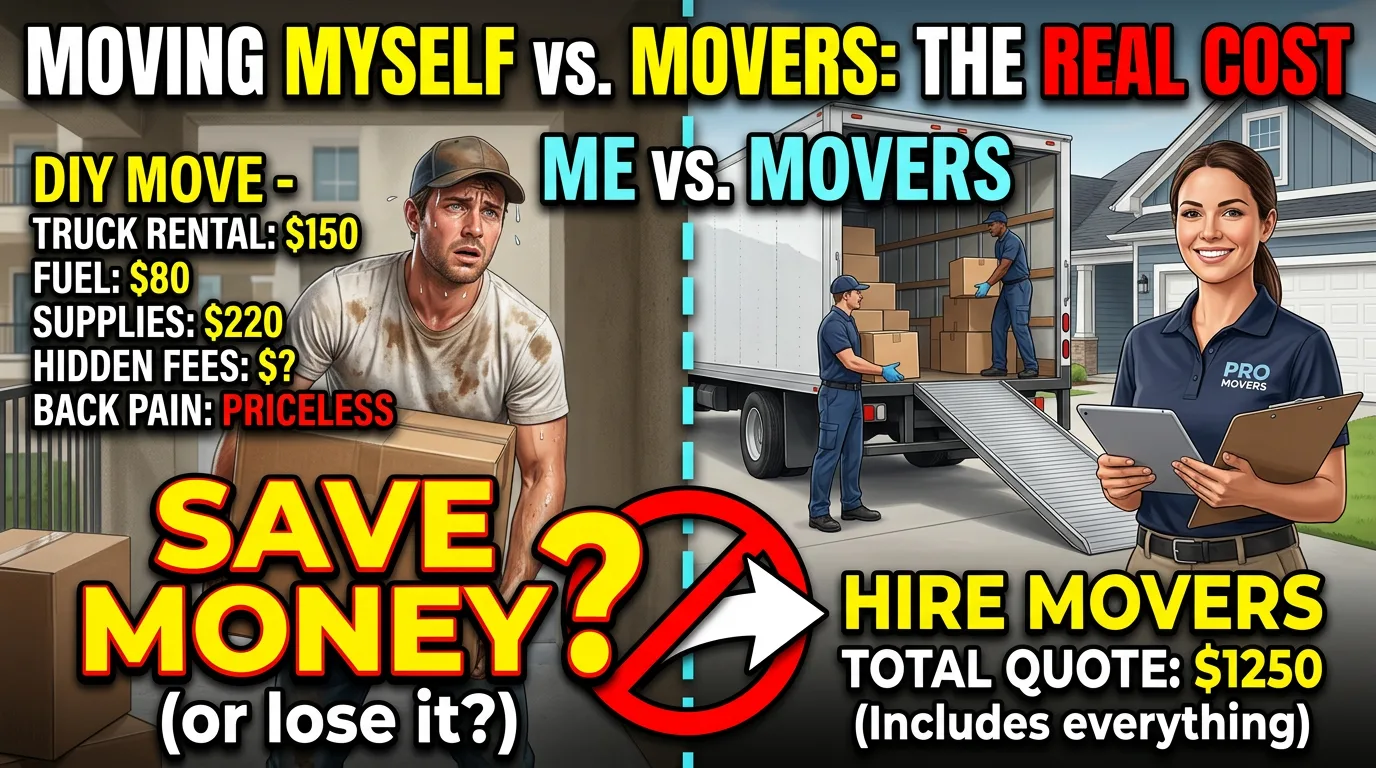
Yes, moving yourself instead of hiring a full-service moving company almost always saves money, often thousands of dollars on a long-distance move. Real 2026 quotes show self-service options running roughly a third to two-thirds of what a comparable full-service move costs, depending on distance and how much stuff you own.
The exact dollar gap depends on which self-service option you pick, truck rental, portable container, or a labor-only hybrid, and how far you’re going. If you haven’t decided which self-service route makes sense for your situation, see the cheapest way to move across the country for a ranked breakdown, or should I hire movers or rent a truck if the decision is about more than just money.
What do full-service movers actually cost?
A long-distance move with a full-service company typically runs anywhere from $1,000 to $25,000, depending on distance, home size, and how much of the work you pay someone else to do. Moves over 2,500 miles commonly land between $5,000 and $25,000 once you factor in the crew’s labor, the truck, and fuel for the whole trip.
That price breaks down into three cost buckets no matter which option you choose: the moving service itself (the biggest line item by far), packing and loading supplies, and your own travel to get there, fuel, lodging, and meals along the way. Self-service options don’t eliminate these buckets; they just shrink the first one dramatically by cutting out professional labor.
Two real quotes that show the actual savings
Numbers are more convincing than percentages, so here are two real 2026 quotes for comparable self-service moves, cited by U-Pack:
| Move | Portable container | Truck rental (incl. est. fuel) |
|---|---|---|
| 1-bedroom apartment, New Hampshire → Washington (~2,500 miles) | ~$3,089 | ~$4,014 |
| 3-bedroom home, Denver → Dallas | ~$2,819 | ~$3,168 |
Now line those up against what full-service movers charge for similar distances. The 1-bedroom NH-to-WA move covers roughly 2,500 miles, the range where full-service quotes commonly run $5,000 to $25,000. Even at the low end of that range, a self-service option in the $3,000-$4,000 area saves close to $2,000, and it can save far more if the full-service quote lands toward the middle or high end of that spread. The Denver-to-Dallas move is a shorter haul with more square footage to move, which puts it in the broader $1,000-$25,000 general range for full-service, but a 3-bedroom home is rarely a budget move once a crew is doing all the packing and loading, so the $2,800-$3,200 self-service quotes still represent a meaningful discount against a typical full-service bid for that size of home.

The surprise: a container can beat renting your own truck
Notice something in both quotes above: the portable container option was cheaper than the do-it-yourself truck rental in both cases, once fuel is factored in. That runs against the assumption that “DIY” automatically means “cheapest.” With a truck rental, you’re paying for the rental itself plus fuel for the entire distance, and on a 2,500-mile move that fuel bill adds up fas, enough, in the NH-to-WA example, to push the truck option about $900 higher than the container.
With a portable container, you still pack and load it yourself, so you’re not paying for labor, but the container company drives it (or ships it) to your new address, which means you’re not covering days of fuel, tolls, and lodging on your own drive. The lesson: don’t assume the truck rental counter is automatically your cheapest option. Get quotes on both before you book.
What you’re trading for the savings
The dollar savings above assume you’re supplying the labor a moving crew would otherwise provide, packing boxes, loading and unloading a truck or container, and driving if you go the DIY route. That’s real work, real time off, and real physical risk if you’re moving heavy furniture without help. If you want the savings without doing 100% of the lifting, a labor-only moving service lets you rent the truck or container yourself and hire local movers just to load and unload, see how much you can save with labor-only moving companies for the numbers on that middle option. And if you’re still weighing physical ability, timeline, and stress tolerance against the dollar amount, should I hire movers or rent a truck walks through that decision beyond just cost.
Where the savings can quietly disappear
The container and truck quotes above cover the moving service itself, not the other two cost buckets. Packing supplies (boxes, tape, wrap, dollies) and personal travel (gas for your own vehicle, hotel nights if the drive spans multiple days, meals on the road) are on you either way, and they can add several hundred dollars that a first-time DIY mover doesn’t budget for. Build them into your plan from the start using a full cross-country moving budget worksheet, and if you’re weighing DIY against full-service, check the hidden costs full-service movers charge so you’re comparing like with like.
Frequently asked questions
Is renting a truck always cheaper than a portable container?
No. In real 2026 quotes for both a 1-bedroom cross-country move and a 3-bedroom regional move, the portable container option came in lower than truck rental once fuel was included. Always compare both before booking.
How much can I realistically save by moving myself?
It depends on distance and home size, but self-service moves in the $2,800-$4,000 range are common for a 1-to-3-bedroom household, versus a general full-service range of $1,000-$25,000 (commonly $5,000-$25,000 for moves over 2,500 miles). Savings of several thousand dollars are realistic on a long-distance move.
Does the DIY price include gas and tolls?
Truck rental quotes usually include an estimate for the truck’s own fuel, but not your personal travel costs, the gas for a tow vehicle, tolls, hotel nights, and meals if the drive takes more than a day. Budget those separately.
What’s the actual cheapest way to move long-distance?
It’s rarely one single answer, it depends on your specific route and how much you own. See the full ranked breakdown of moving options for the tactics that consistently cut cost regardless of which service you pick.
Is it worth hiring help to load a rental truck instead of doing it all myself?
For many people, yes, it captures most of the DIY savings while avoiding the heaviest physical labor. See whether a moving labor service is worth the cost for a full verdict framework.
Bottom line: moving yourself saves real money, often several thousand dollars on a long-distance move, but the size of the savings depends heavily on which self-service option you pick. Compare container and truck rental quotes directly rather than assuming one is cheaper, build packing supplies and travel costs into your moving budget, and weigh the labor trade-off using this decision framework before you book anything.







Leave a Reply