Sleep & Wellness
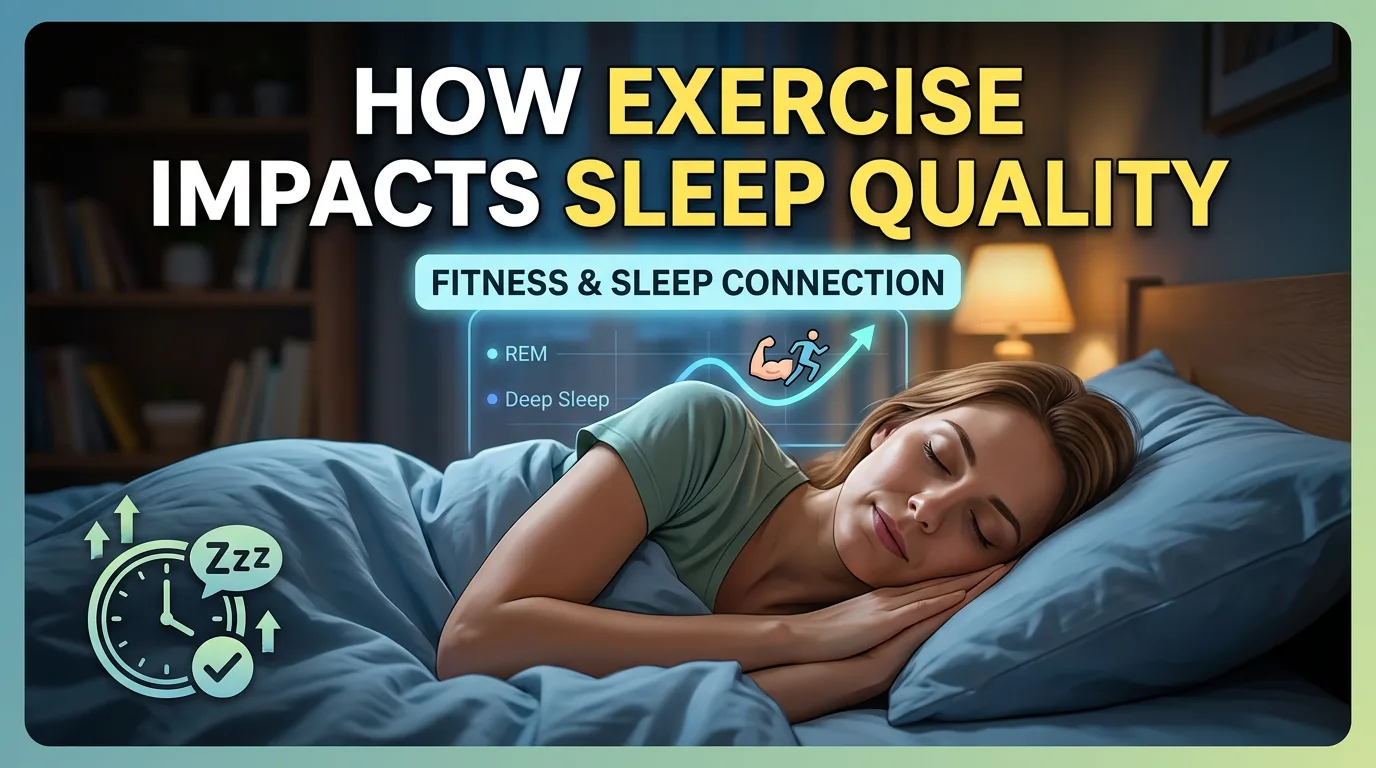
Ask five different people whether they should hit the gym or go for a run in the evening, and you will get five different opinions about what it will do to their sleep. For years, the standard sleep hygiene advice was blunt: do not exercise too close to bedtime, because it revs up your body right when it should be winding down. That advice was not wrong exactly, but it also was not the whole picture. Exercise is one of the most consistently helpful, and most consistently misunderstood, tools for better sleep. Regular aerobic activity measurably deepens the most physically restorative stage of sleep, eases the anxiety and rumination that keep people staring at the ceiling, and can meaningfully shorten the time it takes to fall asleep. At the same time, large real-world datasets and newer clinical trials have started to complicate the old “never exercise before bed” rule, showing that timing effects are smaller and far more individual than sleep advice used to suggest. This guide walks through what the research actually shows about exercise and sleep quality: which types of exercise help the most, what is really going on with morning versus evening workouts, and how to use physical activity as a genuine sleep hygiene tool rather than another source of anxiety about doing it “wrong.”
Quick answer: does exercise improve sleep quality?
Yes. Regular moderate-to-vigorous aerobic exercise is one of the better-supported, non-drug ways to improve sleep quality, according to multiple meta-analyses pooling dozens of studies. Consistent exercisers tend to fall asleep faster, spend more time in deep, slow-wave sleep (the stage most closely tied to physical recovery), and report fewer nighttime awakenings than sedentary people. The benefit is not instant, though. Most research finds meaningful sleep improvements build over several weeks of consistent training rather than appearing after a single workout. As for the old warning to never exercise close to bedtime, that rule has softened considerably. Newer research using real-world wearable data suggests the effect of evening exercise on sleep is smaller and more individual than once believed, and depends heavily on exercise intensity, how close to lights-out it happens, and how a specific person’s body responds. Consistency of exercise, more than its exact timing, appears to matter most for sleep.
How exercise changes the sleep you actually get
“Better sleep” is a vague promise unless you know which parts of sleep are actually changing. Research on exercise and sleep tends to point to three fairly specific mechanisms.

Deeper, more stable slow-wave sleep
Slow-wave sleep, sometimes called deep sleep, is the stage where the body does much of its physical repair work, reinforces the immune system, and releases the bulk of its nightly growth hormone. A study published in Scientific Reports found that exercise improves the quality of slow-wave sleep specifically by increasing the stability of the slow brainwave oscillations that define this stage, not simply by adding more minutes of it. In other words, exercise appears to make deep sleep more consolidated and less choppy, which is a meaningfully different (and arguably more useful) benefit than just a longer number on a sleep tracker. A broader systematic review and meta-analysis in the general population, published in Sleep Medicine Reviews, likewise found a moderate, statistically significant improvement in subjective sleep quality among people who exercise regularly compared with those who do not.
Falling asleep faster and staying asleep
Exercise increases the body’s overall energy expenditure, which builds what sleep scientists call sleep pressure, the biological drive to sleep that accumulates the longer you have been awake and active. Regular exercisers in multiple studies show shorter sleep onset latency (the time it takes to fall asleep) and fewer awakenings after sleep onset than sedentary comparison groups. This is part of why exercise is often recommended as a supporting habit alongside cognitive behavioral therapy for insomnia (CBT-I), the frontline clinical treatment for chronic insomnia.
Less anxiety and rumination at bedtime
A large share of trouble falling asleep is not physical restlessness at all, it is a racing mind. Exercise has well-documented effects on lowering anxiety symptoms and improving mood regulation, both of which are closely tied to sleep onset difficulty. People with anxiety-driven or stress-related sleep problems are often among those who see the clearest sleep benefits from adding regular physical activity, separate from any direct effect on sleep architecture itself.
The “never exercise before bed” myth, and what is actually true
Traditional sleep hygiene guidance has long told people to avoid vigorous exercise in the three to four hours before bedtime. The reasoning was straightforward: intense activity raises core body temperature, heart rate, and sympathetic nervous system arousal, all of which were assumed to delay sleep onset if they had not settled by the time someone tried to fall asleep. That reasoning is not baseless, but the real-world evidence behind the blanket rule turns out to be thinner, and more individual, than the confident wording of most sleep hygiene checklists suggests.
What large real-world studies actually found
A widely cited analysis in Frontiers in Public Health looked at roughly 150,000 nights of combined wearable sleep and activity data and found that evening physical activity, including sessions within four hours of bedtime, was generally not associated with worse sleep for most people, a direct challenge to the old blanket warning. A 2025 dose-response study in Nature Communications examined how the amount and intensity of evening exercise related to sleep outcomes at a large scale, and found the relationship was not simply “the closer to bed, the worse the sleep.” Moderate evening activity was frequently neutral to positive for sleep; it was specifically high-intensity exercise performed very close to lights-out, roughly within an hour, that showed a consistent, measurable delay in falling asleep for a meaningful share of people. A separate 2025 study out of Monash University reached a similar conclusion using accelerometer and sleep-tracking data: vigorous, high-intensity exercise within about an hour of bedtime was linked with modestly disrupted sleep that specific night, while lower-intensity evening movement did not show the same pattern.
Why the nuance matters more than the old blanket rule
Put together, the modern picture is more forgiving and more personal than “never after 6 p.m.” Some people can finish an intense spin class and fall asleep within minutes; others feel wired for hours afterward from the same workout. The difference comes down to individual factors including fitness level, how quickly a person’s core temperature and heart rate return to baseline after exertion, caffeine or pre-workout stimulant use, and general anxiety sensitivity. If you are not sure which camp you fall into, the most useful approach is a short self-experiment: try moving your most intense sessions earlier in the day for two to three weeks and track whether sleep onset improves. If evenings are genuinely the only time you have to train, favor moderate over maximal intensity and leave at least an hour of buffer before bed, more if the workout is especially vigorous.
Morning vs. evening exercise: what randomized trials show
Beyond observational wearable data, a handful of randomized controlled trials have directly compared morning and evening exercise for sleep. A 12-week trial published in Scientific Reports comparing morning versus evening aerobic training found both timing groups improved sleep quality over the study period, with some differing secondary benefits for cardiometabolic markers between groups, but no dramatic sleep advantage for one timing over the other. A randomized trial in older adults comparing morning and evening home-based exercise found improvements in both subjective and objective sleep parameters in both groups, again without a clear across-the-board winner. An ecological study following free-living adults similarly found morning and evening exercisers experienced broadly comparable sleep quality benefits.
The practical takeaway from this body of research is that timing is a secondary lever, not the main one. Total activity and consistency appear to matter more for sleep than the exact clock hour you choose to move. Morning exercise does carry one added advantage worth mentioning: pairing it with natural outdoor light exposure helps anchor the circadian rhythm, which can be genuinely useful for people trying to shift toward an earlier bedtime or manage a delayed sleep schedule. Evening exercise, meanwhile, can double as effective stress relief at the end of a demanding day, as long as the intensity and timing suit your own body’s response.
How intensity, type, and amount of exercise change the benefit
Not all exercise affects sleep equally. A network meta-analysis examining the best approaches and doses of exercise for improving sleep quality found that moderate-intensity aerobic activity, think brisk walking, cycling, swimming, or steady jogging, was the type most consistently associated with sleep quality improvements across studies. The same research pointed to a dose-response pattern: some exercise is better than none, moderate and consistent amounts help most people the most, and there is a point of diminishing, and occasionally reversing, returns with very high training loads that are not matched by adequate recovery.
Resistance training has its own supporting evidence base, with several trials linking regular strength training to improved subjective sleep quality, generally with somewhat smaller effect sizes than aerobic exercise shows for objectively measured deep sleep. Mind-body practices like yoga and tai chi show consistent benefits specifically for sleep onset difficulty and anxiety-related insomnia, likely through their relaxation and stress-reduction effects rather than through the cardiovascular pathway that drives aerobic exercise’s impact on slow-wave sleep.
How much exercise is enough?
Public health guidelines from the CDC and World Health Organization recommend roughly 150 minutes of moderate aerobic activity per week for general health, and population-level sleep studies consistently associate hitting that benchmark with better reported sleep than sedentary behavior. The stronger pattern in the research, though, is not the exact weekly minute count but consistency, exercising on most days rather than concentrating activity into one or two intense weekend sessions appears to produce steadier sleep benefits.
Exercise and specific sleep problems
Insomnia
Multiple trials have found that adding regular aerobic exercise to standard insomnia treatment reduces insomnia severity scores more than treatment alone. Exercise is best understood here as a genuinely useful adjunct, not a replacement for cognitive behavioral therapy for insomnia, which remains the first-line, most evidence-backed treatment for chronic insomnia.
Sleep apnea
Regular exercise and improved cardiorespiratory fitness have been linked to modest reductions in the apnea-hypopnea index, the measure used to grade sleep apnea severity, in some studies, an effect that appears at least partly independent of any accompanying weight loss. That said, exercise is not a substitute for CPAP therapy or other prescribed treatment in moderate-to-severe obstructive sleep apnea; it is a supportive habit, not a cure.
Menopause-related and anxiety-driven sleep disruption
Research on menopausal and perimenopausal women has found regular exercise associated with modest improvements in sleep disruption linked to hormonal changes, alongside its more general benefit for anxiety-driven and stress-related sleep problems across age groups.
When exercise can hurt sleep instead of helping it
More is not always better. Athletes and heavy endurance trainees who do not build in adequate recovery time can develop chronically elevated cortisol and sympathetic nervous system activation, both of which are associated with worse, not better, sleep, a pattern sometimes discussed under the broader umbrella of relative energy deficiency in sport (RED-S) and overtraining syndrome. It is also worth separating the exercise itself from what often accompanies it: pre-workout supplements and caffeine used to power an evening session can disrupt sleep on their own, independent of the exercise, and are easy to mistake for a workout timing problem when the real culprit is a stimulant taken too late in the day.
How to use exercise as a sleep hygiene tool
- Aim for roughly 150 minutes of moderate aerobic activity a week, spread across most days rather than saved for one or two intense sessions.
- Prioritize consistency over perfect timing. The research supports showing up regularly far more strongly than it supports any single “correct” hour to exercise.
- If evenings are your only option, choose moderate over maximal intensity and leave at least an hour of buffer before bed, more for genuinely vigorous training.
- Get outside for morning movement when you can. Combining activity with natural light exposure reinforces your circadian rhythm.
- Give a new exercise routine three to four weeks before judging whether it is helping your sleep. Benefits tend to build gradually rather than appearing overnight.
- Watch for signs of overtraining, such as an elevated resting heart rate, unusual fatigue, or sleep that is getting worse rather than better, and scale back if you notice them.
- Treat exercise as one input among several, not a standalone fix. It works best alongside the rest of a solid sleep hygiene routine.
Frequently asked questions
Does exercising right before bed ruin your sleep?
Not necessarily, and the old blanket rule against any evening exercise has softened considerably in recent research. Large real-world studies suggest moderate evening activity is generally fine for most people, even fairly close to bedtime. The clearest evidence for disruption is specific to high-intensity exercise performed within about an hour of lights-out, which has been linked to a modestly delayed sleep onset in several recent studies. If you notice your own sleep suffers after evening workouts, shifting intense sessions earlier or lowering the intensity is a reasonable, evidence-informed adjustment.
What time of day is best to exercise for sleep?
Randomized trials comparing morning and evening exercise generally find both improve sleep quality over several weeks, without a decisive overall winner. Morning exercise has a modest extra advantage for circadian rhythm alignment when paired with natural light exposure, which can help people trying to shift toward an earlier sleep schedule. For most people, the best time to exercise for sleep is simply whichever time they will actually do it consistently.
How long does it take for exercise to improve sleep?
Most research finds sleep benefits build gradually over several weeks of regular exercise rather than appearing after a single session. Some people notice easier sleep onset within the first week or two, largely from reduced anxiety and increased sleep pressure, while deeper changes in slow-wave sleep quality tend to show up over a longer, sustained period of consistent training.
Can exercise help with insomnia?
Yes, as a supporting habit. Several clinical studies have found that adding regular aerobic exercise to standard insomnia treatment improves outcomes more than treatment alone. It works best as a complement to, not a replacement for, cognitive behavioral therapy for insomnia (CBT-I), which remains the most strongly evidence-backed treatment for chronic insomnia.
Can too much exercise make sleep worse?
Yes. Heavy training loads without adequate recovery can chronically elevate cortisol and sympathetic nervous system activity, both of which are linked to disrupted, rather than improved, sleep. This pattern shows up most often in athletes and dedicated endurance trainees and is part of what is discussed under overtraining syndrome and relative energy deficiency in sport (RED-S).
Is yoga or strength training as good as cardio for sleep?
They help, but generally through different mechanisms and with somewhat different effect sizes. Moderate-intensity aerobic exercise has the strongest evidence for improving objectively measured deep sleep. Resistance training shows meaningful but generally smaller benefits for subjective sleep quality, while yoga and tai chi are particularly well-supported for easing sleep onset difficulty and anxiety-related insomnia. A combination of aerobic activity with some strength or mind-body training tends to cover the most ground.
One closing note: exercise is a genuinely useful, well-supported sleep hygiene habit, but it is not a treatment for an underlying sleep disorder. If you exercise regularly and still struggle with persistent insomnia, excessive daytime sleepiness, or symptoms like loud snoring and gasping at night, it is worth talking to a doctor or sleep specialist rather than assuming more exercise alone will resolve it.





Leave a Reply