
Table of Contents
Table of Contents
What does it mean to live in the paycheck to paycheck cycle?
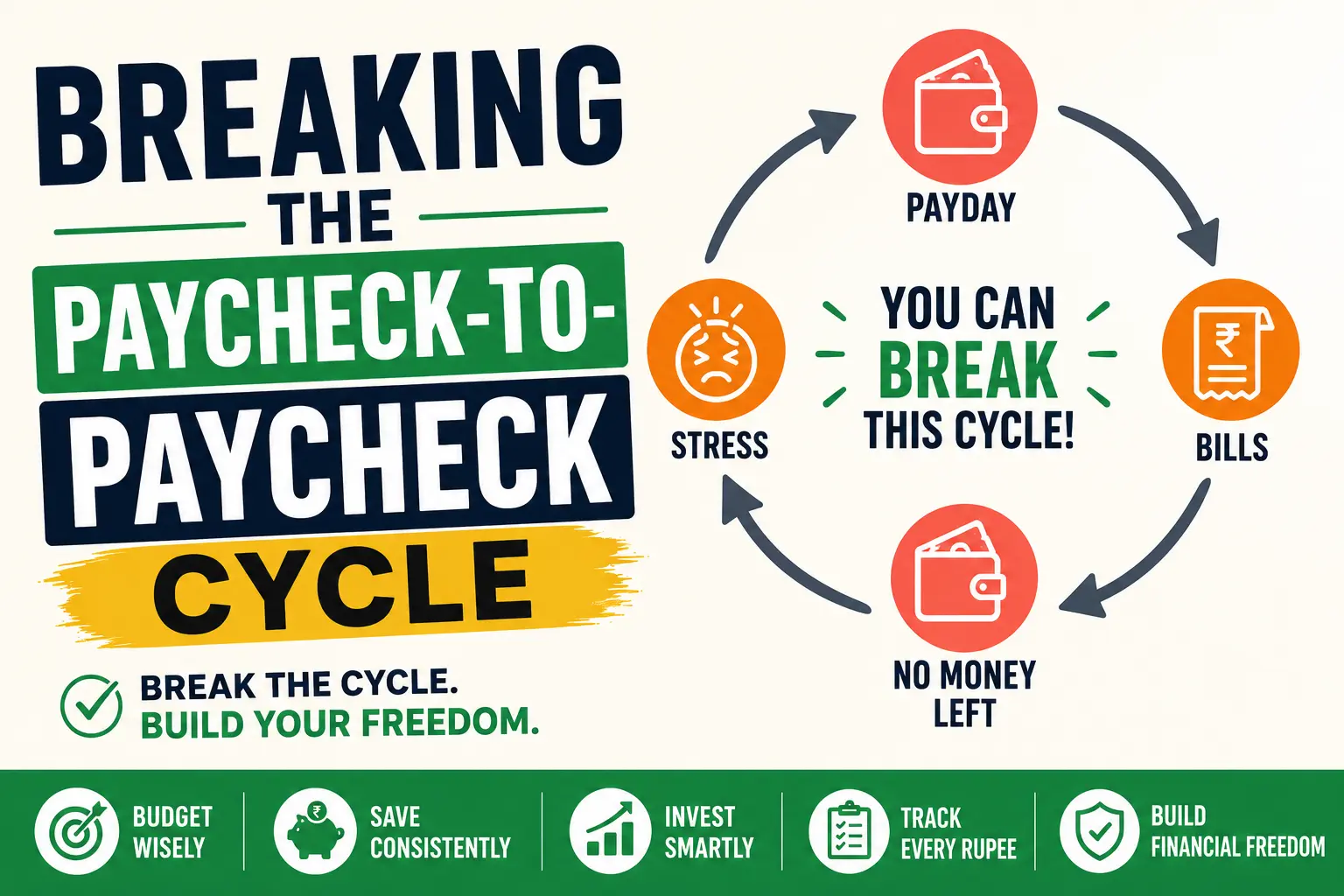
Living paycheck to paycheck means spending nearly all or more than all of your income before your next payday arrives, leaving no meaningful buffer for anything unplanned. It’s not a fixed income threshold; it’s a pattern that can show up at almost any earning level, which is why raising income alone doesn’t automatically fix it.
The clearest sign isn’t a low bank balance on any single day; it’s the recurring feeling of relief when payday hits, followed by that cushion disappearing again within days or weeks. If that paycheck to paycheck cycle repeats month after month regardless of how much comes in, the underlying issue is structural, not just a rough patch.
Why do people live paycheck to paycheck even with a decent income?
People live paycheck to paycheck on a decent income mainly because spending has quietly risen to match earnings, because there’s no buffer to absorb irregular costs, or because debt payments are consuming the room a buffer would otherwise occupy. None of these causes of the paycheck to paycheck cycle are about being bad with money in some general sense, they’re specific, fixable patterns.
- Lifestyle creep – spending expands to match each raise or bonus, so a higher income never actually produces breathing room.
- No buffer for irregular costs – car repairs, medical costs, or annual fees hit as emergencies purely because nothing was set aside for them in advance.
- Debt repayments eating the margin – high monthly obligations from loans or cards leave no slack even when the rest of the budget looks reasonable.
- A timing mismatch – bills clustering right before payday, or an irregular income that doesn’t line up neatly with fixed monthly expenses.
Most people caught in the paycheck to paycheck cycle have more than one of these factors stacked together, which is exactly why a single quick fix rarely resolves it on its own.
How do you break the paycheck to paycheck cycle?
You break the paycheck to paycheck cycle by finding the true size of your monthly gap, cutting the highest fixed cost first, building a small starter buffer, and then protecting that buffer so it isn’t the first thing spent when something unexpected happens. This is a sequence, not a single action; skipping ahead to “just save more” without the earlier steps rarely holds.
- Find the true gap. Track one full month of income against expenses honestly, including the irregular costs you usually forget, to see the actual shortfall rather than a guessed one.
- Cut the highest fixed cost first. A single reduction in rent, a subscription bundle, or a loan’s interest rate typically does more than many small cuts to daily spending.
- Build a starter buffer. Even a small amount, the equivalent of a few days’ worth of essential expenses, breaks the pattern of hitting zero before payday.
- Protect the buffer. Keep it in a separate account you don’t touch for daily spending, so it’s there specifically for the gap it was built to cover.
- Automate the transfer. Move the buffer contribution out on payday, before discretionary spending has a chance to absorb it.

This starter buffer is deliberately smaller and faster to build than a full emergency fund, it exists to break the immediate paycheck to paycheck cycle, not to cover a job loss or medical crisis. Once it’s in place, building a full emergency fund while you budget is the natural next stage.
How do you get your household or family on board with a budget?
You get a household on board with a budget by involving everyone in setting the goals before presenting any rules, since a budget that arrives as a list of restrictions from one person tends to trigger resistance rather than cooperation. Shared finances only work long-term when the plan feels shared too.
Start with a conversation about what you’re both or all working toward, a paid-off card, a trip, a home deposit, rather than opening with spending cuts. People commit far more readily to a goal they helped choose than to a budget someone else designed for them. From there, agree on a simple, visible way to track shared numbers so no one feels like they’re being monitored without knowing why.
Decide together how joint and individual spending will work: some households merge everything, others keep a shared account for joint costs and separate accounts for personal spending money, and both can work fine as long as everyone involved actually agreed to the structure. Revisit the conversation periodically rather than treating it as a one-time discussion, priorities shift, and the budget should shift with them.
With kids old enough to understand money, involving them in small, age-appropriate parts of the family’s financial goals, a savings jar for a shared outing, for instance, builds the same habits early that the fundamentals of saving and budgeting cover for adults starting from scratch.
How long does it take to break the paycheck to paycheck cycle?
For most people, the first noticeable shift a small buffer that survives a full pay cycle without hitting zero, takes about one to three months of consistent effort. Full financial breathing room, where irregular costs stop feeling like emergencies, typically takes longer, often six months to a year depending on how large the original gap was.
Progress out of the paycheck to paycheck cycle is rarely a straight line. A month with an unexpected expense can eat into the buffer you just built, and that’s a normal part of the process rather than a sign it isn’t working. The goal in the early months is simply that the buffer gets rebuilt afterward, not that it’s never touched at all.
Frequently asked questions
Can you break the paycheck-to-paycheck cycle without earning more?
Yes, in most cases, the paycheck to paycheck cycle is usually a gap between spending and a buffer, not purely a function of income size. Cutting a large fixed cost and building even a small starter buffer often closes the gap without any change in what you earn.
What’s the difference between a starter buffer and an emergency fund?
A starter buffer is small and built quickly, meant to stop the immediate cycle of hitting zero before payday. A full emergency fund is larger, typically enough to cover several months of essential expenses and is meant to absorb bigger shocks like job loss or a medical event, which is a longer-term goal built after the starter buffer is in place.
What if my partner doesn’t want to budget?
Lead with shared goals rather than rules, and let them see the numbers rather than just being told the conclusion. Resistance to budgeting is often resistance to feeling controlled, not to the idea of saving money itself. If they still aren’t interested in a full joint budget, agreeing on a few shared numbers (rent, bills, one savings goal) is a reasonable starting point rather than an all-or-nothing approach.
Is it normal to slip back into the cycle occasionally?
Yes, an unusually expensive month can temporarily undo recent progress, and that’s a normal part of the process rather than proof the approach has failed. What matters is whether the buffer gets rebuilt in the following month, not whether it’s ever disturbed at all.
Keep reading: Return to Savings & Budgeting 101 for the fundamentals, review common budgeting mistakes if your budget keeps slipping, and move on to building an emergency fund while you budget once your starter buffer is solid.









Leave a Reply