Fish & Aquariums
The first time I actually looked closely at a Hikari fish food bag instead of just grabbing whatever was cheapest, I realized their whole approach is different from most fish food brands. Instead of one “tropical flake” formula sold under a dozen labels with different artwork, Hikari builds a genuinely separate product line for each major species group- goldfish, bettas, cichlids, bottom-feeders, shrimp- each tuned to that group’s actual digestive needs rather than a one-size-fits-all blend. That’s worth knowing before you shop, because it means the specific product you pick off their shelf matters a lot more than it does with a generic house brand where every bag is more or less the same formula in different packaging.
This Hikari fish food guide is here to help you navigate that catalogue rather than repeat what’s already in my individual species guides: what actually separates Hikari’s manufacturing approach from a typical flake, how to read what’s in the bag, which line fits which fish, and how to store it so you’re not feeding a product that’s already lost most of its nutritional value by the time it reaches the water.
Quick answer: how Hikari fish food is organized
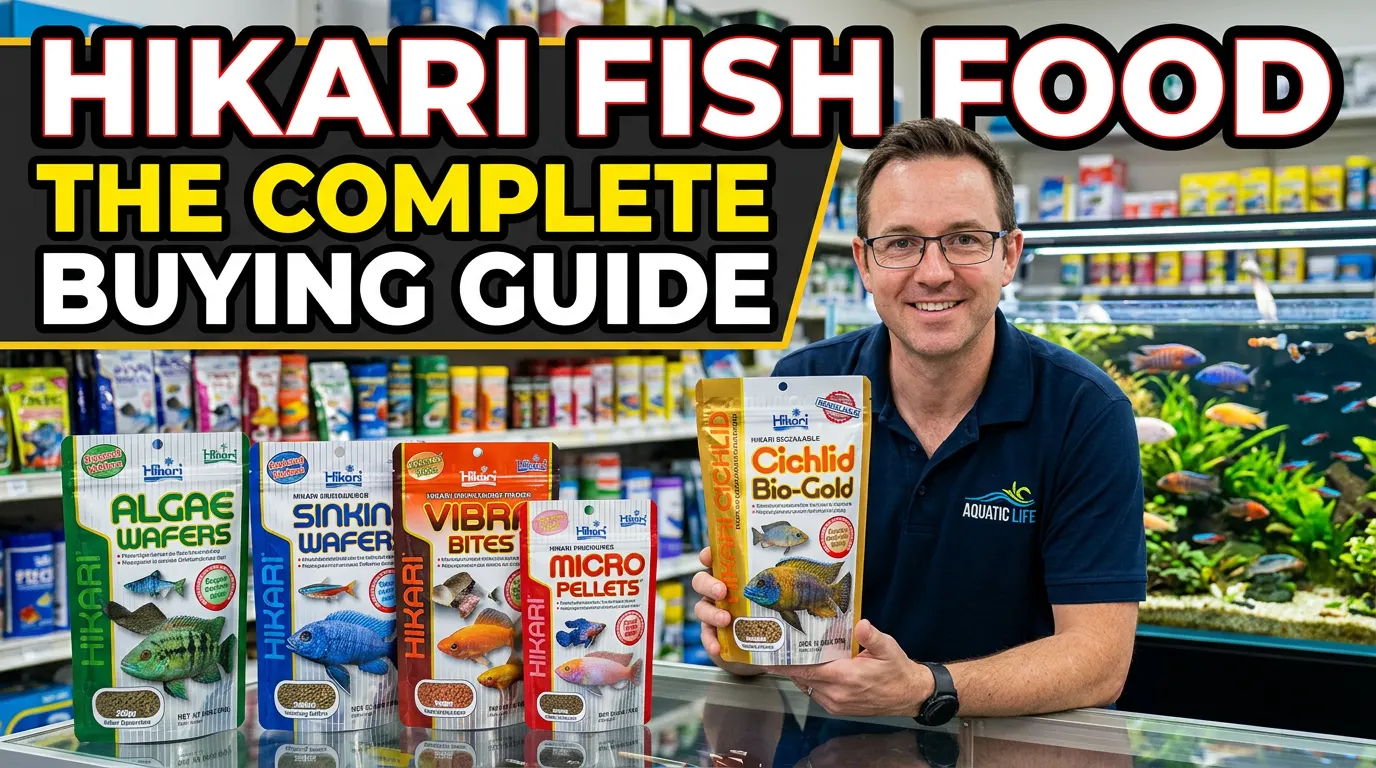
Hikari fish food is organized by species, not by a single all-purpose formula, so start from what you’re keeping rather than picking whatever’s on the shelf or has the most appealing packaging. Their sinking pellets (Cichlid Gold, Sinking Wafers for bottom-feeders) and goldfish-specific lines (which sink or slow-sink rather than float) address the same feeding-behavior issues covered in my individual species guides. If you already know your species, jump to the lineup table below; if you’re comparing Hikari fish food against a generic brand in general, the short version is that the manufacturing process and species-specific formulation are where the real difference shows up, not marketing.

What actually makes Hikari fish food different in manufacturing
Most of what sets a premium fish food apart from a bargain-bin flake isn’t a single miracle ingredient, it’s the manufacturing process that determines how much of the nutrition on the label actually survives to reach the fish. Hikari fish food is known for using an extrusion and stabilization process aimed at protecting fat-soluble vitamins (A, D, E, and K in particular) from breaking down during production and storage, since these are the vitamins most vulnerable to heat, light, and oxidation. A cheap flake made with less protective processing can list an impressive-looking guaranteed analysis on the bag and still deliver noticeably less usable nutrition by the time a fish eats it, simply because more of it degraded before it ever left the factory.
Sourcing matters just as much as processing. Better formulas start by selecting only high-quality raw materials, then check quality and palatability at every production stage. That kind of ingredient-level discipline is exactly what most bargain flake brands don’t publish details about. It’s also a reasonable proxy for why a species-specific Hikari fish food line tends to outperform a generic supermarket flake on paper and in the water.
The other piece worth knowing is pellet and wafer density. Sinking Hikari fish food is formulated to hold together in water for longer than a typical inert pellet, which matters most for slower or more deliberate feeders; bottom-dwellers, shy fish, or species that pick at food gradually rather than gulping it in one pass. A wafer that disintegrates within a minute of hitting the substrate mostly just fouls the water with fine particulate; one engineered to hold its shape for several minutes gives a slower eater the time it actually needs.
Navigating Hikari fish food by species
This is the table to start from if you’re standing in front of a shelf (or a product list online) trying to figure out which Hikari fish food line is actually meant for your fish.
| If you keep… | Look for | Why it fits |
|---|---|---|
| Goldfish | Hikari’s goldfish-specific sinking/slow-sinking lines | Avoids the floating-flake swim bladder issue; see my goldfish food guide |
| Betta | Hikari Betta Bio-Gold or a similar betta-specific pellet | Higher protein, small pellet size matched to a betta’s mouth; see my betta food guide |
| African cichlids | Hikari Cichlid Gold (or a vegetable-forward variant for mbuna) | Match protein and vegetable content to your specific cichlid group; see my cichlid food guide |
| Larger South/Central American cichlids | Cichlid Gold (Large or Massivore-style formulas) | Bigger pellet size and higher protein suited to larger, more predatory feeders |
| Bottom feeders (plecos, corydoras, loaches) | Hikari Sinking Wafers or Algae Wafers | Designed to reach the bottom intact and hold together long enough for slower-feeding species |
| Shrimp | Hikari’s shrimp-specific sinking pellets | Formulated without copper, which is toxic to shrimp and other invertebrates even in trace amounts |
| Community/tropical tank | Hikari Tropical line (flakes, micro pellets) | A reasonable generalist option if you don’t keep a species with more specific needs |
Why the shrimp-safe formulation matters more than people expect
Copper is a common micronutrient in many general fish foods and is genuinely useful in small amounts for fish, but it’s toxic to shrimp, snails, and other invertebrates even at concentrations that don’t bother fish at all. If you keep shrimp alongside fish, checking whether a food is explicitly formulated as copper-free (or shrimp-safe) is worth doing before you feed it into a mixed tank, rather than assuming any high-quality food is automatically fine for every animal in the tank. This is one of the more overlooked reasons a species-specific Hikari fish food line beats a generic all-purpose formula when your tank includes invertebrates.

Reading a Hikari fish food label: what the ingredients actually tell you
The same ingredient-order logic that applies to any fish food applies here, the first few ingredients make up the bulk of what’s in the bag, so a fish meal or krill meal listed first means something different than a formula that opens with wheat flour or soy meal. A few ingredients show up often enough across Hikari’s lines that they’re worth understanding on sight rather than treating as marketing filler.
- Spirulina and chlorella – algae-based ingredients common in cichlid and goldfish formulas, providing plant-based nutrition and natural carotenoid pigments that support both digestion and coloration in herbivore-leaning species.
- Krill and fish meal – the primary protein sources in carnivore-leaning formulas like betta and large-cichlid foods, chosen because they’re closer to what those fish evolved to digest than plant-based protein substitutes.
- Astaxanthin – a carotenoid color enhancer, similar in function to what’s used in many salmon and shrimp aquaculture feeds, that genuinely supports red and orange coloration when a fish’s diet includes it consistently.
- Wheat germ – appears in several cold-water and goldfish formulas; easier for a slower, cooler-water digestive system to process than richer protein sources.
- Stabilized vitamin C – worth looking for specifically, since regular vitamin C degrades quickly with heat and moisture; a stabilized form holds up better through processing and storage, meaning more of it survives to actually reach the fish.
None of these ingredients are exclusive to Hikari fish food, plenty of quality brands use similar formulations, but seeing them on a label is a reasonably reliable signal that a product was built with a specific species’ needs in mind rather than assembled around whatever raw ingredients were cheapest that quarter.
Does the brand actually make a difference?
Species-specific formulation matters more than brand loyalty for its own sake. Hikari fish food isn’t uniquely magical, but their catalogue’s breadth means it’s genuinely easier to find a well-matched product for an unusual or specific species than with brands that only offer two or three generic formulas. If another brand offers an equally well-matched, species-specific option for your fish, same protein source logic, same sinking-versus-floating behavior, same ingredient-order priorities; that’s a reasonable substitute. The underlying principle (match the food to the species, not the other way around) matters more than the logo on the container, and it’s the same principle running through every species guide linked on this page.
Where the breadth of the Hikari fish food lineup pays off most is with less commonly kept species, a mbuna-specific vegetable-forward cichlid formula, or a shrimp-safe sinking pellet, is a narrower niche that not every brand bothers to fill. If you keep only common community fish, the gap between Hikari and another well-regarded species-specific brand is smaller than the gap between either of them and a generic all-purpose flake.

Freeze-dried and frozen treats: where they fit
Beyond the staple pellet and flake lines, the Hikari fish food range also includes freeze-dried and frozen treats, bloodworms, brine shrimp, tubifex, and similar items; under lines like their Bio-Pure range. These are worth treating the same way any freeze-dried or frozen treat is treated across species: a supplement a couple of times a week, not a replacement for a properly formulated staple. Freeze-dried treats specifically benefit from a brief soak in tank water before feeding, since they expand once wet, and feeding them dry increases the risk of bloating regardless of which brand made them. This applies whether you’re feeding a betta, a goldfish, or a cichlid — the treat-versus-staple balance is a general principle, not something that changes by brand.
How to store it and know when to replace a bag
Fish food loses potency over time, especially the fat-soluble vitamins that matter most for color and immune health, so how you store it affects how much you’re actually getting from every feeding, no matter how well the product was formulated at the factory. Keep the bag sealed and away from heat, direct sunlight, and humidity; a cabinet away from the tank itself is better than a shelf right above it, where evaporation and splashing add ambient moisture over time. Transferring dry food into a smaller airtight container once the original bag is opened reduces the air exposure that speeds up degradation, and it’s a cheap habit that meaningfully extends how long a bag stays genuinely fresh.
Buy a size you’ll get through in a few months rather than a large bulk bag for a small tank, food that sits open for a year is noticeably less nutritious by the time you’re using the last of it, even if it still looks and smells fine on the surface. If a pellet or flake has gone soft, clumped together, or developed an off or musty smell, it’s past the point of being worth feeding; those are signs moisture has gotten in, and moisture accelerates both nutrient loss and mold risk.

Common mistakes when buying and feeding Hikari fish food
- Buying the generic Tropical line for a species with its own dedicated formula. If Hikari makes a betta-, goldfish-, or cichlid-specific product for your fish, it’s almost always a better nutritional match than the general-purpose line.
- Assuming every Hikari product is copper-free. Only their explicitly shrimp-formulated lines guarantee this; check the label rather than assuming, if you keep shrimp or other sensitive invertebrates alongside fish.
- Buying a large bag for a small tank. A single betta or a small shrimp colony eats very little; a bulk bag bought for cost savings often outlasts its own freshness well before it’s finished.
- Feeding sinking wafers to fish that won’t reach the bottom. A wafer meant for corydoras or plecos does nothing for a mid-water or surface feeder; match the product to where your fish actually feeds, not just its species group.
- Treating freeze-dried treats as a staple diet. Bio-Pure and similar treat lines are supplements, not replacements for a properly formulated daily pellet; the same rule that applies across every brand.
Hikari fish food: frequently asked questions
Can I use one Hikari formula across my whole mixed tank?
You can as a base for fish with genuinely similar diets, but a tank spanning very different feeding needs, say, goldfish and shrimp, or bottom-feeders and surface-feeding tropicals, is better served by feeding each group its matched formula rather than picking one product for everyone. It’s a small extra step that avoids under-feeding one group’s specific nutritional needs to satisfy another’s.
Are sinking wafers only for plecos?
No, they work for most bottom-dwelling omnivores and herbivores, including corydoras and many loaches, as long as the wafer’s nutritional profile roughly matches the species’ needs. Algae wafers in particular suit herbivore-leaning bottom feeders well beyond just plecos.
Do I need to rotate between multiple foods?
It’s not required, but many keepers rotate between a species-matched staple pellet and occasional treats (frozen or freeze-dried) for variety and enrichment, rather than switching staple brands frequently. Consistency in the daily staple matters more than variety for variety’s own sake.
How long does an opened bag of fish food actually stay good?
Roughly two to three months of regular use for most dry foods once opened, assuming it’s stored sealed and away from heat and moisture, not the year-plus “best by” date printed on an unopened bag, which only applies before the seal is broken. If you’re feeding a single small tank, buying a smaller bag more often beats a large one that sits open and slowly loses potency.
Is Hikari worth the extra cost compared to a supermarket flake?
For most keepers, yes, Hikari fish food is worth it, specifically because of species-matching rather than brand prestige, a betta or goldfish fed a formula built for its actual digestive needs tends to show better color, condition, and appetite than one fed a generic flake, and the cost difference per feeding is small once you account for how little most fish actually eat per day. The exception is a true generalist community tank with no species that has strong specific needs, where a quality generic flake and a well-matched species-specific food perform more similarly.
Does Hikari make food for turtles or other non-fish aquarium pets?
Yes, their catalogue extends beyond fish into products for turtles and other aquatic pets, following the same species-specific philosophy. If you keep a mixed aquatic setup beyond just fish, it’s worth checking whether a dedicated formula exists for that animal too, rather than assuming a fish-formulated pellet covers its needs.
If you keep more than one type of fish, it’s worth reading the individual species food guides linked above, the right pellet shape, sinking behavior, and protein level varies more between species than most people expect, and matching each one correctly is a bigger factor in your fish’s health than which brand’s logo is on the bag.





Leave a Reply