Sleep & Wellness
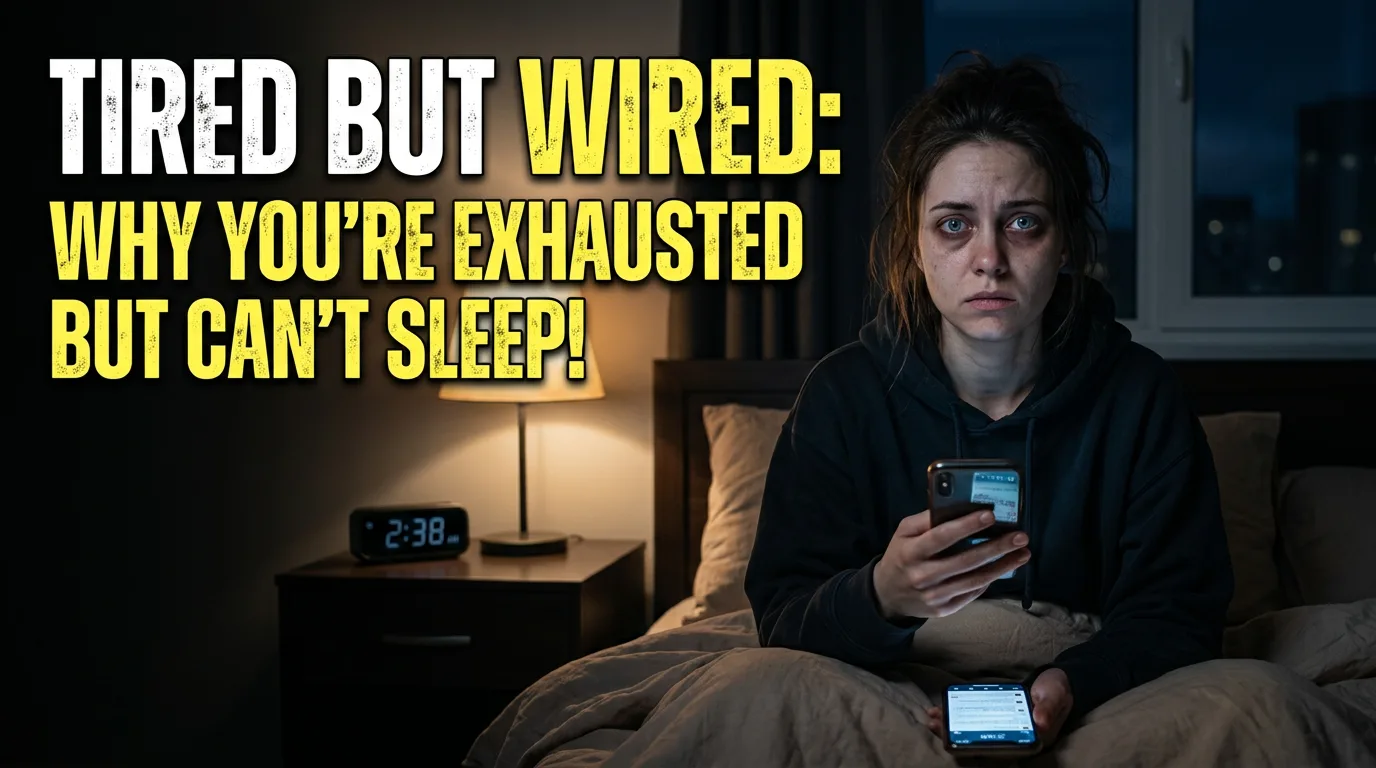
You’ve been dragging all day. Your eyes feel heavy by 4 p.m., you’re yawning through dinner, and you tell yourself you’ll be asleep the second your head hits the pillow. Then you actually lie down, and something flips. Your mind starts racing through tomorrow’s to-do list, your heart feels like it’s beating a little too fast, and the exhaustion that had you yawning an hour ago seems to have evaporated entirely. This is the “tired but wired” paradox, and it’s one of the most common, most confusing sleep complaints there is. It isn’t the same thing as classic insomnia, and it isn’t just “being a bad sleeper.” It’s a specific mismatch between two separate biological systems: one that builds physical pressure to sleep, and one that governs how alert and activated your nervous system is. When those two systems fall out of sync, being exhausted and being unable to sleep can happen to you at the exact same moment. This guide explains why that mismatch happens, what’s driving it physiologically, and what actually helps close the gap.
Quick answer: why you’re tired but wired
“Tired but wired” happens because physical tiredness and mental alertness are controlled by two different systems that aren’t always in sync. Your body can build up plenty of sleep pressure (the drowsy, heavy feeling from a long day) while your sympathetic nervous system stays activated by stress, late caffeine, screen stimulation, or an irregular schedule, keeping cortisol and adrenaline elevated right when they should be tapering off. The result is a nervous system stuck in a mild “on” state at exactly the moment your body wants to shut down. This is closely related to what sleep researchers call hyperarousal, and it’s a well-documented contributor to difficulty falling asleep, even in people who are objectively exhausted. It’s usually fixable with consistent wind-down habits and stress management, but if it happens most nights for weeks on end, it’s worth ruling out an underlying sleep or anxiety disorder with a doctor.
Tired vs. wired: two different systems, not one dial
It’s tempting to think of “tiredness” as a single sliding scale, more tired equals more ready for sleep. Sleep science treats it differently. Sleep researchers, following the two-process model of sleep regulation first described by Swiss chronobiologist Alexander Borbély, split the drive to sleep into two largely independent systems: a homeostatic process (often called Process S) that builds sleep pressure the longer you’ve been awake, and a circadian process (Process C) that governs the timing of alertness and sleepiness across roughly a 24-hour cycle. Physical exhaustion, heavy eyelids, yawning, that bone-deep fatigue, mostly reflects Process S. But whether you can actually drop off when you lie down also depends on a third factor layered on top of both: your level of physiological arousal, driven largely by your autonomic nervous system and stress-hormone levels. You can have maximum sleep pressure and still be too aroused to sleep. That’s the core of the tired-but-wired paradox.
The physiology behind feeling tired but wired
Three physiological threads explain most of what’s happening when exhaustion and alertness collide at bedtime: the chemistry of sleep pressure itself, the timing of your cortisol curve, and the activity of your sympathetic nervous system. Understanding each one makes the paradox much less mysterious.

Sleep pressure: the adenosine side of the equation
Throughout every hour you’re awake, a molecule called adenosine gradually accumulates in your brain. Adenosine is the main driver of homeostatic sleep pressure, the biological “debt” that makes you feel progressively sleepier the longer you stay up, and it’s also the reason caffeine works: caffeine blocks adenosine receptors, which is why it can mask sleepiness without eliminating the underlying pressure. By nightfall, most people have built up a substantial adenosine load, which is exactly why you feel physically drained by evening. But adenosine build-up only creates the capacity for sleep. It doesn’t override an activated nervous system. That’s the piece hyperarousal interferes with, and it’s why you can feel objectively, chemically primed for sleep and still lie awake.
Cortisol dysregulation: your stress hormone at the wrong time
Cortisol, the body’s primary stress hormone, normally follows a predictable daily rhythm: it rises sharply in the 30 to 45 minutes after you wake up (known as the cortisol awakening response), stays relatively steady through the day, and then gradually declines toward its lowest point in the evening and overnight, clearing the way for melatonin and sleep-promoting processes to take over. When that evening decline doesn’t happen properly, because of chronic stress, an irregular schedule, late-day caffeine, or intense evening exercise, cortisol can stay elevated right when it should be dropping. Because cortisol is fundamentally an alerting hormone, part of the body’s fight-or-flight signaling, elevated evening cortisol keeps your brain and body in a more activated state exactly when they’re supposed to be winding down. This is one of the most consistent physiological threads researchers and clinicians point to when explaining why people who are clearly exhausted still can’t fall asleep: the fatigue is real, but so is the misplaced alertness signal running in parallel. Cortisol dysregulation is also closely tied to why some people snap awake in the middle of the night. If that’s a pattern you recognize, it’s worth reading about what hormone wakes you up at 3 AM, since it’s driven by a related but distinct mechanism involving early cortisol spikes and blood sugar dips.
The sympathetic nervous system and hyperarousal
Your autonomic nervous system runs on two branches: the sympathetic branch (fight-or-flight, mobilizing) and the parasympathetic branch (rest-and-digest, calming). Falling asleep requires a shift toward parasympathetic dominance, slower heart rate, lower blood pressure, relaxed muscles, quieter brain activity. Sleep researchers use the term hyperarousal to describe a state in which the sympathetic nervous system stays too active into the pre-sleep period, whether from stress, anxiety, an overstimulating evening, or an ingrained pattern built up over months of poor sleep. Cleveland Clinic describes hyperarousal as your body’s protective stress response staying switched on longer than it needs to, doing more harm than good when it interferes with the ability to relax and rest. In practice this can show up as a faster resting heart rate at bedtime, muscle tension, a racing or looping train of thought, and a subjective feeling of being “keyed up” even while you’re exhausted. Hyperarousal is one of the leading explanatory models for chronic insomnia in sleep medicine research, and it’s the mechanism that best explains the specific tired-but-wired sensation, rather than general sleeplessness with no fatigue at all.
Common causes of feeling tired but wired at night
The physiology above explains the mechanism; these are the everyday triggers that push cortisol and the sympathetic nervous system into that late-night activated state in the first place.

Chronic, low-grade stress
Ongoing stress, work pressure, financial strain, caregiving, or unresolved conflict, keeps the hypothalamic-pituitary-adrenal (HPA) axis, the system that regulates cortisol, running hotter than it should. Unlike a single stressful event, chronic stress can flatten or delay the natural evening cortisol decline night after night, so the nervous system never fully downshifts. Over time this pattern can also condition the brain to associate bedtime itself with alertness and problem-solving, since lying still in a dark, quiet room is often the first moment all day your mind isn’t distracted, which lets background stress rise to the surface.
Caffeine later than you think
Caffeine has a half-life that commonly runs five to six hours, and can be considerably longer for slow metabolizers, meaning an afternoon coffee can still have meaningful stimulant activity in your system at bedtime. Because caffeine works by blocking adenosine receptors, it doesn’t just make you feel more awake, it actively interferes with the sleep-pressure signal your body has spent all day building, which is exactly the kind of mismatch that produces a tired-but-wired evening.
Screens and late-evening stimulation
Bright, blue-enriched light from phones and laptops suppresses melatonin production, but the content matters just as much as the light. Scrolling work email, doomscrolling the news, or getting pulled into an argument online all activate the sympathetic nervous system directly, on top of the light exposure, stacking two arousal triggers right before you try to sleep.
An irregular sleep-wake schedule
Going to bed and waking up at wildly different times disrupts the circadian rhythm that’s supposed to time your cortisol decline and melatonin rise to coincide with your actual bedtime. When your schedule shifts around, your body’s internal clock can be telling your nervous system it’s still “afternoon” even though you’re exhausted from a long day, producing exactly the tired-but-wired mismatch.
Exercising too close to bedtime
Exercise is one of the best long-term tools for sleep quality, but vigorous exercise raises core body temperature, heart rate, and circulating cortisol and adrenaline in the short term. For most people that activation fades within a couple of hours, but for those who are more sensitive to it, a hard workout within roughly one to two hours of bed can leave the nervous system too physiologically activated to power down on schedule, even though the body is also more tired from the exertion.
A racing or ruminating mind
Cognitive arousal, the mental version of hyperarousal, is often the most noticeable symptom people describe: as soon as the lights go off, the brain starts replaying the day, rehearsing tomorrow, or catastrophizing about not being able to sleep. This can become self-reinforcing, since worrying about sleeplessness is itself arousing. When anxious anticipation about bedtime becomes the dominant pattern night after night, rather than an occasional bad night, it’s worth reading our dedicated guide on sleep anxiety, which goes deeper into why trying to fall asleep can itself become the thing that keeps you awake.
Tired but wired vs. insomnia vs. sleep anxiety
These three terms overlap but describe different things, and it’s worth being precise about which one matches your experience. “Tired but wired” describes the specific sensation of physical exhaustion paired with mental or physiological alertness at bedtime, it’s a description of a feeling, not a diagnosis. Insomnia is the clinical term for persistent difficulty falling asleep, staying asleep, or waking too early despite adequate opportunity to sleep, and it can have many underlying causes beyond hyperarousal, including poor sleep hygiene, an underlying medical condition, or a mistimed circadian rhythm; our guide on why you can’t fall asleep walks through that full range of causes and solutions. Sleep anxiety, meanwhile, is a more specific pattern where fear or dread about not being able to sleep becomes the primary driver of wakefulness, a feedback loop where anticipatory anxiety itself produces the physiological arousal that then prevents sleep. In practice, tired but wired is often the physical sensation that sleep anxiety produces, and both can be symptoms of, or precursors to, a formal insomnia diagnosis if they persist. You don’t need to sort yourself perfectly into one category before doing anything about it, but understanding which mechanism dominates for you, stress-driven cortisol elevation, anxious rumination, or simple habit and timing issues, helps you pick the right fix first.
It’s also worth noting that tired but wired can show up even in people who are technically getting enough hours of sleep, since hyperarousal can fragment sleep architecture even after you do drop off. If you’re sleeping a full eight hours but still waking up unrefreshed, that overlaps with a related but distinct issue covered in our guide to why sleep quality can be poor despite getting 8 hours.
Evidence-based ways to fix tired but wired nights
Because the paradox comes from a mismatch between sleep pressure and nervous-system arousal, the fixes that work best directly target arousal, rather than trying to make yourself “more tired,” which usually doesn’t help since you’re often tired enough already.
Build a real wind-down routine, not just a bedtime
A consistent 30 to 60 minute wind-down period gives your sympathetic nervous system time to downshift before you actually try to sleep, rather than asking it to switch off instantly the moment you lie down. That means dimming lights, stepping away from screens or switching them to warm, low-brightness settings, and choosing calm, low-stimulation activities, reading, gentle stretching, a warm shower, over anything that continues to engage your stress response, including checking email “one more time.” If you want a structured framework for the full pre-bed window, our 3:2:1 sleep rule guide lays out a practical, evidence-informed taper for alcohol, food, and fluids that pairs well with a calming wind-down routine.
Use cognitive techniques to quiet a racing mind
Because cognitive arousal, the looping, problem-solving version of a wired brain, is one of the most stubborn parts of this pattern, a handful of specific techniques used in cognitive behavioral therapy for insomnia (CBT-I) target it directly. Slow, controlled breathing (such as extending the exhale longer than the inhale, or a paced pattern like 4-7-8 breathing) activates the parasympathetic nervous system and can measurably lower heart rate within minutes. “Constructive worry,” writing down tomorrow’s tasks and concerns on paper earlier in the evening, before you’re in bed, gives your brain permission to stop rehearsing them once you lie down. Cognitive shuffling, deliberately picturing a random sequence of unrelated, neutral images (a chair, then a lemon, then a bicycle) works by occupying the brain’s verbal, analytical channel just enough to crowd out rumination, without being engaging enough to cause further arousal. And stimulus control, getting out of bed if you’re not asleep within roughly 20 minutes and doing something calm in dim light rather than lying there frustrated, prevents the bed itself from becoming associated with wakeful frustration, which is one of the most well-established recommendations in behavioral sleep medicine.
Address the underlying stress, not just the bedtime symptom
Because cortisol dysregulation is frequently a daytime problem that shows up at night, daytime stress management often does more for tired-but-wired nights than anything done in the hour before bed. Regular (non-late-evening) exercise, time outdoors and natural light exposure earlier in the day, and consistent, brief relaxation practice, even five to ten minutes of mindfulness or breathing exercises during the day, have all been associated with better-regulated cortisol rhythms and improved sleep onset. If stress is chronic and severe enough that it’s affecting most nights for weeks at a time, that’s also a reasonable point to loop in a doctor or therapist rather than relying on bedtime tactics alone to counteract something rooted in daytime life.
Fix the timing: caffeine, exercise, and your schedule
A few timing adjustments reduce the odds of a late-day arousal spike in the first place: cutting caffeine off eight to ten hours before bed (earlier if you know you’re a slow metabolizer), finishing vigorous exercise a few hours before bedtime rather than immediately beforehand, and, perhaps most importantly, keeping a consistent wake-up time every day, including weekends. A fixed wake time is one of the strongest anchors for the circadian rhythm that governs your cortisol curve, and a stable circadian rhythm makes the evening cortisol decline, and the parasympathetic shift that goes with it, much more reliable night to night.
When tired but wired signals something more serious
An occasional wired night after a stressful day is normal and not a cause for concern. But when the pattern is persistent, occurring most nights for a month or longer, and it’s paired with excessive daytime worry, a racing heart at bedtime, dread about going to bed, or difficulty functioning during the day, it may point toward a generalized anxiety disorder or a clinical insomnia disorder rather than an occasional stress response. The American Academy of Sleep Medicine recommends cognitive behavioral therapy for insomnia (CBT-I) as the first-line treatment for chronic insomnia, ahead of medication, precisely because it directly targets the hyperarousal and conditioned-alertness patterns described in this article. A doctor or sleep specialist can also rule out other contributors, including sleep apnea, thyroid issues, or medication side effects, that can mimic or worsen a tired-but-wired pattern. If this is happening most nights and isn’t improving with consistent wind-down habits and stress management, it’s genuinely worth a medical conversation rather than continuing to push through it alone.
Frequently asked questions
Why do I feel exhausted all day but wide awake at night?
This happens because physical exhaustion and mental alertness are governed by separate systems. Daytime fatigue mostly reflects adenosine-driven sleep pressure building up the longer you’re awake, while nighttime alertness reflects sympathetic nervous system activation and cortisol levels that haven’t tapered off as they should. When stress, late caffeine, screens, or an irregular schedule keep your nervous system activated into the evening, you can be fully sleep-pressured and still too aroused to fall asleep, which is the essence of the tired-but-wired feeling.
Is “tired but wired” the same thing as insomnia?
Not exactly. “Tired but wired” describes a specific sensation, exhaustion paired with alertness at bedtime, while insomnia is a broader clinical term for persistent trouble falling asleep, staying asleep, or waking too early. Hyperarousal is one common driver of both, but insomnia can also stem from other causes like poor sleep hygiene, an underlying medical condition, or a shifted circadian rhythm. If the tired-but-wired pattern happens most nights for a month or more, it can develop into, or already reflect, a diagnosable insomnia disorder.
Can stress alone cause tired but wired nights?
Yes. Chronic stress is one of the most common drivers of this pattern because it keeps the HPA axis, the system controlling cortisol, activated for longer than it should be, flattening or delaying the evening cortisol decline that’s supposed to hand your nervous system off to a calmer, parasympathetic state. That elevated cortisol, combined with the racing thoughts stress often produces, is enough on its own to keep you wired at bedtime even without any other contributing factor like caffeine or screens.
Does exercising in the evening make tired but wired worse?
It can, for some people. Vigorous exercise temporarily raises core body temperature, heart rate, and stress-hormone activity, all of which run counter to the calming shift your body needs before sleep. Most people’s systems settle within a couple of hours, but if you’re especially sensitive to this effect, working out within one to two hours of bedtime may leave you feeling more physically tired yet paradoxically more wired. Moving vigorous workouts earlier in the day, while keeping some form of regular exercise in your routine, tends to support better sleep overall.
When should I see a doctor about feeling tired but wired?
If this pattern is occasional, after a stressful day or a late workout, it’s not usually a medical concern. But if you’re feeling tired but wired most nights for several weeks, especially alongside persistent worry, dread about bedtime, or daytime impairment, it’s worth talking to a doctor or sleep specialist. They can screen for generalized anxiety disorder, chronic insomnia, and other conditions like sleep apnea or thyroid dysfunction that can produce similar symptoms, and can refer you to cognitive behavioral therapy for insomnia (CBT-I), which the American Academy of Sleep Medicine recommends as the first-line treatment for chronic insomnia.
References
- Cleveland Clinic – Hyperarousal: When Protective Instincts Do More Harm Than Good
- Cleveland Clinic – Cortisol: What It Is, Function, Symptoms & Levels
- Sleep Foundation – Sleep Drive and Your Body Clock
- Sleep Foundation – Caffeine and Sleep Problems
- Sleep Foundation – How Long Does It Take for Caffeine to Wear Off?
- Sleep Foundation – Blue Light: What It Is and How It Affects Sleep
- Sleep Foundation – Cognitive Behavioral Therapy for Insomnia (CBT-I): How It Works
- American Academy of Sleep Medicine – New Guideline Supports Behavioral, Psychological Treatments for Insomnia
Related Guides
- Why Can’t I Fall Asleep? Common Causes and Solutions
- Why Do I Feel Anxious When Trying to Fall Asleep? Understanding Sleep Anxiety
- What Hormone Wakes You Up at 3 AM? Causes and How to Stop It
- Why Is My Sleep Quality So Poor Despite Getting 8 Hours?
- The 3:2:1 Sleep Rule Explained: A Complete Sleep Hygiene Guide







Leave a Reply