Fish & Aquariums
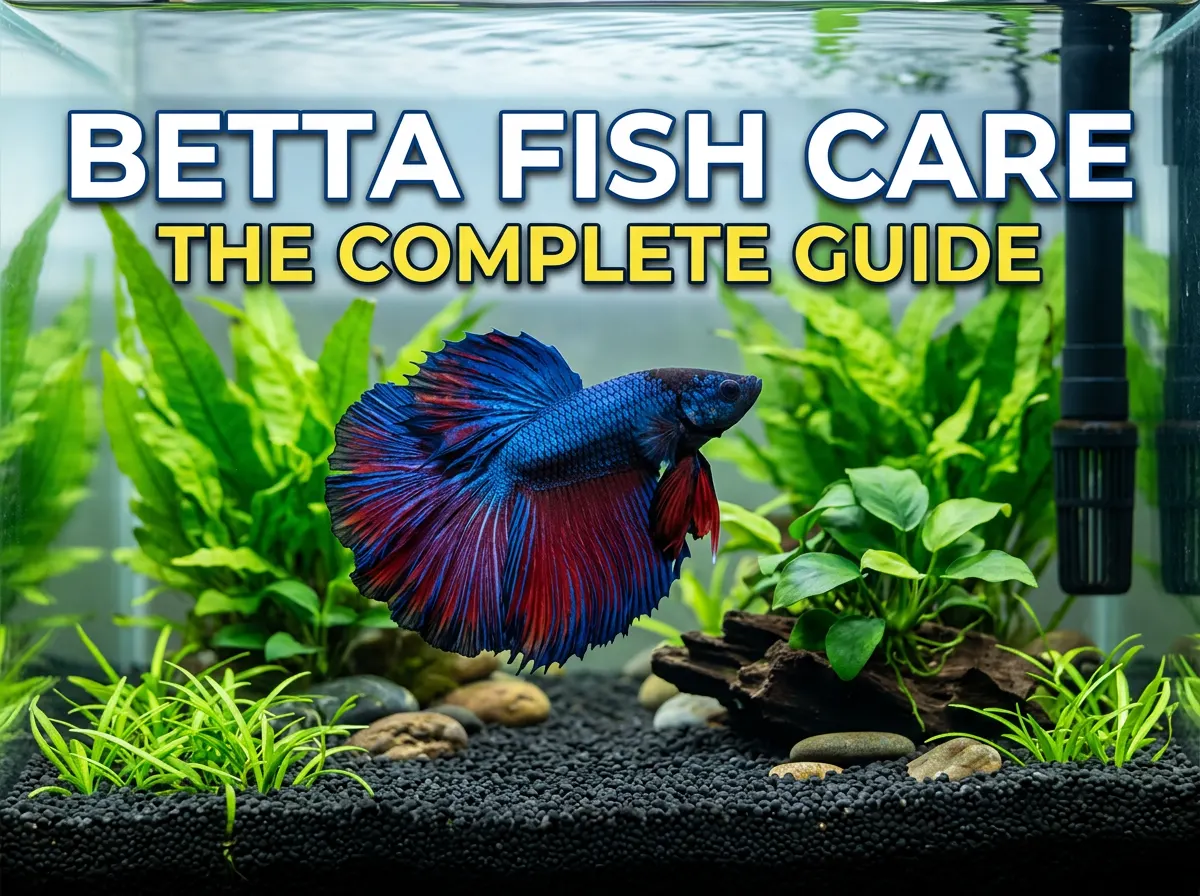
Betta fish care is more demanding than the pet-store label suggests. Bettas get sold as a “low maintenance” starter fish more than almost any other species, usually in a tiny unheated bowl that’s close to the opposite of what they actually need. They’re hardy in the sense that they tolerate a lot of beginner mistakes without dying immediately n,ot in the sense that a bowl is fine for them long-term. I’ve kept bettas for years now, in everything from a cramped 3-gallon cube early on (my first betta, Napoleon, was miserable in it and I didn’t know why) to a properly heated and filtered 10-gallon planted tank today, and the difference in color, activity, and fin condition between those two setups is not subtle. This guide covers everything I wish someone had told me before I bought that first bowl: real tank requirements, the different fin types and color strains, feeding, tankmates, breeding basics, and the diseases that actually show up in betta keeping.
Quick answer: betta fish care in a paragraph
Betta fish care for Betta splendens comes down to a heated, filtered tank of at least 5 gallons (ideally 10+), water held between 24-27°C (75-80°F), gentle filtration (strong flow stresses their long fins), and a varied diet built around a quality betta pellet rather than flakes alone. They’re territorial toward other bettas and many fin-nipping species, but can live successfully in a community tank with calm, non-nippy tankmates given enough space and hiding spots. Males are more commonly kept alone or as the centerpiece of a community tank; females can sometimes be housed together in a “sorority” of five or more in a large, heavily planted tank, though this requires more supervision than most beginner guides let on.
Where bettas come from, and why it matters for betta fish care
Betta splendens originates in the shallow, slow-moving waters of Thailand, Cambodia, Vietnam, and Laos: rice paddies, roadside ditches, and floodplain pools that warm up considerably in the tropical climate and often have low oxygen and low flow. Two things about that native habitat explain most of modern betta fish care. First, the warm water is why a heater isn’t optional: a betta kept at room temperature in a temperate climate is being kept several degrees below what its metabolism evolved for, which shows up as lethargy, poor digestion, and a weaker immune response over time. Second, the still, low-oxygen water is why bettas evolved a labyrinth organ, an accessory breathing structure that lets them gulp air directly from the surface instead of relying solely on their gills. That’s the biological reason bettas can survive (not thrive, survive) in stagnant conditions that would kill most other fish, and it’s also why a betta tank benefits from some open space near the surface rather than being packed floor-to-ceiling with tall decor.
The labyrinth organ also explains a behavior new keepers sometimes panic about: bettas periodically swimming up to gulp air at the surface. That’s normal, not a sign of a struggling fish, as long as it’s an occasional trip and not constant surface-gasping (which instead usually points to low dissolved oxygen or poor water quality, see the water parameters section below).

Fin types and color varieties
Every betta you see for sale is the same species, Betta splendens, selectively bred over decades into a wide range of fin shapes and color patterns. Knowing the fin type matters practically, not just cosmetically; longer, heavier fins mean a fish that tires more easily against strong current and is more prone to fin damage, which changes what filter and decor choices make sense.
Common fin types
- Veiltail: the most commonly sold type, with a long, drooping tail fin. Hardy and easy to find, but the heavy fin is more prone to drag and nipping damage.
- Halfmoon: tail fans out to a 180-degree half-circle when flared. Strikingly showy but among the most fin-heavy varieties, so these fish especially need gentle flow.
- Crowntail: fin rays extend beyond the webbing, giving a spiky, crown-like edge. The reduced webbing means somewhat less drag than a halfmoon.
- Plakat: short-finned, closer to the original wild-type body shape. More agile, faster swimmers, and generally more resilient to fin rot and nipping simply because there’s less fin to damage.
- Delta and super delta: tail fans out but doesn’t reach a full 180 degrees like a halfmoon.
- Double tail: a genetic mutation that splits the caudal fin into two lobes, often paired with a shorter, wider body.
Common color patterns
Beyond solid colors like red, blue, and cambodian (pale body with colored fins), breeders have developed several named patterns: marble (patches of color that can actually shift over the fish’s lifetime due to a jumping gene), dragon scale (thick, metallic scale coverage that gives an armored look), koi (mottled red, white, and black reminiscent of koi carp), butterfly (a solid body color with a distinct band of white or a different color at the fin edges), and galaxy or koi-galaxy strains that combine metallic sheen with mottling. None of this affects care requirements; it’s purely selective breeding for appearance, but it’s worth knowing so you’re not surprised if a marble betta’s pattern changes over a year or two.
Tank setup for betta fish care
- Size: 5 gallons minimum, 10+ gallons gives noticeably more stable water and room for tankmates or plants.
- Heater: required — bettas are tropical fish and suffer in cold water despite the myth that they don’t need one. A small adjustable heater rated for the tank volume, set to hold 24-27°C (75-80°F), is non-negotiable.
- Filter: a sponge filter or a baffled HOB filter, strong, direct flow is genuinely hard on a betta’s long fins and can cause exhaustion. If your filter’s output creates a strong current, baffle it with a sponge, a piece of filter floss, or by redirecting the outflow against the glass to diffuse it.
- Substrate: fine gravel or sand both work fine; the choice matters more for live plants (sand is often preferred for carpeting plants, gravel for root-feeders) than for the betta itself.
- Decor: silk or live plants rather than plastic (which can tear delicate fins), plus a floating plant or resting spot near the surface; bettas are labyrinth fish that breathe atmospheric air and like somewhere shallow to rest. Smooth-edged decor, driftwood, and caves give a betta places to feel secure, which measurably reduces stress-related color dulling.
- Lighting: a normal aquarium light on a consistent 8-10 hour daily cycle is enough; bettas don’t have special lighting needs beyond what live plants might require.
- Lid: bettas are notorious jumpers, especially when startled or when chasing food or an insect near the surface. A tight-fitting lid with only a small gap for the filter and heater cords is worth the trouble.
Before adding a betta, the tank needs to be cycled, meaning the beneficial bacteria that convert toxic ammonia into nitrite and then into far less harmful nitrate have had time to establish. Skipping this step is the single most common reason a “healthy” new betta gets sick or dies within the first couple of weeks. I go through the full nitrogen cycle process in my dedicated guide on cycling and water quality, and it applies to bettas exactly the same way it applies to any other freshwater fish.
Water parameters for betta fish care
Bettas are more tolerant of parameter swings than many delicate species, but “tolerant” isn’t the same as “unaffected.” Consistency matters more than hitting an exact number.
| Parameter | Target range | Why it matters |
|---|---|---|
| Temperature | 24-27°C (75-80°F) | Below this range, metabolism and immune response slow down; bettas kept too cold are more prone to illness and lethargy. |
| pH | 6.5-7.5 | Bettas tolerate a range but do best without sudden swings; match your tap water’s natural pH rather than chasing a specific number with additives. |
| General hardness (GH) | Moderate, roughly 3-10 dGH | Extremely soft or extremely hard water can stress a betta over time, though they’re more adaptable here than livebearers or African cichlids. |
| Ammonia / Nitrite | 0 ppm | Both are toxic even at low levels; any detectable reading means the tank isn’t fully cycled or is overstocked/overfed. |
| Nitrate | Under 20-40 ppm, lower is better | Nitrate is far less toxic than ammonia or nitrite but still stresses fish at high, sustained levels — kept in check with regular partial water changes. |
In betta fish care, a weekly 25-30% water change, paired with gravel vacuuming to remove waste and uneaten food, keeps nitrate low and prevents the slow parameter drift that stresses fish without an obvious single trigger. My beginner setup guide walks through establishing that maintenance routine from day one, and my heater guide covers picking equipment sized correctly for a betta-sized tank so temperature doesn’t fluctuate between water changes.

Feeding
Feeding is a big part of betta fish care. Bettas are primarily carnivorous. A quality betta-specific pellet should be the base of their diet, supplemented occasionally with frozen or freeze-dried bloodworms, brine shrimp, or daphnia. Feed a small amount, roughly what the fish can finish in 1-2 minutes, once or twice daily; bettas are prone to overeating and bloating if fed too much or too often. A betta’s stomach is roughly the size of its eye, which is a useful mental image for portion control since it’s easy to overestimate how much a fish this size actually needs.
A few feeding details that make a real difference to betta fish care over time:
- Soak dried pellets briefly before feeding if your betta has had bloating issues; dry pellets expand once wet, and eating them dry can cause the pellet to swell inside the fish.
- Fast one day a week. Skipping a day gives the digestive system a break and is standard practice among experienced keepers, not a sign of neglect.
- Avoid flakes as a staple. Generic tropical flakes are formulated for a broad range of omnivorous fish and don’t match a betta’s higher protein needs as well as a betta-specific pellet does.
- Watch for bloating and constipation – a swollen belly or stringy white waste usually means overfeeding or too much dry food without enough fiber; a small piece of blanched pea (skin removed) can help clear it.
- Live or frozen food adds enrichment as well as nutrition; many bettas get visibly more active and food-driven when offered occasional live brine shrimp or blackworms.
Behavior: flaring, bubble nests, and personality
Bettas are famous for their aggression toward other bettas, but the same territorial display behavior shows up in a lot of everyday moments that don’t mean anything is wrong. Understanding it makes betta fish care a lot more enjoyable rather than a source of constant worry.
Flaring
Flaring is when a betta spreads its gill covers (opercula) and fans out its fins to look larger, a threat display aimed at a perceived rival. It’s triggered by seeing another betta, its own reflection in glass, or sometimes another brightly colored or long-finned fish. Occasional flaring at a mirror for a few minutes as enrichment is generally considered fine and is even used deliberately by some keepers to encourage color and fin development, but prolonged, repeated flaring throughout the day is stressful and should be avoided by removing reflective triggers.
Bubble nests
Male bettas periodically build clusters of mucus-coated bubbles at the water’s surface, usually tucked under a floating plant or in a corner. This is instinctive breeding behavior; in the wild, it’s where a male would guard fertilized eggs, and a male building bubble nests regularly, even alone with no female present, is generally a sign of good health and comfort in the tank rather than anything to worry about. Not every male builds nests often, and that’s normal too; individual temperament varies.
Male vs. female bettas
Both sexes make good pets, and the differences matter mainly for tank planning rather than day-to-day betta fish care.
| Trait | Male | Female |
|---|---|---|
| Fins | Typically longer and more dramatic, especially in show varieties | Shorter fins, though long-finned female strains exist |
| Color | Usually more vivid | Often more muted, though some strains are just as colorful |
| Social housing | Almost always kept singly, two males together will fight, often fatally | Can sometimes be kept in a “sorority” group of 5+ in a large, heavily planted tank |
| Body | Slimmer profile | Rounder body, and a small white egg spot (ovipositor) near the belly |
Sorority tanks deserve a caution most pet store advice on betta fish care skips: they work well for some keepers and turn into a stress-driven mess for others, since females still establish a pecking order and will chase and nip. A sorority needs a large tank (20 gallons or more), dense plant cover to break sightlines, and close monitoring for the first several weeks, with a backup plan to separate any female being singled out.
Tankmates: what actually works
| Generally compatible | Usually a bad idea |
|---|---|
| Corydoras catfish (bottom-dwelling, calm) | Other bettas (males will fight; females can too in tight spaces) |
| Nerite or mystery snails | Fin-nipping species (tiger barbs, some tetras) |
| Cherry shrimp (in a larger, well-planted tank, some bettas will hunt them) | Bright, flowing-finned fish that resemble another betta (guppies can sometimes trigger aggression) |
| Kuhli loaches | Anything requiring cold or brackish water |
| Small, peaceful schooling fish like ember tetras or harlequin rasboras in a larger tank | Slow, long-finned fish that look similar enough to trigger territorial aggression |
Every betta has an individual temperament; some tolerate tankmates well, others don’t, regardless of what’s “generally” compatible. Introduce potential tankmates gradually and have a backup plan (a spare tank or divider) if aggression shows up. As a rule, anything smaller than the betta’s mouth risks being eaten (shrimp especially), anything with long flowing fins risks being mistaken for a rival, and anything nippy risks damaging the betta’s fins even if the betta itself is calm.
Breeding basics
Breeding bettas is a genuinely involved project, not a casual weekend activity, and it’s worth understanding the basic process even if you never intend to try it, since it explains a lot of natural betta behavior. A male builds a bubble nest, the pair engages in an “embrace” during which eggs are fertilized and fall, and the male collects the eggs in his mouth and spits them up into the bubble nest, guarding them until they hatch; typically within a couple of days. After hatching, the fry hang in the nest living off their yolk sac for another day or two before becoming free-swimming, at which point they need infusoria or another appropriately tiny live food, since they’re too small for adult foods.
The female must be removed after spawning, since the male turns aggressive toward her once eggs are laid, and in many cases pairs need to be conditioned with live foods and kept in separate tanks beforehand and introduced carefully rather than simply placed together. Raising a spawn to adulthood also means sorting hundreds of fry by sex and temperament as they mature, since males will eventually need to be separated from each other. It’s a rewarding project for a dedicated hobbyist but not something to attempt without research well beyond what fits in this guide.
Common health problems
Most betta illnesses trace back to water quality, temperature, or stress rather than being random bad luck, which is why the tank setup and maintenance sections above are the real prevention strategy in betta fish care. Here’s what to actually watch for.
Fin rot
Fin rot is a bacterial or fungal infection that eats away at fin tissue, usually starting at the edges and progressing inward. It shows up as ragged, discolored (often black, brown, or white-edged), or receding fin margins, and it’s almost always secondary to poor water quality, physical fin damage, or prolonged stress. Early-stage fin rot often reverses on its own once water quality is corrected with more frequent water changes; more advanced cases may need an aquarium-safe antibacterial treatment. Left untreated, it can progress toward the fish’s body and become far more serious.
Velvet
Velvet is a parasitic infection (Oodinium) that coats the fish in a fine, gold or rust-colored dust-like film, most visible under direct light shone at an angle across the body. Affected fish often clamp their fins, scratch against decor, and become lethargic. It spreads quickly and is treated with a combination of raised temperature, dimmed lighting (the parasite has a photosynthetic stage), and a copper-based or other anti-parasitic medication formulated for freshwater fish.
Ich (white spot disease)
Ich presents as small white spots resembling grains of salt scattered across the body and fins, usually accompanied by flicking or rubbing against decor. It’s one of the most common freshwater fish diseases and is treatable with heat increase (which speeds the parasite’s life cycle so medication can catch it) combined with an ich-specific treatment, alongside consistent water changes.
Swim bladder disorder
A betta that floats sideways, sinks to the bottom, or struggles to swim upright usually has swim bladder trouble, most often caused by overfeeding, constipation, or eating too much air along with food. A short fast (1-2 days) followed by a single de-shelled, blanched pea resolves most cases within a few days; if it persists alongside other symptoms, it may indicate a more serious internal issue.
Dropsy and popeye
Dropsy, a swollen body with scales that stick outward, described as looking “pinecone”-like, and popeye, one or both eyes bulging outward, are both symptoms of internal bacterial infection or organ failure rather than diseases in themselves. They’re serious, often late-stage signs, and while some cases respond to antibacterial treatment and pristine water, both carry a guarded prognosis, especially dropsy.

Routine betta fish care checklist
- Daily: visual health check, feed 1-2 small meals, confirm heater and filter are running normally.
- Weekly: 25-30% water change with gravel vacuuming, test or observe water clarity, wipe algae from the glass as needed.
- Monthly: rinse filter media in removed tank water (never tap water, which kills the beneficial bacteria), check heater accuracy with a separate thermometer, trim or thin live plants.
- As needed: top off evaporated water with dechlorinated water of matching temperature, replace floating plants that die back, quarantine and treat at the first sign of illness rather than waiting to see if it resolves on its own.

Frequently asked questions
Can bettas really live in a bowl with no filter or heater?
They can survive for a while, which is why the myth persists, but it’s a poor standard of care. Unfiltered water quality degrades quickly in a small volume, and cold water slows a betta’s metabolism and immune function. In betta fish care, a heated, filtered tank of at least 5 gallons gives a betta a genuinely healthy environment rather than just a survivable one.
Why is my betta’s fin torn or ragged?
Common causes include sharp or rough decor, fin-nipping tankmates, or fin rot (a bacterial/fungal infection usually linked to poor water quality). Check water parameters first, remove any sharp decorations, and if the edges look ragged, discolored, or are progressively receding rather than just torn, treat it as possible fin rot.
How long do bettas live?
Typically 2-4 years with good betta fish care, sometimes longer. Lifespan is heavily influenced by water quality, diet, and stress levels, a betta kept in a small, unheated, unfiltered bowl will generally live shorter than one in a proper heated, filtered setup.
Can two male bettas ever live together?
No, not in a shared, undivided tank. Male bettas are territorial toward each other by instinct, and housing two together typically results in fighting that causes serious injury or death. A divided tank with a solid or mesh divider is the only way to keep two males in the same aquarium.
Do bettas need a heater in a warm climate?
Usually yes, even in a warm climate, unless ambient room temperature consistently stays within the 24-27°C (75-80°F) range around the clock, including overnight. Most homes with air conditioning or cool nights drop below that range, so a heater with a reliable thermostat is the safer default for betta fish care rather than something to skip based on the outdoor climate.
Why does my betta keep building bubble nests?
Bubble nest building is instinctive breeding behavior in male bettas and generally indicates the fish is healthy and comfortable in its environment. It happens with or without a female present and is not something you need to intervene in, you can leave the nest alone or gently remove it during maintenance without harming the fish.
Is it cruel to let a betta flare at its reflection?
Brief, occasional flaring sessions of a few minutes are generally considered acceptable enrichment and won’t cause lasting harm. Prolonged or frequent flaring throughout the day is stressful, so a mirror or reflective surface should only be shown briefly and not left in place permanently.
What’s the difference between a betta pellet and a regular tropical flake?
Betta-specific pellets are formulated with higher protein content to match a betta’s carnivorous diet, while generic tropical flakes are designed for a broad range of omnivorous community fish and typically contain more plant-based filler. Feeding a betta-specific formula as the dietary base gives better long-term color, growth, and digestive health than flakes alone.
If your betta’s fins are showing signs of fin rot rather than just wear from decor or tankmates, I’ve written a dedicated guide on cycling and water quality that covers the root cause most fin rot traces back to. For the tank itself, my beginner setup guide and heater guide cover the equipment side of betta fish care in more depth.





Leave a Reply