Fish & Aquariums
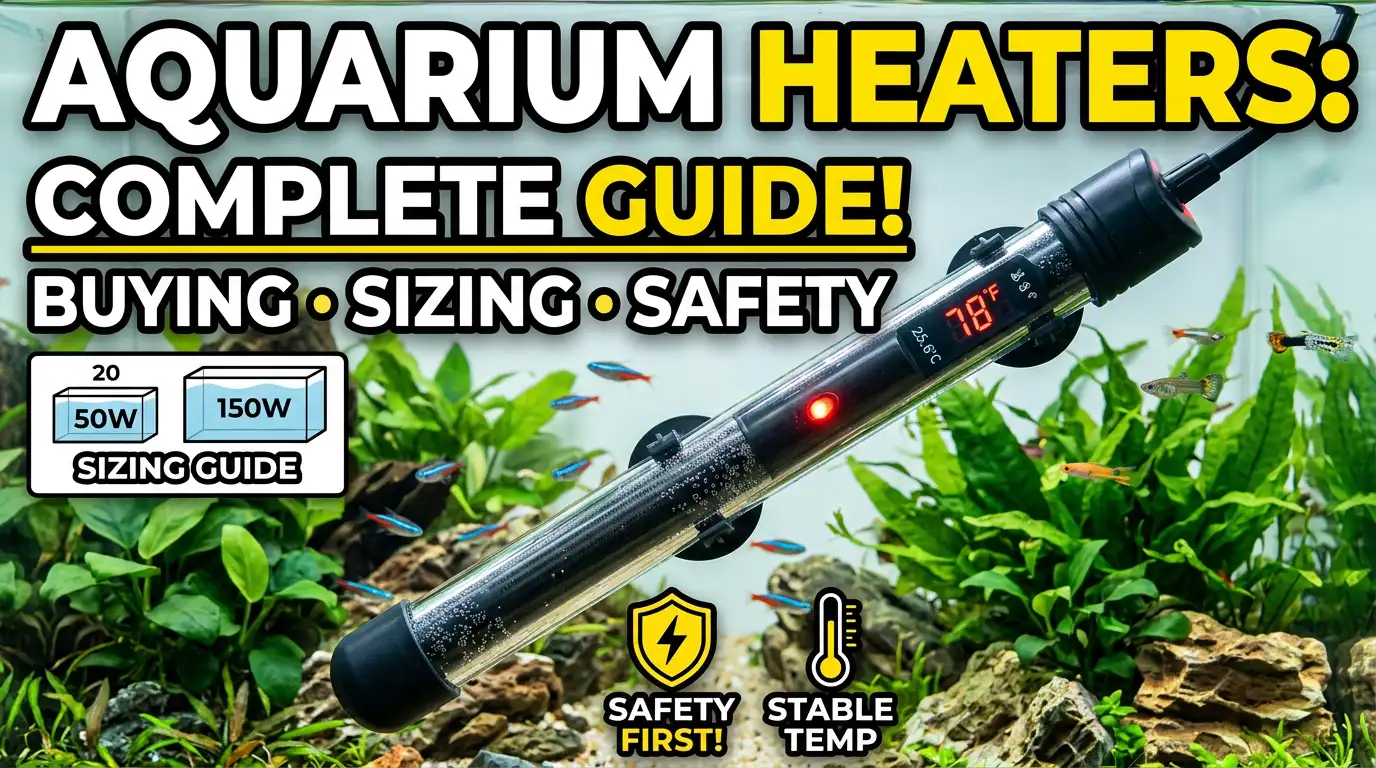
This guide covers aquarium heaters, from sizing to safety. A stuck heater is one of the few aquarium equipment failures that can wipe out an entire tank in hours rather than days, either by cooking everything if it fails stuck-on, or slowly chilling everything if it fails off. It’s worth understanding sizing, installation, and failure modes properly rather than just grabbing whatever’s cheapest on the shelf.
Quick answer: aquarium heaters in one paragraph
Most tropical freshwater fish need water held steady between roughly 24-27°C (75-80°F). Size a heater at approximately 3-5 watts per gallon of water (more like 3W/gal for a room that stays warm, closer to 5W/gal for a cold room or an unusually tall/exposed tank), always paired with a separate thermometer to verify it’s actually holding temperature; never trust a heater’s built-in dial alone. Among aquarium heaters, titanium and glass models with a built-in thermostat are both fine choices; the safety features (auto shutoff, tempered glass, a guard) matter more than the housing material.

Why aquarium heaters matter more than people expect
Fish are ectotherms; their body temperature, metabolism, immune response, and even how food digests are all directly tied to water temperature. A tank that swings a few degrees a day isn’t just uncomfortable for fish, it’s genuinely stressful in a way that shows up as suppressed immune function and higher susceptibility to disease over time, even if no single swing is dramatic enough to kill anything outright. This is different from a one-off spike or crash, which is an acute emergency; chronic instability is a slower, quieter problem that’s easy to miss because the tank still looks fine day to day. Reliable aquarium heaters, paired with a thermometer you actually trust, are what turn temperature from a source of background stress into a non-issue.
Sizing aquarium heaters by tank size
| Tank size | Typical wattage (mild room temp) | Typical wattage (cold room) |
|---|---|---|
| 10 gal / ~40L | 50W | 75W |
| 20 gal / ~75L | 75-100W | 100-150W |
| 40 gal / ~150L | 150W | 200-250W |
| 75 gal / ~285L | 250-300W | 350-400W |
These wattages for aquarium heaters assume a fairly typical indoor room temperature swing (roughly 18-24°C/65-75°F ambient) and a standard rectangular tank shape. A few things push the real number higher than the table suggests: a tall, narrow tank has more surface area relative to volume and loses heat faster than a standard rectangular footprint of the same gallonage; an open-top tank without a lid loses heat to evaporation noticeably faster than a fully covered one; and a drafty room, an air-conditioned space, or a tank near a window in a cold climate all push you toward the higher end of the range or beyond it. If you’re unsure, sizing for the “cold room” column even in a moderate climate is a safe default; an oversized heater simply cycles on and off more briefly, while an undersized one may never reach or hold your target temperature during genuinely cold weather.
Many hobbyists use a similar rule of thumb when sizing aquarium heaters from scratch: roughly 5 watts per gallon when the tank needs to be held about 10°F above room temperature and has a lid to cut down on evaporative heat loss, with a second heater added once a tank gets larger or the room runs colder. That lines up with the higher end of the range above rather than the lower end, which is a useful reminder that erring toward more wattage is the safer mistake to make, not the riskier one. It matters most on winter nights in north India, when room temperature can fall well below your tank’s target.
For aquarium heaters on anything above roughly 40 gallons, splitting the wattage across two smaller heaters at opposite ends of the tank, rather than one large one, gives more even heat distribution and means a single heater failure doesn’t leave the tank with zero heating. This is the same redundancy logic that applies to running two smaller filters instead of one large one on bigger tanks; in both cases, splitting capacity trades a small amount of extra cost and complexity for a real safety margin.
Installation and safety basics for aquarium heaters
- Always fully submerge the heater to the manufacturer’s marked line before switching it on; running one partially exposed to air can crack the heating element or the glass, and can also cause it to overheat since the surrounding water is what carries heat away from the element.
- Let a glass heater acclimate to tank temperature for 15-20 minutes after moving it from a cold box before switching it on, to avoid thermal shock cracking it, this matters even more in cold weather or if the heater has been sitting in an unheated garage or shipping box.
- Position aquarium heaters near a filter outlet or powerhead so their heat circulates rather than pooling near the heater itself, which both evens out tank temperature and gives your thermometer, placed elsewhere, a more accurate overall reading.
- Use a dedicated thermometer, ideally placed away from the heater itself, to sanity-check the actual water temperature daily until you trust the setup; a heater’s own dial or digital display shows its target, not necessarily the tank’s actual temperature if it’s malfunctioning.
- Unplug the heater before doing a water change if the water level will drop enough to expose it, and don’t plug it back in until the water is back above the fill line.
- Consider a heater guard (a plastic cage around the glass) in tanks with larger fish, digging species, or curious cichlids that might strike the glass hard enough to crack it.

Signs that aquarium heaters are failing
Temperature swinging outside your normal range in either direction is the clearest sign. A heater stuck on is the more dangerous failure; water can climb into the low 30s°C (high 80s°F+) within hours, which is lethal for most freshwater fish, since warmer water also holds less dissolved oxygen right as the fish’s metabolism (and oxygen demand) is spiking from the heat. If your thermometer ever reads well above the heater’s set temperature, unplug it immediately and do a partial water change with cooler (not cold, gradual, a few degrees at a time) water while you sort out a replacement. A heater stuck off, or a burnt-out element, is slower and generally more forgiving, temperature drifts down gradually rather than spiking, giving you more time to notice and react, though it’s still worth having a spare heater on hand for exactly this reason. Other warning signs worth checking periodically: a heater that feels unusually hot to the touch even when it should be cycled off, visible cracking or discoloration in the glass or casing, or a heater that no longer clicks on and off audibly the way it used to.
Adjustable vs preset aquarium heaters
Aquarium heaters generally come in two flavors: adjustable models with a dial or digital controller letting you set any target temperature, and preset models fixed at a factory temperature (commonly around 25-26°C/78°F) with no adjustment possible. Preset heaters are simpler and have fewer failure points, which makes them a reasonable choice for a standard community tropical tank that doesn’t need anything unusual. Adjustable heaters are worth the small extra cost for anything outside that standard range, a species that prefers cooler or warmer water than the preset default, a hospital tank that needs a higher temperature during certain medication treatments, or simply wanting the flexibility to fine-tune based on what your thermometer tells you once the tank is running.
Frequently asked questions
Do I need a heater at all?
Only if you’re keeping tropical species, which covers most common aquarium fish, bettas, tetras, guppies, most community fish, and most cichlids. A handful of species (many goldfish varieties, White Cloud Mountain minnows, some cold-water natives) do fine at unheated room temperature, provided that room doesn’t get extremely cold or fluctuate wildly with the seasons. Check your specific species before deciding either way, since “room temperature” varies enormously depending on climate and season.
How much does it cost to run an aquarium heater?
It depends heavily on your local electricity rate, room temperature, and how large a temperature gap the heater has to maintain, a heater doesn’t run continuously at full wattage, only when the water dips below its set point. As a rough sense of scale, a 100W heater running roughly a third of the time draws a similar amount of power to a small always-on appliance; check your local electricity rate to estimate an actual cost for your situation rather than relying on a generic figure. A well-insulated room and a properly sized heater (not oversized beyond what the tank needs) both reduce how often the heater actually has to run.
Glass or titanium heater: does it matter?
Among aquarium heaters, titanium models are shatterproof and generally more durable, which matters more for larger tanks or households with curious pets or kids near the tank. Glass heaters with tempered, shatter-resistant glass are perfectly safe for most home setups and tend to be less expensive. The thermostat quality and auto-shutoff safety features matter more than the housing material either way, a cheap titanium heater with a poor thermostat is a worse choice than a well-made glass one.
How often should I check that my heater is working correctly?
Daily, at least at a glance, is worth building into your routine, ideally as part of a broader habit like the one covered in my maintenance schedule; a quick look at the thermometer takes seconds and is the single fastest way to catch a failing heater before it becomes an emergency. Verify the thermometer itself against a second one occasionally too, since a single failed or drifted thermometer can mask a real problem just as easily as a failed heater can.
Can I use two heaters set to different temperatures for more control?
It’s better to run two aquarium heaters set to the same target temperature rather than staggered ones, since staggering them just means one heater does all the work while the other sits idle until the first fails, defeating the redundancy benefit. Set both to the same target and let them share the load naturally; each will cycle on and off independently based on where it happens to sit in the tank.
A heater is only half of stable water temperature; the other half is making sure your filter is keeping heat circulating evenly rather than leaving cold spots, and that your initial tank setup accounts for both from day one.






Leave a Reply